ICD code T61.773S – Sequela of fish poisoning by assault
Billable Code•Specific Code
Code Definition
T61.773S is the billable ICD-10-CM code for other fish poisoning, assault, sequela. You use it when someone deliberately poisoned the patient with fish and the acute illness is over. A lasting problem, such as fatigue or numbness, is what brings them back.
Most errors with this code come down to two characters. The 6th must reflect documented assault, since unknown intent defaults to accidental. The 7th, S, only fits once the acute phase has resolved. On the claim, the residual condition goes first and T61.773S second. Below, you'll find the intent rules, a documentation checklist, a claim walkthrough and the common denials.
Related Information
Chapter
S00-T88 Injury, poisoning and certain other consequences of external causes
Category
T61 Toxic effect of noxious substances eaten as seafood
Group
T61.773 Other fish poisoning, assault
Billable
Yes
Code also known as
fish toxin late effect, toxic fish sequela, post-fish poisoning syndrome
Save time. Improve accuracy. Get paid faster.
Automate coding with Pabau
Let Pabau's smart automation suggest the right codes, reduce claim denials, and keep your practice compliant—effortlessly.
T61.773SSequela of fish poisoning by assaultHigh match
Confidence score
98%
Why this code?
Matches patient diagnosis
Supported by clinical notes
Commonly used for this condition
Why practices choose Pabau
Save hours every week
Automate repetitive tasks and focus on what matters most—your patients.
Improve accuracy
Reduce coding errors and ensure compliance with the latest regulations.
Get paid faster
Clean claims, fewer denials, and faster reimbursements.
Grow with confidence
Powerful insights and reporting to help your practice thrive.
HIPAA compliant•SOC 2 certified•GDPR-compliant•Trusted by 4,000+ clinics worldwide
Key takeaways
T61.773S is the billable ICD-10-CM code for a late effect of other fish poisoning when the record shows another person caused it deliberately.
Code the residual condition first and T61.773S second, because the sequela code explains the cause rather than the reason for the visit.
Use 7th character S only after the acute poisoning has resolved, and keep A or D while treatment or recovery is still under way.
Ciguatera (T61.0-) and scombroid (T61.1-) have their own codes, and unknown intent defaults to accidental (T61.771S), not assault.
Pabau, practice management software with built-in claims tools, pre-fills claims from the patient record, offers ICD-10-CM and CPT code lookup, and checks required claim fields.
ICD-10 code T61.773S flags a late effect of fish poisoning by assault
ICD-10 code T61.773S is the billable ICD-10-CM code for other fish poisoning, assault, sequela. You report it when a patient still has a problem caused by fish that someone deliberately used to poison them. The acute episode must already be over.
Three details have to line up in the chart before the code fits. The fish can’t be ciguatera or scombroid, the intent has to be assault, and the visit has to be for a late effect. The table below pulls the reference data into one place.
Field
Value
Code
T61.773S
Short description
Other fish poisoning, assault, sequela
Long description
Other fish poisoning, assault, sequela
Billable / specific
Yes, valid for claim submission
FY validity
FY2024, FY2025, FY2026
ICD-10-CM chapter
Chapter 19: Injury, Poisoning and Certain Other Consequences of External Causes (S00-T88)
Block
T51-T65: Toxic effects of substances chiefly nonmedicinal as to source
6th character
3 = assault
7th character
S = sequela
Sequencing rule
Residual condition coded first, T61.773S coded second
Only the full seven characters make T61.773S billable
T61.773S is a seven-character code, and each step down the hierarchy narrows the meaning. The parent levels help you find the code, but none of them can go on a claim.
Code level
Code
Description
Billable?
Block
T51-T65
Toxic effects of substances chiefly nonmedicinal as to source
No
Category
T61
Toxic effect of noxious substances eaten as seafood
No
Subcategory
T61.7
Other fish and shellfish poisoning
No
Subcategory
T61.77
Other fish poisoning
No
Code without 7th
T61.773
Other fish poisoning, assault
No
Billable code
T61.773S
Other fish poisoning, assault, sequela
Yes
Submitting T61.77 or T61.773 in place of the full code is one of the quickest ways to earn a denial. Payers reject any diagnosis that stops short of its highest level of specificity.
Two characters decide whether T61.773S is the right fish poisoning code
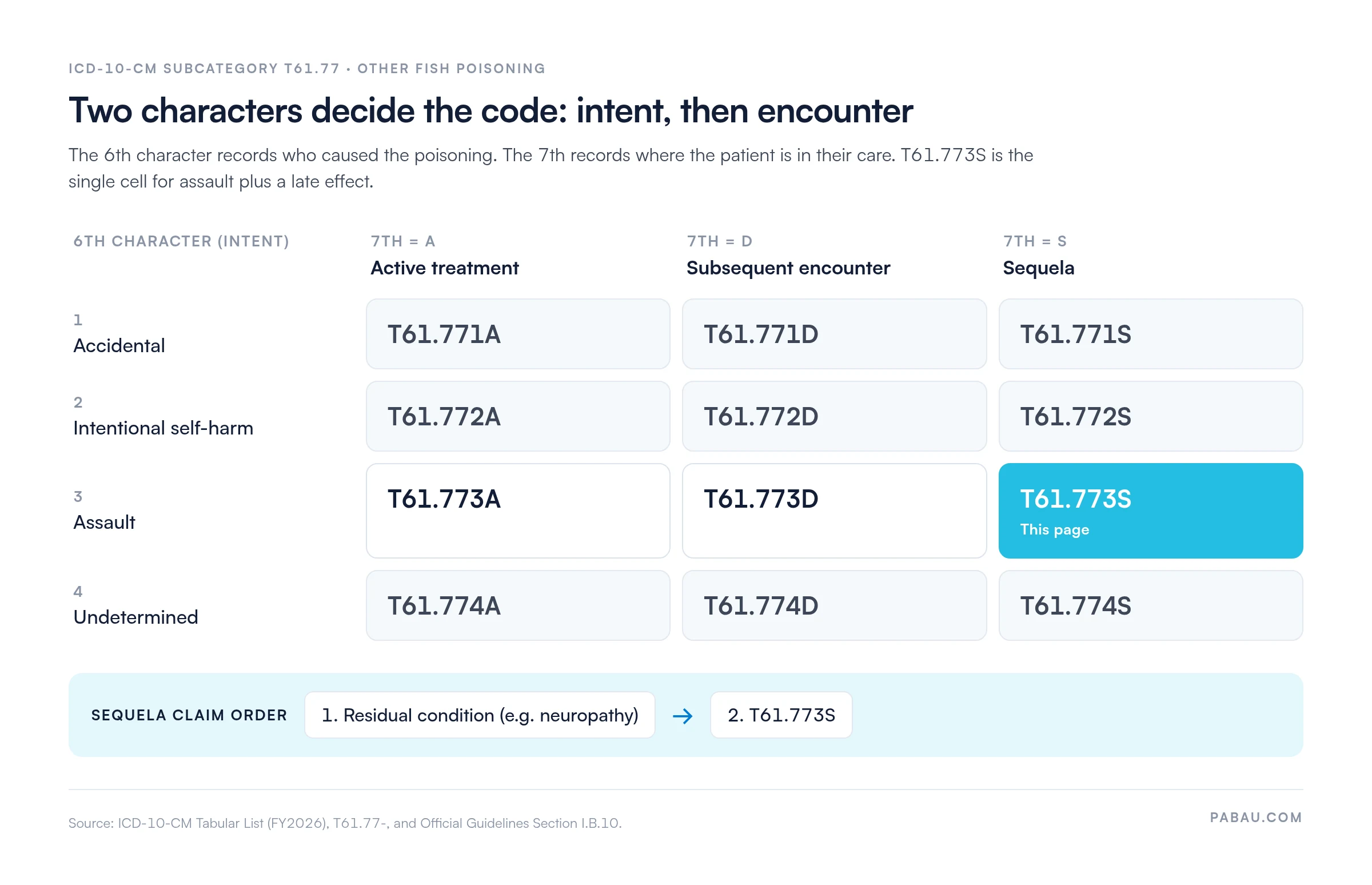
The 6th character records intent, and the 7th records where the patient is in their care. The grid below shows how the two combine across the T61.77 subcategory, with T61.773S in the assault and sequela cell.
T61.773S is one cell in a 12-code grid, so a single wrong character sends the claim to a sibling code. Codes from the ICD-10-CM Tabular List, FY2026.
Assault only fits when the record says someone else caused it
Intent is where T61.773S goes wrong most quietly. The official guidelines say that when intent is unknown or unspecified, you code it as accidental. So T61.771S, not T61.773S, is the default for a late effect of other fish poisoning.
Assault needs documentation that another person deliberately poisoned the patient. A physician statement, a safeguarding note, or a police report named in the history can all support it. Undetermined intent (T61.774S) is only for records stating that intent can’t be established.
That evidence standard carries across the rest of the T51-T65 block. Coding a petroleum product exposure as assault under T52.0X3D needs the same documented third-party involvement.
Here is how four common chart notes map to the intent character:
“Ate spoiled fish at a restaurant”: accidental, so T61.771S.
“Partner admits adding toxic fish to her meal”: assault, so T61.773S.
“Ate fish she knew was toxic to harm herself”: intentional self-harm, so T61.772S.
“Intent could not be determined after review”: undetermined, so T61.774S.
The 7th character tracks the patient’s care, not the calendar
With intent settled, the 7th character signals the type of encounter. Picking the wrong one is the other common denial trigger in this code family.
7th character
Code
Clinical scenario
Common mistake
A (initial encounter)
T61.773A
Patient is receiving active treatment for the poisoning, at any visit during that phase
Keeping A after active treatment has ended
D (subsequent encounter)
T61.773D
Active treatment is complete, and the patient returns for routine care during recovery
Using D once the poisoning has resolved and only a late effect remains
S (sequela)
T61.773S
Acute poisoning has fully resolved, and the patient presents with a residual condition (e.g. fatigue, numbness) caused by the prior exposure
Using S before the acute poisoning has resolved (“premature S”)
When S applies, the sequencing flips. The residual condition, such as neuropathy, fatigue or a GI complaint, goes first as the primary diagnosis. T61.773S follows as the cause. That catches out coders used to A and D encounters, where the poisoning code leads.
Neighboring codes that can pass for T61.773S at a glance
Before you settle on T61.773S, rule out the named fish poisonings and the lookalikes around it. Choosing the wrong sibling code is a documentation mismatch that auditors look for on retrospective review.
Code
Description
Use instead of T61.773S when…
T61.01XS / T61.03XS
Ciguatera fish poisoning, sequela (accidental / assault)
Documentation confirms ciguatoxin exposure, typically from tropical reef fish such as barracuda, amberjack or grouper
T61.11XS / T61.13XS
Scombroid fish poisoning, sequela (accidental / assault)
Documentation confirms a histamine reaction from tuna, mackerel, mahi-mahi, or a similar scombroid species
T61.771S / T61.772S
Other fish poisoning, accidental (unintentional) / intentional self-harm, sequela
The record documents an accidental exposure or self-harm, or gives no intent at all (default accidental)
T61.774S
Other fish poisoning, undetermined, sequela
The record states that intent could not be established
T63.51- / T63.59-
Toxic effect of contact with stingray / other venomous fish
Injury came from a sting, puncture or skin contact, not from eating the fish. The 6th character sets intent, and the 7th matches the encounter.
T61.91XS / T61.93XS
Toxic effect of unspecified seafood, sequela (accidental / assault)
The physician documents seafood generically with no fish identified. Use it only as a last resort.
Scombroid or other fish: the species settles it
Scombroid poisoning (T61.1-) is histamine-driven. Poorly refrigerated fish builds up histamine, which triggers a flushing, allergy-like reaction. The documented species drives the code choice here, not the symptom pattern.
T61.11XS applies when the physician documents tuna, mackerel, bonito, mahi-mahi, bluefish or another scombroid species as the source. It is the default intent, and T61.13XS replaces it only when assault is documented.
T61.773S applies when the fish is neither scombroid nor ciguatera, or when the species is unknown but documented as “other fish” rather than seafood generically.
Never assign a T61.1- code from the symptom pattern alone. You need the species or a physician statement about the toxin mechanism.
Fish allergy isn’t fish poisoning, and the codes differ
An IgE-mediated fish allergy doesn’t code to T61.773S. Allergic reactions have their own codes, such as T78.03- for anaphylaxis due to other fish or Z91.013 for a seafood allergy. The physician’s note has to separate an immune reaction from a direct toxic effect.
Toxicity (T61.773S): the fish substance acts directly on the body. Anyone exposed to enough of it can react, with no prior sensitization.
Allergy: an IgE-mediated immune response that needs prior sensitization. It codes to allergy categories, not T61.
A patient with anaphylaxis after shellfish has an allergy. A patient with neurological symptoms weeks after eating an unidentified fish may have a toxic sequela.
If the note says “allergic reaction to fish,” T61.773S is not supported until the physician clarifies the documentation.
What the physician’s note must say before you code T61.773S
Six details in the note decide whether a T61.773S claim survives payer review. If any one is missing, an auditor has grounds to deny.
Explicit causal link: the note states that the current condition results from the prior fish poisoning. “Peripheral neuropathy secondary to prior fish toxin ingestion” meets the bar. “History of fish poisoning” alone does not.
Resolved acute phase: the note confirms the acute episode has ended. Without it, you can’t justify S over A or D.
Named residual condition: the specific late effect, such as fatigue or GI dysmotility, is named and coded as the primary diagnosis.
Documented assault: the record says another person caused the poisoning on purpose. Without that, code the accidental default.
Fish type or toxin, if known: a note that says “other fish” rather than naming a species supports T61.773S over a more specific code.
Date or rough timeframe of the exposure: not always available, but payers may ask for it on complex sequela claims.
Supporting medical billing compliance at the documentation level is where sequela claims succeed or fail. A note that could describe either active poisoning or a late effect leaves the coder guessing. A physician query before submission stops the denial before it starts.
External cause codes belong to the first visit, not the sequela claim
The short answer is that a T61.773S sequela claim usually carries no Y92, Y93 or Y99 codes. Those codes describe the original event, and the guidelines tie them to the initial encounter.
Place of occurrence (Y92.x): where the exposure happened, such as a home or a restaurant. It is reported once, at the initial encounter for treatment.
Activity (Y93.x): what the patient was doing at the time. Activity codes are not used for poisonings or for sequela.
External cause status (Y99.x): Y99.0 is civilian activity done for income or pay, and Y99.8 covers other statuses such as leisure. Status codes are not used for poisonings or sequela either.
The poisoning itself: no separate external cause code is needed, because the T61 code already carries the intent.
If a payer edit asks for an external cause code on a sequela claim, check that payer’s written policy first. Adding Y codes the guidelines leave out can create a new problem instead of fixing one.
Following a T61.773S claim from the note to payment
So how does a sequela claim move in practice? Take a simplified example. A patient returns months after a coworker deliberately tainted her lunch with toxic fish. The acute illness resolved, but she still has persistent fatigue.
The physician documents the fatigue, links it to the prior fish poisoning, notes the assault, and confirms the acute phase has ended.
The coder lists the fatigue code first (R53.83, other fatigue), then adds T61.773S as the cause.
On the 837P or CMS-1500, the fatigue code takes diagnosis position A and T61.773S takes position B. The service line points to A first. Our guide to 837 files shows where each sits.
The claim scrubber or clearinghouse checks required fields, code validity and format before the claim goes out.
The payer adjudicates. An injury or assault diagnosis can prompt a coordination-of-benefits or accident questionnaire, so answer it quickly.
The remittance comes back as an 835 ERA. If the claim is denied, its CARC and RARC codes point you to the fix.
Why T61.773S claims get denied, and how to fix each one
T61.773S denials follow a predictable pattern, and most trace back to the chart or the claim order. The table maps each trigger to its fix. A clear denial management workflow before submission cuts the rework.
Denial reason
Error description
Fix
Wrong 7th character
A or D submitted when the acute poisoning has resolved and S is correct
Confirm with the physician that the acute phase has ended, then correct to T61.773S
Premature S
S used while the patient is still in active treatment or recovery
Use A or D until the physician documents resolution, and query before assigning S
Sequencing error
T61.773S submitted as the primary diagnosis, with the residual condition missing or secondary
Code the residual condition first. T61.773S is always secondary on a sequela claim.
Non-billable parent submitted
T61.77 or T61.773 (without the 7th character) submitted in place of T61.773S
Always use the full billable code, never a non-billable parent
Wrong intent character
T61.773S billed when the record never documents assault
Code accidental intent (T61.771S) when intent is unknown, or query the physician
Insufficient documentation
The note shows a history of poisoning but does not link it to the current complaint
Query the physician for an addendum stating causation before submitting
When a denial does arrive, the remittance tells you why. Look up the CARC in our list of medical billing denial codes, then match it to the fix above.
Before you submit: A quick T61.773S checklist
Run through these seven checks on every sequela claim before it leaves the practice:
The note names the residual condition and links it to the prior fish poisoning.
The note confirms the acute poisoning has resolved.
The record documents assault, or you have switched to the accidental code.
The fish is not ciguatera or scombroid, and the injury was not a venomous sting.
The residual condition sits first on the claim, with T61.773S second.
No Y92, Y93 or Y99 codes have been carried over from the initial encounter.
Any open question has gone to the physician as a query before the claim goes out.
The official guidelines behind sequela coding for T61.773S
Two parts of the ICD-10-CM Official Guidelines govern this code. Section I.B.10 sets the general sequela rules, and Section I.C.19 covers 7th characters and toxic effects. Both shape clean claim submission for T61.773S.
The sequela condition is coded first. The residual condition is the primary diagnosis. That is the opposite of acute poisoning coding, where the T code leads.
The poisoning code with 7th character S is coded second. T61.773S shows the cause of the residual condition.
No extra external cause code is needed for the poisoning. The T61 code already records intent, and the place code belongs to the initial encounter.
Both codes go on the same claim. They are never split across visits.
The CMS ICD-10 coding page publishes the annual guidelines as a free PDF. Check these sections in the current fiscal year’s release, because the wording can shift in annual updates.
How payers treat T61.773S, and where the assault changes the bill
T61.773S meets ICD-10-CM specificity rules for Medicare and Medicaid, so it’s valid as a secondary diagnosis on a complete claim. Commercial acceptance still varies by plan and coverage policy.
Medicare and Medicaid: no national coverage determination (NCD) excludes T61.773S. Even so, sequela documentation gets close attention on audit.
Commercial payers: many run automated edits that flag a sequela code submitted in the first position.
LCD applicability: a local coverage determination for the residual condition may call for extra documentation. T61.773S has no LCD of its own.
Crime victim compensation: because the code records an assault, the patient may qualify for their state’s crime victim compensation program. These programs usually pay after insurance, so ask whether the patient has an open claim.
Seeing where these claims sit in your revenue cycle management helps you build checks that catch errors every time, not case by case. That is where claims software earns its place.
How claims software keeps sequela claims like T61.773S clean
In many practices, a sequela claim still depends on one coder remembering the sequencing rule. The diagnosis gets retyped from the note, the claim goes out, and the error surfaces weeks later as a denial.
Pabau’s claims management software pre-fills each claim from the patient record, so the diagnoses in the note carry straight onto the claim. Built-in ICD-10-CM and CPT code lookup helps your team find the full seven-character code. Required claim fields are checked before submission.
For US practices, Pabau submits claims through Claim.MD. That adds real-time eligibility checks, ERA posting and claim-status tracking, so a rejected T61.773S claim shows up the same day. Coding judgment, like intent and sequencing, stays with your coders and the checklist above.
Pabau’s claims tools pre-fill each claim from the patient record and flag missing required fields, so a sequela claim leaves with both diagnoses in place.
Send cleaner sequela claims the first time
Pabau pre-fills claims from the patient record and checks required fields before submission. Through Claim.MD, it also runs real-time eligibility checks, posts ERAs and tracks claim status.
T61.773S rewards coders who read the chart before they read the code list. Confirm the assault, confirm the acute phase has ended, and put the residual condition first. Get those three right and the claim has little left to trip over.
The trade-off is time. A physician query adds a day, while a denial and appeal can add weeks. Superbill preparation that captures the residual condition alongside T61.773S keeps those queries rare.
Once the claim is out, Pabau’s eligibility checks and claim-status tracking through Claim.MD show you where it stands. Book a demo to see how Pabau moves your sequela claims from the note to payment.
Continue your research
Need to understand how claim denials are categorized?Denial codes in medical billing explains CARC and RARC codes and how to match them to corrective action.
Want to streamline ICD-10 claim submission?Claim.MD clearinghouse overview covers how electronic clearinghouse submission reduces manual errors on ICD-10-CM claims.
Looking for guidance on the 837 electronic claim format?837 file format guide walks through how ICD-10-CM codes are structured in EDI 837P submissions.
Frequently asked questions
Can T61.773S be used for shellfish poisoning?
No. T61.773S covers fish only. Shellfish poisoning by assault codes to T61.783S, other shellfish poisoning, assault, sequela. Toxic effects of other seafood sit under T61.8X-.
Is there a time limit for using a sequela code like T61.773S?
No. The official guidelines set no time limit on reporting a sequela. A late effect may appear soon after the poisoning or months later. What matters is that the acute phase has ended and the physician links the condition to it.
What was the ICD-9-CM equivalent of T61.773S?
ICD-9-CM had no single match. Coders reported 909.1, late effect of toxic effects of nonmedical substances. They added E969, late effects of injury purposely inflicted by another person, to show the assault.
How is a late effect of fish poisoning by assault coded outside the US?
WHO ICD-10, used in the UK and many other countries, has no intent or 7th characters in T61. A late effect uses T97, sequelae of toxic effects of substances chiefly nonmedicinal as to source. Y87.1, sequelae of assault, records the intent.