ICD-10 code S61.201A: Open wound of left index finger without nail damage
ICD-10 code S61.201A covers a left index finger wound of unstated type ICD-10 co...

Last Updated: Oct 16, 2026
Billable Code Specific Code
T40.422A is the billable ICD-10-CM code for poisoning by tramadol, intentional self-harm, initial encounter. It applies when the record documents that the patient took tramadol deliberately to cause self-harm. The encounter must also be the first visit for active treatment.
The sixth character 2 carries the self-harm intent, and the seventh character A marks the initial encounter. Accidental tramadol poisoning is coded T40.421A instead. Assignment turns on what the provider writes about intent, because an unstated intent codes to accidental.
Let Pabau's smart automation suggest the right codes, reduce claim denials, and keep your practice compliant—effortlessly.
Automate repetitive tasks and focus on what matters most—your patients.
Reduce coding errors and ensure compliance with the latest regulations.
Clean claims, fewer denials, and faster reimbursements.
Powerful insights and reporting to help your practice thrive.
HIPAA compliant SOC 2 certified GDPR-compliant Trusted by 4,000+ clinics worldwide

T40.422A is the billable ICD-10-CM code for tramadol poisoning by intentional self-harm, initial encounter
The sixth character carries the intent: 1 is accidental (T40.421A) and 2 is intentional self-harm (T40.422A)
The 7th character ‘A’ marks the first encounter, and submitting T40.422 without one triggers an automatic rejection
Intent already sits inside the poisoning code, so no separate external cause intent code is assigned alongside it
Pabau, practice management software for busy practices, supports ICD-10-CM documentation and electronic claim submission for opioid-related encounters
ICD-10 Code T40.422A is a fully specified, billable ICD-10-CM code for poisoning by tramadol, intentional self-harm, initial encounter.
It applies when the record documents that the patient took tramadol deliberately to cause self-harm. The encounter must also be the first visit at which the poisoning receives active treatment. The code sits in Chapter 19 of ICD-10-CM (Injury, Poisoning and Certain Other Consequences of External Causes, S00-T88) and is valid in HIPAA-covered transactions. The CDC/NCHS ICD-10-CM web tool confirms it as billable for FY2026.
Each character in T40.422A carries a specific meaning within the ICD-10-CM tabular structure. Understanding that logic prevents the two most common submission errors. Coders either truncate the code to T40.422 and drop the 7th character, or they pick an intent character the record does not support.
The intent digit in position 6 is the character coders get wrong most often. Across the T36-T50 poisoning block that character runs in a fixed sequence. It reads 1 for accidental, 2 for intentional self-harm, 3 for assault and 4 for undetermined. Characters 5 and 6 cover adverse effect and underdosing. Where the record does not state the intent, ICD-10-CM Official Guidelines direct the coder to accidental, which means T40.421A rather than T40.422A. Assign T40.422A only where self-harm is documented, and query the provider before inferring it. The chart below maps each documented intent to the code it produces.
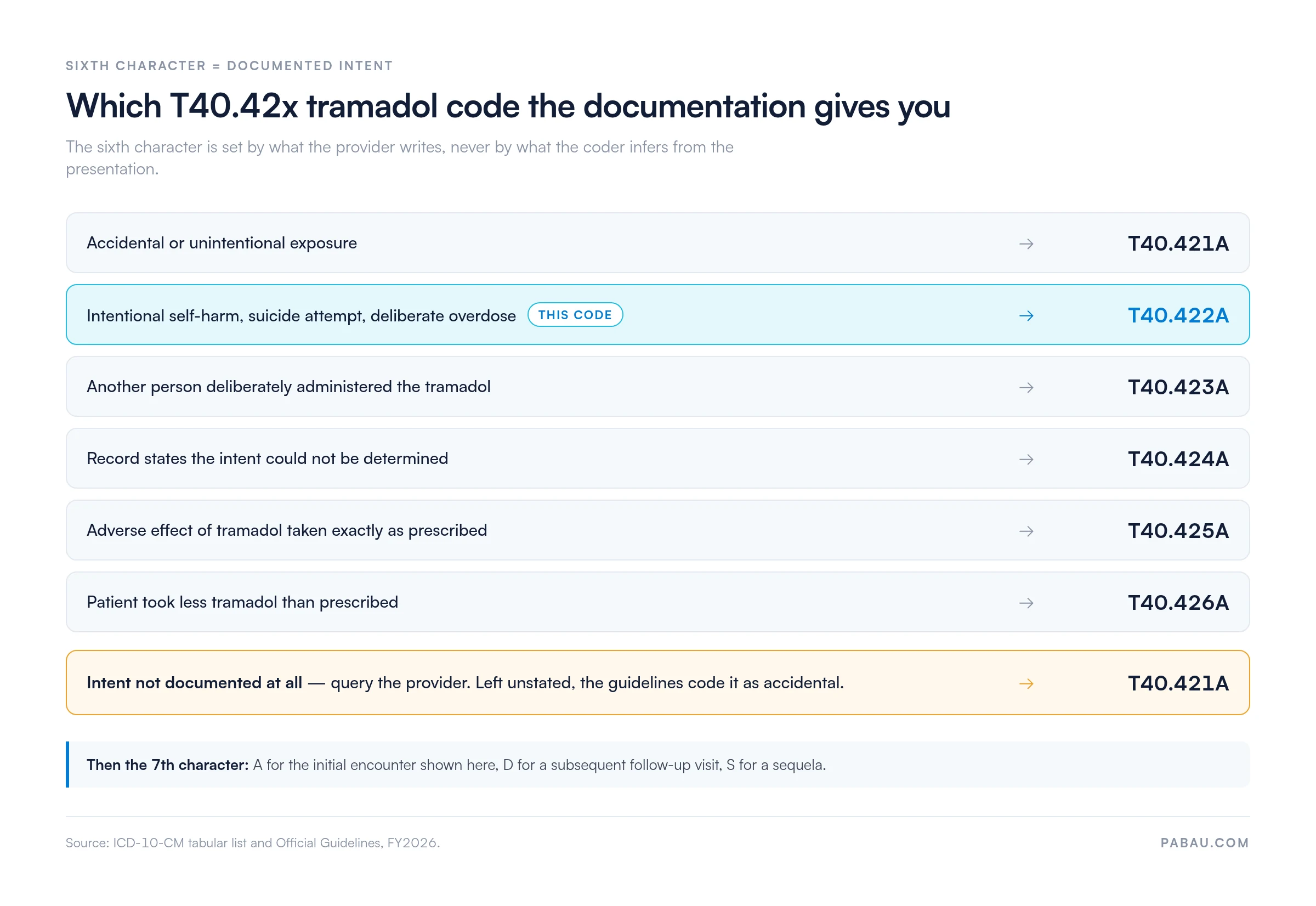
T40.422A belongs to the T40.42 subcategory, which covers tramadol across every intent and encounter combination. Selecting the wrong sibling is one of the fastest routes to a payer denial. That usually happens when the record supports an accidental exposure but the coder assigns the self-harm character instead.
T40.422A covers deliberate self-poisoning with tramadol hydrochloride (brand name Ultram) and other tramadol formulations classified under ICD-10-CM subcategory T40.42. Tramadol has been a DEA Schedule IV controlled substance since August 2014 under 21 CFR Part 1308. Its ICD-10-CM placement as a synthetic narcotic analgesic reflects that scheduling. Working through the inclusions and exclusions keeps correct-dose adverse effects and underdosing encounters off this code.
The 7th character on T40.422 determines which phase of care the encounter represents. Getting this wrong does not always trigger an outright denial. It does invite audits and medical necessity disputes when the encounter type conflicts with the services billed.
While the patient is still being actively treated for the poisoning itself, use ‘A’. That covers naloxone administration, monitoring for respiratory depression, and toxicology management. Once the poisoning has been treated and the patient is in follow-up, switch to ‘D’. Sequela encounters are relatively rare and need clear documentation linking the current condition to the original toxic exposure.
The ‘D’ ending behaves the same way across the rest of Chapter 19. A patient seen for follow-up after intentional bee venom toxicity is coded T63.442D, not the initial-encounter version.
T40.422A only covers the active-treatment visit, so a later sequela encounter takes an S code instead. The same self-harm digit with an S ending gives T38.5X2S for estrogen and progestogen poisoning.
T40.422A applies when the provider documents intentional self-harm. T40.421A applies when the tramadol exposure was accidental. The distinction matters clinically, because a self-harm encounter triggers psychiatric assessment and safety planning. It matters administratively too, since it drives payer adjudication and public health reporting.
The same intent digit runs through other drug families in the T36-T50 poisoning block. Where the clinician documents undetermined intent, a cholinergic poisoning takes T44.1X4A at the initial encounter.
T40.422A is rarely the only code on a tramadol self-harm claim. Codes in the T36-T65 range are combination codes that already carry both the substance and the intent. That is why the CMS ICD-10 coding guidelines do not ask for a separate external cause intent code. What payers do expect is the supporting clinical picture around the poisoning. Opioid use disorder codes in the F11.xx range are frequently paired with T40.422A when the provider documents them.
Run a pre-submission audit on every T40.422A claim. Confirm the provider note states self-harm rather than leaving the intent open. Verify the 7th character matches the encounter phase. Check that manifestation codes sit after the poisoning code, not before it. Those checks catch most T40.422A denials before they reach the payer.
Robust documentation protects both medical necessity and code assignment. Providers working in emergency department settings should address each of the following elements for a T40.422A claim to be defensible. Incomplete opioid overdose documentation is a frequent root cause of post-payment audits on these encounters.
The Centers for Medicare and Medicaid Services (CMS) follow ICD-10-CM Official Guidelines when adjudicating T40.422A claims. Individual payers may layer additional requirements on top through Local Coverage Determinations (LCDs). For practices submitting electronic claims, routing through a clearinghouse that validates codes before submission catches structural errors before they reach the payer. A clearinghouse edit that rejects T40.422 for a missing 7th character costs the coder minutes. The same error caught by the payer costs a whole denial cycle.
Payers also expect HIPAA-compliant documentation practices on these claims. The provider record has to support both the code selection and the medical necessity of the services rendered. For Medicare claims, automated clearinghouse code edits catch the most common structural errors before adjudication.
Commercial payers and Medicaid plans may require prior authorization for inpatient admissions and behavioral health stays that follow a self-harm poisoning. Always verify current LCD/NCD requirements with the specific payer before assuming coverage. The superbill for these encounters carries all the secondary codes, not just the principal poisoning code.
Most T40.422A denials trace back to one of five structural coding errors. Each is preventable with a pre-submission checklist. Denial management workflows for opioid poisoning encounters should address all five categories below.
When naloxone (Narcan) is administered during a tramadol overdose encounter, the poisoning code T40.422A remains the principal diagnosis. Naloxone administration is the treatment response to the poisoning, not a separately coded condition. The procedure itself may still need to be captured in additional coding, depending on the setting and the payer. The AAPC Codify ICD-10-CM lookup and commercial encoder tools can confirm current procedure code pairings.
For inpatient encounters (ICD-10-PCS settings), naloxone administration is captured as a procedure code. For outpatient and ED encounters, naloxone drug administration may be billed using an appropriate HCPCS J-code, depending on the specific payer and current formulary year.
Because HCPCS J-codes for naloxone can change annually, coders should verify the current applicable code with the payer rather than relying on a prior-year reference. Pairing an expired J-code with T40.422A turns one claim into two separate correction cycles.
Verify the current HCPCS J-code for naloxone with each payer annually, since formulary classifications update on October 1 alongside ICD-10-CM. Billing an expired or non-covered J-code alongside T40.422A adds a second denial reason to an already complex claim.
The T40.42x family generates coder confusion because the descriptors differ by a single character. One legacy code still turns up in old crosswalks. T40.4X2A was deleted on October 1, 2020, when ICD-10-CM split T40.4 into fentanyl, tramadol and other synthetic narcotic subcategories. Its current replacement is T40.492A. The table below maps each code to the scenario where it applies. Lookup tools such as ICD List and ResDAC’s ICD codes in Medicare files resource are useful secondary references for confirming code specificity.
A truncated poisoning code usually gets caught the same way any other coding error does. The claim goes out, the payer rejects it, and a biller works backwards from the denial weeks later. By then the encounter is closed and the coder has moved on.
Pabau, practice management software for busy practices, moves that check to the point of submission. Its claims management software validates code structure before the claim goes to Claim.MD for transmission. A missing 7th character or an unsupported intent character is flagged while the chart is still open.
Documentation templates for opioid encounters prompt the provider to state the substance, the intent and the treatment given. That is exactly what an auditor asks for later. The result is fewer rejections on the T40.42x family and shorter correction cycles on the ones that still come back.

Pabau’s claims management software supports ICD-10-CM diagnostic code workflows and electronic claim submission via Claim.MD. Its documentation tools help practices get opioid-related encounters paid on the first submission.

Accurate assignment of ICD-10 Code T40.422A rests on three conditions at once. The sixth character must match the documented intent, which here means self-harm rather than an accidental exposure. The 7th character must match the encounter phase.
The clinical record must also name tramadol, state the intent, and describe the treatment given. Miss any one of the three and the claim either rejects outright or faces a post-payment audit. The query to the provider costs far less than the appeal does.
Practices billing opioid-related encounters benefit from claim submission workflows that validate code structure and secondary code completeness before transmission. Book a demo to see how Pabau checks a T40.422A claim for its 7th character and secondary codes before it is transmitted.

Need to understand how clean claims are built? Clean claim requirements in medical billing covers the structural elements every claim needs to pass payer edits on first submission.
Working through opioid encounter denials? Denial codes in medical billing maps common CARC denial reason codes to the root causes and correction steps.
Looking for guidance on insurance eligibility for these encounters? Insurance eligibility verification explains real-time eligibility checks and how to confirm coverage before service.
ICD-10 Code T40.422A is the billable ICD-10-CM diagnosis code for poisoning by tramadol, intentional self-harm, initial encounter. It is used when the record documents that the patient took tramadol deliberately to cause self-harm. The visit must also be the first active treatment for that poisoning episode.
Yes, T40.422A is a fully billable and valid ICD-10-CM code for HIPAA-covered transactions, confirmed by the CDC/NCHS tabular list for FY2026. It is the most specific code available for intentional self-harm tramadol poisoning on an initial encounter, and it can be reported as a principal diagnosis.
The sixth character carries the intent. T40.421A covers accidental or unintentional tramadol poisoning, while T40.422A covers a deliberate tramadol overdose taken as self-harm. Provider documentation must state the intent before the coder picks one over the other, and an unstated intent codes to accidental.
Use 7th character ‘A’ (giving code T40.422A) for the initial encounter, meaning the patient is receiving active treatment for the poisoning. Use ‘D’ for subsequent follow-up encounters after definitive care. Use ‘S’ for a sequela visit, where the patient presents with a late effect of the original poisoning.
No separate intent code is needed. Codes in the T36-T65 range already combine the substance and the intent, so no X71-X83 self-harm code is assigned alongside T40.422A. Place of occurrence (Y92.xx) and activity (Y93.xx) are reported on the initial encounter only where the record documents them.
Payers require the clinical record to identify tramadol by name and document the self-harm intent. It must also record clinical findings such as vital signs and toxidrome presentation, plus the treatment given. Generic “opioid overdose” documentation without a named substance and a stated intent will not support T40.422A on audit.
No. T40.4X2A was deleted on October 1, 2020, when ICD-10-CM expanded T40.4 into fentanyl, tramadol and other synthetic narcotic subcategories. Report T40.492A for intentional self-harm poisoning by another synthetic narcotic, or T40.422A when the substance is tramadol.