ICD-10 Code V91.84XS: Other burn due to burning watercraft
ICD-10 Code V91.84XS: overview and key facts ICD-10 Code V91.84XS identifies the...

Last Updated: Oct 30, 2026
Billable Code Specific Code
T32.92 is the billable ICD-10-CM code for corrosions involving 90% or more of body surface with 20-29% third degree corrosion.
It sits in category T32, which classifies chemical corrosions by extent of body surface rather than by site. When the record documents the corroded sites, T32.92 is a supplementary code with T20-T25. It is the primary code only when the site is unspecified. Claims are commonly queried when documentation is missing, especially the third-degree percentage or the chemical agent.
Let Pabau's smart automation suggest the right codes, reduce claim denials, and keep your practice compliant—effortlessly.
Automate repetitive tasks and focus on what matters most—your patients.
Reduce coding errors and ensure compliance with the latest regulations.
Clean claims, fewer denials, and faster reimbursements.
Powerful insights and reporting to help your practice thrive.
HIPAA compliant SOC 2 certified GDPR-compliant Trusted by 4,000+ clinics worldwide

T32.92 covers corrosions of 90% or more of body surface with 20-29% third-degree corrosion, so the record needs both figures.
T32 is for chemical corrosions only, and thermal burns use the T31 family, so confirm the agent before picking a code.
When the record names the corroded sites, T32.92 is a supplementary code with T20-T25. It is the primary code only when the site is unspecified.
T51-T65 codes identify the chemical and intent, and Y92, Y93 and Y99 external cause codes are recommended where documented.
Pabau’s claims management software submits claims through its Claim.MD clearinghouse integration and flags denied claims for rework.
ICD-10 Code T32.92 is a billable ICD-10-CM diagnosis code. Its official descriptor is Corrosions involving 90% or more of body surface with 20-29% third degree corrosion. It has been valid since the ICD-10-CM transition on October 1, 2015, and it is valid for claim submission for FY2027.
The code is used almost entirely in inpatient burn unit and trauma settings. A corrosion covering 90% or more of total body surface area (TBSA) is a life-threatening injury. An outpatient claim with this code will draw payer scrutiny.
Under the ICD-10-CM Official Guidelines, Section I.C.19.d, T32.92 is a supplementary code alongside T20-T25 site codes when the record documents the site. It is the primary code only when the site of the corrosion is unspecified.
T32.92 encodes two separate clinical measurements in a single code. The first axis is the total extent of corrosion, and the second is the share of body surface with third-degree corrosion. Both must be documented in the clinical record for the code to hold up on audit.
The digit “9” in the T32.9X subcategory means corrosion involves 90% or more of the patient’s total body surface area. Clinicians estimate TBSA with the Rule of Nines for adults. Each arm counts as 9%, each leg 18%, the head and neck 9%, the anterior and posterior trunk 18% each, and the perineum 1%. For pediatric patients, the Lund-Browder chart adjusts for age-related differences in body proportion.
Key clinical distinction: Corrosion in ICD-10-CM means injury caused by a chemical agent (acid, alkali, or caustic substance). Thermal burns, electrical burns, and radiation burns are classified under the T31 family. Using T32.92 for a thermal burn is a classification error that can trigger a denial or audit.
The final digit “2” indicates that 20 to 29 percent of the body surface has third-degree (full-thickness) corrosion. Third-degree corrosion destroys every layer of the dermis and often requires surgical debridement and grafting. The notes must state this percentage separately. A record that gives only the total TBSA leaves the final digit unsupported.
T32.92 sits within the T32.9 subcategory, which covers corrosions of 90% or more of body surface. The final digit selects the third-degree percentage band, and each band has its own entry in the ICD-10-CM code set. Check the documented third-degree percentage against the table below before you assign a code.
Take the documented third-degree percentage directly from the physician’s assessment note or operative report. An attending note of “approximately 25% full-thickness involvement” maps to T32.92. A note of “approximately 35% full-thickness” maps to T32.93. Query the physician when a round-number estimate sits on a band boundary and the record is ambiguous.
Run a quick chart audit before assigning any T32.9X code. Confirm (1) the agent is chemical, not thermal, and (2) a Rule of Nines or Lund-Browder TBSA estimate is documented. Then check (3) the third-degree percentage is stated separately. All three must appear in the record before T32.92 can be defended on payer review.
Accurate T32.92 coding depends on six facts in the clinical record. Miss one and you either land on the wrong code or send a claim that a payer’s clinical editor will question.
T32.92 rarely travels alone. When the record documents the corroded sites, it is a supplementary code with T20-T25. It becomes the primary code only when the site is unspecified. If you’re new to how a claim is assembled, medical billing fundamentals covers the basics, but the companion set below is specific to corrosions.
When the sites are documented, sequence the T20-T25 site codes ahead of T32.92, which then adds the extent data. A corrosion covering 90% or more of body surface almost always involves several sites, so expect several T20-T25 codes. The diagram below shows both sequences, with the T51-T65 chemical code first in each.
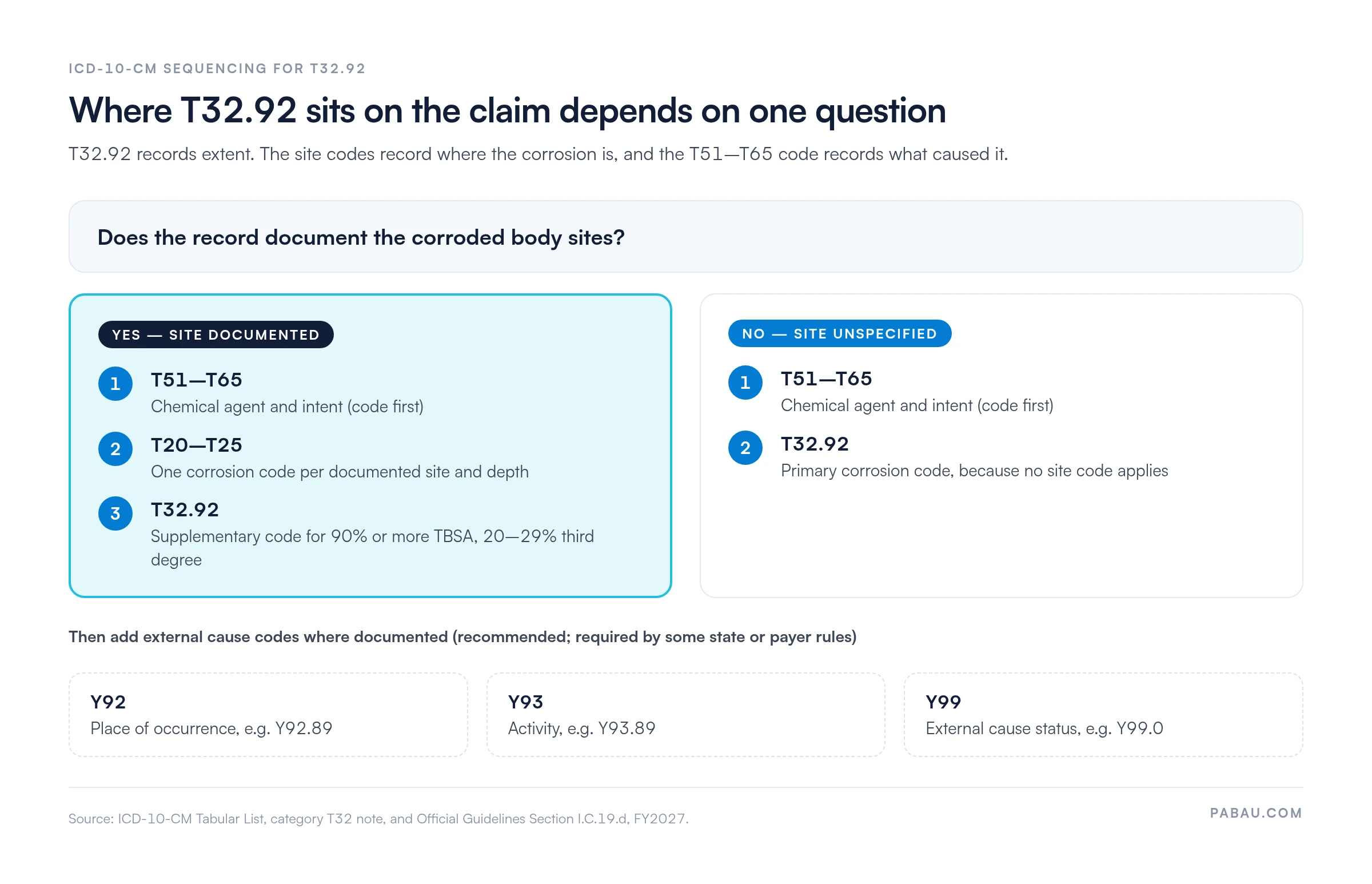
The costliest error with T32.92 is reaching for the T31 family instead of T32. Both classify injuries by extent with the same logic. T31 covers thermal burns and T32 covers chemical corrosions, so the two are never interchangeable.
A thermal burn at the same extent and depth codes to T31.92 instead. When the record describes both thermal and chemical injury to the same patient, assign codes from both families, one set per injury mechanism. Don’t merge them into a single code.
The T32 category carries ICD-10-CM coding notes that restrict how and when T32.92 can be used. Ignoring them is a compliance risk during audit.
Before you finalize the code, check the T32.92 excludes notes in the AAPC ICD-10-CM code lookup or the ICD List reference tool.
A corrosion covering 90% or more of TBSA is a catastrophic injury. Payers, including Medicare, Medicaid, and commercial insurers, treat T32.92 as a high-acuity inpatient code, and their documentation requirements reflect that severity.
T32.92 rewards careful preparation. The denial patterns below recur across payers, and each one traces back to a fact the record didn’t state. The coder can’t supply it after the fact without querying the physician.
A denial management workflow built for high-acuity burn and corrosion codes shortens resubmission turnaround. Track denial reasons by code. If T32.92 denials cluster around the same CARC code, the admitting workflow is likely missing a documentation step, rather than one coder making one mistake.
Run a pre-bill checklist before submitting any T32.92 claim. Check for (1) the T51-T65 chemical code and any external cause codes your payer requires, and (2) T20-T25 codes for every documented site. Then confirm (3) the physician documented the third-degree percentage and (4) the chart notes the TBSA method. A clean submission through your clearinghouse catches avoidable rejections before they reach a human reviewer.
A clean claim carries every required code and the documentation behind it on first submission. On a complex corrosion case, that means the site, chemical and extent codes all go out together.
Billing teams handling catastrophic corrosion cases often track companion codes by hand, then chase denials in a separate clearinghouse portal. Pabau, the practice management platform we build, includes denial-tracking claims software that generates claims from the invoice. Claims go out through a Claim.MD clearinghouse integration to thousands of US payers, including Medicare and Medicaid.

Real-time eligibility checks confirm coverage before a T32.92 claim goes out. Each claim is then tracked through acceptance, payment or denial, and denied claims are flagged for rework. Remittance advice flows back into Pabau and is matched to the claim it settles. Your team sees which corrosion claims paid without logging into a second system.

Pabau connects your clinical documentation to claims management, so your team can track companion codes, monitor denials, and resubmit corrected claims in one system.

Code T32.92 only when the record supports both numbers: 90% or more of body surface corroded, and 20 to 29 percent third degree. If either figure is missing, query the physician before the claim goes out. A coder’s estimate won’t survive an audit.
Sequencing is the decision that changes the claim. Documented sites mean the T20-T25 codes carry the injury and T32.92 adds the extent. An unspecified site is the only case where T32.92 takes the primary slot. Book a demo to see how Pabau tracks corrosion claims from submission to payment, so denied claims get reworked fast.

Need to understand how clearinghouse submission works for complex ICD codes? Medical claims clearinghouse guide explains the electronic submission process from coder to payer.
Tracking down why a corrosion claim came back denied? Denial codes in medical billing decodes the CARC and RARC codes payers return on rejected claims.
Looking for the electronic remittance advice after claim payment? Electronic remittance advice (ERA) overview covers 835 transaction files and how to reconcile payments against your submitted codes.
Coding a case with 90% or more third-degree corrosion? ICD-10 code T32.99 covers the most severe band in the T32.9 subcategory.
Is the third-degree share under 10%? ICD-10 code T32.90 covers the lowest third-degree band at the same extent.
ICD-10 Code T32.92 is the billable ICD-10-CM diagnosis code for corrosions involving 90% or more of body surface with 20-29% third-degree corrosion. It belongs to the T32 category, which classifies chemical corrosions by extent of body surface. It is a supplementary code with T20-T25 when the site is documented, and the primary code only when the site is unspecified.
Yes, T32.92 is a billable ICD-10-CM code, valid for claim submission for FY2027. When the record documents the corroded sites, it is reported as a supplementary code with T20-T25 site codes. Add a T51-T65 code for the chemical, and external cause codes where your state or payer requires them.
T31 codes classify thermal burns (caused by flame, scald, contact heat, radiation, or electricity) by extent of body surface. T32 codes classify chemical corrosions (caused by acids, alkalis, or other caustic substances) with the same extent logic. They are never interchangeable. Assign T32.92 only when the injury is confirmed as chemically induced.
For adult patients, the Rule of Nines is the standard method. Each arm accounts for 9%, each leg 18%, the head and neck 9%, the anterior and posterior trunk 18% each, and the perineum 1%. For pediatric patients, the Lund-Browder chart adjusts these proportions for age. The physician’s notes must record both the percentage and the method for T32.92 to hold up.
In ICD-10-CM, a burn results from thermal, electrical, or radiation energy, while a corrosion results from chemical agents such as acids or alkalis. The two may look similar, but the cause decides the code family. Burns use T20-T25 and T31, and corrosions use T20-T25 and T32. The codes for the cause differ too.
All three codes cover corrosions of 90% or more of body surface but differ in the third-degree share. T32.91 specifies 10-19% third degree, T32.92 specifies 20-29%, and T32.99 specifies 90% or more. Match the documented third-degree percentage to its band rather than approximating.