ICD-10 Code Y76.0: Diagnostic obstetric and gynecological devices
ICD-10 Code Y76.0: Definition and billable status ICD-10 Code Y76.0 is a valid, ...

Last Updated: Oct 23, 2026
Billable Code Specific Code
T32.99 is the billable ICD-10-CM code for corrosions involving 90% or more of body surface with 90% or more third degree corrosion.
Its official description reads: Corrosions involving 90% or more of body surface with 90% or more third degree corrosion. The 2026 edition took effect on October 1, 2025. T32.99 has been in the ICD-10-CM set since the United States adopted the classification.
Per the CMS ICD-10-CM codes page, coders use the most specific child code available in a category. T32.99 satisfies that requirement at the top of the T32 range.
Let Pabau's smart automation suggest the right codes, reduce claim denials, and keep your practice compliant—effortlessly.
Automate repetitive tasks and focus on what matters most—your patients.
Reduce coding errors and ensure compliance with the latest regulations.
Clean claims, fewer denials, and faster reimbursements.
Powerful insights and reporting to help your practice thrive.
HIPAA compliant SOC 2 certified GDPR-compliant Trusted by 4,000+ clinics worldwide

ICD-10 Code T32.99 covers corrosions involving 90% or more of body surface, with 90% or more of it third degree.
The code is billable and specific, while the T32 category and the T32.9 subcategory are not.
T32.99 leads the claim only when the note leaves the corrosion site unspecified.
Only T31 and T32 separate burns from corrosions, because T20 through T30 carry both.
Pair T32.99 with an external cause code, usually from the X46 category.
T32.99 encodes two clinical facts at once. Reading both correctly is what keeps a burn center claim off the denial list.
The first axis of the T32.xx family records the total percentage of body surface area, or BSA, affected by corrosion of any depth. At T32.99 the corrosive injury covers at least 90% of the patient’s BSA. That is a near-total-body chemical insult, and it needs intensive burn-center management.
The second axis records how much of the involved area has progressed to full-thickness, or third degree, corrosion. T32.99 requires 90% or more of that already-extensive area to be third degree. Full-thickness corrosion destroys the epidermis and dermis, and it usually reaches subcutaneous tissue.
The CDC/NCHS ICD-10-CM web tool is the official US lookup for code descriptions and tabular list notes.
T32 corrosion codes are organized in a tree. Knowing where T32.99 sits confirms you have picked the right level of specificity, and it explains why the codes above it cannot be billed.
T32 itself is non-billable. As the AAPC ICD-10-CM lookup notes, you have to use a child code that describes the diagnosis in more detail. T32.99 is the most specific point in the T32.9x subcategory. If the encounter needs codes from other chapters, the ICD-10-CM code index covers the rest of the diagnosis set.
The T32.9x subcategory covers every presentation where total BSA involvement reaches 90% or more. The fifth character sets the third degree proportion. Picking the wrong sibling is a common audit finding. When the note puts third-degree corrosion at 40-49% of total body surface, the correct sibling is T32.94.
The two-axis structure is what coders misread. The fourth character stays at 9 across the whole T32.9x subcategory, which anchors total BSA at 90% or more. The fifth character then moves from 0 to 9 as third-degree involvement climbs in 10-point bands. T32.99 is the endpoint of both axes at once.
Every T32 subcategory ends at the code where its fourth and fifth characters match. For corrosions covering 10-19% of body surface, that endpoint is T32.11. Each subcategory also opens at the other extreme, a fifth character of 0 for third-degree involvement under 10%. In the 20-29% band, that opening code is T32.20.
The 10-19% band follows the same rule. Its opening code is T32.10, which applies when the documented third-degree area stays under 10%.
Documentation teams meet these alternate terms in physician notes. Each one maps to T32.99 once the BSA and depth criteria are met.
“Chemical burn” is a common synonym for corrosion in both lay and clinical language. In the classification itself, burns and corrosions are separate. The section below sets out how to choose between the two code families.
BSA percentage drives code selection across the whole T32 family. Two clinical tools are standard for measuring it.
The rule of nines splits the adult body into regions worth roughly 9% of total BSA each:
For T32.99, almost every region has to be involved to clear the 90% threshold. That picture usually follows a large-volume industrial caustic or a mass-casualty chemical incident.
The Lund-Browder chart estimates BSA more accurately, especially in pediatric patients, because it adjusts region proportions for age. Whichever tool the treating clinician uses, the documented percentage has to appear in the record. T32.99 needs both figures at 90% or more, documented separately.
Without explicit documentation of both, query the clinician rather than assigning T32.99. Undercoding a severe injury encounter depresses the case-mix index and the payment that follows it. If the clinician confirms 90% or more in total but 80-89% at third degree, ICD-10 code T32.98 applies instead.
Document BSA percentage and third-degree proportion separately in the encounter note. T32.99 requires both thresholds to be confirmed independently. A note that says ‘extensive full-thickness chemical burns’ without a percentage figure will not support T32.99 without a clinical query.
T32.99 fits a narrow set of scenarios, all of them catastrophic chemical exposure.
These patients are managed in a burn center or an ICU. Length of stay runs long, and debridement, grafting and wound management each generate their own codes.
The ICD-10-CM Official Guidelines for Coding and Reporting govern how T32.99 is used. Three requirements apply to almost every encounter that carries it.
T-chapter injury codes should be accompanied by external cause codes for the cause, intent, place and activity. For corrosion cases the relevant codes usually sit in the X46 category, which covers contact with other and unspecified corrosives.
An adjacent category applies if the agent or mechanism is different. External cause codes are always additional diagnoses, never the principal one.
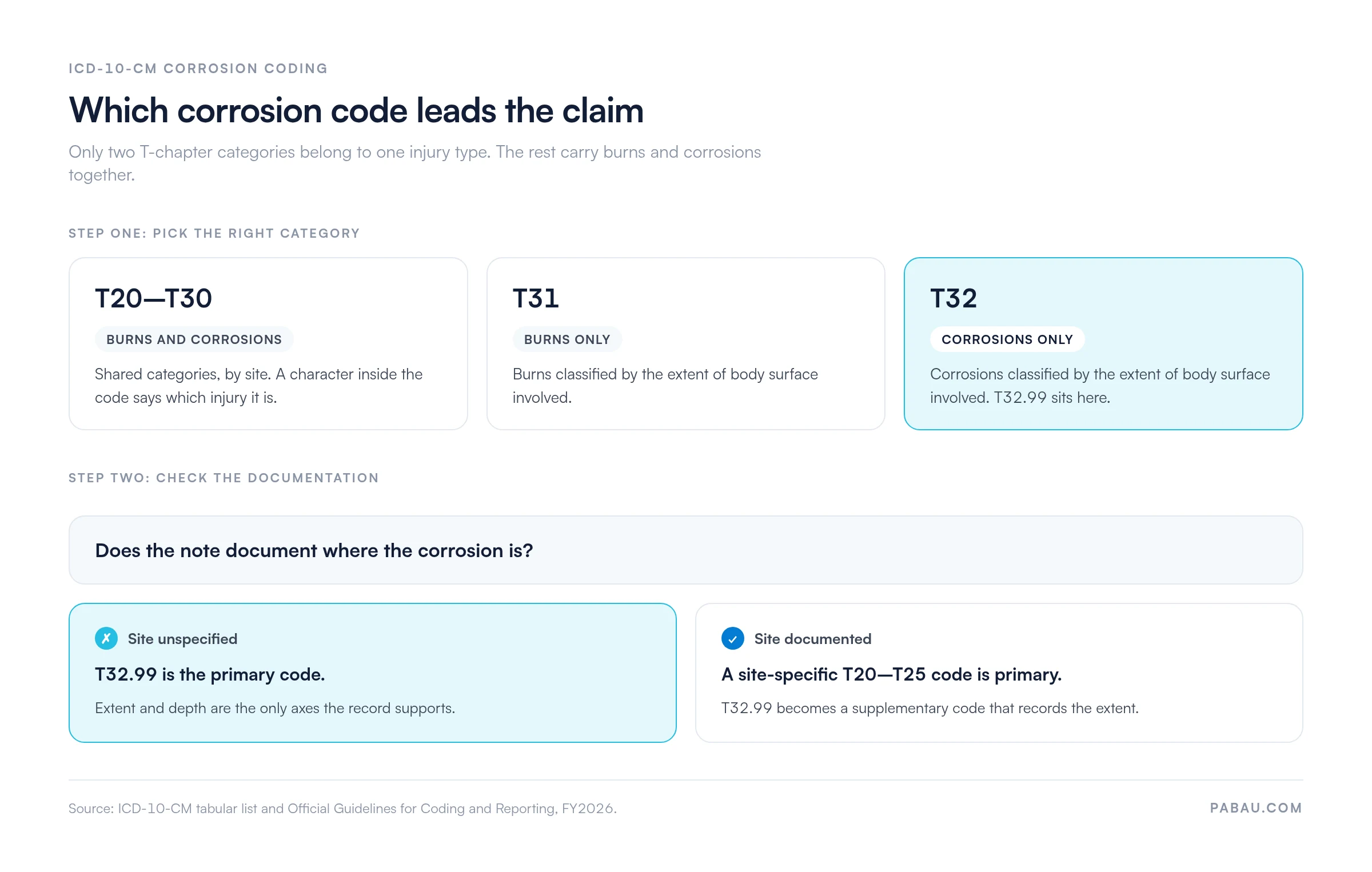
The T32.9x codes are used as the primary code only when the corrosion site is unspecified. Where the note documents the site, the site-specific code from T20 through T25 is primary. T32.99 then becomes a supplementary code that records the extent. The parallel T31.9x burn codes work the same way.
Beyond that rule, T32.99 may be principal or additional depending on the encounter. When the admission is solely for treating the corrosion, and the site is unspecified, T32.99 is the principal diagnosis.
When the patient is admitted for a complication such as sepsis from the wound, the complicating condition takes the principal position. Section II of the Official Guidelines settles sequencing for each encounter.
Sequencing also has a payment consequence. CMS classifies T32.99 as a major complication or comorbidity, or MCC, in the MS-DRG system. That classification can lift the severity level of an inpatient stay. The two decisions behind the primary code are shown below.
Beyond the external cause code, a corrosion encounter often needs more codes:
Choosing between the burn and corrosion families is the most common question in the T20 to T32 range. Pick wrong and the whole claim runs on the wrong code set. The WHO ICD-10 browser and the ICD-10-CM Official Guidelines are unambiguous on the split.
The injuring agent is the documentation driver. A note describing acid exposure, an alkali burn, chemical corrosion or caustic injury points at the corrosion codes.
A note describing heat, flame, scalding, electrical contact or friction points at the burn codes. Never assign T32.99 for a thermal mechanism, however severe the injury.
T32.99 is not a new code. It has been in the ICD-10-CM tabular list since the United States adopted the classification. The 2026 edition took effect on October 1, 2025, under the annual CMS and NCHS update cycle. No substantive description change was made to T32.99 in the FY2026 update.
Coders on older billing systems should check that their encoder has loaded the FY2026 files. A T32.99 claim rejected for an invalid code is usually an encoder version problem, not a code problem. Good claim denial management starts with that check before anyone appeals on clinical grounds.
Verify your encoder is running FY2026 ICD-10-CM files (effective October 1, 2025) before submitting T32.99 claims. An outdated code file is the most common reason a valid code triggers a denial at the clearinghouse level.
A T32.99 encounter never travels alone. The claim needs the external cause code, the sequencing decision, and often sepsis, wound infection or inhalation injury codes alongside it. When that set is assembled by hand, the missing piece usually surfaces at the clearinghouse.
Practice management software like Pabau, with medical claims management built in, holds the code set on the encounter itself. Codes are validated against the current ICD-10 catalog before submission, and the invoice is built from the record the clinician documented. So a severe injury claim leaves the practice complete, instead of coming back for a companion code.
For a coding team, that means fewer clinical queries reopened after submission and fewer denials to work. It also means the documentation supporting T32.99 stays attached to the claim it justifies.

Pabau validates ICD-10 codes and companion codes on the encounter before the claim leaves the practice. So high-acuity coding stops turning into rework.

T32.99 is the endpoint of both severity axes in the corrosion family, and it belongs to chemical mechanisms only. Two checks decide whether you can use it. Both BSA figures need to be documented at 90% or more, and the site needs to be unspecified for T32.99 to lead the claim.
Get those two right and the external cause pairing follows easily. Get them wrong and the correction lands after the denial, when the record is harder to query. The trade-off worth remembering is that a clinical query before submission costs less than an appeal after it.
Book a demo to see how Pabau validates a multi-code injury claim before it reaches the payer.

Need a structured approach to clean claim submission? Clean claim best practices covers the documentation and coding requirements that prevent rejections before claims reach the payer.
Want to understand how the clearinghouse validates ICD-10 codes? Medical claims clearinghouse explained walks through how codes are checked against payer edits at submission.
Coding a related acute injury encounter? Superbill documentation guide explains how to capture all required diagnosis codes on a single encounter claim for high-acuity cases.
ICD-10 Code T32.99 is a billable ICD-10-CM code for corrosions covering 90% or more of body surface. Of that area, 90% or more must be third degree. It is assigned in acute care and burn center settings after an extensive full-thickness chemical or caustic injury. It leads the claim only when the note leaves the corrosion site unspecified.
Yes. T32.99 is a specific, billable ICD-10-CM code valid for reimbursement as of the 2026 edition, effective October 1, 2025. The T32 category and the T32.9 subcategory are not billable. You have to use a child code such as T32.99 that specifies both extent and depth.
Yes. When the note documents where the corrosion is, the site-specific code from T20 through T25 becomes primary. T32.99 is then reported as a supplementary code that records the extent of body surface involved. The parallel T31.9x burn codes follow the same rule.
In ICD-10-CM, burns come from thermal mechanisms such as heat, flame, steam, electricity and radiation. Corrosions come from chemical agents such as acids, alkalis and caustics. Categories T20 through T30 carry both, with a character inside the code marking which one it is. Only the extent-based categories are exclusive: T31 for burns and T32 for corrosions.
Per ICD-10-CM Official Guidelines, T32.99 should be accompanied by an external cause code identifying the cause, intent, place of occurrence, and activity. For chemical corrosion, external cause codes usually come from the X46 category, which covers contact with other and unspecified corrosives. An adjacent category applies if the agent or mechanism differs. These codes are always additional diagnoses, never the principal one.
Clinicians use either the rule of nines or the Lund-Browder chart. The rule of nines assigns roughly 9% of BSA to each major adult body region. The Lund-Browder chart adjusts those proportions for age, which matters most in pediatric patients. The documented percentage must appear in the record, and both figures have to reach at least 90%.
The 2026 edition of ICD-10 Code T32.99 became effective on October 1, 2025, following the standard CMS annual ICD-10-CM update cycle. No substantive description change was made in the FY2026 update. The code has been in the ICD-10-CM tabular list since the United States adopted the classification.