ICD-10 Code Y76.0: Diagnostic obstetric and gynecological devices
ICD-10 Code Y76.0: Definition and billable status ICD-10 Code Y76.0 is a valid, ...

Last Updated: Oct 23, 2026
Billable Code Specific Code
T32.93 is the billable ICD-10-CM code for corrosions involving 90% or more of body surface with 30-39% third degree corrosion.
The code carries two qualifiers at once. One is the total extent of the corrosion, at 90% or more of body surface. The other is the share of that surface at third degree depth, between 30% and 39%.
Both numbers have to come from the medical record. T32.93 cannot be read off a general "severe corrosion" note. The treating clinician documents the total body surface area (TBSA) affected and the third degree depth, and only then is the code assignable.
Let Pabau's smart automation suggest the right codes, reduce claim denials, and keep your practice compliant—effortlessly.
Automate repetitive tasks and focus on what matters most—your patients.
Reduce coding errors and ensure compliance with the latest regulations.
Clean claims, fewer denials, and faster reimbursements.
Powerful insights and reporting to help your practice thrive.
HIPAA compliant SOC 2 certified GDPR-compliant Trusted by 4,000+ clinics worldwide

T32.93 is a billable ICD-10-CM code for corrosions involving 90% or more of body surface with 30-39% third degree corrosion.
The code is POA (present on admission) exempt, so no POA indicator is required on hospital claims.
Documentation must confirm the third degree depth, the total body surface area percentage, and the causative corrosive agent.
Coders cannot calculate TBSA themselves, so an undocumented percentage means a physician query rather than a code.
Pabau’s claims management software supports accurate diagnosis code submission and clean claim workflows for corrosion cases.
T32.93 has been billable since ICD-10-CM took effect in the US on October 1, 2015, and its description has not changed since. Annual updates can still revise descriptions elsewhere in the T32 category. Check the current fiscal year files on the CMS ICD-10 codes page before you bill it.
In ICD-10-CM, a corrosion is an injury caused by a chemical or corrosive substance, such as an acid, alkali, or caustic agent. That is what separates T32 codes from T31 codes, which classify burns caused by heat or thermal sources.
ICD-10 code T32.93 applies when a chemical corrosion has affected 90% or more of the patient’s total body surface. It also requires that between 30% and 39% of that surface has sustained third degree, or full-thickness, injury.
Third degree corrosion destroys all layers of the skin, including the dermis and epidermis, and may extend into subcutaneous tissue. The treating clinician determines the depth classification. Coders must not infer depth from the description of the causative agent alone.
Two validated methods are used to calculate TBSA for ICD-10 corrosion coding purposes.
The T32 category exists for cases where the extent of corrosion drives code selection, as the CDC/NCHS ICD-10-CM web tool sets out. That makes TBSA documentation the foundational requirement on every T32.9x claim.
The T32 category classifies corrosions by the percentage of body surface area affected. It sits within the T30-T32 block, which covers burns and corrosions in Chapter 19 of ICD-10-CM. T32 is the corrosion-specific counterpart to T31, which covers burns on the same extent-based logic.
T32.9x codes apply when 90% or more of the total body surface is affected by corrosion. The fifth character then specifies the proportion of that surface involving third degree injury. Two levels of specificity are what make T32.93 a billable terminal code rather than a header.
Each 10-point band of total surface area has its own subcategory, so the documented TBSA total decides the fourth character. A note recording 20-29% total with under 10% at third degree depth lands on T32.20.
Before assigning any T32.9x code, check that the clinician documented two separate values. One is the total TBSA percentage. The other is the proportion of that surface at third degree depth. A note reading only ‘90% TBSA corrosion’ does not support T32.93. Query the physician before you code it.
T32.93 belongs to the T32.9x subcategory, which classifies all corrosions affecting 90% or more of body surface. The fifth character specifies what proportion of that surface involves third degree injury. Picking the right sibling means reading the clinician’s documented third degree percentage precisely. A record showing 40-49% at third degree points one band up, to ICD-10 code T32.94.
Where the chart documents 80-89% at third degree, the correct code is five bands higher, at ICD-10 code T32.98. The total extent stays the same, so only the fifth character moves.
For cross-category context, T31.9x codes cover thermal burns at the same 90%+ extent. The differentiator is the causative agent. Corrosive chemical contact maps to T32.9x, and heat exposure maps to T31.9x. Where both are documented, standard multi-injury sequencing rules under Chapter 19 apply.
ICD-10 code T32.93 demands specific clinical documentation before assignment. Missing any of the three required elements leaves coders without grounds for the code, even when the injury is clearly severe. Documentation this tight also supports clean claim submission from the outset, so payers ask for less additional information.
The three documentation elements are:
Those three elements are not interchangeable. Each one settles a different character of the code, as the breakdown below shows.
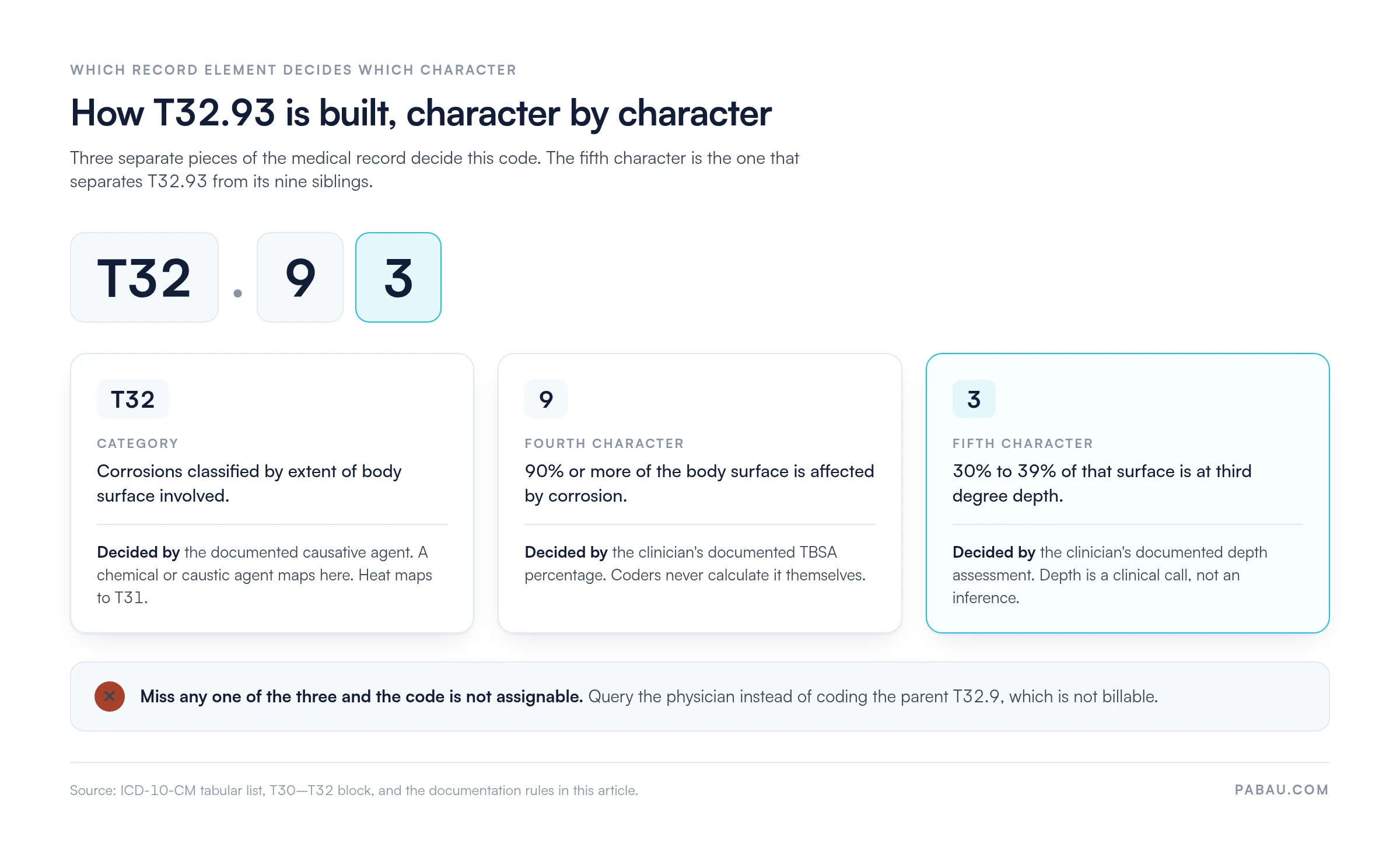
A secondary code from the T51-T65 category (Toxic Effects of Substances) is typically reported alongside T32.93. It identifies the specific corrosive substance involved.
Several entry paths through the ICD-10-CM alphabetic index arrive at T32.93. Knowing the synonyms reduces the risk of picking an adjacent but incorrect code when the documentation uses non-standard terminology.
The primary index path runs: Corrosion (injury) (acid) (caustic) (chemical) (lime) → multiple body regions → specified site NEC. From there the tabular list directs coders to T32, then to the subcategory matching the documented TBSA and third degree percentages. The AAPC Codify ICD-10-CM lookup lets coders verify every synonym path and parent-child relationship for T32.93.
The ICD-10-CM Official Guidelines for Coding and Reporting set specific sequencing and documentation rules for corrosion codes in Chapter 19. Several of them get skipped on high-acuity claims, and each omission carries a denial risk.
Practices with recurring corrosion cases should also set internal audit checkpoints. Knowing which denial codes a payer returns for an unspecified injury diagnosis tells a billing team exactly which part of the record to tighten first.
Run a quarterly audit on every T32.9x claim you submit, and check four points on each one. The record must show a TBSA percentage of 90% or more. The documented third degree percentage must match the fifth character you selected. A T51-T65 toxic substance code must accompany the diagnosis. No POA indicator should appear on the claim. Catching these at claim level prevents most T32.93 denials before submission.
The T32.93 documentation trail is usually spread across systems. The clinician’s TBSA note sits in the chart, and the corrosive agent lands in a separate incident record. Then someone types the diagnosis code into a billing tool by hand. Each hand-off gives the fifth character a chance to drift from the record.
Practice management software like Pabau keeps the clinical note and the claim in one system. The depth assessment, the TBSA percentage and the causative agent all sit on the patient’s file. So the coder reads the source note rather than someone’s summary of it.
Pabau’s claims management software then submits the diagnosis code electronically through Claim.MD, reaching over 4,000 US payers. Your billing team fields fewer retrospective physician queries, and fewer claims sit in a work queue over a missing depth percentage. You catch the deficiency while the chart is still open.

Pabau connects directly with Claim.MD to submit high-specificity ICD-10 codes including T32.93 to over 4,000 US payers. See how our claims management tools reduce denials and keep burn and trauma billing on track.

T32.93 is one of the codes where a coder’s job is almost entirely a reading job. The classification never asks you to judge how severe the injury looks. It asks whether three specific statements sit in the record, and the fifth character follows from them.
So the effort that pays off is upstream. Build the physician query into the corrosion workflow rather than the denial workflow, and the fifth character stops being a judgment call. One trade-off is worth holding on to. A 10-point shift in the documented third degree percentage moves both the code and the DRG weight.
Book a demo to see how Pabau keeps corrosion documentation and diagnosis codes in the same system as the claim.

Need a foundation for understanding ICD-10 burn and injury coding? Medical billing fundamentals covers how diagnosis codes flow from clinical documentation through to payer submission.
Want to reduce corrosion claim denials before submission? Denial management strategies outlines the audit and query workflows that keep complex injury codes clean.
Looking for the rules behind high-acuity ICD-10 claims? Medical billing compliance guidance explains the regulatory framework that supports accurate corrosion code submission.
Submitting corrosion claims through a clearinghouse? Medical claims clearinghouse submission walks through how a claim is scrubbed and routed before it reaches the payer.
ICD-10 code T32.93 is a billable ICD-10-CM diagnosis code describing corrosions involving 90% or more of body surface with 30-39% third degree corrosion. It applies when a chemical or corrosive agent has caused full-thickness injury to 30-39% of the body surface. That surface must itself be 90% or more affected by corrosion. The code has been active since ICD-10-CM took effect in the US on October 1, 2015 (FY2016). It remains valid in the current fiscal year.
Yes. T32.93 is a specific, billable ICD-10-CM code confirmed by both the CMS tabular list and AAPC code reference databases. It is a terminal code with a valid fifth character, making it acceptable for claim submission. Its parent, T32.9, is not billable on its own.
In ICD-10-CM, a burn (T31 category) results from heat or a thermal source such as flame, hot liquid, or radiation. A corrosion (T32 category) results from a chemical or corrosive substance such as an acid, alkali, or caustic agent. The causative agent in the clinical documentation drives which category applies. Coders cannot infer the distinction from the injury’s appearance alone.
Yes. T32.93 is listed as POA exempt, meaning no present on admission indicator is required when reporting this code on inpatient hospital claims. Coders should still verify POA exempt status against the current fiscal year CMS POA exempt list, because that list is updated annually.
The treating clinician determines body surface area percentage using the Rule of Nines for adults or the Lund-Browder chart for pediatric patients. Coders must not calculate TBSA independently. The documented percentage from the medical record drives code selection under the T32 category, and any ambiguity requires a physician query first.
The T32.9x subcategory includes T32.90 through T32.99. Every code in it shares the same extent, at 90% or more of total body surface. They differ only in the proportion at third degree depth. The bands run T32.90 (0-9%), T32.91 (10-19%), T32.92 (20-29%) and T32.93 (30-39%). They continue T32.94 (40-49%), T32.95 (50-59%), T32.96 (60-69%), T32.97 (70-79%), T32.98 (80-89%) and T32.99 (90%+).