

ICD-10 Code S42.444P: Medial epicondyle fracture, right humerus
ICD-10 Code S42.444P: full descriptor and code validity ICD-10 Code S42.444P car...

Last Updated: Oct 13, 2026
Billable Code Specific Code
T32.90 is the billable ICD-10-CM code for corrosions involving 90% or more of body surface with 0% to 9% third degree corrosion. It takes no seventh character, and its parent code T32.9 is a header that payers reject.
Assignment turns on two documented figures, the total body surface area and the third-degree percentage. Miss either one and the claim drops to a less specific code or comes back denied. What follows covers the documentation, the subcode family, and the errors that cost the most time.
Let Pabau's smart automation suggest the right codes, reduce claim denials, and keep your practice compliant—effortlessly.
Automate repetitive tasks and focus on what matters most—your patients.
Reduce coding errors and ensure compliance with the latest regulations.
Clean claims, fewer denials, and faster reimbursements.
Powerful insights and reporting to help your practice thrive.
HIPAA compliant SOC 2 certified GDPR-compliant Trusted by 4,000+ clinics worldwide

T32.90 is billable, but its parent T32.9 is a header code that payers reject.
The code covers corrosions over 90% of body surface with 0% to 9% third degree involvement.
The physician note needs two figures, the total body surface area and the third-degree percentage.
T32.90 is a complete five-character code, so it takes no seventh character.
The FY2026 edition took effect October 1, 2025, so recheck code currency each October.
ICD-10 code T32.90 reports corrosions covering 90% or more of body surface, with 0% to 9% of that surface burned to third degree. It is billable in the FY2026 edition, effective October 1, 2025. The rest of the claim rests on two documented numbers.
Here is the metadata worth keeping open while you code.
Check code currency on the CMS ICD-10 codes page before each fiscal year claim run. The CDC/NCHS ICD-10-CM web tool gives you the official tabular list with annual update tracking.
T32.90 carries two separate clinical measurements. The first is how much of the body the corrosion touches. The second is how much of that surface went full thickness.
Corrosion in ICD-10-CM means injury from a chemical, not from heat. Strong acids, alkalis, and industrial solvents are the usual agents. The note has to name the agent, because external cause coding depends on it.
Take an attending who writes “92% BSA corrosion from hydrofluoric acid, 6% full thickness.” Both figures clear the T32.90 thresholds, so the code fits. Move that 6% up to 14% and the claim belongs on T32.91 instead.
Injuries on this scale almost always run through a burn center, intensive care, and a long wound plan. So the claim is long too, with many lines and plenty of room for a specificity error to slip through.
T32 groups corrosions by how much body surface they cover. Inside it, T32.9 covers 90% or more. But T32.9 is a header code with no third-degree detail attached, so payers will not accept it. The billable subcodes run from T32.90 to T32.99, one per third-degree band.
Submitting T32.9 directly is the most common error at this level. Pick the subcode that matches the documented third-degree percentage instead. The AAPC ICD-10-CM code lookup is a quick way to cross-check the rest of the T32 hierarchy.
T31 and T32 are built the same way. They part on a single point, which is what caused the injury. Choose the wrong category and the claim misreports the encounter.
The answer sits in the clinical note. “Flame burns” sends you to T31. “Acid splash” or “industrial solvent exposure” sends you to T32. A patient with both thermal and chemical injuries may need codes from each category.
The ICD-10-CM Official Guidelines for Coding and Reporting are maintained by CMS and the National Center for Health Statistics. They set out how to report burns and corrosions by extent. Four of those rules land directly on T32.90.
Two tools do the measuring, and the note should say which one was used.
Those checks always run in the same order. The ladder below shows where each answer sends the claim.
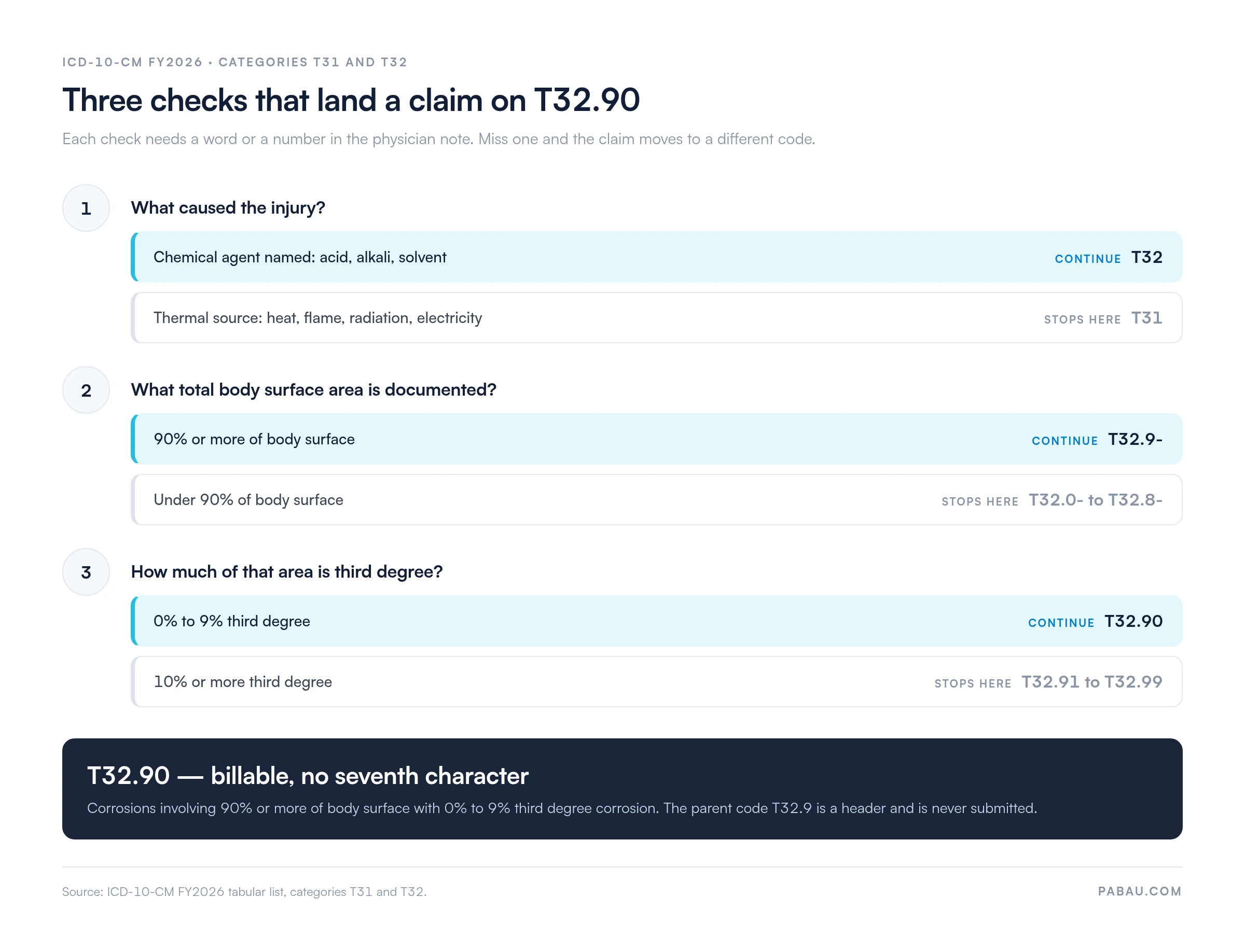
Run a documentation review at discharge on every burn and corrosion case, before anyone opens the encoder. Both figures you need, total BSA and third-degree BSA, have to appear in the attending note or the wound assessment. If either is missing, query the provider first. One missing number pushes you onto a non-billable parent code or the wrong subcode, and both come back denied.
Clinical notes rarely quote the ICD-10 descriptor. Knowing the phrases that map to T32.90 speeds up chart review.
None of these appear as official “Applicable To” notes under T32.90. They are simply how attending physicians and burn surgeons write. Your job is to translate that language into the right extent code and degree band.
T32.90 rarely travels alone on a claim. Knowing the codes around it helps you check sequencing and catch a wrong pick early. Our diagnostic code library covers the other ICD-10-CM entries these encounters tend to pull in.
Two of these trip people up most often. T31.90 looks identical on the page but describes a thermal burn. T32.80 differs only in the total BSA band, so a rounded measurement can move a claim between them.
T32.90 is billable, but it will not survive a payer review without five specific elements in the record. Here is what to look for before the claim goes out.
The same habit catches all three. Read the two figures and the agent first, then open the encoder.
Electronic submission helps once the note is right. A clearinghouse route such as Claim.MD runs eligibility checks, sends the CMS-1500, tracks claim status, and posts the remittance. It will not tell you that a diagnosis code lacks specificity, so that judgment stays with the coder.
Give your providers a corrosion query template. Four prompts do the work, covering total BSA involved, third-degree BSA, causative agent, and BSA method. Drop them into the note template and all four figures arrive before the chart reaches a coder. Query turnaround drops, and far fewer claims stall on a missing number.
T32.90 has been in the ICD-10-CM tabular list since the US adopted the clinical modification. Its descriptor and structure have held steady across recent fiscal years.
Stability is not a reason to skip the annual check. Updates can revise descriptors, add subcodes, or retire entries in the T32 category. Put an October 1 review into your revenue cycle management calendar so a descriptor change never surprises a claim run.
A T32.90 encounter generates a long claim. Site-specific codes, the extent code, the external cause code, and a stack of procedure codes all have to line up. Plenty of teams assemble that by hand, then learn at the clearinghouse what was missing.
Practice management software like Pabau takes a different route. Our claims software for practices pre-fills the CMS-1500 straight from the encounter. The codes attached to the service land on the charge line, and ICD-10 slots are seeded from the recorded problem list.
Lookup libraries for ICD-10-CM and CPT sit inside the claim form, so you can check a subcode without leaving it. Pabau also confirms that claim-required fields are complete before the send button unlocks.
In the US, claims route through Claim.MD. That covers eligibility checks, CMS-1500 submission, status tracking, and ERA remittance posting. It does not judge whether a diagnosis code is specific enough, so that call stays with your coder.
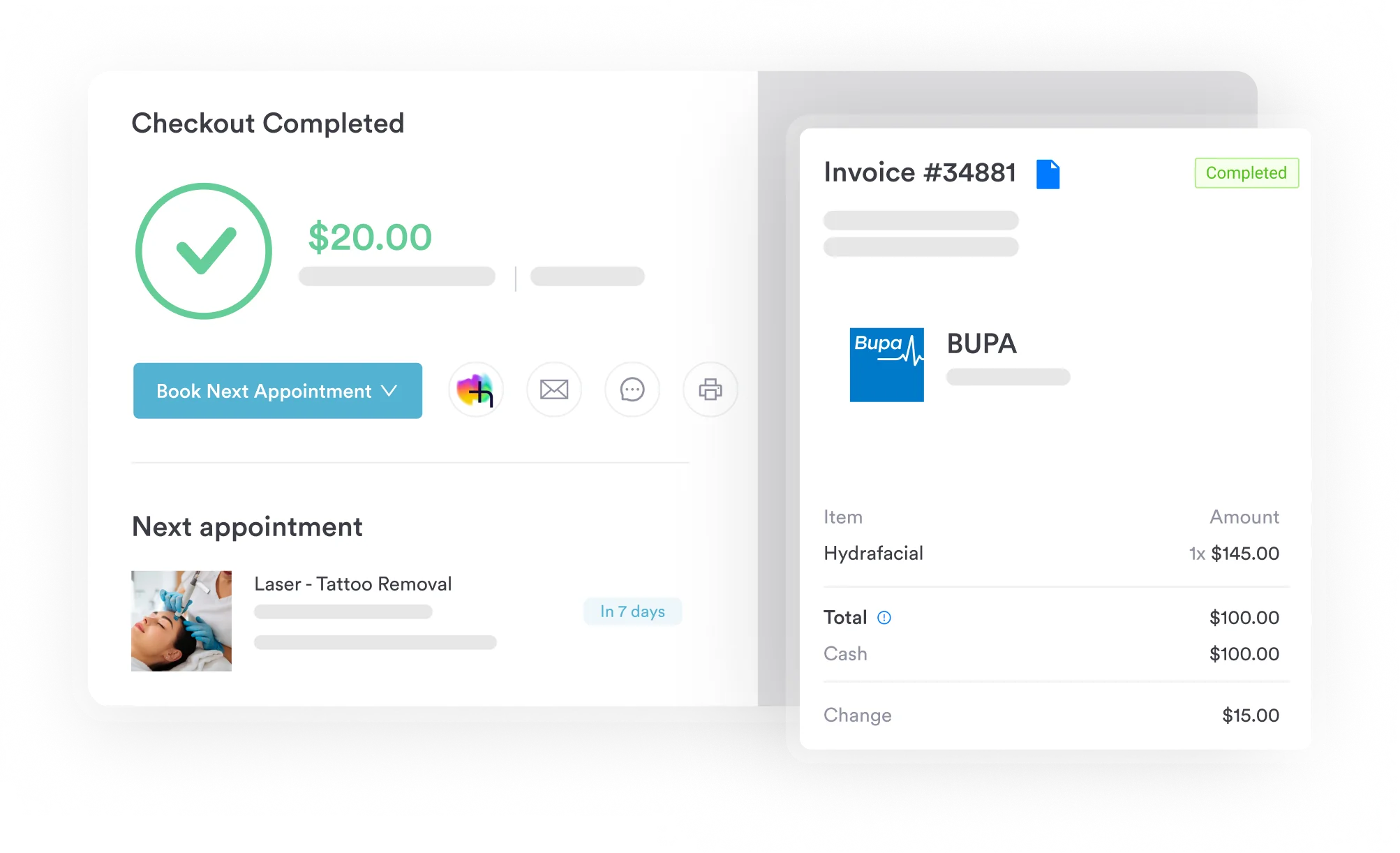

Pabau pre-fills the CMS-1500 from the encounter, checks that claim-required fields are complete, and tracks each submission through to remittance. See how that fits a high-acuity billing workflow.

T32.90 is easy to assign and hard to document. Both figures the payer wants get written by the attending long before the chart reaches you. Fixing the note template is worth more than any amount of care at the encoder.
Get the total BSA, the third-degree percentage, the agent, and the measurement method into the record as standard. Then the claim goes out clean the first time. Miss one and you are querying a provider weeks after discharge.
If the same figures keep going missing, the fix sits upstream in your documentation and claim workflow. Book a demo to see how Pabau assembles a corrosion claim from the record and follows it through to remittance.

Fighting denials on complex injury codes? Denial management in healthcare shows how to build prevention into the workflow instead of appealing after the fact.
Want the claim right the first time? What is a clean claim in medical billing breaks down the fields a payer checks before it pays.
New to the billing cycle? What is medical billing walks through each step from encounter to payment.
Worried about audit exposure? Medical billing compliance covers the documentation standards that hold up under review.
No. T32.90 is a complete five-character code and takes no seventh character. That sets it apart from the site-specific corrosion codes in T20-T25, which do need one to show initial encounter, subsequent encounter, or sequela. Adding a seventh character to T32.90 creates an invalid code and the claim rejects.
T26-T28 classify corrosions of the eye and adnexa, the respiratory tract, and other internal organs. T32 measures only how much external body surface a corrosion covers. So an ocular or inhalation injury is coded separately, and both are reported when the record documents both.
Burn wound debridement (CPT 16020-16036), skin grafting (CPT 15002-15431), and critical care (CPT 99291-99292) are the common pairings. The procedures performed during the encounter decide the CPT codes, not the diagnosis code.
Both cover corrosions of 90% or more of body surface. The difference sits on the third-degree axis. T32.90 is for 0% to 9% third-degree involvement, and T32.99 is for 90% or more. The bands in between run T32.91 through T32.98.




