ICD-10 code S61.201A: Open wound of left index finger without nail damage
ICD-10 code S61.201A covers a left index finger wound of unstated type ICD-10 co...

Last Updated: Oct 16, 2026
Billable Code Specific Code
T31.92 is the billable ICD-10-CM code for burns involving 90% or more of body surface with 20-29% third degree burns.
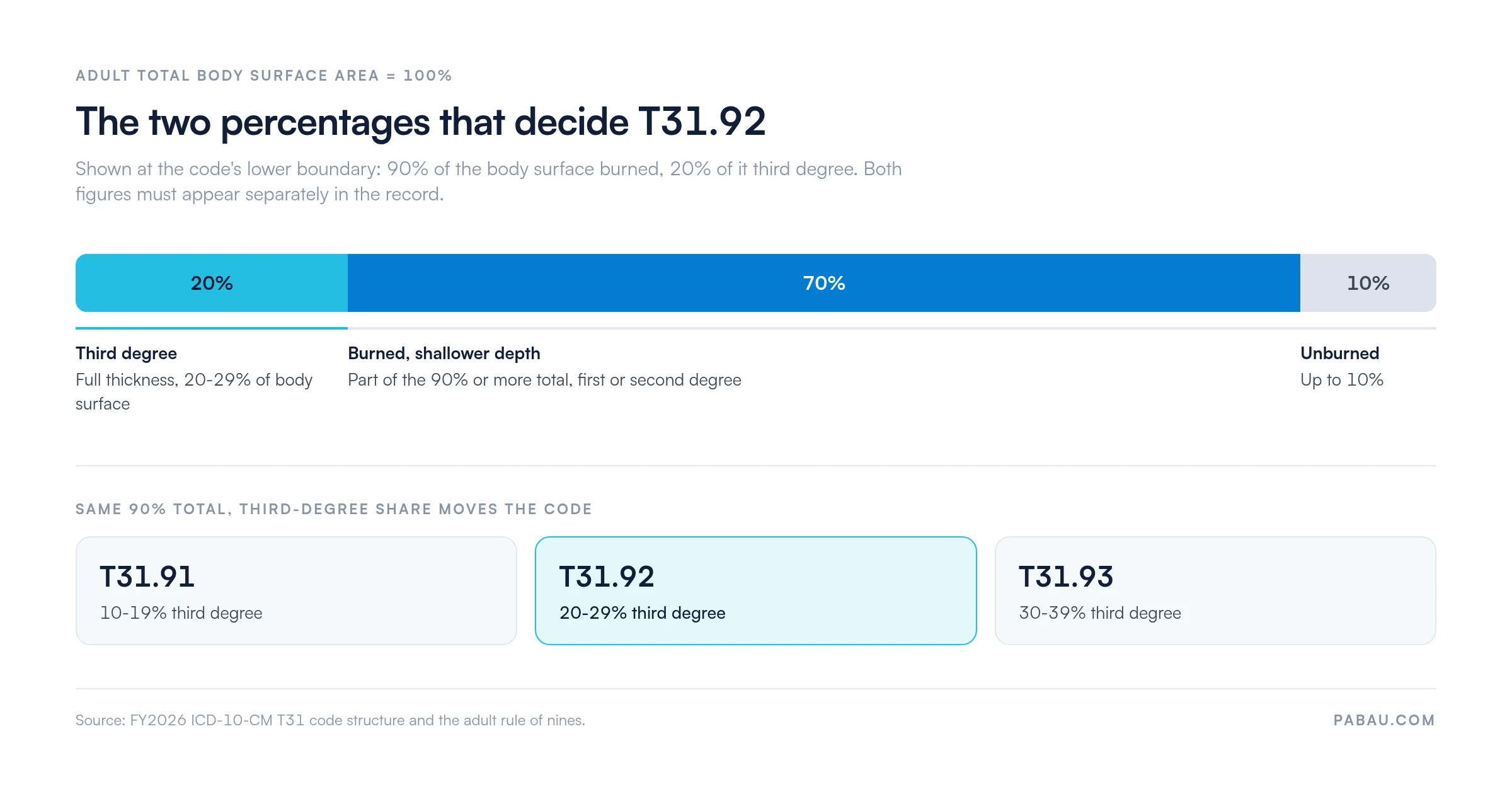
Two measurements sit inside that one code. The first is the share of body surface burned, and the second is the share of it destroyed to full thickness.
The 2026 edition of T31.92 became effective on October 1, 2025, under the standard CMS annual update cycle.
Let Pabau's smart automation suggest the right codes, reduce claim denials, and keep your practice compliant—effortlessly.
Automate repetitive tasks and focus on what matters most—your patients.
Reduce coding errors and ensure compliance with the latest regulations.
Clean claims, fewer denials, and faster reimbursements.
Powerful insights and reporting to help your practice thrive.
HIPAA compliant SOC 2 certified GDPR-compliant Trusted by 4,000+ clinics worldwide

ICD-10 Code T31.92 is a billable diagnosis code for burns covering 90% or more of total body surface area (TBSA), with 20-29% third-degree involvement.
The T31 category classifies burns by extent, so T31.92 needs both the total TBSA percentage and the third-degree percentage in the record.
Missing T20-T25 companion codes and an undocumented third-degree percentage are the two errors that most often trigger a denial.
Practice management software like Pabau captures the TBSA and degree documentation T31.92 needs, with a built-in ICD-10 code lookup.
The table below summarizes the key data points coders and billers need before submitting ICD-10 Code T31.92.
The Centers for Medicare and Medicaid Services (CMS) updates ICD-10-CM annually on October 1. T31.92 is confirmed valid. Coders should not submit this code for encounters predating its effective date without verifying the applicable fiscal year’s code set.
The T31 category takes a different approach from most burn codes in the ICD-10-CM code set. Rather than classifying by anatomical site, it classifies by how much of the body surface is involved. That measure is called total body surface area, or TBSA.
The ICD-10-CM coding guidelines are co-published by CMS and the National Center for Health Statistics (NCHS). They specify that T31 codes are additional codes, assigned alongside the site-specific burn codes from T20 to T25. T31 adds the extent dimension that payers, trauma registries, and quality benchmarking systems require.
The full T31 matrix runs from T31.0 through T31.99. T31.0 covers burns involving less than 10% of body surface. T31.99 covers 90% or more, with 90% or more of it third degree. The second character gives the overall TBSA range, and the third gives the third-degree share.
T31.9X is the most clinically severe subcategory in the T31 series. Every code here shares one threshold, which is a total TBSA of 90% or more. What varies is how much of that total is third degree, meaning full thickness.
T31.92 sits in the middle of this subcategory, and the 20-29% third-degree band is what separates it from its neighbors. A third-degree share of 30% to 39% at the same total is coded T31.93 instead. Rounding or approximating that figure is a documentation and compliance risk. The chart below shows how the two percentages divide one body surface.
The Rule of Nines is the standard clinical method for calculating TBSA quickly at the bedside. It assigns a fixed percentage to each major body region, and coders use those percentages to confirm the correct T31 subcategory.
To confirm T31.92, the clinician’s assessment must show burned areas summing to 90% or more of the body surface. It must also show that the third-degree subset accounts for 20-29% of the whole body surface. Third degree means full thickness, with all layers of skin destroyed.
The Rule of Nines values above apply to adults. Pediatric patients use the Lund-Browder chart, which adjusts head and lower-extremity proportions by age. The record should specify which assessment method was used.
The single most common reason T31.92 claims are questioned on audit is insufficient documentation. Two numbers must appear explicitly in the clinical record to support this code.
Practices that standardize their burn admission documentation against these five requirements are far less likely to face compliance problems on retrospective audit. The WHO ICD-10 browser and the ICD-10-CM Official Guidelines for Coding and Reporting both emphasize specificity as the governing principle for code selection.
Flag T31.92 documentation at admission, not discharge. Burn extent can be revised as edema resolves and wounds declare their depth, but the initial assessment record is what payers scrutinize most closely. Build a standardized burn admission note template that prompts for total TBSA, third-degree TBSA, and the assessment method used, every time.
T31 codes classify thermal burns by extent. T32 codes classify chemical corrosions using the same two-percentage structure. Coders sometimes treat the two categories as interchangeable, and they are not.
A patient who sustains both thermal burns and chemical corrosion injuries may legitimately receive codes from both T31 and T32. The distinction is the cause of the injury, with T31 covering heat sources and T32 covering chemical agents. Applying the wrong category is a classification error that may prompt a payer query.
ICD-10 Code T31.92 does not stand alone. The ICD-10-CM Official Guidelines for Coding and Reporting specify that T31 extent codes are assigned alongside site-specific burn codes. Missing companion codes are a primary driver of claim rejection for burn unit encounters.
According to AAPC ICD-10-CM coding guidance, the standard companion code set for a T31.92 encounter includes:
Sequencing guidance from the ICD-10-CM Official Guidelines is straightforward. When a burn is the reason for the encounter, the site-specific code from T20-T25 is typically the principal diagnosis. T31.92 then follows as an additional code that adds the extent dimension.
Burn coding is one of the higher-complexity areas in ICD-10-CM. These mistakes recur most often in T31.92 submissions, and avoiding them takes documentation discipline, coder awareness, and a working denial management process.
Verified burn centers and regional burn units assign T31.92 most often. Burns covering 90% or more of TBSA are the most catastrophic category of thermal injury, and most community hospitals will rarely see one.
Getting T31.92 right depends on structured clinical documentation captured at the time of assessment, not reconstructed at billing. Practices that rely on free-text notes face more retrospective coding queries. The two key numbers end up buried in narrative instead of sitting in auditable fields.
Practice management software like Pabau lets burn care teams build their own assessment templates. TBSA percentage, third-degree subset percentage, assessment method, and anatomical site detail all sit there as standard fields. Capture that data consistently at point of care and the coder receives the exact numbers T31.92 requires.
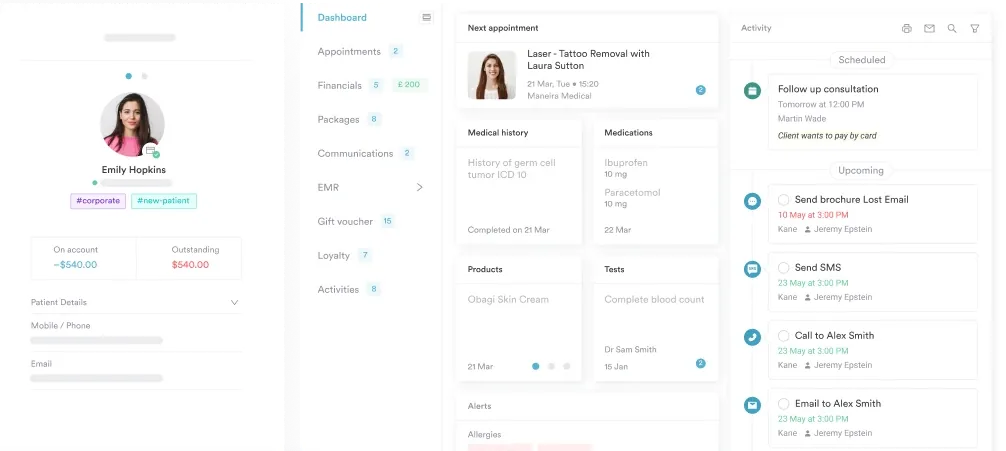
Pabau also connects to electronic claims through Claim.MD, its US clearinghouse partner, which supports more than 4,000 payers and eligibility verification. That means T31.92 and its companion codes can be validated before the claim leaves the practice.
The claims management software in every Pabau subscription includes an ICD-10 code catalog. Coders can look up T31.92 and link it to the encounter without switching systems.

Review your burn admission note template annually against the ICD-10-CM Official Guidelines for Coding and Reporting. Ask one question of it. Does the template force clinicians to record total TBSA and third-degree TBSA as separate numeric fields? If those numbers sit in free text, your coding team is doing interpretive work that belongs in the clinical note.

Pabau’s structured clinical notes and built-in ICD-10 code lookup help burn care teams capture the percentages T31.92 depends on. That means fewer denials and less back-and-forth between the coder and the clinical team.

The work that decides a T31.92 claim happens at admission, not in the billing office. If the total TBSA and the third-degree percentage are both written down while the assessment is fresh, the code follows on its own. If either is missing, the coder defaults to T31.90 and the claim understates a catastrophic injury.
That makes this a template problem more than a training problem. Put total TBSA, third-degree TBSA, and the assessment method on the burn admission note as separate fields, and the documentation problem stops recurring. Book a demo to see how Pabau captures those fields at point of care and carries them through to the claim.

Need to understand how clean claims reduce T31.92 denials? What makes a clean claim explains the submission standards payers apply to complex diagnosis codes.
Managing denials after a T31.92 submission? Denial management in healthcare covers the workflows that turn rejected claims into recovered revenue.
Want to understand the broader billing context? What is revenue cycle management gives a full picture of how diagnosis coding connects to financial performance.
ICD-10 Code T31.92 is a billable ICD-10-CM diagnosis code for burns involving 90% or more of total body surface area (TBSA). Of that total, 20-29% must be third-degree, meaning full thickness. The code records both the extent and the depth of the injury for reimbursement and trauma registry purposes.
Yes. T31.92 is a billable, specific ICD-10-CM code valid for reimbursement submission. It became effective October 1, 2025, as part of the FY2026 ICD-10-CM edition, and it is confirmed valid for the current coding year.
T31 codes classify thermal burns, caused by heat, by the percentage of body surface area involved. T32 codes classify corrosions, caused by chemical agents, using the same dual-percentage structure. T31.92 applies only to heat-source burns. Chemical injuries require T32 codes instead, and both categories can be assigned together when a patient has both injury types.
Four items must appear in the clinical record. The first is a total TBSA of 90% or more. The second is a third-degree burn percentage of 20-29%, recorded as a separate figure. The third is the assessment method used, either the Rule of Nines or the Lund-Browder chart. The fourth is a treating clinician’s signed attestation. Both percentages must be written as discrete figures, not inferred from treatment descriptions.
Assign T31.92 alongside site-specific burn codes from the T20-T25 range, which identify the anatomical locations involved. Add external cause codes from X00-X19 to identify the heat source. Every code on the claim should carry the matching 7th character for encounter type. That is A for initial, D for subsequent, and S for sequela. The T20-T25 site code is typically the principal diagnosis, with T31.92 as the secondary extent code.
For adults, clinicians use the Rule of Nines. It assigns 9% to the head and neck, 18% to the anterior trunk, and 18% to the posterior trunk. Each upper extremity is 9%, each lower extremity is 18%, and the perineum is 1%. Add the percentages for every burned region to get the total TBSA. Pediatric patients use the Lund-Browder chart instead, which adjusts for age-related differences in body proportion. The method used must be documented in the clinical record.
ICD-10 Code T31.92 became effective on October 1, 2025, as part of the FY2026 ICD-10-CM annual update published by CMS and NCHS. It should not be submitted for encounters prior to that date unless the applicable year’s code set confirmed validity at that time.