ICD-10 Code S42.444P: Medial epicondyle fracture, right humerus
ICD-10 Code S42.444P: full descriptor and code validity ICD-10 Code S42.444P car...

Last Updated: Oct 13, 2026
Billable Code Specific Code
T32.31 is the billable ICD-10-CM code for corrosions involving 30-39% of body surface with 10-19% third degree corrosion.
Let Pabau's smart automation suggest the right codes, reduce claim denials, and keep your practice compliant—effortlessly.
Automate repetitive tasks and focus on what matters most—your patients.
Reduce coding errors and ensure compliance with the latest regulations.
Clean claims, fewer denials, and faster reimbursements.
Powerful insights and reporting to help your practice thrive.
HIPAA compliant SOC 2 certified GDPR-compliant Trusted by 4,000+ clinics worldwide

ICD-10 code T32.31 covers corrosions on 30-39% of total body surface area, with 10-19% of that surface at third degree.
T32.31 is an established code. It has been in the ICD-10-CM tabular list since the US adopted the code set on October 1, 2015.
T32.31 is not directly billable without a seventh character. The three billable subcodes are T32.31XA, T32.31XD and T32.31XS.
T32 codes classify corrosions from chemical agents only. Thermal burns belong under T31, and mixing the two is a common coding error.
Practice management software like Pabau keeps TBSA, depth and the causative agent on one record, so coders are not chasing details.
T32.31 is an ICD-10-CM diagnosis code for corrosions involving 30-39% of total body surface area (TBSA), where 10-19% of that surface involves third degree corrosion. It has been in the code set since ICD-10-CM took effect in the US on October 1, 2015, with the same descriptor.

The code sits in the T32 category, which covers corrosions classified by the extent of body surface involved. That category belongs to Chapter 19 of ICD-10-CM, Injury, poisoning and certain other consequences of external causes (S00-T88).
T32.31 is not valid without a seventh character, so T32.31XA, T32.31XD and T32.31XS are the three billable subcodes. Both the CDC/NCHS ICD-10-CM web tool and the CMS ICD-10 codes page carry the current descriptor.
Every code in the T32 category needs a seventh character to be valid. T32.31 becomes billable when A, D or S is appended. The X before that character is a placeholder, required because T32.31 is a five-character code that has to reach the seventh position.
Claims submitted with T32.31 alone come back from payers as incomplete, so the seventh character is part of every clean claim.
T32.31XA applies when a patient is receiving active treatment for the corrosive injury for the first time. This includes emergency department visits, initial surgical debridement, and the first hospitalization for the corrosion. “Active treatment” is the defining criterion. A patient transferred from one facility to another for initial treatment still qualifies for the A character at the receiving facility.
T32.31XD is used once active treatment has concluded and the patient returns for follow-up care. Wound checks, dressing changes, physical therapy for range of motion, and outpatient follow-up after discharge all fall under the D character. The key distinction from T32.31XA is that the injury has left the acute treatment phase.
T32.31XS documents late effects that arise as a direct consequence of the original corrosion. Scarring, skin contracture, and chronic pain stemming from the chemical injury are typical sequela presentations. When coding a sequela, the condition causing the current encounter is sequenced first, with T32.31XS listed as the secondary code to establish causation.
The T31/T32 split trips up coders more often than any other burn-related decision. Both categories organize injuries by percentage of body surface area, and both use the same TBSA thresholds. They describe different injuries, so using one where the other belongs changes the clinical picture on the claim.
Practices managing chemical injury cases usually record the causative agent at intake in a dermatology EMR, which keeps that detail with the note.
The rule is simple. If a chemical caused the injury, assign T32. If heat, flame or electricity caused it, assign T31. The physician has to document the causative agent, because coders cannot infer the mechanism from clinical history.
When a note is ambiguous, the AAPC ICD-10-CM code lookup shows both categories with their full descriptors. The T31 side is built the same way, so T31.54 pairs the same two percentages for a thermal injury.
Selecting the correct T32 subcategory depends on an accurate TBSA figure. For T32.31, the total corrosion area has to fall within 30-39% of TBSA. Wound care and reconstruction cases in a plastic surgery EMR are where this range turns up most often. Two clinical tools produce that number.
The Rule of Nines divides the adult body into regions, each representing approximately 9% of TBSA (or a multiple of 9). It is the most widely used bedside assessment tool for adult patients.
To reach the 30-39% range, a typical presentation covers the whole anterior trunk (18%) plus both arms (9% + 9%), which totals 36% TBSA. The physician’s documented estimate drives code selection. Coders cannot adjust or estimate it themselves.
The Lund-Browder chart provides more precise TBSA estimation, particularly for pediatric patients where body proportions differ significantly from adults. It adjusts head and leg percentages based on the patient’s age. When a physician uses the Lund-Browder chart to document TBSA, that documented figure is what coders use for code selection.
T32.31 carries two separate percentage qualifiers, and both have to be met. Miss either one and the code shifts to a different subcategory.
A patient with 35% TBSA corrosion, of which 15% is documented as full-thickness, maps directly to T32.31. If the third degree component rises to 22%, the correct code shifts to T32.32. The physician’s note therefore decides which subcode applies.
US sequencing rules for corrosion codes come from the CMS and NCHS ICD-10-CM Official Guidelines for Coding and Reporting, Section I.C.19. When several corrosions are present, the most severe one is sequenced first. The T32 category also carries a tabular note that limits it to the primary position only when the corrosion site is unspecified.
Practices managing corrosion cases across several encounters need medical billing compliance habits that keep the encounter character current as treatment moves to follow-up.
Documentation failures are the leading cause of T32.31 claim denials, which makes them a denial management problem as much as a coding one. Payers audit corrosion codes closely, because the injuries they describe are complex and expensive to treat.
Patient record management systems with structured prompts help clinicians capture TBSA percentages, depth classifications and the causative agent at the point of care. Practices handling burn and corrosion cases should also keep HIPAA-compliant record keeping processes in place for chemical injury documentation.
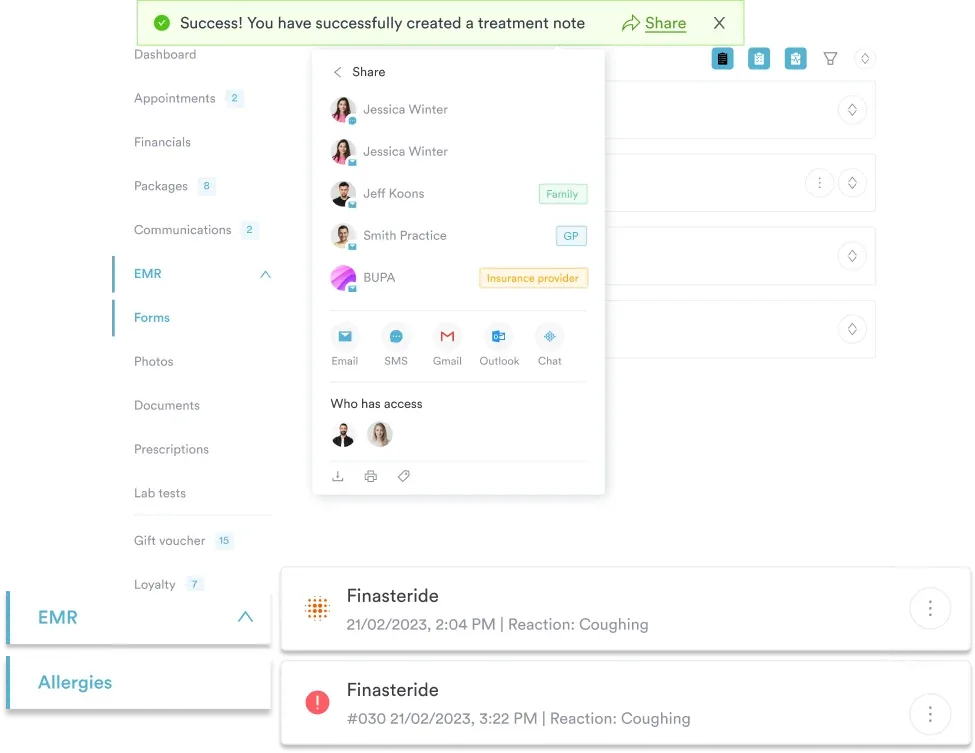
Digital intake forms with injury classification fields built in leave fewer missing details for a coder to query after the encounter.

T32.31 sits within the T32.3X subcategory, which groups all corrosions covering 30-39% of TBSA. The second digit varies based on the proportion that involves third degree corrosion. Understanding the adjacent codes helps coders avoid selecting the wrong subcode when third degree percentages fall near the boundary between ranges.
Extent codes for larger areas follow the same two-part logic, so T32.43 and T32.53 and T32.53 read the same way once the TBSA total changes.
T32.31 appears in claims that are audited closely because the injury severity it describes carries significant treatment costs. These are the most frequent coding mistakes in this code range, and the situations where they occur. A medical coding cheat sheet keeps the seventh-character rules and common denial codes on one page for quick reference.
Audit your T32.3X claims quarterly by filtering for cases where the seventh character shifts from XA to XD within the same episode of care. A pattern of late character updates points at the workflow rather than the individual coder.
Most practices record a corrosion case in three places. The TBSA estimate sits in a narrative note, the depth in an operative report, and the chemical agent in the triage record. The coder then reads all three before assigning T32.31XA.
Practice management software like Pabau keeps those fields on one structured record. Intake and treatment forms can make the TBSA percentage, the depth estimate and the causative agent required fields. That way the encounter is complete before anyone opens the claim.
Coders still choose the code. Pabau’s claims management software pulls the data already on the record into a pre-filled claim. The Claim.MD integration then submits it electronically and tracks its status.
Whichever route you bill through, the seventh character has to be right before the CMS-1500 form leaves the practice. A check on the record catches the encounter type while the chart is still open.

Pabau keeps TBSA percentages, corrosion depth and the causative agent on one structured patient record. Your coders and billers work from a complete chart instead of chasing details after the encounter.

T32.31 is a documentation problem more than a coding one. Once the physician’s note gives a total TBSA of 30-39% and a third degree share of 10-19%, the code follows. The judgment call is whether the note is specific enough to support it.
So query the vague note before the claim goes out, rather than after the denial arrives. One number added at the point of care costs less than an appeal three months later.
Practices treating corrosion cases across several encounters gain most by making those fields mandatory in the record itself. Book a demo to see how Pabau keeps TBSA, depth and agent documentation together for burn and wound care billing.

Grafting a full-thickness corrosion? CPT code 15150 covers the tissue cultured skin autograft billing that often follows an injury this size.
Billing a new patient office visit? New patient office visit billing guide covers CPT code 99203 for a new patient visit with low-complexity decision making or 30 to 44 minutes.
Waiting on approval for a costly admission? Prior authorization software explains how practices track approvals without a spreadsheet.
Billing the highest-level new patient visit? Highest-level office visit billing guide covers CPT code 99205, requiring high-complexity decision making or 60 to 74 minutes of total time.
ICD-10 code T32.31 describes corrosions involving 30-39% of body surface area with 10-19% third degree corrosion. It is not directly billable and needs a seventh character, giving T32.31XA, T32.31XD or T32.31XS. The code has been in ICD-10-CM since the US adopted the code set on October 1, 2015.
T32.31 takes one of three seventh characters. A marks the initial encounter with active treatment, D marks a subsequent encounter for follow-up care, and S marks a sequela such as scarring. The X placeholder fills position six, so the valid codes are T32.31XA, T32.31XD and T32.31XS. Submitting T32.31 without a seventh character results in claim rejection.
TBSA is most commonly estimated with the Rule of Nines, or the Lund-Browder chart for pediatric patients. The adult version gives 9% to the head and neck, 9% to each arm and 1% to the perineum. Each side of the trunk and each leg counts 18%. The physician documents the percentage in the record, and coders use that figure to select the T32 subcategory.
Chemical injuries are coded using T32 for corrosions, while thermal injuries use T31 for burns. Assign the site-specific corrosion code from T20-T25 first to identify location, then add T32.31XA, T32.31XD or T32.31XS for total extent. Name the chemical with a Chapter 19 toxic-effect code such as T54.-, which also records intent. Thermal burns follow the same structure, using T31 for extent and X00-X19 external cause codes.