ICD code T86.839 – Unspecified bone graft complication
Billable Code•Specific Code
Code Definition
T86.839 is the billable ICD-10-CM code for unspecified complication of bone graft. It applies when the record confirms a bone graft complication but does not name its type, and it is valid for FY2027.
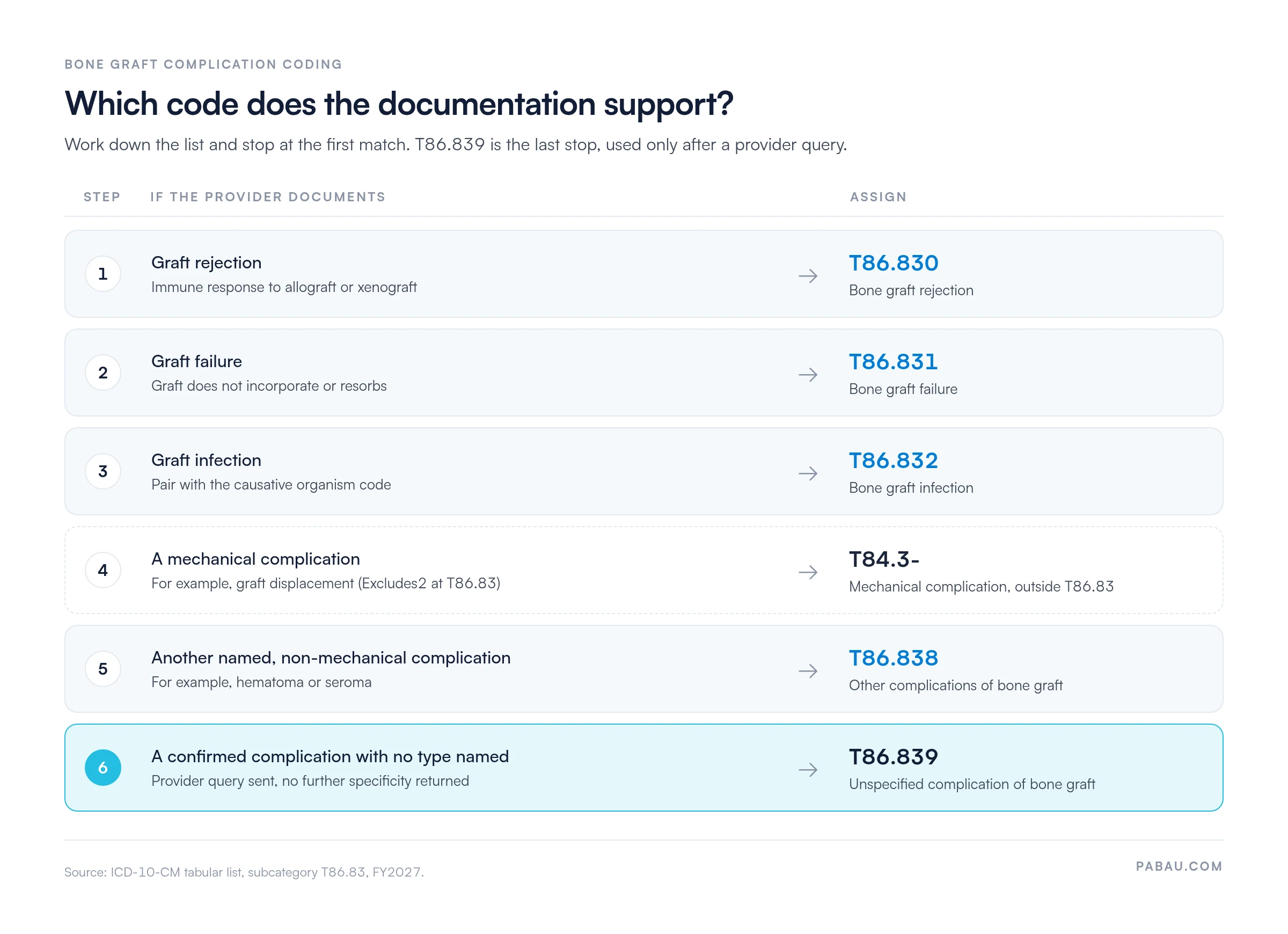
If the documentation names the complication type, assign the matching specific T86.83x code (T86.830, T86.831, T86.832 or T86.838) instead. Unspecified codes often draw review, so query the provider before settling on T86.839.
Related Information
Chapter
S00-T88 Injury, poisoning and certain other consequences of external causes
Category
T86 Complications of transplanted organs and tissue
Group
T86.83 Complications of bone graft
Billable
Yes
Code also known as
unspecified bone graft complication
Save time. Improve accuracy. Get paid faster.
Automate coding with Pabau
Let Pabau's smart automation suggest the right codes, reduce claim denials, and keep your practice compliant—effortlessly.
T86.839Unspecified bone graft complicationHigh match
Confidence score
98%
Why this code?
Matches patient diagnosis
Supported by clinical notes
Commonly used for this condition
Why practices choose Pabau
Save hours every week
Automate repetitive tasks and focus on what matters most—your patients.
Improve accuracy
Reduce coding errors and ensure compliance with the latest regulations.
Get paid faster
Clean claims, fewer denials, and faster reimbursements.
Grow with confidence
Powerful insights and reporting to help your practice thrive.
HIPAA compliant•SOC 2 certified•GDPR-compliant•Trusted by 4,000+ clinics worldwide
Key takeaways
T86.839 is a valid, billable ICD-10-CM code for FY2027, used for unspecified bone graft complications in both inpatient and outpatient settings.
Use T86.839 only when documentation does not support a more specific sibling code (T86.830 rejection, T86.831 failure, T86.832 infection, T86.838 other specified).
A missing complication type in the operative or pathology note is a common cause of T86.839 denials. A physician query can often resolve it.
Pabau, the practice management platform we build, tracks ICD-10-CM code assignments, clean claim submission and denial follow-up for practices billing bone graft complications.
ICD-10 code T86.839: Definition and code details
ICD-10 code T86.839 is the billable code for an unspecified complication of a bone graft.
It has applied to discharges and encounters since October 1, 2015, and it is valid for FY2027 with no change. It sits in subcategory T86.83 (Complications of bone graft), under the T80-T88 block (Complications of surgical and medical care, NEC). That block belongs to chapter 19 of ICD-10-CM (S00-T88: Injury, poisoning and certain other consequences of external causes).
Field
Value
Code
T86.839
Official descriptor
Unspecified complication of bone graft
Billable / specific
Yes – valid for claim submission
FY2027 status
Active – no change from FY2026
Chapter
19: Injury, poisoning, and certain other consequences of external causes (S00-T88)
Block
T80-T88: Complications of surgical and medical care, NEC
Category
T86: Complications of transplanted organs and tissue
Subcategory
T86.83: Complications of bone graft
Applicable settings
Inpatient and outpatient
7th character required
No
POA indicator required
Yes (inpatient only)
Verify the code against the CDC/NCHS ICD-10-CM web tool each fiscal year. Annual updates can affect parent-category descriptions even when a specific code like T86.839 carries over unchanged. Neighboring T86 codes are listed in our ICD-10-CM code pages.
What T86.839 covers: Inclusions and clinical scope
T86.839 covers bone graft complications where the provider’s documentation confirms a complication exists. The documentation does not identify it as one of the four named types in subcategory T86.83. The code applies across graft material types.
Autograft complications: complications arising from bone harvested from the same patient (e.g., iliac crest, fibula, calvarium)
Allograft complications: complications from donor-sourced processed bone, including cancellous chips, cortical struts, and demineralized bone matrix
Synthetic/xenograft complications: complications from hydroxyapatite, tricalcium phosphate, or animal-derived graft materials where the complication type is not otherwise specified
Mixed-graft complications: procedures combining autograft and allograft where the complication affects the graft construct as a whole and cannot be attributed to one specific type
The anatomical site matters for clinical management but does not change the T86.839 assignment. Spinal fusion grafts, long-bone defect grafts, craniofacial grafts, and dental implant-site bone grafts all fall under T86.839 when the complication is unspecified.
What T86.839 does not cover: Excludes notes and limitations
T86.839 does not cover complications with a specified type. It also does not apply to implanted device failure or to post-procedural bone conditions classified elsewhere in ICD-10-CM.
Excludes notes: T86.83 has an Excludes2 note for mechanical complications of bone graft (T84.3-); no Type 1 Excludes applies to T86.839.
Superseded by more specific sibling codes: When documentation supports T86.830 (rejection), T86.831 (failure), T86.832 (infection), or T86.838 (other specified complication), T86.839 must not be used. Selecting the unspecified code when a specific one is supported is a coding error.
Not for device-related or mechanical complications: Mechanical complications of bone graft (T84.3-), such as displacement, code to T84 rather than T86.83x. Complications of internal fixation devices, orthopedic implants, or non-graft bone void fillers also fall under T84.x. That category covers internal orthopedic prosthetic devices, implants and grafts.
Not for acute fracture complications: Nonunion or malunion of fractures coded under M84.x applies when the healing failure is at the fracture site. It is not attributable to a graft procedure.
Pro Tip
When documentation is ambiguous about the complication type, query the provider before defaulting to T86.839. Ask specifically whether the finding represents rejection, infection, mechanical failure, or another defined process. A completed query that names the type saves the claim and supports better clinical data.
T86.839 vs related bone graft complication codes: Key differences
Subcategory T86.83 contains five codes, and the documented complication type decides which one applies. Mechanical complications sit outside it, in T84.3-.
Code
Descriptor
Clinical trigger
Key documentation element
T86.830
Bone graft rejection
Immune-mediated response to allograft or xenograft
Pathology or imaging confirming host immune response; provider documents “rejection”
T86.831
Bone graft failure
Graft does not incorporate or resorbs completely
Imaging shows lack of osseointegration; provider documents “failure” or “non-incorporation”
T86.832
Bone graft infection
Bacterial or fungal infection at the graft site
Culture, WBC, CRP, or provider statement confirming infection; pair with causative organism code
T86.838
Other complications of bone graft
Named complication not fitting rejection, failure, or infection
Provider documents a specific named complication type (e.g., fracture through graft, hematoma, seroma)
T86.839
Unspecified complication of bone graft
Complication documented but type not specified
Documentation confirms complication is present but does not name the type; provider query attempted and unsuccessful
When to use T86.839 over a more specific code
T86.839 is appropriate only when documentation does not support a more specific T86.83x code. Under the ICD-10-CM Official Guidelines for Coding and Reporting, coders must use the most specific code the documentation supports. Treat T86.839 as the code of last resort, assigned after a provider query, and work through the options in the order below.
Checking each specific code first leaves T86.839 for records that still name no type after a query. Code titles follow the FY2027 ICD-10-CM tabular list.
Appropriate use: Post-operative note states “patient presenting with bone graft complication, further workup pending” and query to provider returns no additional specificity
Inappropriate use: Pathology report documents infection at the graft site but coder assigns T86.839 to avoid selecting an additional organism code
Appropriate use: Early post-operative imaging shows an abnormality at the graft site described as “concerning finding” with no further characterization in any provider note
Inappropriate use: Provider documents “graft rejection” but coder is uncertain and assigns T86.839 as a hedge, when T86.830 is required
How bone graft complications are diagnosed and documented
Supportable documentation for T86.839 requires more than a vague reference to a complication. Payers conducting medical necessity reviews expect the record to establish that a complication occurred, even when the type remains unspecified.
These are the documentation elements coders should verify before assigning T86.839, and the steps that support submitting a clean claim:
Confirm the bone graft history: The record must establish that a prior bone graft procedure occurred. A surgical history note, operative report, or prior radiology report referencing the graft provides this foundation.
Document the complication’s clinical presentation: Pain, swelling, wound dehiscence, abnormal imaging, or laboratory abnormalities belong in the provider’s note. Nursing or therapy notes alone are not enough.
Record diagnostic workup results: Imaging reports (CT, MRI, X-ray), laboratory values (ESR, CRP, WBC), and pathology results should be in the record. Each should be clearly linked to the graft site.
Initiate a provider query when type is unclear: If the provider has not characterized the complication after the workup, the coder should query. Use a compliant, open-ended format. The query response becomes part of the record.
Document that T86.839 was assigned as last resort: In the coding audit trail, note that a query was sent and no type came back. Then record that T86.839 was selected per ICD-10-CM guidelines on unspecified codes.
Payer and Medicare requirements for T86.839
Medicare and commercial payers do not categorically exclude T86.839, but its unspecified nature draws more scrutiny than its specific siblings. Practices billing these diagnoses can set their practice claims software to flag T86.839 for documentation review before submission.
Automate claims and billing with Pabau, so each T86.839 claim is tracked from code assignment through submission and denial follow-up.
Medicare medical necessity: CMS does not maintain a National Coverage Determination (NCD) specific to T86.839. Local Coverage Determinations (LCDs) for bone graft revision procedures, issued by Medicare Administrative Contractors (MACs), may list T86.83x codes as covered diagnoses. Check the relevant MAC’s LCD before billing.
Prior authorization: Commercial payers typically require prior authorization for revision surgery after a bone graft complication. That holds whether T86.839 or a sibling code is used. The unspecified code does not reduce or increase the authorization burden, but missing specificity in the authorization request can cause mismatches.
Secondary diagnosis sequencing: T86.839 is commonly assigned as a secondary diagnosis when the primary reason for the encounter is the revision procedure. For inpatient claims, principal diagnosis selection follows the ICD-10-CM Official Guidelines for Coding and Reporting, Section II.
Outpatient vs inpatient: In outpatient settings, only confirmed conditions are coded. If the provider documents a “possible” or “suspected” bone graft complication without confirmation, the code cannot be assigned. Inpatient rules differ, and uncertain diagnoses at discharge may be coded as if established.
T86.839 typically appears on claims for revision procedures, debridement, or diagnostic workup related to a failing or complicated bone graft. The table below lists CPT codes frequently reported alongside T86.839, based on common clinical presentations of bone graft complications.
CPT code
Descriptor
Clinical context with T86.839
20900
Bone graft, any donor area; minor or small
Re-grafting after failed initial graft where complication type is unspecified
20902
Bone graft, any donor area; major or large
Major revision re-graft for unspecified complication requiring substantial new graft material
11042
Debridement, subcutaneous tissue
Debridement at graft site when complication presents as wound breakdown without confirmed infection
11043
Debridement, muscle and/or fascia
Deeper debridement when complication affects muscle layer overlying graft site
99213-99215
Office or other outpatient E/M visit, established patient
Outpatient follow-up managing an unspecified bone graft complication without surgical intervention
Before billing, check the CMS NCCI edits for procedure-to-procedure bundling between the CPT codes on the claim. Pabau’s Claim.MD integration then sends the claim through the clearinghouse’s checks before it reaches the payer.
Common claim denial reasons for T86.839 and how to appeal
T86.839 denials cluster around four root causes. Knowing which denial reason applies points directly to the corrective action needed.
Denial reason
Why it happens
Appeal strategy
Lack of specificity
Payer system flags unspecified codes for review; adjuster determines a specific code was available
Submit the original provider note and query response showing specificity was sought and not established; if a specific code was available, recode and resubmit
Medical necessity not established
The record does not contain sufficient clinical evidence that a complication occurred
Attach operative note, imaging report, and lab results documenting the complication’s clinical presentation
Incorrect principal diagnosis sequencing
T86.839 coded as principal when the encounter was driven by a procedure, not the diagnosis
Correct the sequencing: list the procedure-driven reason as principal and T86.839 as secondary; resubmit
Missing or mismatched procedure code
CPT code billed does not align with the complication diagnosis, triggering a medical necessity mismatch
Review the CPT-to-ICD crosswalk; confirm that the procedure performed is clinically linked to the T86.839 complication and documented accordingly
Systematic denial management strategies track denial patterns by code rather than by individual claim. Practices that monitor T86.839 denial rates separately from other T86.83x codes spot weak documentation sooner.
Pro Tip
Track T86.839 denials separately from T86.830-T86.838. If T86.839 denial rates run higher than your other bone graft complication codes, look first at the documentation and the provider query workflow.
ICD-10-CM coding guidelines for bone graft complication codes
Code to the highest level of specificity: Section I.B.2 (Level of Detail in Coding) requires assignment of the most specific code the documentation supports. If documentation supports T86.830 through T86.838, T86.839 is not acceptable.
Signs and symptoms with a definitive diagnosis: When a definitive bone graft complication is established, do not code the signs and symptoms separately. The complication code captures the clinical picture.
Sequencing as principal vs secondary diagnosis: T86.839 is sequenced as principal only when the complication itself is the reason for admission or encounter. When the reason for the encounter is a procedure prompted by the complication, the procedure drives principal diagnosis selection and T86.839 follows as secondary.
Outpatient coding rule for uncertain diagnoses: Per the ICD-10-CM Official Guidelines for Coding and Reporting, Section IV.H, outpatient coders report only confirmed conditions. “Possible,” “probable,” or “suspected” bone graft complication cannot be coded in an outpatient setting.
POA (Present on Admission) indicator: Inpatient claims require a POA indicator for T86.839. A complication that developed after admission carries indicator “N” (not present on admission); a complication present before or at the time of admission carries “Y”.
Many practices find a weak T86.839 claim only when the denial arrives. The coder then digs through the operative note, sends a late query and resubmits weeks after the visit.
Pabau keeps code assignment, claim submission and denial follow-up in the same system as the patient record. Your coder can check the operative note and the query response before the claim goes out.
That means fewer lack-of-specificity denials, and a clear audit trail when a payer asks why the unspecified code was used.
Streamline bone graft complication billing with Pabau
Pabau’s integrated claims management workflows help practices track ICD-10-CM code assignments, submit clean claims, and manage denial follow-up without switching systems.
Treat T86.839 as the answer to one narrow situation. The record confirms a bone graft complication, and a provider query still names no type. Any named type points to T86.830, T86.831, T86.832, T86.838 or T84.3- instead.
The query adds a step before billing. That step costs far less than an appeal after a lack-of-specificity denial, so build it into the workflow rather than skipping it.
Book a demo to see how Pabau tracks bone graft complication claims from code assignment to payment.
Continue your research
Need to understand how claim denials are managed systematically?Denial management in healthcare covers the full workflow from root cause identification to appeal submission.
Looking for clearinghouse guidance on ICD-10-CM claim submission?Claim.MD clearinghouse overview explains how electronic claim validation works before claims reach the payer.
Wondering how to structure a billing compliance review?Medical billing compliance outlines the documentation and audit requirements that support defensible code assignments.
Is the graft infected?ICD-10 code T86.832 covers bone graft infection and the organism code that goes with it.
Did the provider name another complication?ICD-10 code T86.838 explains when other named bone graft complications apply.
Frequently asked questions
What does ICD-10 code T86.839 mean?
ICD-10 code T86.839 is the billable diagnosis code for an unspecified complication of a bone graft. It is assigned when the record confirms a bone graft complication but does not name its type. Named types code to T86.830 (rejection), T86.831 (failure), T86.832 (infection) or T86.838 (other). It sits in subcategory T86.83, in chapter 19 of ICD-10-CM.
Is T86.839 a billable ICD-10 code?
Yes, T86.839 is a valid billable code for FY2027. It is a specific, six-character code (T86.839, excluding the decimal point) and needs no 7th character. It may be used on inpatient and outpatient claims when documentation supports an unspecified bone graft complication.
What is the difference between T86.839 and T86.830?
T86.830 is for documented bone graft rejection, an immune-mediated response usually confirmed by pathology or a provider statement. T86.839 is for complications where no specific type is documented. If the record says “rejection,” use T86.830. If a complication is documented without a type, T86.839 applies once a provider query returns no further specificity.
What are the most common reasons for claim denial with T86.839?
The four leading denial reasons are lack of specificity, medical necessity not established, incorrect principal diagnosis sequencing, and a CPT-to-ICD mismatch. Lack of specificity means the payer found that a specific T86.83x code was available. Each reason has its own appeal strategy, tied to the documentation the payer found missing.
Can T86.839 be used as a primary diagnosis?
Yes, T86.839 can be the principal diagnosis when the bone graft complication is the primary reason for the inpatient admission or outpatient encounter. When a revision procedure prompted by the complication drives the encounter, T86.839 is more commonly sequenced as a secondary diagnosis.
What documentation is required to support T86.839?
The record should show a prior bone graft in the surgical history and a provider note describing the complication. It also needs supporting workup results, such as imaging, labs or pathology. Finally, it should hold the provider query and a response confirming the type could not be specified. Without these, payers that treat “unspecified” as weak medical necessity will deny the claim.