ICD-10 Code Y90.2: Blood alcohol level of 40-59 mg/100 ml
ICD-10 code Y90.2: Quick-reference code summary ICD-10 code Y90.2 records a labo...

Last Updated: Oct 13, 2026
Billable Code Specific Code
W50.3XXA is the billable ICD-10-CM code for accidental bite by another person, initial encounter. It records how the injury happened when a patient receives active treatment for an unintentional human bite.
As an external cause code, W50.3XXA is always reported after the injury S-code that describes the bite wound. When the provider note documents an assault, Y04.1 applies instead.
Let Pabau's smart automation suggest the right codes, reduce claim denials, and keep your practice compliant—effortlessly.
Automate repetitive tasks and focus on what matters most—your patients.
Reduce coding errors and ensure compliance with the latest regulations.
Clean claims, fewer denials, and faster reimbursements.
Powerful insights and reporting to help your practice thrive.
HIPAA compliant SOC 2 certified GDPR-compliant Trusted by 4,000+ clinics worldwide

W50.3XXA is a billable external cause code for an unintentional human bite at the initial treatment encounter, valid in the current FY2027 code set.
It is never the principal diagnosis. The injury S-code for the bite wound goes first, and W50.3XXA follows as a secondary external cause code.
The seventh characters A, D, and S are not interchangeable. A means active treatment, D means routine or rehabilitative follow-up, and S means a late effect or sequela.
Y04.1 (assault by human bite) is the correct code when the documentation suggests intent, and miscoding between the two carries legal and payer consequences.
ICD-10 Code W50.3XXA is the billable ICD-10-CM code for an accidental bite by another person, initial encounter. It is valid in the current FY2027 code set, which took effect on October 1, 2026. As an external cause code, it always follows the injury S-code that describes the bite wound. Use the table below to verify the key attributes before coding a claim.
W50.3XXA captures injuries caused by an unintentional human bite during physical contact. Per the CDC/NCHS ICD-10-CM tabular list, the code applies across several clinical scenarios. Coders see them in emergency departments, urgent care settings, and outpatient wound care.
The code does not cover self-inflicted bites, animal or insect bites, or any bite where documentation implies intent. Those scenarios route to different codes covered later in this reference.
W50.3 requires a seventh character to complete the code. The subcategory W50.3 has only four characters, so placeholder Xs fill positions 5 and 6 before the encounter suffix. That gives three valid codes: W50.3XXA, W50.3XXD, and W50.3XXS. They are not interchangeable. According to the ICD-10-CM Official Guidelines published by CMS, the encounter character reflects the phase of care, not the calendar visit number.
A common coder trap: a patient who returns three times for wound dressing changes uses W50.3XXD on visits two and three, not W50.3XXA. The “A” suffix belongs on the visit where active treatment begins, regardless of how many follow-ups occur. The CMS guidelines cited above apply the same seventh-character rule to every external cause code that takes one.
The W50 block carries Excludes notes that redirect coders to the correct code when the clinical facts do not match an accidental human bite. Applying W50.3XXA when one of these exclusions is met is a coding error that can trigger audits.
W50.3XXA and Y04.1 are mutually exclusive for any single bite encounter. W50.3XXA applies when the bite was unintentional. Y04.1 (assault by human bite) applies when the bite was intentional. The distinction rests entirely on documentation, and miscoding in either direction has legal and reimbursement consequences.
When a provider note contains ambiguous language (“patient was bitten”), query the provider before selecting the code. Coding a bite as accidental when the facts support assault misstates the medical record. The fix starts with a provider query and an amended note.
The decision path below puts the three coding questions in order: who caused the bite, whether intent is documented, and which phase of care applies.
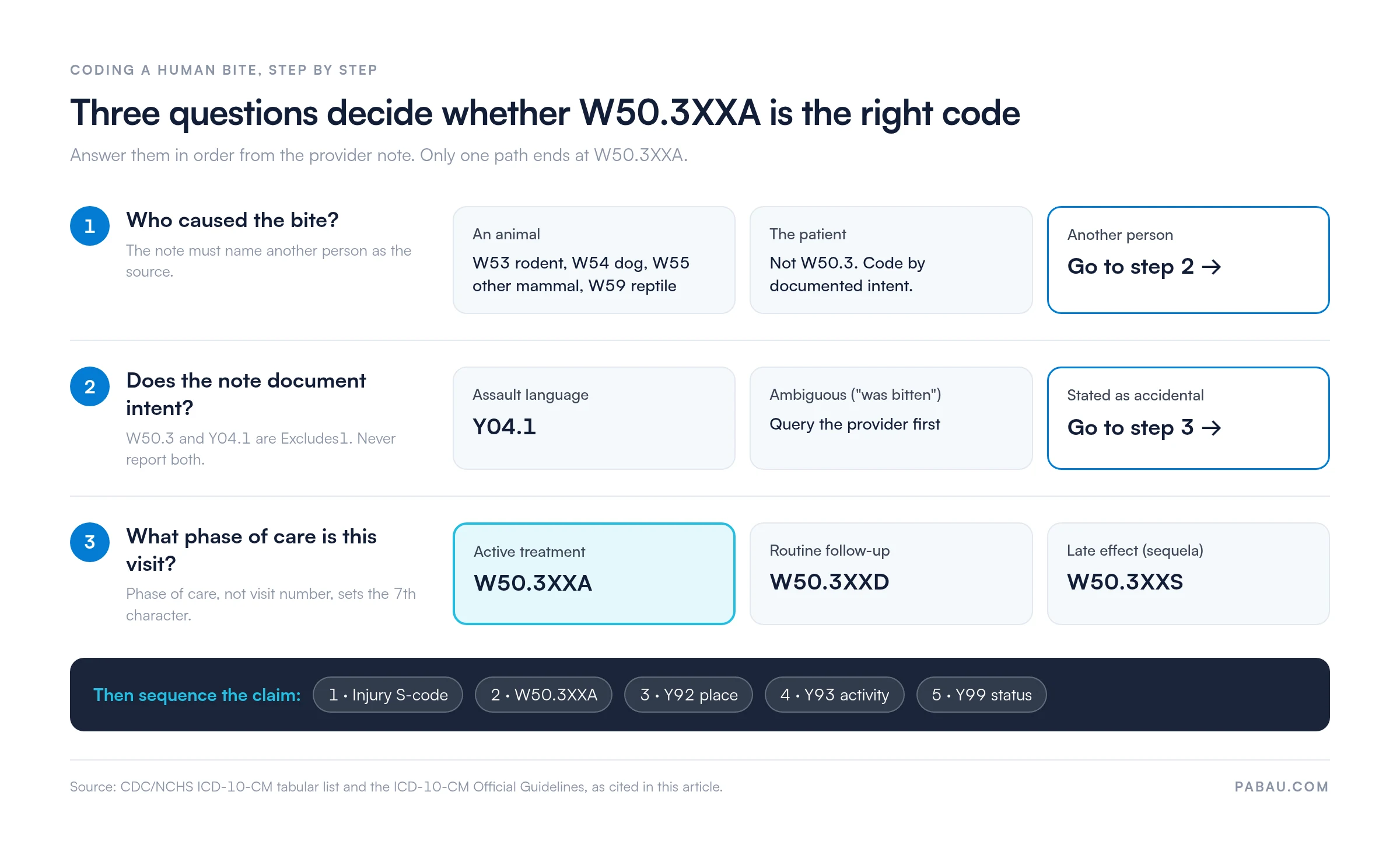
W50.3XXA is an external cause code. It cannot stand alone on a claim. The AAPC ICD-10-CM coding guidelines and the ICD-10-CM Official Guidelines (Section I.C.20) both specify that external cause codes are always secondary. A grasp of medical billing fundamentals explains why companion codes are needed to establish medical necessity for the encounter.
Check each payer’s coverage policies for external cause code requirements before submitting. CMS does not require Y92, Y93, or Y99 on Medicare Part B claims, but many commercial insurers and state Medicaid programs do. A missing place of occurrence code is a common denial trigger on commercial W50.3XXA claims.
Per ICD-10-CM Official Guidelines Section I.C.20.a, external cause codes are never the principal (first-listed) diagnosis. W50.3XXA belongs in a secondary position on every claim. Submitting a clean claim for a bite wound requires this exact ordering.
The provider note must support every element the code asserts. Auditors reviewing W50.3XXA claims look for five documentation components. Missing even one can produce a query, a denial, or a recoupment.
W50.3XXA denials are predictable. Good denial management starts with knowing which errors trigger rejections for this code, listed in the table below. Each rejection also comes back with a reason code, and decoding denial codes points you to the root cause.
The W50 category covers all accidental contact injuries caused by another person’s physical action. Knowing the sibling codes helps coders confirm they have selected W50.3XXA and not an adjacent code for a different mechanism.
CMS does not mandate external cause codes for Medicare Part B fee-for-service claims. However, several MAC jurisdictions and many state Medicaid programs do require them for accident-related encounters, including claims involving W50.3XXA.
Review the applicable Local Coverage Determinations (LCDs) and state Medicaid billing manuals before assuming external cause codes are optional. Good medical billing compliance includes documenting this payer-level check in your coding policy.
A bite-wound claim usually passes through several hands. The provider writes the note, a coder assigns the S-code and W50.3XXA, and someone keys the claim into a clearinghouse portal. Each handoff is another chance to drop the Y92 code or flip the sequence.
Pabau, the practice management platform we build, raises the claim from the invoice your team already creates at checkout. Pabau integrates with Claim.MD for electronic claims submission, sending CMS-1500 claims to thousands of US payers. Its built-in claims management also runs real-time eligibility checks, tracks each claim’s status, and posts ERA remittances back to the invoice.
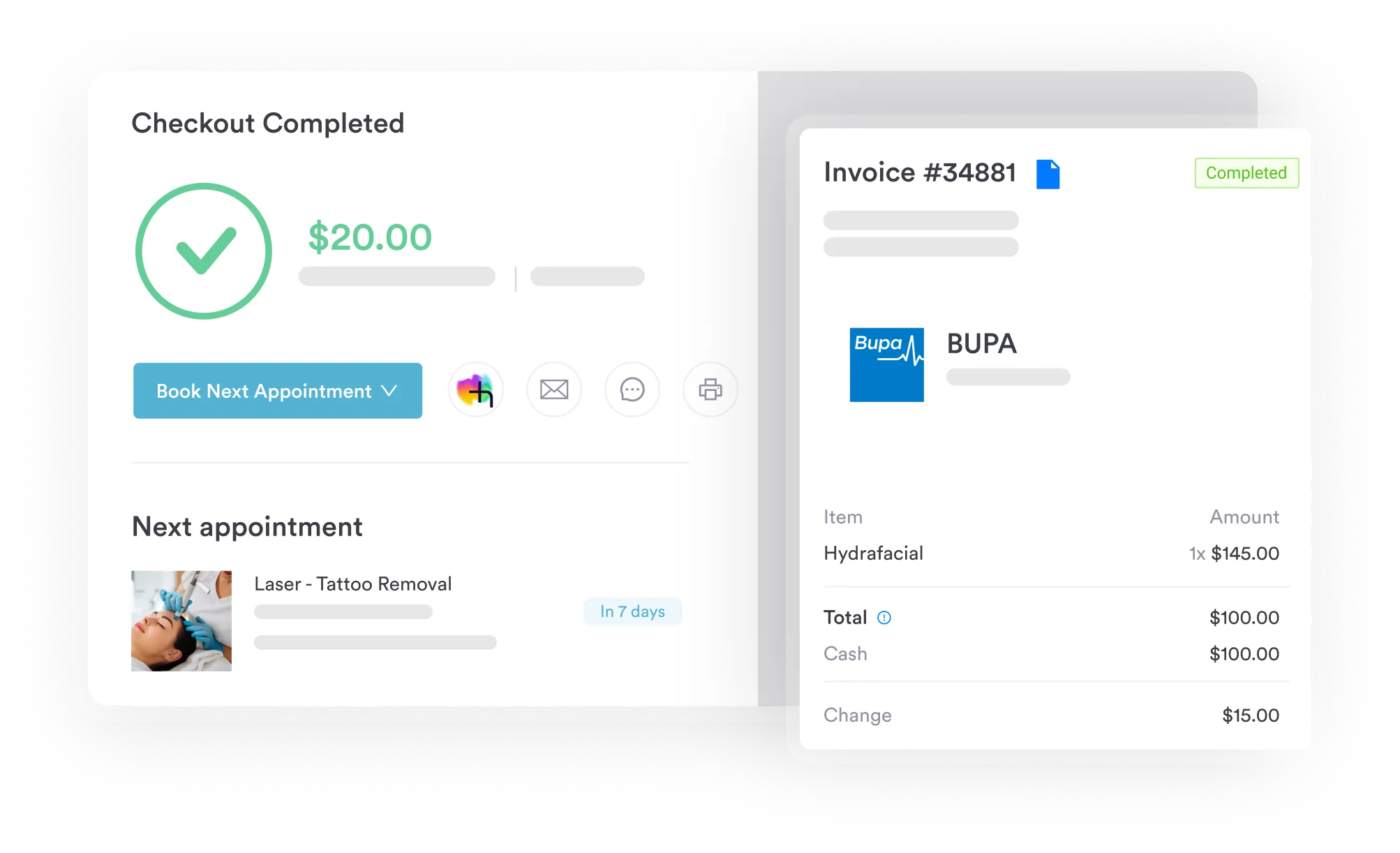
The result is fewer avoidable rejections on external cause claims. Coverage problems surface before the patient leaves. A denied claim shows its status in Pabau’s claims dashboard, so your team can correct and resubmit it.

Pabau integrates with Claim.MD for electronic claims submission, with real-time eligibility checks, claim status tracking, and ERA remittances. See how practices keep bite-wound claims moving from invoice to payment.

W50.3XXA rarely causes trouble on its own. Claims fail when it lands in the first position, or when the note never says the bite was accidental. Fix those two habits first, then add the Y92, Y93, and Y99 codes your payers ask for.
If your notes still read only “patient was bitten,” start with the provider query. A one-line amendment settles the accident-or-assault question before the claim is built, and it protects the record if the case is ever reviewed.
Book a demo to see how Pabau carries a bite-wound claim from the checkout invoice to electronic submission through Claim.MD.

Need to understand how clearinghouse submissions work? Medical claims clearinghouse guide explains how 837P electronic claims route through payers and where external cause codes sit in the transmission.
Tracking denials across your coding team? Denial codes in medical billing maps CARC codes to the root causes that generate them, including sequencing errors common on external cause code claims.
Submitting claims electronically for the first time? 837 file guide covers the electronic claim format, segment structure, and how diagnosis codes are sequenced in the 2300 loop.
ICD-10 Code W50.3XXA is the billable ICD-10-CM external cause code for an accidental bite by another person, initial encounter. It sits in Chapter 20 (External Causes of Morbidity). It is always reported as a secondary code alongside an injury S-code that identifies the wound itself.
Yes, W50.3XXA is a billable ICD-10-CM code, valid in the current FY2027 code set, per the ICD-10-CM tabular list. It requires a companion injury S-code as the principal diagnosis before it will process correctly on a claim.
W50.3XXA (seventh character A) is used when the patient is receiving active treatment for the bite wound: wound cleaning, suturing, antibiotic initiation, or tetanus prophylaxis. W50.3XXD (seventh character D) applies at follow-up visits where treatment is routine or rehabilitative, such as a wound check or suture removal. The A/D distinction reflects phase of care, not visit number.
W50.3XXA covers accidental (unintentional) bites; Y04.1 covers assault by human bite (intentional aggression). The two codes share an Excludes1 relationship, meaning they cannot be reported together for the same encounter. The determining factor is provider documentation: language indicating intent routes to Y04.1; language indicating accident or unintentional contact routes to W50.3XXA.
A bite wound S-code is required as the principal diagnosis. Y92 (place of occurrence), Y93 (activity code), and Y99 (external cause status) are recommended and may be required by commercial payers or state Medicaid programs. CMS does not mandate external cause companion codes for Medicare Part B, but many MACs and commercial insurers do.
The most common denial cause is sequencing error: W50.3XXA listed as the principal diagnosis rather than a secondary code. Other frequent triggers include a missing injury S-code or a missing Y92 place of occurrence. So does the wrong encounter character, such as D or S when A is correct. A provider note that suggests intent while the code says accidental also leads to denials.