ICD-10 Code T86.839: Unspecified complication of bone graft
ICD-10 code T86.839: Definition and code details ICD-10 code T86.839 is the bill...

Last Updated: Oct 13, 2026
Billable Code Specific Code
S27.892S is the billable ICD-10-CM code for contusion of other specified intrathoracic organs, sequela. It applies after the original contusion has healed, when the patient is treated for a residual condition caused by it.
Two errors drive most denials on this code. The first is using the sequela character when a subsequent encounter (character D) is correct. The second is failing to document the causal chain between the original injury and the current condition.
Let Pabau's smart automation suggest the right codes, reduce claim denials, and keep your practice compliant—effortlessly.
Automate repetitive tasks and focus on what matters most—your patients.
Reduce coding errors and ensure compliance with the latest regulations.
Clean claims, fewer denials, and faster reimbursements.
Powerful insights and reporting to help your practice thrive.
HIPAA compliant SOC 2 certified GDPR-compliant Trusted by 4,000+ clinics worldwide

S27.892S is a billable ICD-10-CM code for contusion of other specified intrathoracic organs, sequela – distinct from the initial (A) and subsequent (D) encounter variants.
The ‘S’ 7th character applies only when documenting a late effect of the original injury, not routine follow-up care.
Confusing S27.892S with S27.893S (laceration) or S27.899S (unspecified injury) is the most common sibling-code error for this code family.
Pabau’s claims management software integrates ICD-10 code lookup directly into the billing workflow, reducing 7th-character errors before claims are submitted.
ICD-10 Code S27.892S is the billable diagnosis code for contusion of other specified intrathoracic organs, sequela. It applies when a patient is treated for a residual condition left by an earlier blunt-force contusion of a named intrathoracic organ. The table below summarizes the reference data for the code, taken from the CDC/NCHS ICD-10-CM coding tool.
S27.892S covers blunt-force bruising, or contusion, of an intrathoracic organ that the record names but that category S27 does not code individually. The organs with codes of their own are the lung (S27.0-S27.39), the heart (S26.-), the bronchus (S27.4-), the trachea (S27.5-), and the diaphragm (S27.80-). S27.892S is the appropriate code when the contused organ is an “other specified” structure such as the thoracic duct or thymus. The encounter also has to be a sequela visit rather than active treatment.
Two conditions have to hold before this code is correct.
If the organ is specified but the injury type is laceration, use the S27.893x family. If neither the organ nor the injury type is fully specified, S27.899S (unspecified injury, sequela) is the fallback. Payers treat unspecified codes with greater scrutiny.
The 7th character in ICD-10 Code S27.892S is the most consequential coding decision – and the most common source of denials. Per CMS ICD-10-CM Official Guidelines, Section I.C.19, the three 7th characters for S27.892 are defined as follows.
The sequela character (S) is not a substitute for “D” when the visit is routine follow-up. Sequela applies only when the original contusion has resolved and the patient now has a distinct residual condition. Persistent thoracic duct lymphatic dysfunction months after blunt chest trauma is one example. Use character D for every follow-up visit during active healing.
All three codes share the same base descriptor – contusion of other specified intrathoracic organs – and differ only in encounter type. The table below provides a clinical scenario for each to help coders select the correct 7th character.
The decision comes down to one question about the chart note. The diagram below sets the three answers side by side, with the sequencing rule that follows.
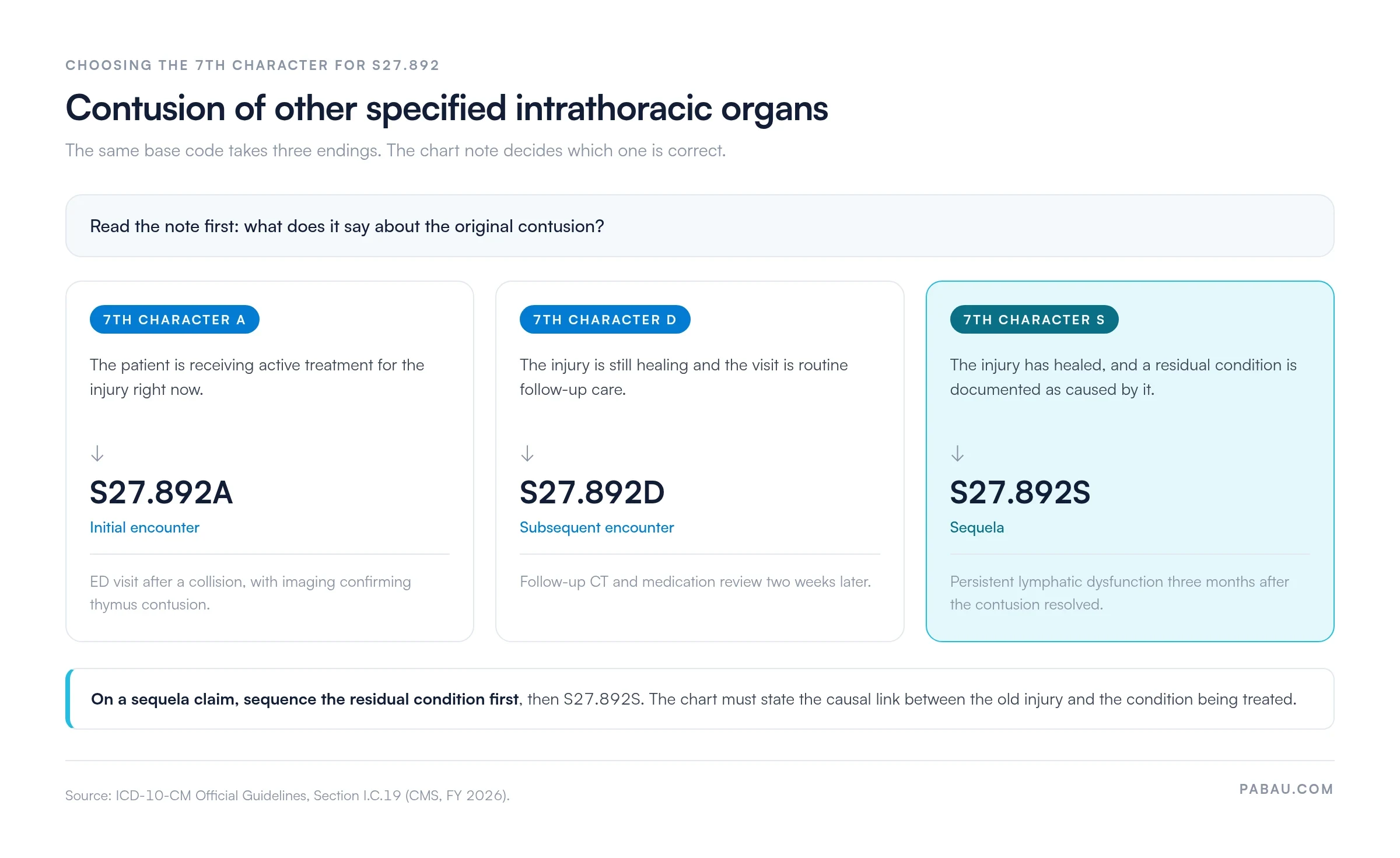
Check the clinical note for the phrase ‘history of’ or ‘resulting from prior injury’ before assigning the S suffix. If the provider is still treating the original contusion, character D is correct. Character S applies only when a distinct residual condition has emerged from an injury the chart documents as healed.
Category S27 carries Excludes2 notes that coders must check before finalizing any S27.892S claim. An Excludes2 note means the excluded condition is not part of this code, but it may be coded separately when clinically appropriate. The notes at S27 exclude injury of the cervical esophagus and injury of the cervical trachea, both of which belong in S10-S19.
Category S27 also carries a code-also instruction. Report any associated open wound of thorax (S21.-) alongside the injury code.
For the sequela variant specifically, the ICD-10-CM Official Guidelines require an additional code naming the nature of the sequela. Section I.C.19.a sets the order the claim has to follow.
Four codes in the S27.8xx family are routinely confused with S27.892S. Substituting the unspecified S27.899S for the specified S27.892S is the costliest of those errors. Payers expect the most specific code available when the record supports it, so the claim draws a medical necessity challenge.
Chest trauma rarely arrives on its own, so read the whole S27 block before settling on S27.892S. The ICD-10-CM code library lists every S27 subcategory with its 7th-character variants.
Payers running legacy ICD-9-CM reports and researchers using older Medicare claims data reach the approximate equivalent through the CMS General Equivalence Mappings (GEM). The approximate ICD-9-CM predecessor sits in the 862.xx range, injury to other specified intrathoracic organs. That mapping is one-to-many, and ICD-9 had no equivalent of the sequela concept.
Two caveats apply when using this crosswalk for medical billing workflows that span the ICD-9 to ICD-10 transition period.
Supporting documentation must establish a clear causal chain between the original contusion and the condition being treated now. Under Section I.C.19.a of the guidelines, sequela coding requires the provider to link the current condition to the prior injury explicitly. A visit note that records the current condition without referencing the earlier injury will not support S27.892S.
A complete record for an S27.892S claim should contain each of the following elements. A clean claim submission depends on having them in the chart before the claim leaves the practice.
Medicare publishes no Local Coverage Determination aimed at S27.892S on its own. Sequela claims for thoracic injuries are reviewed under general medical necessity standards instead.
The diagnosis must appear on the claim alongside the code for the residual condition. The services billed must treat that residual condition, not the original injury. Using claims software for practices that validates diagnosis-to-procedure pairing flags these mismatches before the payer sees them.

For commercial payers, three scenarios commonly trigger prior authorization requirements when S27.892S appears on the claim.
Sequela codes for thoracic injuries generate a predictable set of denials. Building the documentation workflow around those patterns is the most practical way to reduce rework. Effective denial management workflows for S27.892S claims address each of the root causes below.
Build a denial tracking log for S27.892S claims. Record the denial reason code (CARC), the 7th character used, and whether the residual condition code was on the claim. Read the log monthly: if the same CARC keeps returning, the cause is usually thin provider documentation rather than coder judgment.
A 7th-character error usually surfaces on the remittance advice. The coder assigns S27.892S, the claim goes out without the residual condition code, and the denial lands weeks later. By then the encounter is cold, and the provider query takes longer than it would have on the day.
Pabau, the practice management platform we build, keeps ICD-10 lookup inside the billing screen where the claim is assembled. Coders see the 7th-character options for S27.892 as they work. The sequela code and the residual condition are paired before the claim leaves the practice.
Claims then go out electronically through the Claim.MD clearinghouse, which runs edits on code combinations and 7th-character validity. A missing residual condition code or an invalid character is caught there, before the payer ever sees the claim.

Pabau validates diagnosis codes, 7th-character selections, and payer rules as the claim is built. S27.892S claims leave the practice complete and accurate.

S27.892S is a straightforward code once the documentation is right. The sequela character applies only after the original contusion has resolved and a distinct residual condition remains. Routine follow-up during healing takes character D instead.
Name the organ the record identifies, document the causal link, and sequence the residual condition ahead of S27.892S. Those three habits remove most of the denials this code generates.
Pabau validates ICD-10 code pairings and 7th-character selections in the billing workflow before claims are submitted. To see how that holds up at your practice’s coding volume, book a demo.

Need a primer on how clearinghouses catch coding errors before payers do? Pabau’s Claim.MD clearinghouse guide explains how electronic claim validation works and what gets caught at the clearinghouse step.
Want to understand what makes a claim clean before it reaches the payer? Clean claim submission best practices covers the elements every diagnosis-supported claim needs to avoid front-end rejections.
Looking to reduce denial rework across your practice’s ICD-10 billing? Denial management in healthcare outlines the workflow steps that prevent the most common CARC-coded rejections.
ICD-10 Code S27.892S is the billable ICD-10-CM diagnosis code for contusion of other specified intrathoracic organs, sequela. It is assigned when a patient presents with a residual condition caused by a prior blunt-force thoracic contusion that has since resolved. The claim also carries a code for the residual condition, sequenced ahead of S27.892S.
The ‘S’ 7th character denotes a sequela encounter. The patient is being treated for a late effect or residual condition caused by the original injury, rather than for the injury itself. Section I.C.19 of the ICD-10-CM Official Guidelines requires the provider to document a causal link between the two.
S27.892A is the initial encounter variant, used while the patient is receiving active treatment for the thoracic contusion. S27.892S is the sequela variant, used only after the original injury has resolved and a distinct residual condition has emerged. Assigning S while the injury is still being treated is a coding error that causes denials.
Use S27.892S when the clinical record identifies both the organ, such as the thoracic duct or thymus, and the injury mechanism as contusion. Use S27.899S only when the documentation does not clearly support the injury type. Defaulting to the unspecified code where the record supports specificity can trigger medical necessity challenges.
Yes, S27.892S is a billable, HIPAA-valid ICD-10-CM diagnosis code for FY 2026. It must be submitted with a code naming the residual condition, sequenced first on the claim. Submitting S27.892S on its own is one of the top denial triggers for this code.
Three reasons account for most of them. They are incorrect 7th character selection, missing causal linkage documentation in the provider note, and omitting the code that identifies the residual condition. Payers also deny claims where S27.899S was used although the record supported the more specific S27.892S.