ICD-10 Code S27.892S: contusion of intrathoracic organs, sequela
ICD-10 Code S27.892S: code details at a glance ICD-10 Code S27.892S is the billa...

Last Updated: Oct 13, 2026
Billable Code Specific Code
S42.444P is the billable ICD-10-CM code for nondisplaced fracture (avulsion) of medial epicondyle of right humerus, subsequent encounter for fracture with malunion.
It sits in the S42 fracture category for shoulder and upper arm injuries, and is valid for fiscal years 2025, 2026 and 2027. Coders reach for it when a patient returns for routine care during healing and the fracture has united in an abnormal position. The usual confusion is with S42.444K for nonunion, S42.444S for sequela, and S42.455P, which covers the lateral condyle rather than the medial epicondyle.
Let Pabau's smart automation suggest the right codes, reduce claim denials, and keep your practice compliant—effortlessly.
Automate repetitive tasks and focus on what matters most—your patients.
Reduce coding errors and ensure compliance with the latest regulations.
Clean claims, fewer denials, and faster reimbursements.
Powerful insights and reporting to help your practice thrive.
HIPAA compliant SOC 2 certified GDPR-compliant Trusted by 4,000+ clinics worldwide

S42.444P is billable for subsequent encounters only. Imaging or clinical assessment must confirm malunion of a nondisplaced avulsion fracture of the right medial epicondyle.
The 7th character P marks a subsequent encounter during the healing or recovery phase, with the fracture united in an abnormal position.
S42.444P covers the medial epicondyle, not the lateral condyle. A nondisplaced lateral condyle fracture of the left humerus with malunion is S42.455P, a different sub-category.
Laterality sits in the 6th character, not the 4th. The 4th character 4 marks the lower end of the humerus, while the 6th character 4 marks a nondisplaced fracture on the right.
Missing laterality, an absent malunion statement, or a mismatched CPT code are the three most frequent reasons claims carrying S42.444P are denied.
Pabau’s claims management tools help orthopedic and physical therapy practices submit clean ICD-10 claims through the Claim.MD clearinghouse integration.
ICD-10 Code S42.444P carries the official ICD-10-CM descriptor: Nondisplaced fracture (avulsion) of medial epicondyle of right humerus, subsequent encounter for fracture with malunion. It is a fully billable, specific code for use in HIPAA-covered transactions. It is valid for fiscal years 2025, 2026 and 2027, per the CMS ICD-10 codes reference.
The quick-reference table below lists the fields a coder checks before claim submission.
The tabular hierarchy adds one piece of specificity at each level, and a claim needs every one of them.
S42.444 is not itself billable. A 7th character is always required. Submitting S42.444 without the appropriate suffix will result in a claim edit or rejection at the payer level. Each neighboring entry in the diagnostic codes library carries the same 7th-character requirement.
Read the code a second way and each character position becomes one decision, with its own characteristic error.
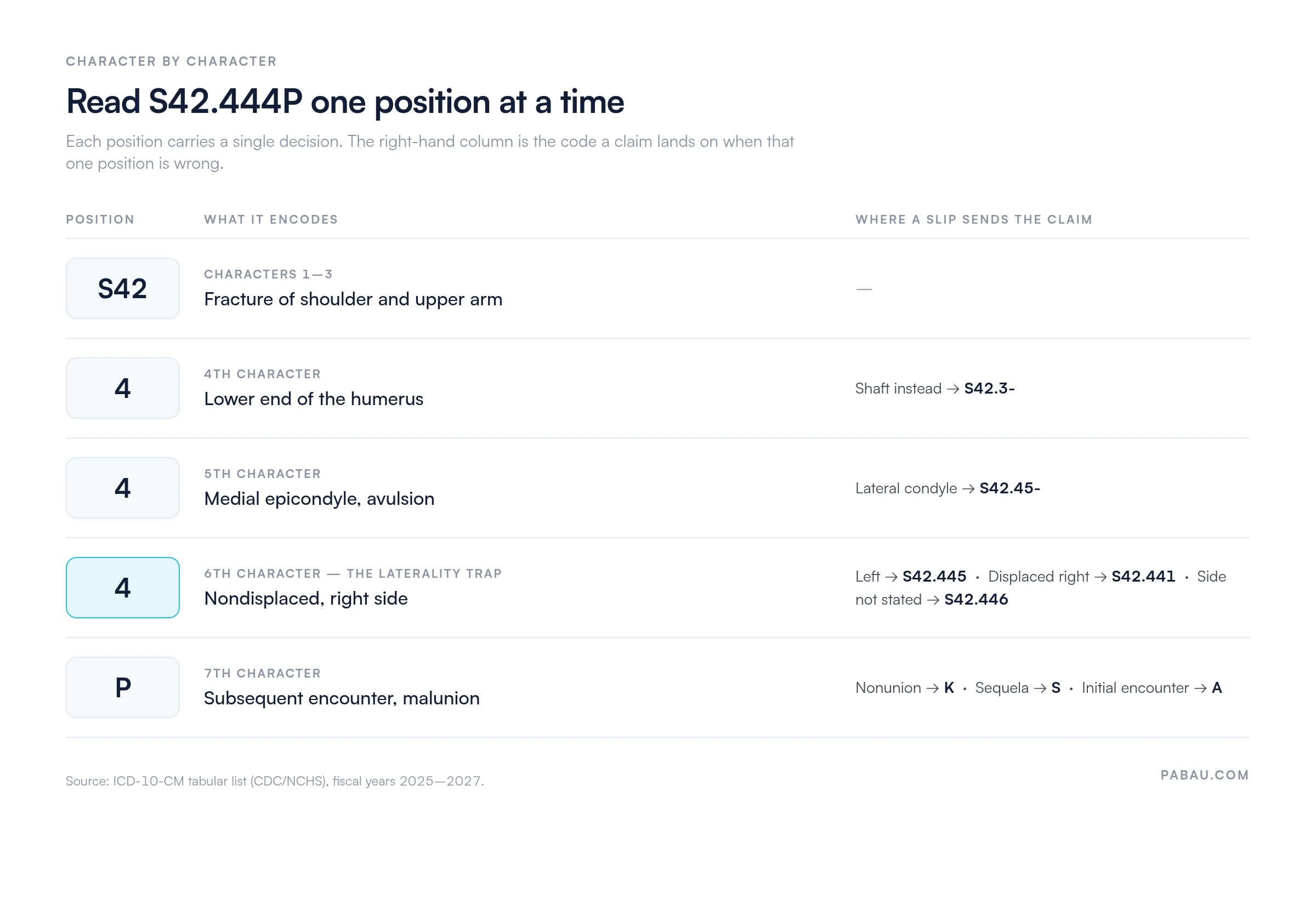
The 7th character P means the patient is presenting for a subsequent encounter, during the healing or recovery phase. The fracture has united, but in an abnormal position (malunion). This is defined in the CDC/NCHS ICD-10-CM official tabular list and in the ICD-10-CM Official Guidelines for Coding and Reporting, Section I.C.19.a.
Those guidelines reserve characters A and B for active treatment. D, G, K and P all cover routine care delivered during the healing or recovery phase.
The full set of 7th characters available for S42.444 is shown below. Each one requires different clinical findings in the documentation.
P vs K (the most common mix-up): Nonunion (K) means the fracture fragments never united. Malunion (P) means they did unite, but in a mechanically suboptimal position. Both require imaging to distinguish, and payers treat them differently for medical necessity review.
P vs S (the second most common mix-up): The S suffix covers residual conditions left once the fracture has healed. Chronic pain and limited range of motion are the usual examples. S42.444P applies earlier, while the patient is still being seen for the malunion during the healing or recovery phase.
When a patient presents for physical therapy following a humeral malunion, the P suffix is correct for the orthopedic diagnosis code. The treating therapist should document treatment goals linked to the malunion, not just functional limitations, to support medical necessity for continued PT visits. Review the orthopedic referral and imaging report before finalizing the encounter code.
A nondisplaced avulsion fracture occurs when a tendon or ligament pulls a small bone fragment away from the main bone. The fragment has not shifted significantly from its anatomical position. That distinction is what separates the S42.444 codes from the displaced codes S42.441 to S42.443.
Three elements define the anatomical site coded by S42.444P:
Claims using S42.444P face three distinct error patterns: the wrong side, the wrong bony site, and the wrong 7th character. The table below shows the codes most often confused with S42.444P and what separates them.
A coder cannot assign S42.444P unless the provider note contains all four of the following elements. Missing even one forces a query to the provider or assignment of a less specific code, which risks medical necessity denials. Solid medical billing fundamentals start with documentation that fully supports the selected code.
Medicare and most commercial payers treat subsequent encounter fracture codes with heightened scrutiny, particularly when a complication suffix like P is involved. A clean claim submission for S42.444P typically requires the following supporting documentation, though specific requirements vary by MAC and plan policy year.
The CPT code must reflect the type of service provided at the encounter where S42.444P appears. Payer edits fire when a surgical CPT is paired with a non-surgical subsequent encounter code. They fire again when an office visit code is paired with a procedure that required an operative suite. A pre-submission crosscheck of the CPT/ICD pairing inside claims management software catches the mismatch first.
CPT 24430 covers repair of a humeral nonunion or malunion without a graft, and 24435 covers the same repair with an iliac or other autograft. Applicability should be verified against the current CPT annual edition for the specific surgical technique performed. E/M codes (99213-99215) are the most common pairing for non-surgical follow-up encounters involving malunion management.
Denials on S42.444P claims cluster around three root causes. A documentation mismatch with the code’s clinical requirements is the first. The second is an ICD/CPT pairing that triggers an automated edit, and the third is a payer-level policy issue that requires appeal. Tracing each denial back to its cause is what makes denial management workflows pay off.
Run a quarterly audit on all claims carrying P-suffix fracture codes, then sort the denials by reason code. Two CARC codes recur on CPT-mismatch denials. CO-4 covers a procedure inconsistent with the modifier, and CO-11 covers a diagnosis inconsistent with the procedure. Correcting those patterns in the documentation saves more time per quarter than appealing claims one at a time.
A laterality or suffix error usually surfaces weeks after the claim went out. The payer rejects it and a biller reopens the chart. Only then does anyone work out which of the six S42.44 codes the note supported.
Pabau, the practice management platform we build, keeps the clinical note, the diagnosis code, and the claim in one record. Coders select S42.444P against the imaging and the note that support it. Pabau’s Claim.MD integration then submits the claim electronically and runs a real-time eligibility check before it reaches the payer.
Claim statuses come back from the payer, and denied claims are flagged in the claims dashboard. A recurring laterality error on fracture claims then reads as a pattern worth fixing in the documentation.

Pabau integrates with Claim.MD for electronic claim submission and real-time eligibility checks. Claim statuses and remittances come back into one dashboard, so your team spends less time chasing payers.

S42.444P is a precise, billable code that rewards coders who know its three pressure points. The malunion has to be documented explicitly, the side has to be right, and the CPT code has to match a subsequent-encounter service. One trap sits upstream of all three. The code covers the medial epicondyle, so a lateral condyle fracture belongs in S42.45 instead. Get all four right and the claim moves cleanly.
Pabau’s Claim.MD integration submits those claims electronically and checks eligibility in real time before they reach the payer. Orthopedic and physical therapy practices get one place to watch the claims most likely to come back. To see how that works on a fracture caseload, book a demo.

Need to understand how clean claims reach payers? Medical claims clearinghouse guide explains how EDI transactions move from practice to payer and where fracture claim edits typically fire.
Seeing repeated denials across your ICD-10 claims? Denial codes in medical billing breaks down CARC and RARC denial reason codes so you can trace the root cause faster.
Want to understand the full revenue cycle behind fracture billing? What is revenue cycle management covers the end-to-end workflow from charge capture through payment posting.
ICD-10 Code S42.444P is the billable diagnosis code for a nondisplaced avulsion fracture of the medial epicondyle of the right humerus. It applies at a subsequent encounter where that fracture has healed with malunion. The patient is seen for routine care during the healing or recovery phase. The provider documents, or imaging confirms, that the fragment has healed in an abnormal position.
No. S42.444P sits in sub-category S42.44, fracture (avulsion) of the medial epicondyle of the humerus. Fracture of the lateral condyle of the humerus is a separate sub-category, S42.45. A nondisplaced lateral condyle fracture of the left humerus seen at a subsequent encounter with malunion is S42.455P, not S42.444P. Check which bony prominence the imaging report names before assigning either code.
Yes, S42.444P is a fully billable, specific ICD-10-CM diagnosis code valid for use in HIPAA-covered claims transactions for fiscal years 2025, 2026 and 2027. It should be verified against the current annual code set each October, as codes can be updated, revised, or retired in annual ICD-10-CM releases.
S42.444P applies at a follow-up during the healing or recovery phase, where the fracture has united in an abnormal position. S42.444S (sequela) applies once healing is complete. It codes residual conditions, such as chronic pain or reduced range of motion, that remain after fracture care ends. Using S42.444S while the patient is still being treated for the malunion may trigger medical necessity denials.
The 7th character P designates a subsequent encounter for fracture with malunion. The patient has returned for routine care during the healing or recovery phase, and the fragments have united in an abnormal position. It differs from K (nonunion, where fragments failed to unite at all), D (subsequent with routine healing), and S (sequela, where healing is complete). Clinical or radiographic confirmation of the abnormal healing position is required to assign any P-suffix fracture code.
Four elements must be present in the provider note. It must confirm that this is a subsequent encounter, during the healing or recovery phase. It must state malunion explicitly, or reference an imaging report showing malaligned union. It must document laterality as right. Finally, it must identify the fracture as an avulsion of the medial epicondyle.
Three causes account for most denials. The first is malunion that is not explicitly documented in the provider note or imaging report. The second is a laterality error, where the chart documents the left side but the coder uses the right-side code. The third is a CPT/ICD mismatch, where a first-visit fracture care CPT code is submitted alongside a subsequent encounter diagnosis code. Missing imaging evidence to support the malunion finding is a fourth common trigger on higher-value surgical claims.
For non-surgical follow-up visits, E/M codes 99213-99215 are the most common pairing. Radiology codes 73060 (humerus, minimum 2 views), 73070 (elbow, 2 views) and 73080 (elbow, complete, minimum of 3 views) accompany imaging encounters. Physical therapy visits pair with 97110 (therapeutic exercises) or 97530 (therapeutic activities). Surgical correction uses 24430 (repair of nonunion or malunion, humerus, without graft) or 24435 (the same repair with an iliac or other autograft).
No. S42.444P is strictly a subsequent encounter code. A newly diagnosed fracture seen at the initial encounter for active treatment uses S42.444A. The P suffix requires that malunion be present and documented. That cannot happen at an initial encounter, because malunion develops over the course of healing. Using S42.444P on an initial encounter claim will result in a code-logic denial.