ICD-10 Code T32.95: Corrosions involving 90% or more of body surface
ICD-10 Code T32.95: Definition and official classification ICD-10 Code T32.95 is...

Last Updated: Oct 19, 2026
Billable Code Specific Code
T32.21 is the billable ICD-10-CM code for corrosions involving 20-29% of body surface with 10-19% third degree corrosion. It records the extent of a chemical injury, such as an acid or alkali burn, across the whole body.
T32.21 is a complete five-character code with no 7th character. It is the primary code only when the corrosion site is unspecified. Otherwise it follows the T54 toxic effect code and the site-specific T21-T25 corrosion codes.
Let Pabau's smart automation suggest the right codes, reduce claim denials, and keep your practice compliant—effortlessly.
Automate repetitive tasks and focus on what matters most—your patients.
Reduce coding errors and ensure compliance with the latest regulations.
Clean claims, fewer denials, and faster reimbursements.
Powerful insights and reporting to help your practice thrive.
HIPAA compliant SOC 2 certified GDPR-compliant Trusted by 4,000+ clinics worldwide

T32.21 describes corrosions covering 20-29% of total body surface area (TBSA), with 10-19% of the body surface at third-degree depth.
T32.21 is a complete five-character code, with no 7th character, placeholder X or episode-of-care extension.
When the corrosion site is documented, T32.21 is an additional code behind a T54 toxic effect code and the site-specific T21-T25 corrosion codes.
Pabau, the practice management platform we build, checks each claim for missing or invalid details before it reaches Claim.MD.
ICD-10 Code T32.21 is the billable ICD-10-CM code for corrosions involving 20-29% of body surface with 10-19% third degree corrosion. It has been valid since FY2016 and sits in Chapter 19 under category T32, corrosions classified by extent of body surface involved.
T32.21 records how much of the body a chemical injury covers. Where the note names the injured sites, it is an additional code behind the T54 toxic effect code and the site-specific T21-T25 corrosion codes. It belongs to the ICD-10-CM code set, and the CDC/NCHS ICD-10-CM browser tool lists it with its tabular notes.
T32.21 encodes two separate percentage figures in a single code, and understanding both is essential before applying it.
The first figure (20-29%) is the total corrosion extent: the sum of all body surface areas affected by any degree of corrosion. The second figure (10-19%) is the depth qualifier: the share of body surface that carries third-degree (full-thickness) corrosion.
Both percentages must be supported by explicit physician documentation. A record that states “extensive chemical burns” without specifying percentage is not sufficient to code T32.21. The clinician’s note must independently state the TBSA involved and the depth breakdown per body region.
Accurate TBSA calculation determines whether T32.21 applies at all. Two established methods exist: the Rule of Nines for adults and the Lund-Browder chart for pediatric patients, where proportions differ substantially from adults.
The Rule of Nines divides the adult body into regions that each represent about 9% of TBSA, or a multiple of it. Coders take the TBSA percentage from the treating physician’s documentation and do not calculate it from the chart.
For pediatric patients, clinicians typically use the Lund-Browder chart. It accounts for the larger proportional surface area of the head and smaller proportional area of the legs in children. The physician’s documented TBSA figure always governs the code selection; coders do not override it.
Document the TBSA calculation method used (Rule of Nines or Lund-Browder) in the operative or admission note. An auditor can then retrace how the percentage was reached.
The T32.2 subcategory holds three codes, and all of them share the same total extent band of 20-29% TBSA. The final character separates them by the share of body surface carrying third-degree depth.
The subcategory has no unspecified option. The ICD-10-CM index sends an extent with no third-degree figure to T32.20. If the chart describes full-thickness injury but gives no percentage, query the physician before accepting T32.20.
T31 covers burns classified by extent of body surface involved, and T32 covers corrosions classified the same way. The two categories share a structure, and the causative mechanism is what separates them.
A category error carries through the whole revenue cycle, so the clinical note must name a corrosive agent before T32 applies.
When documentation is ambiguous, query the physician before selecting the category. “Chemical burn” in the note points to T32; “thermal burn” or “scald” points to T31. Never assign T32 based on clinical inference when the note only says “burn.”
The T32 tabular note calls for secondary codes from Chapter 20 to show the cause of injury. Codes in the T section that already include the cause, such as T54, need no extra external cause code.
Section I.C.20 of the official guidelines sets no national mandate for Chapter 20 codes. Whether Y92, Y93 and Y99 codes are required depends on your payer or state reporting rules.
The T54 code stays on every claim for the injury, and its 7th character moves from A to D or S as care progresses. Place, activity and status codes do not repeat on subsequent or sequela claims.
T32.21 is a complete five-character code. Category T32 carries no 7th character extension, so there is no placeholder X and no A, D or S to append.
Episode of care still matters on these claims, and it lives on the companion codes. The T54 toxic effect code and each T21-T25 site code take the 7th character instead.
On a sequela claim, the late-effect condition (a contracture or scar) is listed first. The site-specific corrosion code with 7th character S follows it. T32.21 describes the acute injury and has no sequela form.
The medical record must demonstrate all three elements the code encodes: TBSA range, third-degree proportion, and corrosive causation.
Solid documentation practices are part of broader medical billing compliance standards that apply to all complex injury codes. Missing even one element exposes the claim to a documentation request or denial.
Clinical documentation improvement (CDI) queries are appropriate when the chart contains a TBSA percentage without a depth breakdown. The coder should query, not infer the missing depth.
Medicare pays for medically necessary inpatient and outpatient burn care, and T32.21 supports those claims when the documentation backs it up.
Individual MACs may publish Local Coverage Determinations (LCDs) with documentation expectations for burn-related services. Check the current LCDs for your jurisdiction before submitting, since they are revised over time.
As a principal inpatient diagnosis, T32.21 groups to the extensive-burn MS-DRGs 927 and 933. The split depends on whether a skin graft was performed.
The grouper, not the coder, settles the final DRG. Accurate secondary diagnoses and procedure codes give it the information it needs. CMS’s ICD-10 page carries the annual code files.
T32.21 denials cluster around five documentation and coding errors. Proactive denial management in healthcare for burn codes starts with a pre-submission checklist that addresses each trigger below.
Working with a clean claim framework that validates each of these elements before submission reduces the T32.21 denial rate. The AAPC ICD-10-CM code lookup confirms current code validity for T32 codes.
Run a monthly audit of T32.21 denials filtered by denial reason code, and group them into the five categories above. When one reason accounts for more than 40% of rejections, a CDI query template aimed at that reason fixes it at the source.
A 38-year-old industrial worker is admitted after a caustic lye (sodium hydroxide) splash during a chemical processing incident.
The physician documents 23% TBSA corrosion, with 12% third-degree corrosion across the anterior chest wall and right upper arm. The admission is active treatment, and the finished code order looks like this.
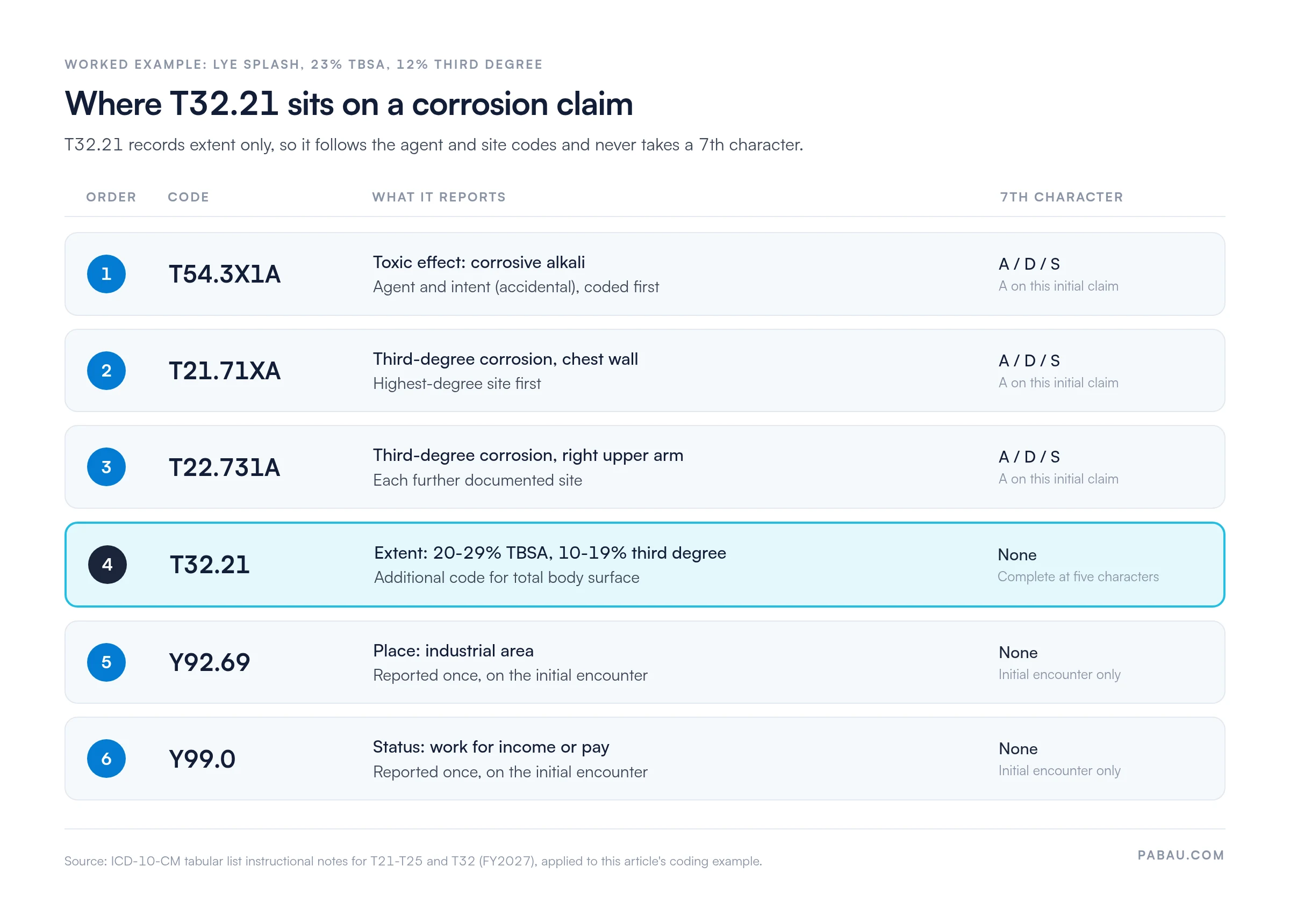
The first-listed code on this claim is T54.3X1A, and T32.21 follows the site codes as the extent code. Each element traces back to the physician’s admission note.
Every denial above comes from an error a coder can catch before submission. The usual culprits are a 7th character bolted onto T32.21, a missing T54 code, or a stale A on a follow-up visit. Catching them by hand means re-reading every burn claim line by line.
Pabau’s claims software for coders builds each CMS-1500 claim from the invoice your team already raised. Claim validation then checks it for missing or invalid details before it leaves Pabau.
US practices submit through Claim.MD, Pabau’s clearinghouse partner, to thousands of payers. Eligibility checks run before the visit, and claim statuses and ERA remittances come back into Pabau. Your billing team sees a denied corrosion claim, and the reason, without logging into a separate portal.
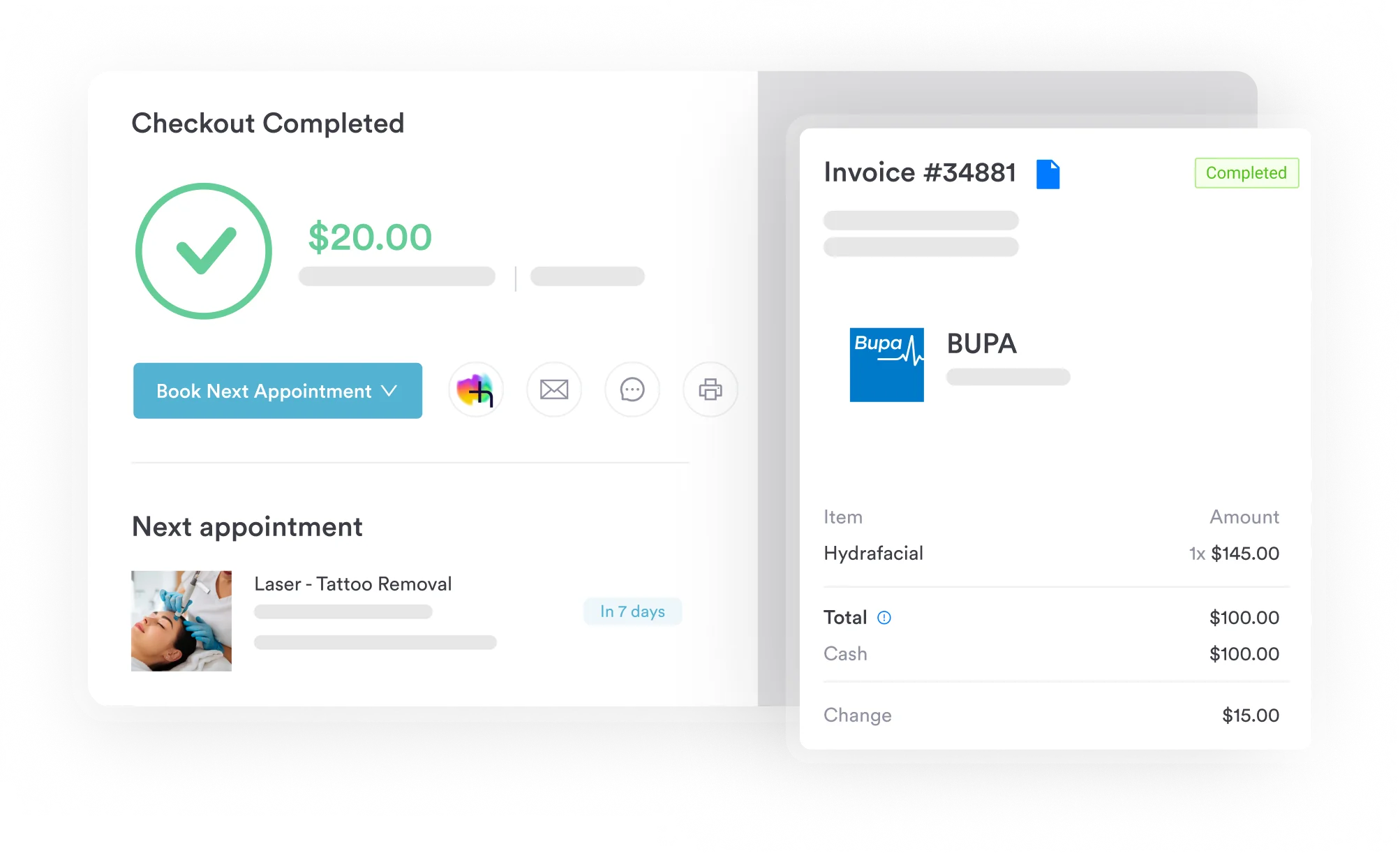

Pabau checks each T32.21 claim for missing or invalid details before it goes to Claim.MD. It then tracks denials by claim so your billing team can act fast.

T32.21 is a narrow code with a narrow job. It reports how much of the body a chemical injury covers. The T54 and T21-T25 codes carry the agent, the sites and the episode of care. Treat it as an extent code and the invalid 7th-character and sequencing errors behind these denials stop.
Before you code, confirm the physician documented both percentages and named the corrosive agent. If either is missing, query first, because the T32.2 subcategory has no unspecified code to fall back on.
Validated electronic claims catch what slips past that check before a payer sees it. Book a demo to see how Pabau checks corrosion and burn claims before they reach Claim.MD.

Submitting electronic claims for the first time? Understanding the 837 EDI file explains how electronic claim transactions are structured and transmitted.
Looking for guidance on building cleaner claim submissions? What is medical billing covers the end-to-end billing workflow and where T32 codes fit within it.
Coding a heat burn of the same extent? ICD-10 Code T31.20 covers thermal burns of 20-29% of body surface with 0-9% third degree.
Has the corrosion spread past 30% of the body? ICD-10 Code T32.32 covers corrosions of 30-39% of body surface with 20-29% third degree.
ICD-10 Code T32.21 is a billable ICD-10-CM diagnosis code for corrosions involving 20-29% of body surface, with 10-19% of body surface at third-degree depth. It belongs to category T32, corrosions classified by extent. It is reported as five characters, with no 7th character.
Yes, T32.21 is a valid billable ICD-10-CM code, and it is submitted exactly as written. Category T32 has no 7th character, so forms such as T32.2XXA or T32.21A are invalid.
Both codes describe corrosions involving 20-29% TBSA, and they differ on the third-degree share. T32.20 covers 0-9% of body surface at third-degree depth, and T32.21 covers 10-19%. A third-degree share of 20-29% moves the claim to T32.22.
The required companion is a T54.x (Toxic effect of corrosive substances) code, which identifies the corrosive substance and the intent. Some payers and states also want place (Y92.x), activity (Y93.x) and status (Y99.x) codes on the initial encounter. A missing agent code is a common denial trigger for T32.21 claims.
No. T32.21 describes the acute injury and has no sequela form. Late effects such as contractures or scars take the site-specific T21-T25 corrosion code with an S in the 7th position. List the late-effect condition first, then that sequela code.
As a principal diagnosis, T32.21 groups to the extensive-burn MS-DRGs 927 and 933, split by whether a skin graft was performed. The grouper settles the final DRG from the complete code set. Secondary diagnoses and procedure codes therefore matter as much as the corrosion code.