ICD-10 Code S52.101P: Right radius fracture with malunion
ICD-10 Code S52.101P: definition and code details ICD-10 Code S52.101P is a bill...

Last Updated: Oct 19, 2026
Billable Code Specific Code
T32.32 is the billable ICD-10-CM code for corrosions involving 30-39% of body surface with 20-29% third degree corrosion.
The two digits after the decimal do separate jobs. The first records the total body surface area affected. The second records how much of that total is third degree. Reading them the wrong way round produces a code that does not match the chart.
The code is used in the United States for Medicare, Medicaid, and commercial insurance claims. It is not a standalone diagnosis. It supplies quantitative BSA context to a site-specific corrosion code already assigned to the claim.
Let Pabau's smart automation suggest the right codes, reduce claim denials, and keep your practice compliant—effortlessly.
Automate repetitive tasks and focus on what matters most—your patients.
Reduce coding errors and ensure compliance with the latest regulations.
Clean claims, fewer denials, and faster reimbursements.
Powerful insights and reporting to help your practice thrive.
HIPAA compliant SOC 2 certified GDPR-compliant Trusted by 4,000+ clinics worldwide

ICD-10 Code T32.32 classifies corrosions involving 30-39% of body surface area with 20-29% third-degree corrosion involvement.
T32.32 is a billable ICD-10-CM code valid for FY2026 claims, effective October 1, 2025 onward.
A site-specific corrosion code is sequenced first, and T32.32 follows as a secondary code quantifying BSA extent.
T32.32 is POA exempt, so an inpatient claim carries no present-on-admission indicator for it.
Practice management software like Pabau checks ICD-10 and CPT pairings before submission, so corrosion claims go out clean.
T32.32 is a valid, billable ICD-10-CM code for FY2026. The CMS ICD-10 codes page publishes annual updates confirming which codes are active. T32.32 has remained in continuous use, and no effective-date restriction blocks submission on claims dated October 1, 2025 onward.
A pairing error between the site-specific corrosion code and T32.32 is a common cause of claim rejection in burn and trauma billing. Practices catch those mismatches earlier by validating the combination in claims software for coders before the claim is sent.
The T32 category classifies corrosion injuries entirely by body surface area. The two-digit logic below is what every code in the series depends on, so it is worth reading before assigning any of them.
The decimal digits in T32 codes are not arbitrary. Each position carries a distinct meaning drawn from the ICD-10-CM tabular structure.
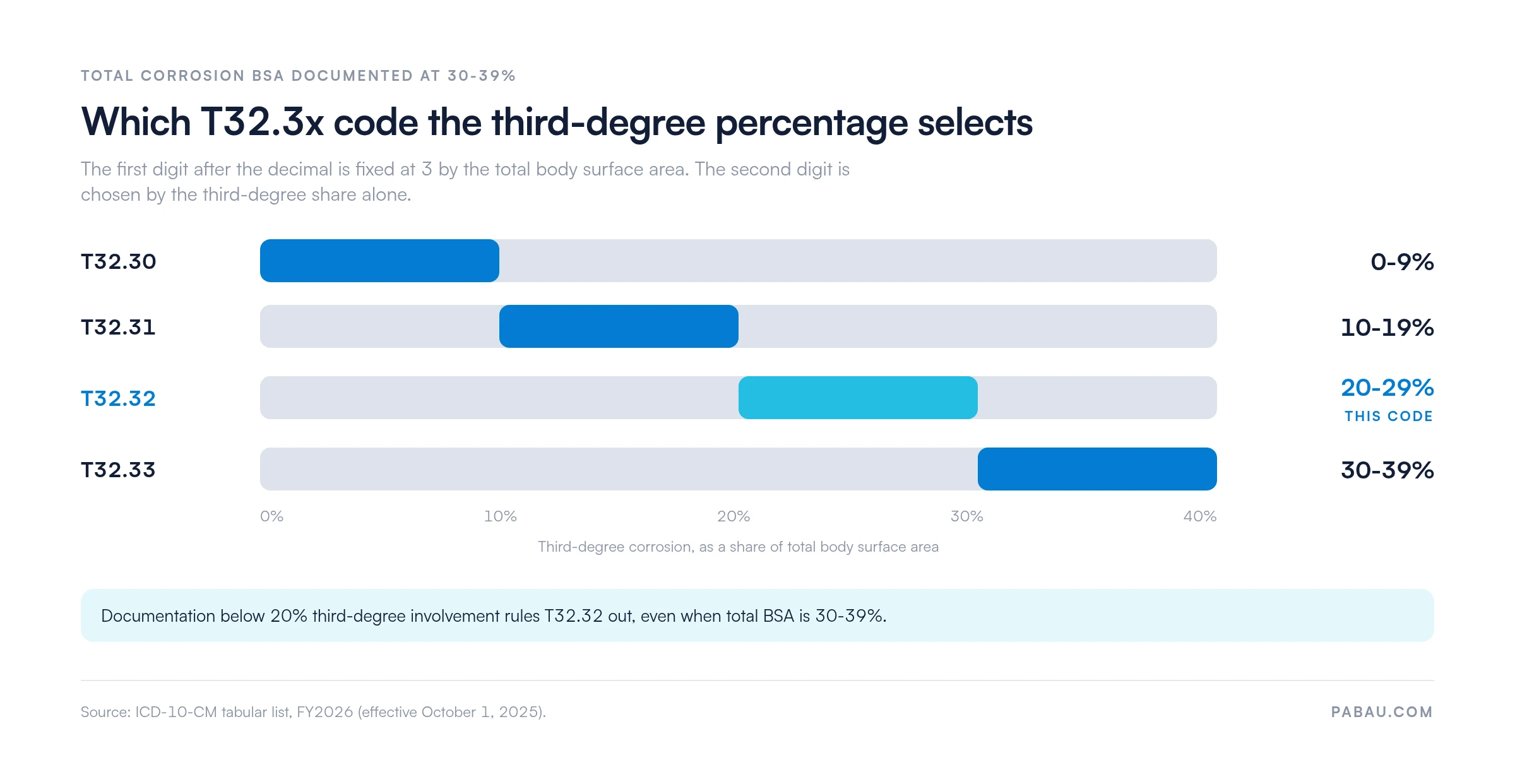
For a valid T32.32 assignment, the injury must involve 30-39% of total body surface, and 20-29% of that total must be third degree. Both conditions have to be documented. Assigning T32.32 when third-degree involvement falls under 20% is a coding error. Where 20-29% describes the total extent instead, and third-degree corrosion stays below 10%, the code is T32.20.
The same rule extends to the next band down. Where 10-19% is the documented total extent and third-degree corrosion stays under 10%, the code is T32.10.
The CDC/NCHS ICD-10-CM web tool publishes the official tabular list for verifying code descriptions and hierarchical relationships within T32.
T31 and T32 are parallel categories with an important clinical distinction. Coders who mix them up produce claims that do not match the documented etiology. The distinction matters for coding accuracy and for payer adjudication.
The ICD-10-CM Official Guidelines define corrosion as injury caused by chemical agents. Whenever the documented cause is a caustic or corrosive chemical, the T32 series applies rather than T31.
The site-specific code, such as T21.71XA for third-degree corrosion of the chest wall, establishes the anatomical location and degree. T32.32 then documents the total body surface extent.
T32.32 cannot be coded without clinical documentation supporting both BSA figures. Auditors frequently flag corrosion claims where the chart supports one percentage but not the other. Here is what must appear in the medical record to justify this code.
Third-degree corrosion destroys the full dermis and the tissue beneath it. The documented third-degree percentage for T32.32 must be 20-29%.
If documentation shows third-degree involvement below 20%, the correct code is T32.30 (0-9% third-degree) or T32.31 (10-19% third-degree). Using T32.32 in those circumstances is a coding error with audit risk.
Laid side by side, the four codes on the 30-39% row divide the same axis into four bands.
Always document both BSA percentages separately in the chart note: total corrosion BSA and third-degree BSA. A single percentage figure without specifying which it represents creates ambiguity that coders cannot resolve without a physician query, adding days to the billing cycle.
The ICD-10-CM Official Guidelines for Coding and Reporting, Section I.C.19, govern how burn and corrosion codes are assigned and sequenced. These rules decide the sequencing order and which codes may appear together on an inpatient or outpatient corrosion claim.
T32.32 is an additional (secondary) code. It is never sequenced as the principal diagnosis on its own. The sequencing order for corrosion claims is:
When multiple corrosion sites are present, the site with the highest degree of injury is sequenced first. T32.32 still follows as the BSA extent code. Coders can cross-reference current guidance and code descriptions through the AAPC Codify ICD-10-CM lookup tool.
T32.32 does not itself carry a 7th character extension. The 7th character (A = initial encounter, D = subsequent encounter, S = sequela) is appended to the site-specific corrosion code, not to T32.32. The distinction catches coders who are new to the T32 category structure.
T32.32 is POA exempt. POA exempt codes do not require a present-on-admission indicator when reported on Medicare inpatient claims. Hospitals and inpatient facilities therefore assign no Y, N, U, or W indicator to T32.32 on the claim form.
The exemption reflects what corrosion extent codes describe. The injury is present when the patient arrives, so it is never a hospital-acquired condition. Tracking POA status by claim type keeps inpatient corrosion accounts out of the denial queue.
T32.32 sits within a family of codes that coders need in order to select the right level of specificity. The table below shows the T32.3x sibling codes on the 30-39% total BSA row, plus the adjacent T32.2x and T32.4x rows for context. The ICD-10-CM code index lists the neighboring categories a burn and corrosion coder reaches for next.
Selecting between the two closest siblings hinges on the documented third-degree percentage. A figure of 10% to 19% belongs to T32.31, and 20% to 29% belongs to T32.32. Where physician documentation is ambiguous, a physician query is needed before the claim is submitted. You can confirm the wording on the AAPC code lookup for T32.32.
Corrosion injuries at the T32.32 severity level usually require inpatient or intensive outpatient management. The procedures documented alongside this diagnosis fall into three clinical groups: wound debridement, skin grafting, and dressing management.
These CPT pairings are clinically plausible for T32.32-level injuries. Each procedure still needs its own documentation of medical necessity in the patient record before it is billed alongside T32.32.
On a corrosion claim, the biller assigns the site-specific code, adds T32.32, and attaches the graft or debridement CPT codes. A mismatch between any two of those lines usually surfaces only after the payer returns the claim. That puts the account back at the start of the cycle.
Practice management software like Pabau moves that check upstream. Invoices become electronic CMS-1500 claims inside the system, and real-time eligibility checks confirm coverage before treatment. Claims then go out through Claim.MD, our US clearinghouse partner, which reaches thousands of US payers.
Payer responses come back into the same record. Claim status and electronic remittance advice tie each payment to the claim that earned it. A coder working burn and corrosion cases can see which line a payer questioned, without opening a separate portal.

Pabau’s claims management tools help medical billers submit accurate ICD-10-CM and CPT code combinations, reducing denials on complex injury claims like T32.32.

T32.32 is a precise code. Both the 30-39% total BSA and the 20-29% third-degree figure have to be documented before it is assigned. Sequencing errors, POA confusion, and BSA percentage mix-ups are the failure points that show up most often at this severity level.
The habit worth building is a small one. Read the second digit as the third-degree share, never as the total, and query the physician whenever the chart states only one percentage. Book a demo to see how Pabau checks corrosion code pairings before the claim leaves your practice.

Want the claim to pass on first submission? Submitting a clean claim sets out what payers check before they accept a claim.
Working a returned corrosion claim? Denial codes in medical billing lists the common reason codes and how to clear each one.
Need the wider billing picture? Revenue cycle management shows how coding, submission, and collection fit together in a US practice.
ICD-10 Code T32.32 is a billable ICD-10-CM diagnosis code for corrosions involving 30-39% of body surface area with 20-29% third-degree corrosion involvement. It is used as a secondary code alongside a site-specific corrosion code. It documents the total extent of a chemical burn injury on claims submitted to US payers.
Yes, T32.32 is a billable and valid ICD-10-CM code for FY2026, effective October 1, 2025. It can be submitted on Medicare, Medicaid, and commercial insurance claims when the documentation confirms both the total and third-degree BSA percentages.
T31 classifies burns by body surface area where the injury comes from a thermal source such as flame, heat, or radiation. T32 classifies corrosions by body surface area where the injury comes from a chemical agent such as an acid, alkali, or caustic substance. The etiology documented in the medical record determines which category applies.
BSA for T32 codes is typically calculated using the Rule of Nines or the Lund-Browder chart. The physician must document the total corrosion BSA percentage and the third-degree subset percentage separately in the medical record. A single combined figure does not give enough specificity for accurate T32 code assignment.
Yes, T32.32 is POA (Present on Admission) exempt, so inpatient facilities do not assign a POA indicator to this code on Medicare claims. The exemption applies because corrosion extent codes describe an injury present at the time of hospital admission rather than a hospital-acquired condition.
CPT codes commonly paired with T32.32 include wound debridement codes (16020, 16025), escharotomy (16035), split-thickness autograft codes (15100), and skin substitute graft codes (15273). Each procedure requires independent documentation of medical necessity in the patient record before it can be billed alongside T32.32.