ICD-10 code S61.201A: Open wound of left index finger without nail damage
ICD-10 code S61.201A covers a left index finger wound of unstated type ICD-10 co...

Last Updated: Oct 16, 2026
Billable Code Specific Code
T31.20 is the billable ICD-10-CM code for burns involving 20-29% of body surface with 0% to 9% third degree burns.
The T31 category classifies a burn by how much surface it covers, not by where it sits on the body. That is why the code stops at five characters and takes no encounter extension. The site-specific burn codes in T20-T25 carry those extensions instead.
Let Pabau's smart automation suggest the right codes, reduce claim denials, and keep your practice compliant—effortlessly.
Automate repetitive tasks and focus on what matters most—your patients.
Reduce coding errors and ensure compliance with the latest regulations.
Clean claims, fewer denials, and faster reimbursements.
Powerful insights and reporting to help your practice thrive.
HIPAA compliant SOC 2 certified GDPR-compliant Trusted by 4,000+ clinics worldwide

ICD-10 code T31.20 is a billable five-character code for burns covering 20-29% of total body surface area with 0% to 9% third-degree involvement
T31.20 takes no seventh character, so codes written as T31.20XA, T31.20XD or T31.20XS do not exist in ICD-10-CM
T31.20, T31.21 and T31.22 are sibling codes under the T31.2 subcategory, separated by the documented percentage of third-degree burns
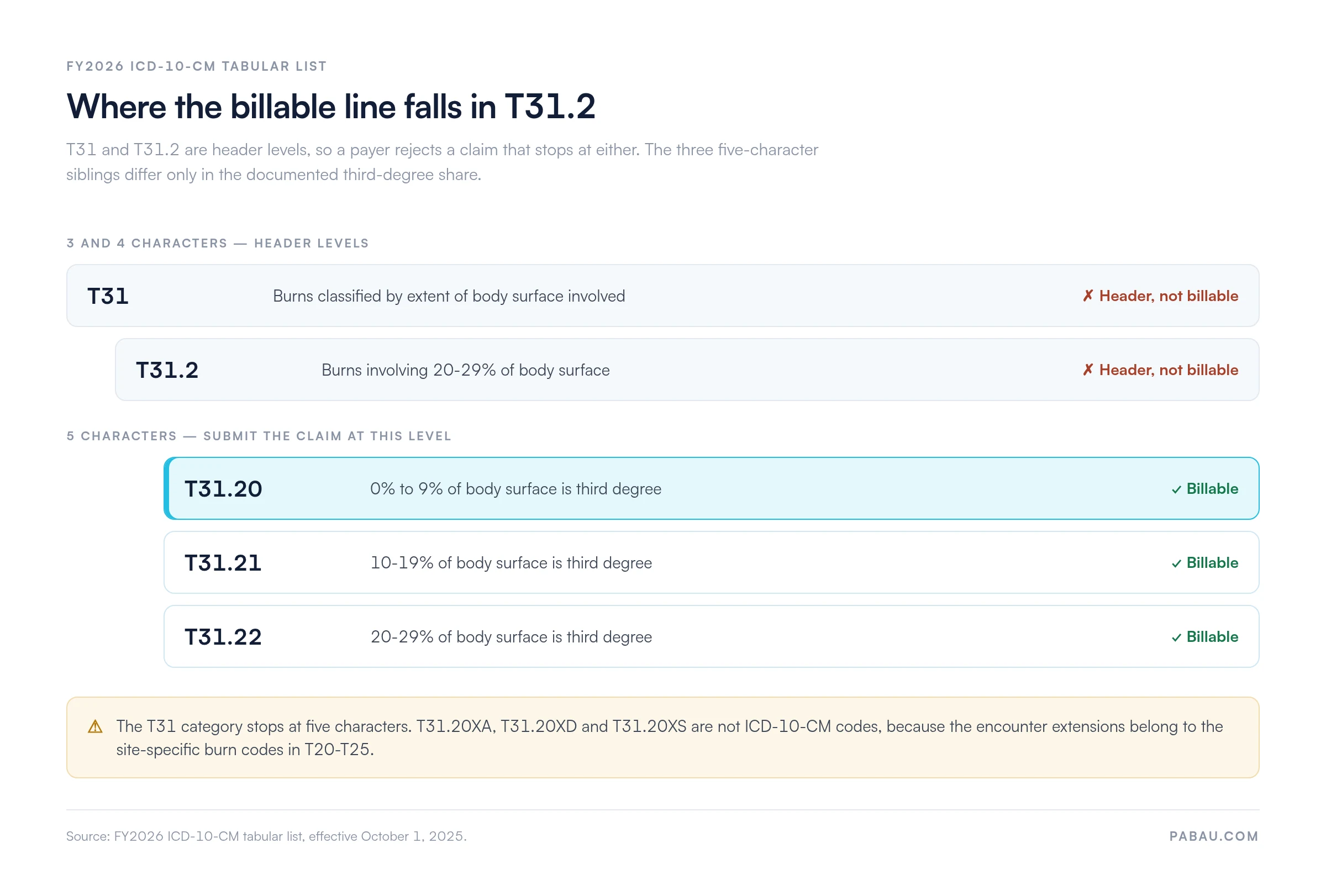
The non-billable levels are T31 and T31.2, so a claim that stops at either one gets rejected for lack of specificity
Practice management software like Pabau links burn diagnosis codes to encounter documentation, so coders catch truncated codes before claims reach the payer
T31.20 is the ICD-10-CM code for burns involving 20-29% of body surface with 0% to 9% third degree burns. It is a complete five-character code. Nothing sits beneath it in the tabular list, so it is the level a burn claim in this TBSA band is submitted at.
Where the non-billable line falls: T31 and T31.2 are header levels. T31 names the whole category, and T31.2 names the 20-29% band without stating third-degree involvement. Neither carries enough specificity for a payer. T31.20 does, because its fifth character records that third-degree burns cover 0% to 9% of the body surface.
T31.21 and T31.22 are not subcodes of T31.20. All three are five-character siblings under the T31.2 subcategory, and each one is billable on its own. The fifth character records how much of the 20-29% burn area is third degree.
No seventh character, and no placeholder X: T31.20XA, T31.20XD and T31.20XS are not ICD-10-CM codes. The initial-encounter, subsequent-encounter and sequela extensions belong to the site-specific burn codes in T20-T25, which pad to seven characters using X as a placeholder. An example is T20.20XA for a second-degree burn of the head. The T31 category records extent instead of site, and it stops at five characters.
Documentation must state what share of the 20-29% burn area is third degree. When the note gives the TBSA range but not the third-degree share, query the provider before coding. The T31.2 subcategory offers no separate unspecified option, so a query beats a guess.
T31 classifies burns by the extent of body surface involved, not by anatomical location. This is the fundamental distinction between the T31 series and the T20-T25 series, which classify burns by site (head, trunk, hand, etc.).
Clinicians use the Rule of Nines to estimate TBSA involvement at the point of assessment. The method assigns each body region a percentage in multiples of nine, as the table below shows.
The Lund-Browder chart is preferred for pediatric patients, because children’s body proportions differ from adults. An infant’s head accounts for a larger share of total surface area. Either way, the code follows the percentage the physician documents, not the tool used to estimate it.
The T31 category spans T31.0 for burns under 10% of body surface through T31.9 for 90% or more. T31.2 holds the 20-29% band, and T31.20 is the first of its three billable codes.
According to the CMS ICD-10-CM coding guidelines, T31 codes apply when the burn site is not specified. They also apply when the extent of the burn needs recording alongside the site codes in T20-T25.
Document both the TBSA percentage and the third-degree burn percentage in every burn encounter note. Without both figures stated, coders must query the provider before choosing between T31.20, T31.21 and T31.22, which adds lag to the billing cycle.
The T31 series runs from T31.0 to T31.9, and neighboring codes differ by a single character. Reading the levels in order is the quickest way to land on the right one.
The T31.2 subcategory sits between two neighbors that work the same way. T31.1 covers 10-19% of body surface and holds two billable codes, T31.10 and T31.11. T31.3 covers 30-39% and holds four, T31.30 through T31.33. The count rises with the band, because a larger burn can carry a larger third-degree share.
Within that 30-39% band, T31.31 is the code for a 10-19% third-degree share. Both of its percentages sit one band above T31.20, so the total surface and the third-degree figure have to move together.
Every T31 subcategory follows the same pattern. The first character after the decimal point gives the total body surface area burned, and the second gives the third-degree share.
T31.0 is the one exception to the pattern. A burn covering less than 10% of body surface needs no third-degree character, so the code is complete at four characters.
The ICD-10-CM Official Guidelines for Coding and Reporting, co-maintained by the CDC/NCHS and CMS, set the rules for burn code selection. The ones below decide how a T31 code is sequenced and when it is reported at all.
T31 is the primary code only when the burn site is not documented. When the record names the site, the site-specific code from T20-T25 leads and T31.20 follows as an additional code.
Burn units also rely on T31 codes as supplementary data for mortality and severity reporting. That is a second reason to record the third-degree share even when the site codes already carry the clinical detail.
Route a burn encounter through a documentation check before coding begins. If the TBSA and third-degree percentages are missing, query the provider before the claim leaves the practice. Note templates that prompt for TBSA and burn depth catch the omission at the point of care instead.
Drugs given during a burn encounter sit in a separate code set. If a wound infection is treated with injected penicillin G, that dose bills under HCPCS code J2540 while T31.20 stays on the diagnosis line.
Most T31.20 rejections come from a handful of repeated mistakes. Two of them turn on the character count, so the diagram below marks where the billable line falls.
Each mistake below is easy to catch at the point of coding, which is where a clean claim gets decided.
Check that your EHR code library has been updated to the FY2026 ICD-10-CM release before coding any burn encounter seen after October 1, 2025. One outdated code table can generate cascading rejections across every burn claim until it is corrected.
ICD-9-CM to ICD-10-CM mappings are General Equivalence Mappings (GEMs) published by CMS. They are reference guides, not certified one-to-one conversions. A single ICD-9 code may map to multiple ICD-10 codes, and the reverse also happens. Use the crosswalk as a starting point, then verify the fifth character against current clinical documentation.
The ICD-9 fifth digit and the ICD-10-CM fifth character do the same job here, so this mapping runs one to one. One difference matters. ICD-9’s 948.20 also absorbed cases where third-degree involvement was unspecified, and T31.20 states a range of 0% to 9% instead.
Legacy billing systems that still surface ICD-9 codes during payer audits or retrospective reviews can use the GEM table above as a starting reference. The WHO’s ICD-10 browser carries the international base classification from which ICD-10-CM is derived, which helps when comparing the U.S. and international versions.
ICD-10 code T31.20 is valid in the FY2026 ICD-10-CM edition, which took effect on October 1, 2025. Its description and its placement under T31.2 carried forward from FY2025 without revision.
A burn admission rarely carries one code. The encounter needs the TBSA percentage, the third-degree share, the site codes from T20-T25, and any codes for complications. All of them have to be right before the claim reaches a payer, and one wrong character sends the whole claim back.
Pabau is practice management software built for cleaner claims management, and it links clinical documentation directly to the billing workflow. Coders see the encounter record and the selected diagnosis codes side by side, so a truncated T31.2 does not ship in place of T31.20. Built-in ICD-10-CM validation flags an incomplete code before it reaches the payer.
Practices can build prompts for TBSA percentage and burn depth straight into their intake and note templates. With both fields captured at the point of care, choosing between T31.20, T31.21 and T31.22 becomes a lookup rather than a chase. Fewer chases mean fewer burn claims sitting in accounts receivable.
Claims route out through Pabau’s integration with the Claim.MD clearinghouse, which covers thousands of U.S. payers. Electronic remittance advice and real-time eligibility checks then surface a burn coding error early, before it ages into a denial queue.

Pabau connects ICD-10 diagnosis documentation directly to your billing workflow, so coders see the clinical record and the selected code side by side. Book a demo to see how it works.

One habit settles this code. Ask for both percentages in the burn note before coding, and the fifth character follows from the record rather than from a judgment call.
The trade-off is a provider query now against a rejection later. A query costs a day. A claim rejected for specificity costs the rework, and the aging sits on top of that.
Pabau’s claims management software validates ICD-10 codes inside the billing workflow, so a truncated code is caught before submission. Book a demo to see how Pabau handles a burn encounter that carries several codes at once.

Need to understand how clearinghouse submission works for burn claims? Claim.MD clearinghouse guide explains the electronic claims submission process and payer network coverage.
Want a walkthrough of clean claim requirements? Clean claim submission standards covers the documentation and coding fields payers check before accepting a claim.
Looking to understand how denial patterns affect burn coding reimbursement? Denial codes in medical billing maps the most common CARC denial reasons back to coding root causes.
T31.20 is the ICD-10-CM code for burns involving 20-29% of body surface with 0% to 9% third degree burns. It is a billable five-character code, so it can be submitted as documented. The fifth character records the third-degree share, which is what separates it from T31.21 and T31.22.
Yes. T31.20 is a billable, specific ICD-10-CM code and needs no further characters. The non-billable levels are T31, the three-character category, and T31.2, the four-character subcategory. A claim that stops at either of those is rejected for lack of specificity.
No. Those codes are not in ICD-10-CM. T31.20 takes no seventh character and no placeholder X, because the T31 category stops at five characters. The initial-encounter, subsequent-encounter and sequela extensions apply to the site-specific burn codes in T20-T25, such as T20.20XA.
All three cover burns involving 20-29% of body surface, and all three are billable. They differ only in the documented third-degree share. T31.20 is 0% to 9%, T31.21 is 10-19%, and T31.22 is 20-29%. They are siblings under T31.2, not a parent and its children.
T31 classifies burns by the extent of body surface involved, while T20-T25 classify them by anatomical site. The two sets can appear on the same claim when the physician documents both site and extent. Only the T20-T25 codes carry a seventh character for encounter type.
The record must state the total body surface area burned and the share of it that is third degree. T31.20 asserts that third-degree burns cover 0% to 9%, so it is not a fallback for a silent chart. The T31.2 subcategory has no separate unspecified option, so query the provider instead.
The FY2026 ICD-10-CM edition took effect on October 1, 2025. T31.20 carried forward from FY2025 with no change to its description or its placement. Code every burn encounter dated October 1, 2025 or later against the FY2026 code set.