ICD-10 Code Y76.0: Diagnostic obstetric and gynecological devices
ICD-10 Code Y76.0: Definition and billable status ICD-10 Code Y76.0 is a valid, ...

Last Updated: Oct 23, 2026
Billable Code Specific Code
T31.21 is the billable ICD-10-CM code for burns involving 20-29% of body surface with 10-19% third degree burns. It's valid for FY2025 through FY2027 and needs no seventh character.
The code sits in category T31, which classifies burns by extent rather than body site. To support it, the provider must document both the total body surface area (TBSA) burned and the third-degree percentage. That second figure is what separates T31.21 from T31.20, so a missing number understates the injury. Below, you'll see how the fourth and fifth characters encode total TBSA and third-degree extent. Then we walk a burn claim from the provider's note to payment.
Let Pabau's smart automation suggest the right codes, reduce claim denials, and keep your practice compliant—effortlessly.
Automate repetitive tasks and focus on what matters most—your patients.
Reduce coding errors and ensure compliance with the latest regulations.
Clean claims, fewer denials, and faster reimbursements.
Powerful insights and reporting to help your practice thrive.
HIPAA compliant SOC 2 certified GDPR-compliant Trusted by 4,000+ clinics worldwide

T31.21 covers burns of 20-29% of body surface with 10-19% third degree, while its sibling T31.20 covers 0-9%.
T31 codes are complete at five characters, while the T20-T25 site codes need a seventh character.
When the note names the burn site, the T20-T25 code leads and T31.21 follows as a supplementary code.
External cause codes are strongly encouraged under Guidelines Section I.C.20, and required where a payer or state mandates them.
Pabau’s claims management software pre-fills the claim form, offers an ICD-10-CM lookup library, and checks required claim fields before submission.
ICD-10 code T31.21 reports burns covering 20-29% of total body surface area (TBSA), with 10-19% of the body burned to third degree. It’s billable and needs no seventh character. It’s valid from FY2025 through FY2027, since the FY2027 update left it unchanged.
In practice, the code tells the payer two facts about one patient. The burn is extensive, and a large share of it is full thickness. Both facts have to come from the provider’s note.
Category T31 sorts burns by how much of the body they cover, not by where they sit. That sets it apart from the T20-T25 body-site codes. When the site is documented, add the T20-T25 code. T31.21 stands alone when the site is unspecified.
The fourth character (the digit after the decimal) represents the total TBSA range. The fifth character represents the third-degree share. So T31.21 reads as a 20-29% total burn, with 10-19% of the body full thickness. The diagram shows where that sits next to its siblings.
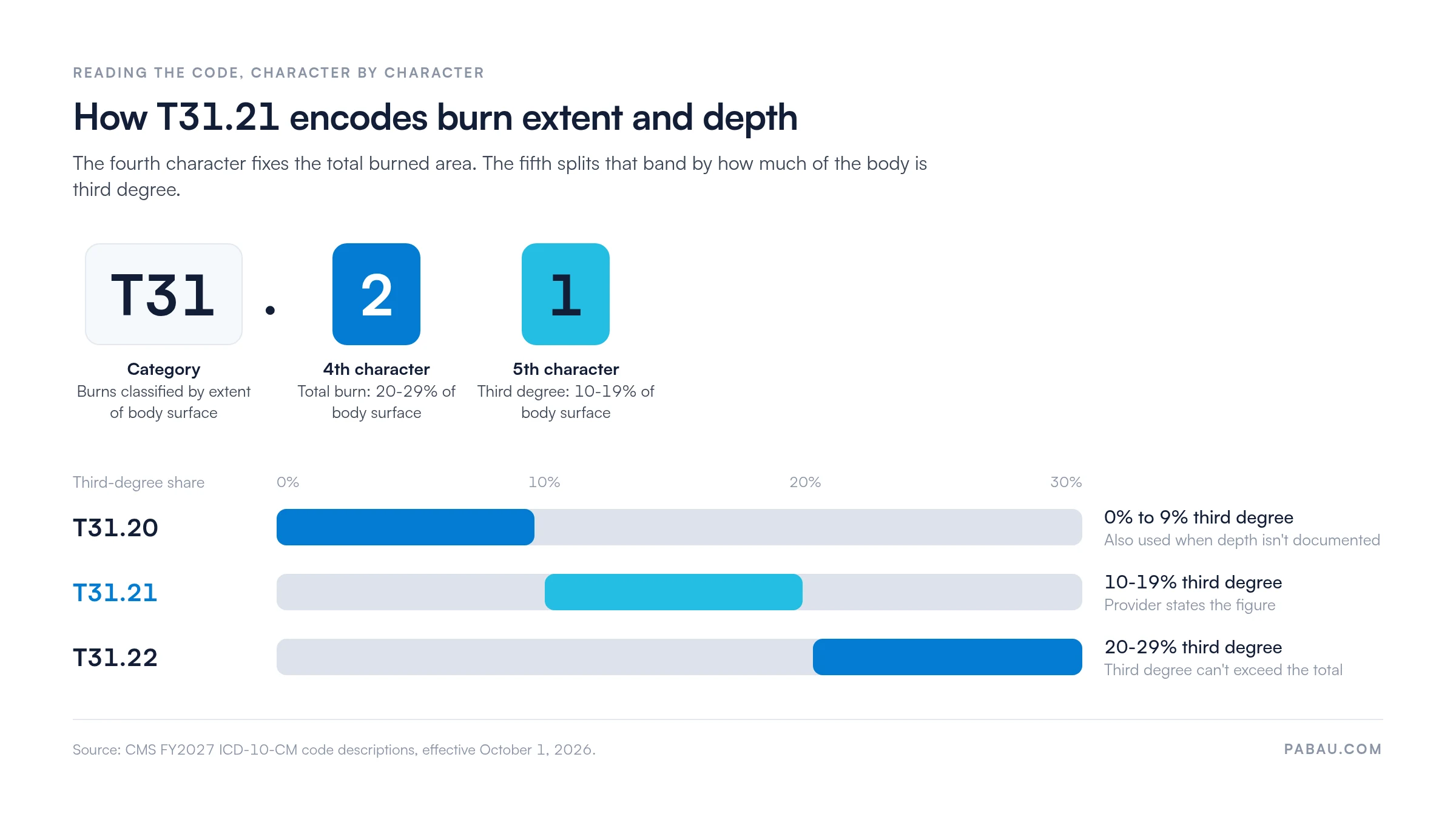
Notice the ceiling. The third-degree share can’t be larger than the total burn, so the T31.2 group stops at T31.22.
Providers estimate TBSA with the Rule of Nines, which gives each body region a fixed share. For children, the Lund-Browder chart is more precise. A child’s head is larger, and the legs smaller, relative to an adult’s.
Your job as the coder is to read these figures, not calculate them. ICD-10-CM Official Guidelines Section I.B.14 lists the details other clinicians may document, and burn extent isn’t one of them. So the provider’s own note has to state both percentages.
Say the provider writes: “Flame burns to anterior trunk and right arm, 27% TBSA. Full thickness over 12% TBSA.”
Had the note said only “27% TBSA,” you’d be choosing between T31.20 and a provider query.
T31.21 doesn’t take a seventh character, because the code is complete at five. The T20-T25 site codes work differently. They need A for the initial encounter, D for a subsequent encounter, or S for sequela.
Adding a seventh character to T31.21 creates an invalid code, and front-end claim edits typically reject it. Dropping it from a T21 or T22 code is the mirror error. Both tend to land on the same claim when the two code families get treated alike.
The tabular note at category T31 sets the rule. T31 is the primary code only when the burn site is unspecified. When the site is specified, T31 becomes a supplementary code to T20-T25.
Guidelines Section I.C.19.d.6 calls that extra T31 code advisable, partly because burn units use it to evaluate burn mortality. The site codes you’ll pair it with most often:
So a burn center transfer with documented sites keeps the same order. T31.21 is principal only when the burn site is unspecified.
External cause codes tell the payer how, where, and during what activity the burn happened. ICD-10-CM Official Guidelines Section I.C.20 governs them. There’s no national mandate to report them.
They’re strongly encouraged, and required only where a payer or state mandates them. Check both as part of your medical billing compliance requirements. Four categories can apply to a T31.21 claim:
X75-X77 cover intentional self-harm and X96-X98 cover assault. Report the place, activity and status codes once, at the initial encounter.
T31.21 covers thermal burns only. When a chemical or corrosive substance caused the injury, the T32 category applies instead. Its matching code, T32.21, uses the same TBSA and third-degree bands.
A note reading “acid burns, 22% TBSA, 12% full thickness” gets T32.21, not T31.21. Add a T51-T65 code for the chemical, and confirm the cause before you pick the category.
Coders can’t calculate TBSA. The treating provider documents it, along with burn depth. Five elements support T31.21 on a claim:
When a note gives total TBSA but no full-thickness figure, query the provider for the third-degree percentage of total body surface. It takes a minute to answer, and it settles T31.20 versus T31.21 before the claim exists.
Here’s the path a typical burn claim takes, and where each code gets settled:
If a burn claim does come back, its denial codes point to the step that needs another look.
Each of these starts in the note or the code order, so the fix sits with the coder. Strong denial management workflows catch them at the documentation stage, long before an appeal.
Fold this into your clean claim routine and burn claims stop bouncing on avoidable errors. For lookups, the AAPC’s ICD-10-CM lookup helps during coding. The CMS ICD-10 codes page publishes each year’s official files.
Most burn claim trouble starts before the claim exists, with a note that’s missing a figure. A structured superbill with fields for total TBSA and third-degree share captures both at the point of care.
Pabau, the practice management platform we build, carries that record into billing. Its claims management software pre-fills the claim from the patient record and offers an ICD-10-CM lookup library. It also validates required claim fields before the claim can be sent.
US practices submit through the Claim.MD clearinghouse, which adds eligibility checks, CMS-1500 and 837P electronic claims, and ERA/835 remittance posting. Your coders still make the coding calls, with less admin around them.
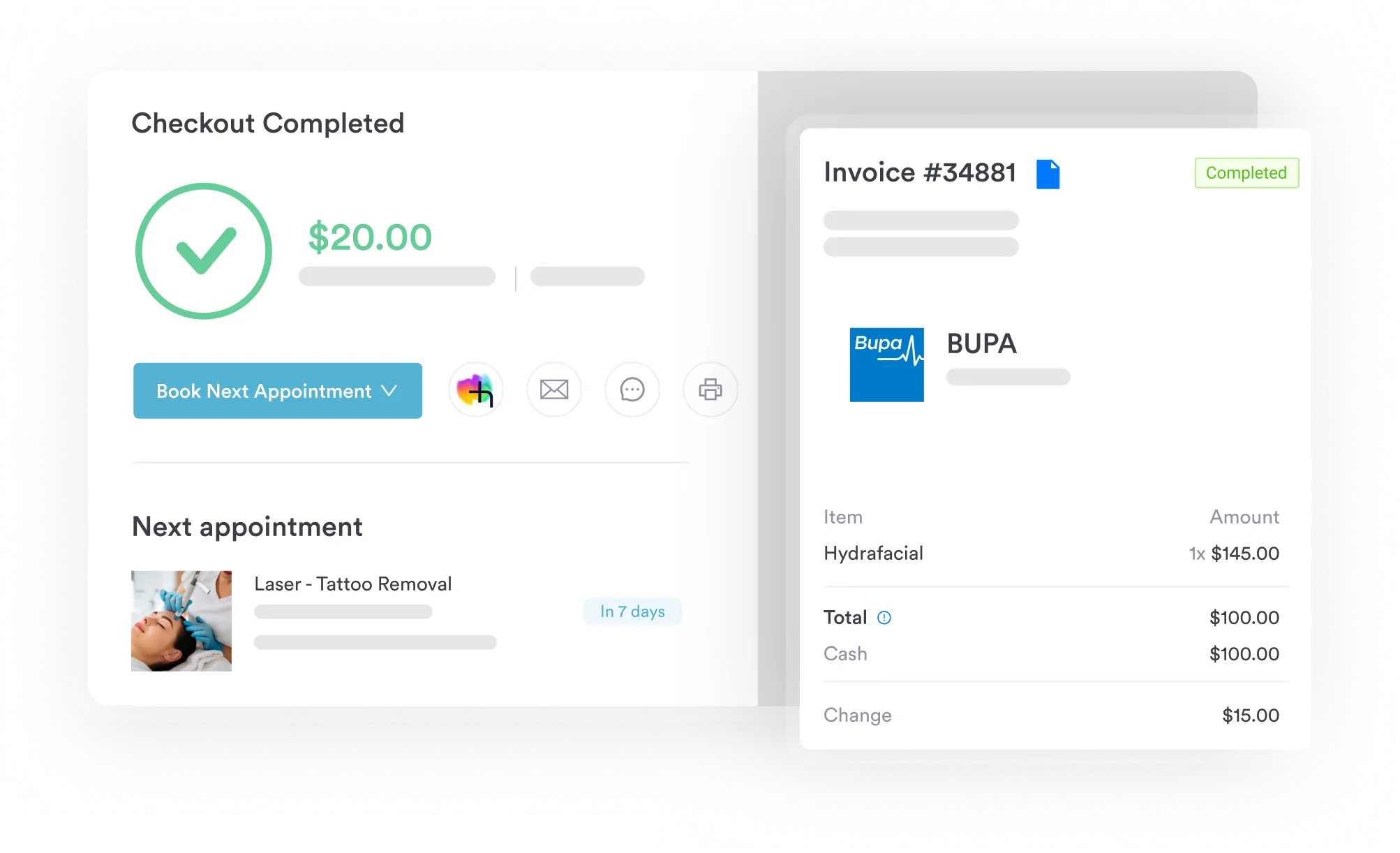

Pabau’s claims management software pre-fills the claim from the patient record, offers an ICD-10-CM lookup, validates required claim fields and submits through Claim.MD.

T31.21 rests on two numbers from the provider: total TBSA and the third-degree share. If either is missing, query before you code. Settling for T31.20 understates the injury, and correcting a claim later takes longer than the query.
The point most worth remembering is order. When a site is documented, T31.21 supports the claim rather than leading it.
Book a demo to see how Pabau pre-fills burn claims from the patient record and checks required fields before they go out.

Sending burn claims through a clearinghouse? Claim.MD clearinghouse overview explains how Pabau’s US clearinghouse partner submits claims, checks eligibility and posts remittances.
Seeing recurring rejections on injury claims? Reading electronic remittance advice correctly helps you identify CARC denial reasons and appeal burn claim rejections efficiently.
Want to understand what counts as a clean submission? Revenue cycle management fundamentals covers how each step from documentation to posting affects burn injury reimbursement.
Still filing some claims on paper? Medical insurance claim form template lays out the fields a complete claim needs before it goes to the payer.
ICD-9-CM code 948.21 is the closest match. It also describes burns of 20-29% of body surface with 10-19% third degree. ICD-9 is retired for US claims, so use it only to read older records.
Yes, on inpatient claims. T31.21 isn’t on the FY2027 POA exempt list, so it needs a Y, N, U or W indicator. The Y92, Y93 and Y99 codes that often travel with it are exempt.
No. Sunburn is coded to L55.-, which the burns and corrosions block (T20-T32) excludes. T31.21 is for burns from sources such as fire, hot objects, electricity or friction.
No. T31.21 has no seventh character, so it reads the same at every encounter. The site codes change instead, moving from A to D for subsequent care.
Use T31.22 when 20-29% of the body surface is third degree. With a total burn under 30%, that’s the highest code in the T31.2 group.