ICD-10 Code V91.84XS: Other burn due to burning watercraft
ICD-10 Code V91.84XS: overview and key facts ICD-10 Code V91.84XS identifies the...

Last Updated: Oct 30, 2026
Billable Code Specific Code
T32.30 is the billable ICD-10-CM code for corrosions involving 30-39% of body surface with 0% to 9% third degree corrosion. It records how much of the body a chemical injury covers, and how much of that area is full thickness.
T32.30 is usually reported as an additional code alongside site-specific corrosion codes from T20-T25, which record where the injury sits. Once third-degree corrosion reaches 10% of body surface, the code moves to T32.31.
Let Pabau's smart automation suggest the right codes, reduce claim denials, and keep your practice compliant—effortlessly.
Automate repetitive tasks and focus on what matters most—your patients.
Reduce coding errors and ensure compliance with the latest regulations.
Clean claims, fewer denials, and faster reimbursements.
Powerful insights and reporting to help your practice thrive.
HIPAA compliant SOC 2 certified GDPR-compliant Trusted by 4,000+ clinics worldwide

T32.30 covers chemical corrosions of 30-39% of body surface where third-degree corrosion covers 0% to 9% of body surface.
The code follows the documented third-degree band, so 10-19% third degree moves the claim to T32.31, 20-29% to T32.32, and 30-39% to T32.33.
T32.30 is a billable ICD-10-CM code, usually reported as an additional code alongside site-specific corrosion codes from T20-T25.
Seventh characters A, D, and S belong to the T20-T25 site codes, because T32.30 takes no seventh character and is not used for sequelae.
Pabau’s claims management software keeps the clinical note, the codes, and the invoice for a corrosion claim in one patient record.
ICD-10 Code T32.30 is the billable ICD-10-CM code for corrosions involving 30-39% of body surface with 0% to 9% third degree corrosion. It sits in category T32, “Corrosions classified according to extent of body surface involved.” The code set is maintained by the Centers for Medicare and Medicaid Services (CMS) and the National Center for Health Statistics (NCHS).
Corrosions are burns caused by chemicals, such as acids, alkalis, and other caustic substances. ICD-10-CM codes them under the same rules as thermal burns, with their own corrosion subcodes.
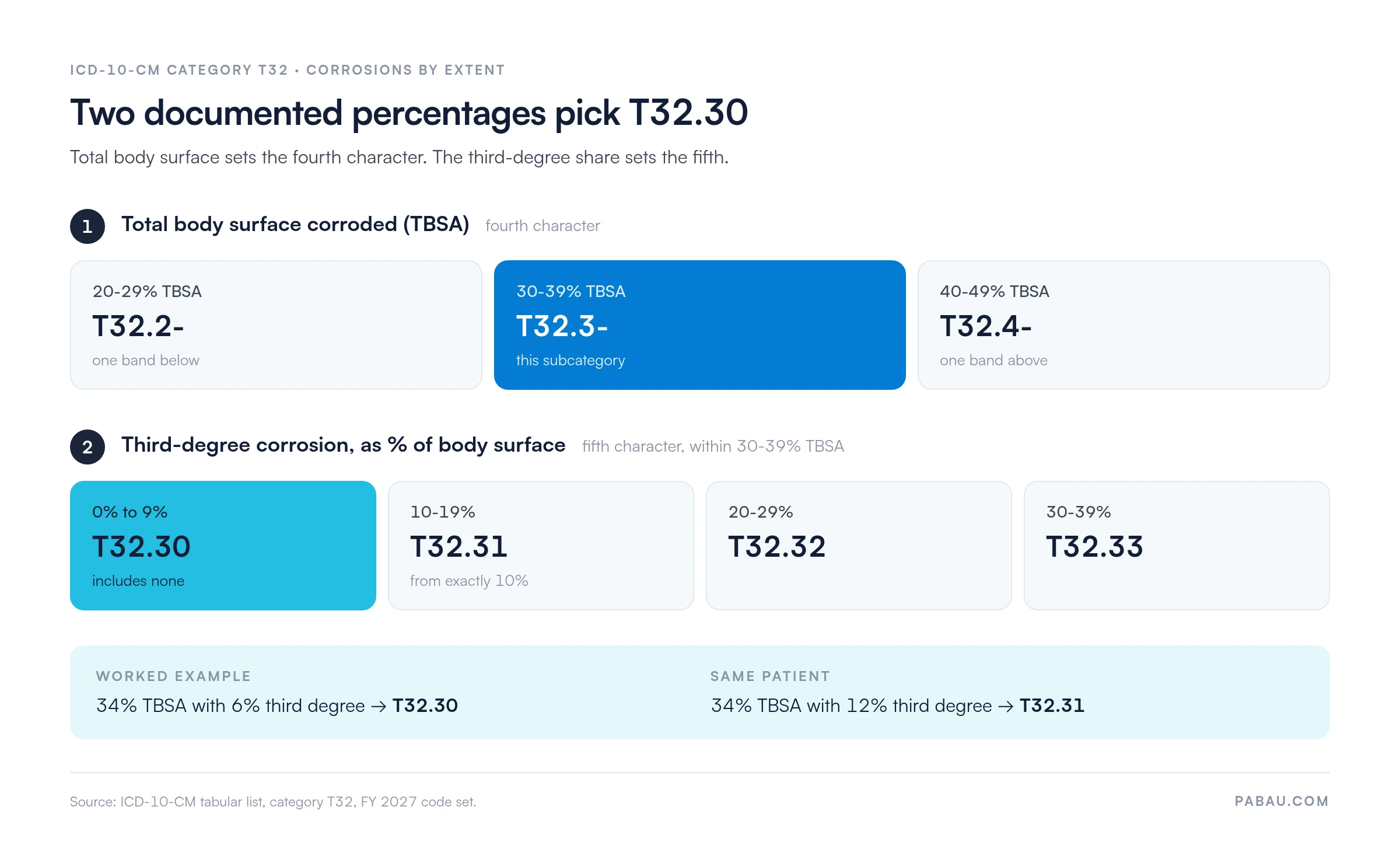
Each character after the category does one job. The fourth character “3” places the injury in the 30-39% total body surface area (TBSA) band. The fifth character “0” records that third-degree corrosion covers 0% to 9% of body surface.
A patient with corrosions over 34% of body surface, and third-degree corrosion over 6% of body surface, maps to T32.30. The same patient with third-degree corrosion over 12% maps to T32.31.
ICD-10-CM separates burns from corrosions by mechanism, but both share the same site categories. Thermal burns come from heat sources, electricity, or radiation. Corrosions are burns due to chemicals, whatever the temperature of the substance. Categories T20-T25 hold both, with separate burn and corrosion subcodes for each site.
Pairing a T31 extent code with a chemical injury mixes two classifications for one event. The extent code, the site codes, and the agent code should all describe the same chemical mechanism.
The T32.3- subcodes all cover corrosions of 30-39% TBSA. They differ only in how much of the body surface has third-degree (full-thickness) corrosion, so the coder selects by the documented third-degree band.
T32.30 is not reserved for injuries with no full-thickness damage. A note documenting third-degree corrosion over 5% of body surface still codes to T32.30. If the note gives a total TBSA but no third-degree percentage, query the clinician rather than assuming the 0% to 9% band.
Accurate TBSA documentation is the prerequisite for any T32.3- code. The ICD-10-CM Official Guidelines for Coding and Reporting (Section I.C.19.d.6) state that categories T31 and T32 are based on the classic rule of nines. Providers may adjust those percentages for infants and children, whose heads are proportionately larger.
The rule of nines assigns the head and neck 9%, each arm 9%, and each leg 18%. The anterior trunk and the posterior trunk count 18% each, and the genitalia 1%. For pediatric patients, clinicians often use a Lund-Browder chart, which adjusts head and leg proportions by age.
A corrosion covering the whole anterior trunk plus one arm equals 27% TBSA, which falls in the T32.2- band. Add part of the posterior trunk, and the total can reach the 30-39% band of T32.3-. From there, the third-degree share picks the fifth character, as the decision below shows.
When the clinician documents only “extensive burns” or “large chemical exposure” without percentages, T32.30 cannot be assigned. The coder must query the clinician before submitting.
T32.30 is an extent code. Under Section I.C.19.d.6 of the guidelines, T31 and T32 codes are assigned when the site is not specified or when additional data is needed. When sites are documented, T32.30 is reported alongside site-specific corrosion codes from T20-T25. Good medical billing workflows build this companion-code check into charge capture.
Each documented site gets its own corrosion code, because the guidelines tell coders to assign separate codes for each burn site. A patient with corrosions of the trunk (T21.-), the upper limb (T22.-), and the lower limb (T24.-) carries all three alongside T32.30.
These site codes carry the seventh character. Use “A” for active treatment, “D” for routine care during the healing phase, and “S” for sequelae such as scar contracture. T32.30 has no seventh character, and T31 and T32 codes are not used for sequelae.
The T20-T25 corrosion subcodes carry a “code first” note pointing to T51-T65. That toxic effect code identifies the chemical and the intent, such as T54.2- for corrosive acids or T54.3- for corrosive alkalis. Its sixth character records intent, from accidental to assault. The site codes also instruct an additional Y92 code for place of occurrence.
ICD-10-CM sets no national requirement to report external cause codes unless a payer or state mandates it. Where they are reported, three code types complete the picture:
Build a corrosion code check into your billing workflow. It should cover the T51-T65 agent code, T20-T25 site codes with the right seventh character, T32.30, and Y92. A missing element is a frequent cause of initial denials on corrosion claims.
Sequencing for corrosions follows ICD-10-CM Official Guideline Section I.C.19.d, which covers burns and corrosions. T31 and T32 codes serve as primary codes only when the site is not specified. When sites are documented, the site-specific corrosion codes lead and T32.30 follows as an additional code. Strong medical billing compliance processes keep these sequencing decisions documented and auditable.
Outpatient encounters follow the same companion-code logic, with the reason for the visit listed first. A wound care visit for a healing corrosion lists the site-specific code with seventh character “D,” and T32.30 can follow for extent.
The T32.20 to T32.40 range generates most boundary errors. Each total-TBSA band spans ten percentage points, and so does each third-degree band. A loosely documented figure can shift the code by a full subcategory.
The T32.30 to T32.31 boundary is the most consequential, and it turns on one point: 9% versus 10% third degree. A note reading “about 10%” leaves the fifth character open, because 10% exactly belongs to T32.31. Confirm the exact percentage before choosing “0” or “1.”
Corrosions covering 30-39% of body surface usually need inpatient care, often in a burn unit, so many payers review the admission. Pabau, the practice management platform we build, includes denial-reducing claims software. Its pre-submission documentation checks help avoid authorization delays.
Medicare has no National Coverage Determination (NCD) specific to T32.30, so local contractor policies set the documentation expectations. The TBSA and third-degree percentages belong in the admitting physician’s note, not only in nursing documentation. Medicaid rules vary by state, so check the state program’s requirements for burn admissions.
Commercial payers commonly ask for the following before authorizing an inpatient admission for T32.30:
An authorization request that lists T32.30 without its site-specific companion codes commonly draws an initial denial. That holds even when the clinical documentation supports the claim.
T32.30 denials cluster around a small set of recurring errors. Claims sent through Pabau’s Claim.MD integration pass a clearinghouse check, which catches some of these errors before the payer sees them. Understanding the denial management workflow for T32.30 helps prevent the rework that follows a rejected corrosion claim.
Reviewing medical billing denial codes for corrosion-related rejections helps coding teams identify patterns across T32.30 claims before they become systemic billing problems.
A clean claim submission for T32.30 depends on the clinical note capturing each element a coder needs. Use this checklist at the point of documentation, because missing details are harder to recover at charge entry.
Query the treating clinician before submitting any T32.30 claim where the note states only ‘extensive chemical burns’ without percentages. One query that adds the TBSA and third-degree figures can prevent the denial and the appeal that follows.
Most T32.30 errors start in the clinical note, long before a biller sees the claim. A missing third-degree figure or an unlisted site turns into a query, a resubmission, or a denial weeks later.
Pabau keeps the clinical note, the codes, and the invoice in one patient record. Billers can check the TBSA figures, the site codes, and the agent code against the note before the claim leaves the practice. Claims then go out electronically through the Claim.MD integration.

The result is fewer corrosion claims coming back for rework, and steadier payment for high-acuity burn care.

Pabau’s claims management tools help burn care teams check site codes, agent codes, and TBSA documentation before submission, so T32.30 claims go out complete. See how it works for your practice.

T32.30 turns on two numbers in the note: a total TBSA of 30-39%, and third-degree corrosion under 10% of body surface. With both on record, the choice between T32.30 and T32.31 stops being a judgment call.
The stronger habit is to capture those figures at the bedside rather than chase them at charge entry. Pabau’s revenue cycle management tools help burn care and emergency teams keep those checks inside the clinical workflow. Book a demo to see how Pabau handles corrosion and burn claims end to end.

Need to understand clearinghouse submission for T32.30 and related corrosion claims? Claim.MD clearinghouse overview covers how electronic claim routing works for complex injury codes.
Want to see how 837P claim files handle multi-code corrosion submissions? 837 file format guide explains how companion codes and external cause codes are structured in electronic transactions.
Coding corrosion injuries alongside eligibility verification? Insurance eligibility verification outlines how pre-submission eligibility checks reduce denials for high-acuity burn care claims.
Third-degree corrosion at 10% or more? ICD-10 code T32.31 covers the next third-degree band within 30-39% of body surface.
Same extent, but a thermal burn? ICD-10 code T31.30 is the burn counterpart for 30-39% of body surface.
ICD-10 Code T32.30 is the billable ICD-10-CM code for corrosions involving 30-39% of body surface with 0% to 9% third degree corrosion. It belongs to category T32, which codes corrosions by extent of body surface rather than by site. The fifth character “0” records that third-degree corrosion covers less than 10% of body surface. Verify code status against the current fiscal year ICD-10-CM tabular list, as codes can change with annual updates.
Yes, T32.30 is a billable ICD-10-CM code with enough specificity for claim submission. When the corrosion sites are documented, it is reported as an additional code alongside site-specific corrosion codes from T20-T25. It serves as a primary code only when the site is not specified. The corrosion site codes also call for a T51-T65 code, sequenced first, to identify the chemical and intent.
Burns come from heat sources, electricity, or radiation, while corrosions are burns due to chemicals such as acids and alkalis. Both are coded by site in T20-T25, which holds separate burn and corrosion subcodes, and in T26-T28 for the eye and internal organs. Extent is coded with T31 for burns and T32 for corrosions. Using a T31 code for a chemical injury, or a T32 code for a thermal one, is a coding error.
The rule of nines gives each body region a set percentage, such as 9% for each arm and 18% for each leg. Clinicians sum the regions involved. For T32.30, the total must fall between 30% and 39%, with less than 10% third degree. The ICD-10-CM Official Guidelines state that T31 and T32 are based on the rule of nines. Providers may adjust the percentages for infants and children, often with a Lund-Browder chart.
Both codes cover corrosions of 30-39% of body surface. T32.30 applies when third-degree corrosion covers 0% to 9% of body surface, and T32.31 applies at 10-19%. The choice turns on the 9% versus 10% threshold, not on whether any third-degree area exists. Coders should confirm the documented third-degree percentage before choosing between the two.
When the corrosion sites are documented, T32.30 is sequenced as an additional code. Per ICD-10-CM Official Guideline Section I.C.19.d, T31 and T32 serve as primary codes only when the site is not specified. Otherwise, the T51-T65 agent code comes first per the “code first” note, followed by the highest-degree site code from T20-T25. T32.30 then follows to report extent.