
Pabau Engage inbox

Pabau Engage is here: every patient conversation in one inbox.

Learn more
ICD-10-CM Code

ICD code R06.00 – Dyspnea, unspecified

Billable Code Specific Code


Code Definition

R06.00 is the billable ICD-10-CM code for dyspnea, unspecified. It applies when the provider documents dyspnea, including nocturnal or paroxysmal dyspnea, without naming a more specific type or a confirmed cause.

Shortness of breath has its own code, R06.02, and other named types such as exertional dyspnea usually fall to R06.09. Once a definitive diagnosis explains the breathing difficulty, code that condition instead of the symptom.

Chapter
R00-R99 Symptoms, signs and abnormal clinical and laboratory findings, not elsewhere classified
Category
R06 Abnormalities of breathing
Group
R06.0 Dyspnea
Billable
Yes
Code also known as
Dyspnea NOS, nocturnal dyspnea, paroxysmal dyspnea
Save time. Improve accuracy. Get paid faster.
Automate coding with Pabau

Let Pabau's smart automation suggest the right codes, reduce claim denials, and keep your practice compliant—effortlessly.

  • AI-powered code suggestions
  • Real-time compliance checks
  • Faster claims, fewer denials
Why practices choose Pabau
Save hours every week

Automate repetitive tasks and focus on what matters most—your patients.

Improve accuracy

Reduce coding errors and ensure compliance with the latest regulations.

Get paid faster

Clean claims, fewer denials, and faster reimbursements.

Grow with confidence

Powerful insights and reporting to help your practice thrive.

HIPAA compliant SOC 2 certified GDPR-compliant Trusted by 4,000+ clinics worldwide

Key takeaways

Key takeaways

R06.00 (Dyspnea, unspecified) is a valid, billable ICD-10-CM code in the FY2027 code set, effective October 1, 2026.

Use it when the note says dyspnea, including nocturnal or paroxysmal dyspnea, with no other type and no confirmed cause.

“Shortness of breath” codes to R06.02, orthopnea to R06.01, and other named types such as exertional dyspnea to R06.09.

Drop R06.00 once a confirmed diagnosis, such as a COPD exacerbation or heart failure, explains the breathing difficulty.

Most R06.00 denials trace back to the note’s wording, so check it against the Alphabetic Index before the claim goes out.

ICD-10 code R06.00 covers dyspnea the note leaves untyped

ICD-10 code R06.00 is the billable ICD-10-CM code for dyspnea, unspecified. It is valid in the CMS FY2027 ICD-10-CM files for encounters from October 1, 2026. Use it when the provider writes “dyspnea” without a type and without a confirmed cause. If the note says “shortness of breath,” the code is R06.02 instead.

Here are the facts to check before you assign it.

FieldDetail
CodeR06.00
Official descriptorDyspnea, unspecified
Code systemICD-10-CM
Chapter18 – Symptoms, signs and abnormal clinical and laboratory findings, not elsewhere classified (R00-R99)
CategoryR06 – Abnormalities of breathing
Billable?Yes, valid and billable in the current FY2027 ICD-10-CM code set
Common synonymsDyspnea NOS, nocturnal dyspnea, paroxysmal dyspnea
Alphabetic Index entry“Dyspnea (nocturnal) (paroxysmal)” → R06.00
Not this code“Shortness of breath” → R06.02; “breathlessness” → R06.81

R06.00 fits notes that say dyspnea and nothing more

R06.00 means the provider documented dyspnea without a type, a trigger, or a confirmed cause. “Unspecified” doesn’t mean mild or non-urgent. It means the record doesn’t qualify the dyspnea any further.

The FY2027 ICD-10-CM Official Guidelines accept symptom codes when the provider hasn’t confirmed a related definitive diagnosis. In practice, R06.00 turns up in a few predictable places:

  • Emergency department triage, before the workup is done and no cause is established
  • Outpatient visits where the provider writes “dyspnea” with no descriptor and no underlying condition
  • Telehealth visits for a new breathing complaint, with the workup deferred
  • Notes describing nocturnal or paroxysmal dyspnea, which the Alphabetic Index sends to R06.00

That last point surprises coders. Paroxysmal nocturnal dyspnea sounds like a named variant, but the Index lists “nocturnal” and “paroxysmal” as nonessential modifiers of R06.00. If the note says “shortness of breath” instead, the Index routes it to R06.02.

“Dyspnea on exertion” is less settled. The Index has no exertional entry, so most coders follow “Dyspnea, specified type NEC” to R06.09. Check payer or Coding Clinic guidance, and query the provider when the note is vague.

Inclusions and Excludes1 notes set the limits for R06.00

R06.00 carries no inclusion terms of its own. Its limits come from the Excludes1 notes at two levels, R06.0 and the whole R06 category, plus the symptom guidelines.

Note typeWhat it means for R06.00
Excludes1 at R06.0Tachypnea NOS (R06.82); transient tachypnea of newborn (P22.1).
Excludes1 at R06 (applies to every R06 code)Acute respiratory distress syndrome (J80), respiratory arrest (R09.2) and respiratory failure (J96.-). In newborns: respiratory arrest (P28.81), respiratory distress syndrome (P22.-) and respiratory failure (P28.5). Don’t report R06.00 with any of these for the same condition.
Section I.B.5 guidelineSigns and symptoms routinely associated with a disease aren’t coded separately. If a COPD exacerbation (J44.1) explains the dyspnea, R06.00 is dropped.
Coding guidanceR06.00 has no “code also” note. It can sit beside a comorbidity code when that condition doesn’t explain the dyspnea and both are addressed at the encounter.

R06.00, R06.02 or R06.09: the wording decides

These codes sit side by side in the Tabular List and get swapped often. Severity never decides between them. The term in the provider’s assessment does, and the guide below follows the Index path for each one.
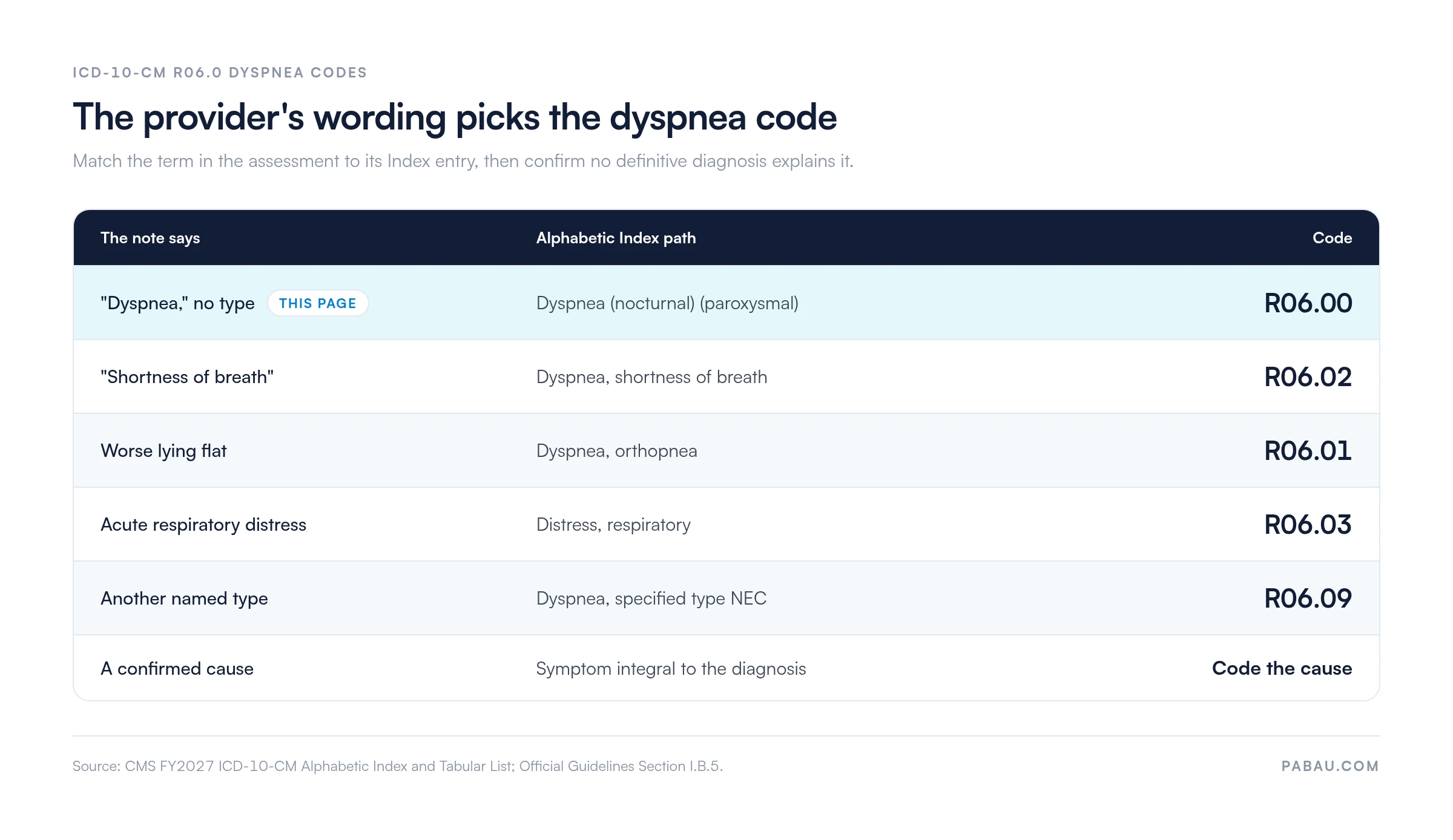
Decision table for ICD-10-CM R06.0 codes: dyspnea with no type, including nocturnal or paroxysmal, codes to R06.00; shortness of breath to R06.02; orthopnea to R06.01; acute respiratory distress to R06.03; another named type to R06.09; a confirmed cause is coded instead of the symptom
One word in the note can move the claim to a different R06.0 code, so read the assessment before the code list. Mapping from the CMS FY2027 ICD-10-CM Index and Tabular List.
CodeDescriptorDocumentation triggerCommon examples
R06.00Dyspnea, unspecifiedProvider documents “dyspnea” with no type, or nocturnal or paroxysmal dyspneaNew ED presentation; “PND” in a heart failure workup note; unqualified outpatient note
R06.01OrthopneaProvider documents difficulty breathing when lying flatHeart failure follow-up; “sleeps on three pillows”
R06.02Shortness of breathProvider documents “shortness of breath” or “SOB” without more detailTelehealth SOB complaint; urgent care visit
R06.03Acute respiratory distressProvider documents acute respiratory distress, not ARDSED arrival in visible distress before a cause is found
R06.09Other forms of dyspneaProvider names a dyspnea type with no code of its own“Dyspnea on exertion,” coded through “Dyspnea, specified type NEC”

Don’t treat “unspecified” as a default. If “on exertion” or “shortness of breath” appears in the assessment and the claim says R06.00, the code doesn’t match the note. That mismatch is exactly what a payer review finds.

The full R06 category has 17 billable codes to tell apart

Category R06 covers every abnormality of breathing, from stridor to snoring. Each code needs its own documentation trigger, so none should be picked because it sits next to R06.00.

CodeDescriptorKey differentiator from R06.00
R06.00Dyspnea, unspecifiedDyspnea with no qualifier, or nocturnal or paroxysmal dyspnea
R06.01OrthopneaPositional: lying flat triggers or worsens breathing difficulty
R06.02Shortness of breathThe note says “shortness of breath” or “SOB”
R06.03Acute respiratory distressAcute respiratory distress documented, without ARDS (J80)
R06.09Other forms of dyspneaA named dyspnea type with no code of its own
R06.1StridorHigh-pitched inspiratory noise documented; not a breathing-effort complaint
R06.2WheezingAudible wheeze documented; Excludes1: asthma (J45.-)
R06.3Periodic breathingCheyne-Stokes or another rhythmic breathing pattern documented
R06.4HyperventilationAbnormally rapid, deep breathing documented; Excludes1: psychogenic hyperventilation (F45.8)
R06.5Mouth breathingMouth breathing documented as the presentation
R06.6HiccoughHiccups documented as the breathing abnormality
R06.7SneezingSneezing documented as the complaint
R06.81Apnea, not elsewhere classifiedApnea NOS; the Index also sends “breathlessness” here
R06.82Tachypnea, not elsewhere classifiedRapid breathing; Excludes1 with every R06.0 code
R06.83SnoringSnoring documented, without a sleep apnea diagnosis
R06.89Other abnormalities of breathingBreath-holding spells or sighing
R06.9Unspecified abnormalities of breathingA breathing abnormality that isn’t dyspnea and isn’t described further

When R06.00 can be the first-listed or principal diagnosis

Whether R06.00 goes first depends on the care setting and on what the provider confirmed by the end of the encounter. The rules differ between outpatient and inpatient claims.

Outpatient and ED claims

Under Section IV of the Official Guidelines, the first-listed diagnosis is the condition chiefly responsible for the visit. If the dyspnea workup was inconclusive, R06.00 is correctly listed first.

Once COPD, heart failure or another cause is confirmed, that condition goes first. For interstitial lung disease confirmed without a named subtype, that means code J84.9. R06.00 is dropped unless the provider treats the dyspnea as a separate problem.

Inpatient claims and the DRG

On an inpatient claim, the principal diagnosis is the condition established after study as chiefly responsible for the admission. R06.00 is principal only when the full workup found no underlying cause.

When a cause such as pulmonary embolism or acute heart failure is documented, that code becomes principal instead. The MS-DRG follows the principal diagnosis, so leaving R06.00 in that slot misstates the whole admission.

Pro Tip

Run a documentation query before closing the inpatient chart. If the final assessment names a cardiopulmonary diagnosis that explains the admission, ask the attending whether R06.00 stays as a secondary code. One query at discharge prevents an entire appeal cycle.

Before you submit an R06.00 claim, run this checklist

Strong R06.00 documentation names the symptom, shows it was assessed, and shows no cause was confirmed. Meeting medical billing compliance standards comes down to checking each point below before the claim leaves.

  • The provider wrote “dyspnea.” It appears in the assessment or problem list, not only in nursing notes or vitals.
  • The note doesn’t say “shortness of breath.” If it does, the code is R06.02.
  • No qualifier hides elsewhere. “On exertion,” “worse lying flat” or “acute respiratory distress” anywhere in the encounter points to another code. Query the provider.
  • No confirmed cause explains it. The assessment doesn’t name COPD, heart failure, pneumonia or PE as the reason, unless the dyspnea is addressed separately.
  • The HPI carries detail. Onset, duration, severity and associated symptoms support medical necessity for the visit level billed.
  • The workup matches. Orders such as a chest X-ray, spirometry, BNP or D-dimer fit an undiagnosed complaint, and inconclusive results back the code.
  • No Excludes1 pair is on the claim. Respiratory failure (J96.-), ARDS (J80) and tachypnea NOS (R06.82) can’t sit beside R06.00.

A claim that passes all seven points stands the best chance of being a clean claim on first submission.

Four denial patterns account for most R06.00 rejections

Symptom codes draw extra scrutiny in denial management work. Most R06.00 denials fit one of four patterns, and each has its own fix.

Denial reasonWhat triggers itResolution
Specificity availableThe record supports R06.02 (“shortness of breath”) or R06.09 (“on exertion”), not R06.00Recode and resubmit as a corrected claim
Symptom coded with definitive diagnosisR06.00 sent with I50.x (heart failure) or J44.1 (COPD exacerbation), which explains the dyspneaDrop R06.00 and resubmit with the definitive code, unless the note supports both
Medical necessity not establishedThe note documents dyspnea but lacks the HPI detail needed for the service level billedObtain a provider addendum and resubmit with the supporting record
Excludes1 violationR06.00 sent with an excluded code, such as J96.- or R06.82Fix the code combination before resubmission

Appeal a denied R06.00 claim in five steps

Appeal only when the coding was right: no cause was confirmed, the note supports unspecified dyspnea, and no Excludes1 pair was billed. Use the Official Guidelines as your authority, and quote the payer’s own denial codes from the electronic remittance advice.

  1. Pull the CARC/RARC codes. Find the exact reason on the ERA. For R06.00 the usual two are CARC 50 (not medically necessary) and CARC 11 (diagnosis inconsistent with the procedure). Our guide to common denial codes explains the rest.
  2. Confirm the code. Check that no qualifier, such as exertional, orthopnea or “shortness of breath,” appears in the note. If one does, recode and send a corrected claim rather than an appeal.
  3. Gather the record. Collect the encounter note, the diagnostic orders, and proof no diagnosis was confirmed. A normal chest X-ray or negative BNP shows the cause wasn’t established.
  4. Draft the appeal letter. Cite Section I.B.4 of the Official Guidelines, which accepts symptom codes when no related definitive diagnosis is confirmed. Quote the provider’s assessment language that supports R06.00.
  5. File within the deadline. Commercial windows vary by contract, so check each payer’s policy. A Medicare Part B redetermination is due 120 days from receipt of the initial determination, with receipt presumed five days after the notice date.

Comorbidities decide whether R06.00 stays on the claim

The rule of thumb is simple. If the confirmed condition explains the dyspnea, R06.00 comes off. If the dyspnea is a separate, addressed problem, both codes can be reported. Check each pairing against the Tabular in the CDC/NCHS ICD-10-CM browser tool.

ScenarioCode combinationR06.00 retained?
COPD exacerbation explains the dyspneaJ44.1 (first-listed)No. Dyspnea is integral to J44.1.
Admitted for dyspnea; heart failure confirmed on day 2I50.x as principal diagnosisNo. The principal diagnosis is set after study, so the confirmed cause replaces the symptom.
Pulmonary embolism confirmed; dyspnea was the presenting complaintI26.x (first-listed)No. PE explains the dyspnea.
Stable asthma managed; dyspnea documented and not attributed to asthmaJ45.x (first-listed) + R06.00 (secondary)Yes, if the provider addresses the dyspnea as a separate problem.

Pro Tip

Check the assessment and plan against the HPI before finalizing code combinations. A chart that describes ‘worsening dyspnea’ in the HPI and ‘COPD exacerbation’ in the assessment almost always supports only J44.1, because the dyspnea is integral. Retaining R06.00 in that scenario invites a denial.

How Pabau keeps R06.00 claims accurate from chart to payment

Most R06.00 errors start when a coder retypes a diagnosis from the note onto a claim form by hand. A second system then tracks whether the payer accepted it.

Pabau, the practice management platform we build, pulls the diagnosis from the patient’s recorded problem list into the claim. Coders search the full ICD-10-CM library inside the same record, so the code sits beside the note it came from. Its simpler claims management workflow also checks required claim fields before the claim can be sent.
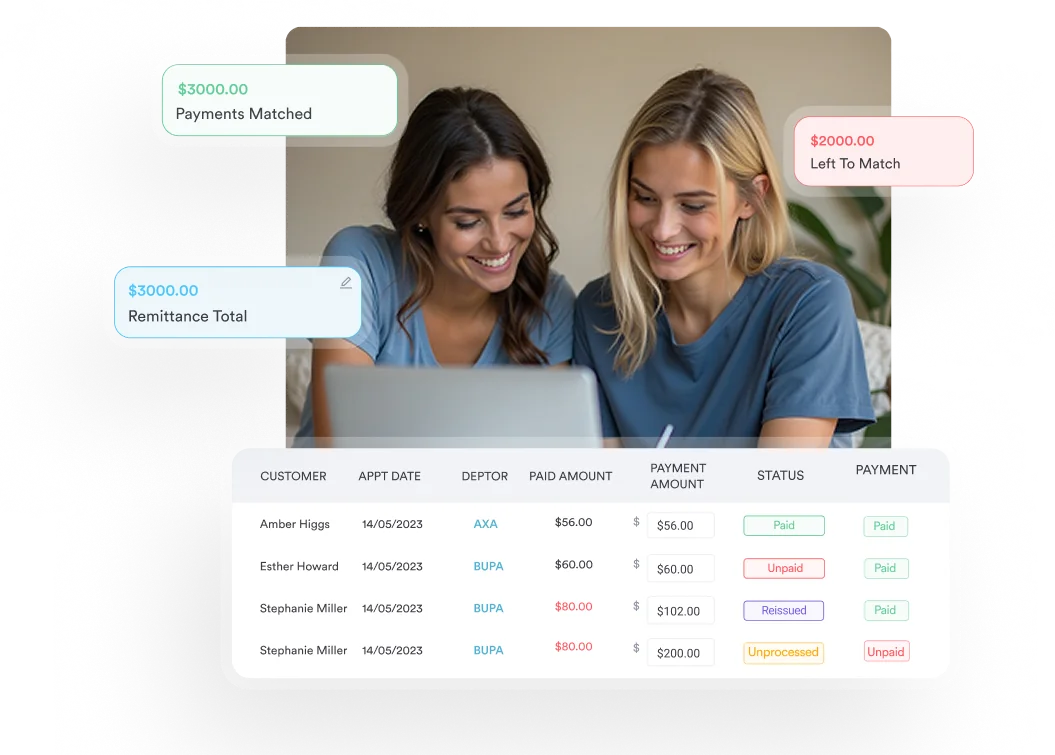
Fully Integrated with Pabau Billing
Pabau’s billing view keeps the dyspnea diagnosis, the visit and the claim on one record. A coder can check R06.00 against the note before submission.

US practices submit claims through Claim.MD, which validates payer edits before transmission. Eligibility checks, claim status and ERA remittances come back into Pabau too. That keeps revenue cycle management in one system, so a denied R06.00 claim is easy to trace and correct.

Send R06.00 claims that match the chart

Pabau pre-fills claims from the patient record, checks required fields, and submits through Claim.MD with ERA posting built in. See it in a 15-minute walkthrough.

Pabau claims management dashboard

Conclusion

R06.00 earns its place on a claim only when the note says dyspnea without a type or a cause. Read the assessment for the exact term first. “Shortness of breath” and “on exertion” each move the code somewhere else.

The bigger risk comes later in the encounter. When a cause is confirmed, the symptom code has to come off, and that one habit prevents most corrected claims.

Book a demo to see how Pabau carries the diagnosis from the patient record onto a clean claim and tracks it to payment.

Continue your research

Continue your research

Need a primer on how claims move from code to payment? Medical billing fundamentals explains the full claim lifecycle from encounter to reimbursement.

Coding a note that says shortness of breath? ICD-10 code R06.02 covers the shortness of breath code that sits beside R06.00.

Seeing repeat denials across your respiratory code claims? Denial management in healthcare covers root-cause analysis and appeal workflows for common payer rejections.

Want to understand what makes a claim pass payer edits the first time? Clean claim submission breaks down every element payers validate before processing payment.

Frequently asked questions

What is the ICD-10 code for shortness of breath?

The ICD-10-CM code for shortness of breath is R06.02. The Alphabetic Index lists it under Dyspnea, so a note that says “SOB” or “shortness of breath” without more detail takes R06.02, not R06.00.

What is the ICD-10 code for dyspnea on exertion?

There’s no dedicated code. Most coders follow the Index entry “Dyspnea, specified type NEC” to R06.09, while “shortness of breath on exertion” is often coded R06.02. Check the Index and your payer’s or Coding Clinic guidance.

Is shortness of breath from anxiety coded R06.00?

No. The Index sends psychogenic, functional and hysterical dyspnea to F45.8, other specified somatoform disorders. Use it only when the provider links the dyspnea to a psychological cause.

What code is used for dyspnea in a newborn?

Newborn dyspnea indexes to P28.89, other specified respiratory conditions of newborn. Transient tachypnea of newborn (P22.1) is an Excludes1 at R06.0, so R06.00 isn’t used for these infants.

Does R06.00 support medical necessity for a chest X-ray?

It can, but coverage depends on the payer’s policy for that procedure code. Check the relevant LCD or the payer’s covered diagnosis list before you rely on R06.00 alone.


Avatar photo
Maja Popovska
Content Writer

Maja is a Senior Content Writer at Pabau, where she covers everything from practice management and compliance to medical aesthetics and patient experience. Off the clock: binging true crime docuseries, baking and dreaming about travel.
×

