

ICD-10 Code R63.4: Abnormal weight loss
ICD-10 Code R63.4: Definition, billability, and code structure ICD-10 code R63.4...

Last Updated: Nov 13, 2026
Billable Code Specific Code
I95.9 is the billable ICD-10-CM code for hypotension, unspecified. Use it when the physician diagnoses low blood pressure but documents no type or cause, such as orthostatic, drug-induced or postprocedural.
The code sits in category I95, in the circulatory system chapter, and is valid for FY2027 claims with no change from the prior code set. A low reading with no hypotension diagnosis is coded R03.1 instead.
Let Pabau's smart automation suggest the right codes, reduce claim denials, and keep your practice compliant—effortlessly.
Automate repetitive tasks and focus on what matters most—your patients.
Reduce coding errors and ensure compliance with the latest regulations.
Clean claims, fewer denials, and faster reimbursements.
Powerful insights and reporting to help your practice thrive.
HIPAA compliant SOC 2 certified GDPR-compliant Trusted by 4,000+ clinics worldwide

I95.9 is the billable ICD-10-CM code for hypotension when the physician documents no specific type or cause.
Orthostatic (I95.1), drug-induced (I95.2), hemodialysis (I95.3) and postprocedural (I95.81) hypotension each have their own code, so check for them first.
A low reading with no hypotension diagnosis is coded R03.1, and shock with organ compromise belongs in R57.
Charts that hold up on review show numeric BP readings with times, the symptoms, and why no subtype could be assigned.
Pabau, the practice management platform we build, sends ICD-10 claims through Claim.MD with eligibility checks and ERA processing for US practices.
ICD-10 code I95.9 is the billable ICD-10-CM code for hypotension, unspecified, and it’s valid for FY2027 claims. It closes category I95 in the CDC’s FY2027 tabular list, under Diseases of the circulatory system. Assign it when the physician diagnoses low blood pressure but documents no type or cause.
Here are the facts to check before you code a hypotension encounter.
I95.9 captures hypotension that the physician diagnoses as a clinical condition without naming a cause or subtype. Clinically, hypotension usually means a systolic reading low enough to cause symptoms. The threshold varies by guideline and payer policy, so no single cutoff applies everywhere.
The code fits when low blood pressure is the reason for the visit, or a significant problem addressed during it. Typical scenarios look like this:
Think of I95.9 as a residual code. It belongs on the claim when the record supports nothing more specific, never as a shortcut around chart review.
The tabular list puts instructional notes on category I95, and they apply to every code under it, I95.9 included. Read them before you assign any I95 code.
R03.1, the code for a nonspecific low blood pressure reading, catches coders out often. It sits in the symptoms chapter, and I95 excludes it. When a low reading is incidental and nobody diagnoses hypotension, R03.1 is likely the better fit. The test is whether the provider diagnosed a condition or simply noted a number.
The I95 category also holds I95.0, I95.1, I95.2, I95.3, I95.81 and I95.89. I95.9 is right only when the documentation supports none of them. Use the table to match the record to a code before you default to the unspecified option.
The decision path below puts the same rules in the order a coder actually checks them, starting with whether this is hypotension at all.
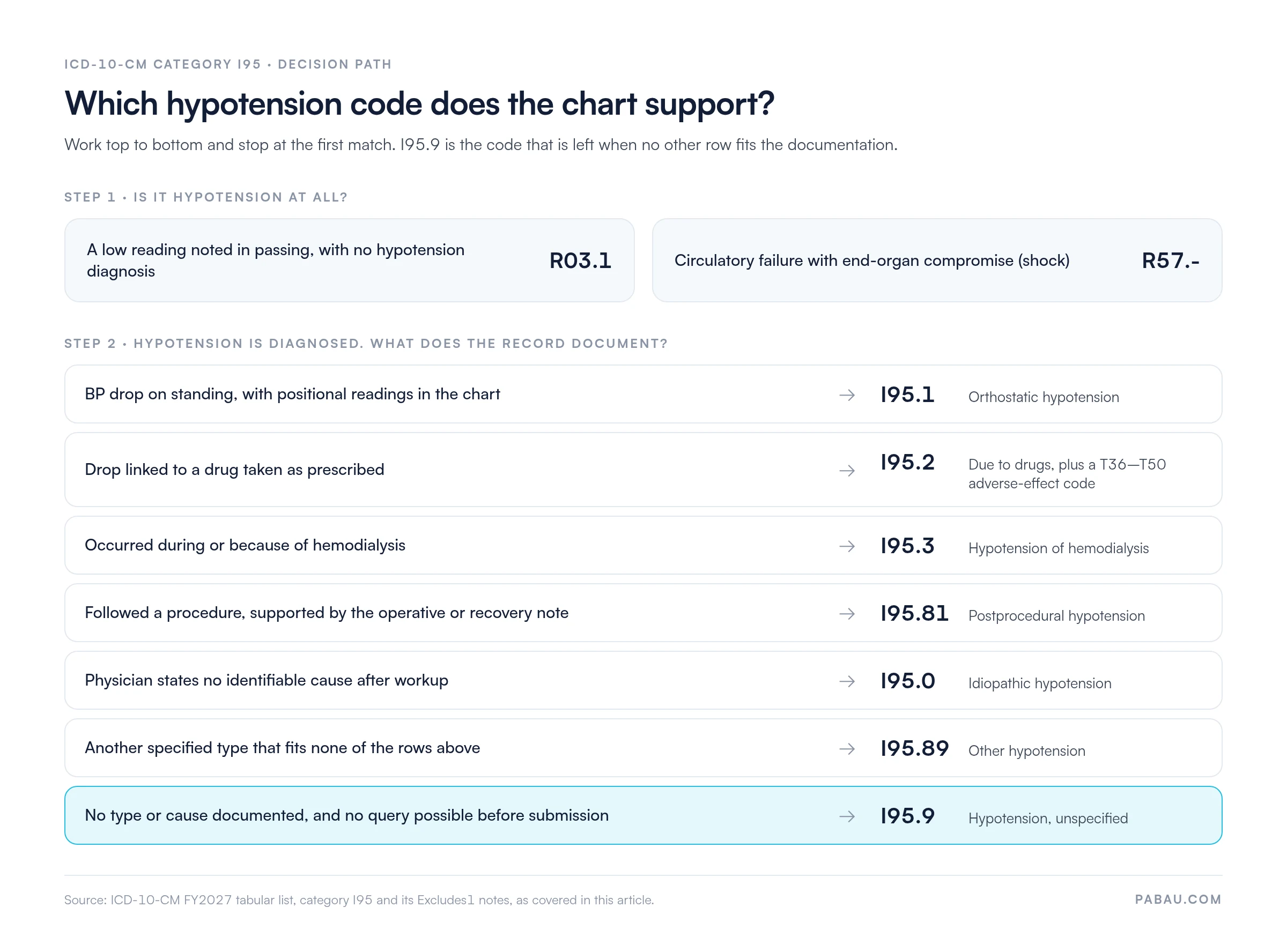
Orthostatic hypotension is the specific subtype that most often gets coded down to I95.9. The cue is a BP drop recorded on position change, usually readings taken lying down and again standing. A formal tilt-table test isn’t required. When the physician does order formal autonomic testing, a combined cardiovagal and adrenergic study with passive tilt is reported as code 95924.
Coders can’t assign I95.1 from nursing vitals alone, though. When the nursing record shows positional readings and the physician notes dizziness on standing, query the physician for orthostatic hypotension. Don’t default to I95.9 while that evidence sits in the chart.
Drug-induced hypotension is where I95.9 gets overused most. Medication lists often live in nursing notes rather than the physician’s note. So I95.9 lands on the claim because the attending never wrote the link between the drug and the drop.
When the physician documents hypotension and the patient takes antihypertensives, diuretics or vasodilators, send a query before defaulting to I95.9. If I95.2 applies, add a code from T36-T50 (fifth or sixth character 5) identifying the drug taken correctly as prescribed. That is the adverse effect. Poisoning and underdosing are coded from T36-T50 first, not with I95.2.
Postprocedural hypotension requires the operative or procedure note to tie the low BP episode to the procedure, in time and in cause. An I95.9 claim for hypotension right after surgery is a common audit flag. If the anesthesia record or recovery note documents a hypotensive event after the procedure, I95.81 is probably the accurate code. Assigning I95.9 instead can read as undercoding on audit.
Before you assign I95.9 on a post-surgical claim, review the anesthesia record, the operative note and the recovery room notes. Hypotension documented in the perioperative window usually supports I95.81. Using the unspecified code when postprocedural timing is on record is a frequent audit flag.
Syncope and shock often appear in the same notes as hypotension, but each is its own diagnosis. Picking the wrong one, or missing the sequencing rules when two apply, invites denials and audit questions.
When syncope and hypotension occur together, sequence by the established diagnosis. If the physician names unspecified hypotension as the cause of the faint, I95.9 goes first and R55 follows as an additional diagnosis.
Orthostatic hypotension works differently. I95.1 is an Excludes1 note at R55, so a faint caused by orthostatic hypotension takes I95.1 alone. If only a low reading accompanies the episode and nobody diagnoses hypotension, R55 alone may be right.
Shock is a different matter. It implies end-organ dysfunction and hemodynamic compromise well past a low reading. It also carries its own severity and sequencing rules for inpatient DRG assignment, so never swap R57 and I95.9.
Payers reviewing I95.9 look for two things. The record should show hypotension as a diagnosis, not just a low reading, and explain why no subtype was assigned. A clean claim submission for I95.9 rests on these elements.
Under outpatient guidelines, don’t assign I95.9 when the record gives enough to query for a more specific code. AHIMA query guidance supports clinical documentation improvement (CDI) queries before submission when the chart suggests a cause it never states.
Most I95.9 trouble starts long before the payer sees the claim. Here’s the path a typical outpatient claim takes.
Medicare and commercial payers don’t publish LCDs or NCDs for I95.9 on its own. The code still trips claim edits when it’s paired with certain services, or used as the only diagnosis on an inpatient claim. Prior authorization depends on the service, so infusion therapy, tilt-table testing and monitoring may need it whatever the diagnosis. Check LCD and NCD policies with your Medicare Administrative Contractor (MAC) before you submit.
These are the denial patterns that come up most with I95.9, and how to fix each.
For a full appeal workflow, our guide to denial management in healthcare covers CARC codes and appeal steps. The remittance reason codes themselves are listed in our medical billing denial codes reference.
Audit I95.9 claims each quarter against the medication reconciliation. If one physician keeps documenting hypotension for patients on diuretics or beta-blockers without naming the drug, set up a standing CDI query. Fixing it at the source stops the same denial from recurring.
Which procedure codes pair with I95.9 depends on the setting and the clinical picture. These are the common pairings.
A tilt-table study often settles the subtype question, so check the 93660 requirements when one is ordered. A positive result usually moves the diagnosis from I95.9 to I95.1. For how diagnosis and procedure codes fit together on a claim, see our guide to medical billing basics.
The care setting decides which guidelines govern I95.9, and the two sets differ in ways that matter for hypotension.
In many practices, the coder hunts through nursing notes for positional readings, the claim goes out, and a specificity denial lands weeks later. By then the visit is hard to reconstruct, and the rework eats into someone’s afternoon.
Pabau’s claims management for practices keeps that loop in one place. US claims go out as CMS-1500/837P files through Claim.MD, with eligibility checks before the visit. Claim.MD’s claim edits can catch rejections before the payer sees the claim.
When the payer responds, the ERA remittance posts back against the claim, and secondary claims follow from the same record. So a denied I95.9 claim shows up for your team to fix, with the patient’s notes a click away.
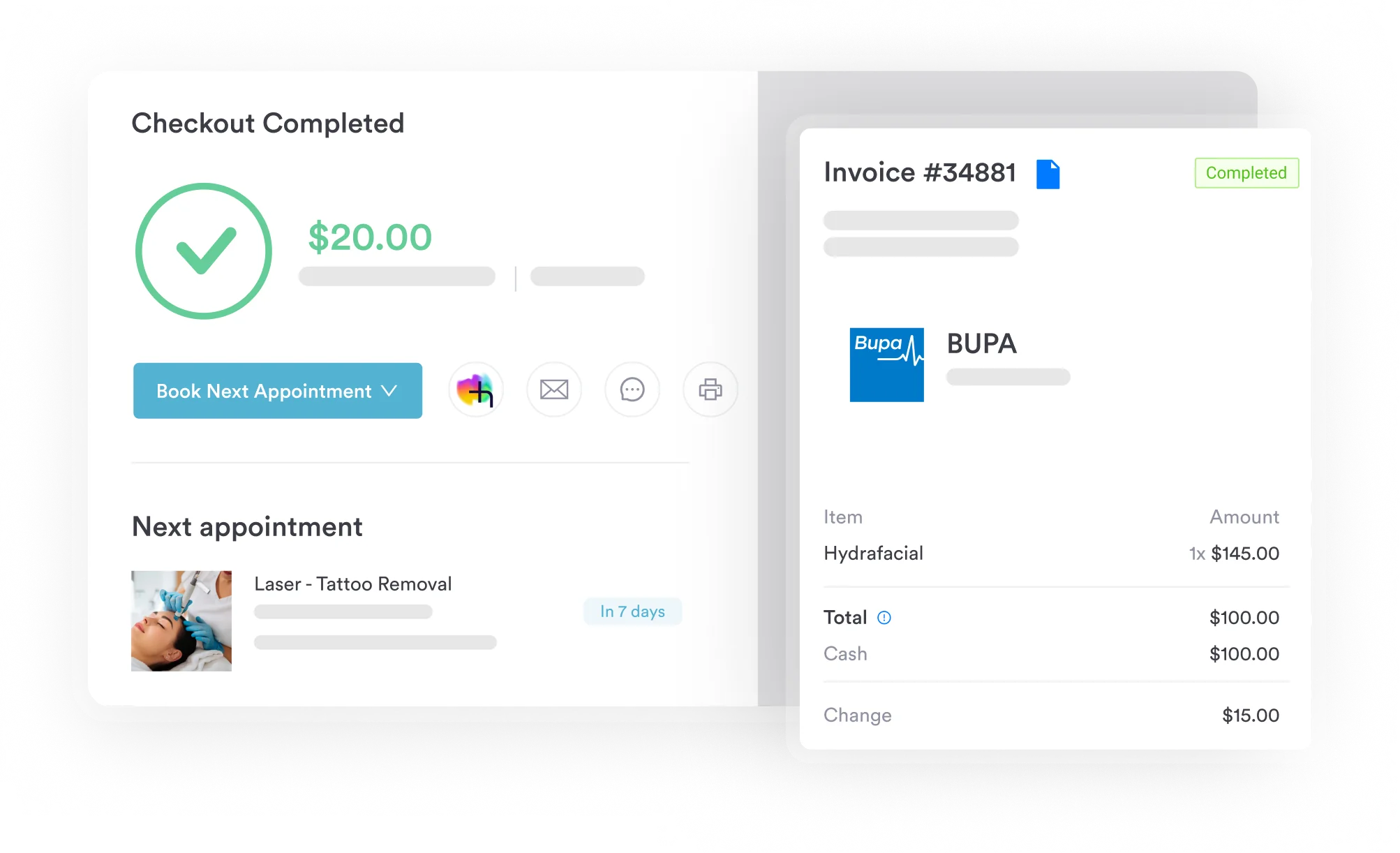

Pabau sends ICD-10 claims through Claim.MD, checks eligibility in real time and posts ERA remittances. Denied claims come back to your team ready to rework.

I95.9 earns its place on a claim only after the chart has been checked and nothing more specific fits. Positional readings, a recent procedure, dialysis or a new antihypertensive are all reasons to look again.
If you change one habit, query before you default. A two-line answer from the physician costs far less than a specificity denial and a resubmission weeks later.
Book a demo to see how Pabau sends hypotension claims through Claim.MD and brings denials back to your team ready to fix.

Need a denial management framework for your practice? Denial management in healthcare covers CARC codes, appeal timelines, and systematic workflows to reduce write-offs.
Looking for a comprehensive billing compliance checklist? Medical billing compliance outlines the documentation and audit-readiness standards that apply to ICD-10 claims.
Want to understand how the clearinghouse submission process works end to end? Medical claims clearinghouse guide explains 837P file structure, eligibility checks, and ERA receipt from first submission to payment posting.
Use I95.9 when the physician diagnoses hypotension without naming a type. If the chart only shows a low reading with no diagnosis, the code is R03.1, nonspecific low blood pressure reading.
Chronic hypotension is coded I95.89, other hypotension. The tabular list names chronic hypotension as an inclusion term under that code, so it doesn’t go to I95.9.
Neurogenic orthostatic hypotension, also called Shy-Drager, is coded G90.3. It’s excluded from I95.1 because it sits with the autonomic nervous system disorders.
Maternal hypotension syndrome is coded from O26.5-, with the fifth character set by trimester. I95 excludes it, so don’t use I95.9 for a pregnant patient with this syndrome.
Before ICD-10-CM, unspecified hypotension was coded 458.9. ICD-9 codes don’t go on claims for services from October 1, 2015 onward, so map older records to I95.9.



