ICD-10 Code S82.242H: Displaced spiral tibial shaft fracture, delayed healing
ICD-10 Code S82.242H: Definition and code details ICD-10 Code S82.242H designate...

Last Updated: Oct 15, 2026
Billable Code Specific Code
S72.8X1B is the billable ICD-10-CM code for other fracture of right femur, initial encounter for open fracture type I or II.
It applies to an open Gustilo type I or II fracture during active treatment, at a femur site that fits no more specific S72 subcategory. Most denials on this code come from the operative note: a missing Gustilo grade, a wrong 7th character, or an unstated side.
Let Pabau's smart automation suggest the right codes, reduce claim denials, and keep your practice compliant—effortlessly.
Automate repetitive tasks and focus on what matters most—your patients.
Reduce coding errors and ensure compliance with the latest regulations.
Clean claims, fewer denials, and faster reimbursements.
Powerful insights and reporting to help your practice thrive.
HIPAA compliant SOC 2 certified GDPR-compliant Trusted by 4,000+ clinics worldwide

S72.8X1B is a billable ICD-10-CM code for an open Gustilo type I or II fracture of the right femur, initial encounter. It applies when the fracture site fits no more specific S72 subcategory.
The 7th character B means an initial encounter for an open type I or II fracture. It applies while the patient is in active treatment, even if this is not the first visit.
The treating surgeon must document Gustilo grade I or II in the operative report. Coders cannot infer or assign a grade the report doesn’t state.
Traumatic amputation of hip and thigh (S78.-) is the only Excludes1 note on category S72, while lower leg, foot, and periprosthetic hip fractures are Excludes2.
Pabau’s claims management software turns invoices into electronic CMS-1500 claims and sends them through Claim.MD to thousands of US payers, with real-time eligibility checks first.
ICD-10 Code S72.8X1B is the ICD-10-CM code for other fracture of the right femur, initial encounter for open fracture type I or II. It became effective on October 1, 2015, and remains valid for FY2027 claims.
Use it when the operative report documents an open Gustilo type I or II fracture of the right femur during active treatment. The fracture site must fall outside the femoral head and neck, the trochanteric region, the shaft, and the lower end.
Each character in S72.8X1B carries a distinct clinical meaning. Swap 1 for 2, or B for A, and the code describes a different patient.
The placeholder X in position 5 is mandatory. Dropping it, as in S72.81B, produces an invalid code string that payers reject outright.
“Other fracture of femur” describes fracture patterns that do not map to the more specific S72 subcategories. Coders reach S72.8 when none of the following subcategories applies.
S72.8 is a residual subcategory, so rule out the specific codes first. Isolated greater and lesser trochanter fractures belong in S72.1-, not S72.8. Stress fractures (M84.3-) and atypical femoral fractures (M84.75-) have their own codes outside category S72.
The operative or imaging report must name the fracture location. Coders cannot infer “other” from a vague descriptor like “femur fracture, right.”
The Gustilo-Anderson classification, established in 1976, grades open fractures by wound size, contamination, and soft-tissue damage. The 7th character B in ICD-10 Code S72.8X1B covers Gustilo Types I and II specifically.
Only the operating surgeon can designate the Gustilo type, and only intraoperatively. Assigning B without a documented type I or II grade is a coding error, and it carries compliance risk. When the operative report says “open fracture” without a Gustilo grade, query the surgeon before coding.
The 7th character B denotes an initial encounter for an open type I or II fracture, which means the patient is receiving active treatment. Per ICD-10-CM Official Guidelines Section I.C.19.a, “initial encounter” refers to the treatment phase, not the visit number.
Take a patient seen in the emergency department, transferred to a trauma center, and then admitted for surgery. All three providers report B as long as active treatment continues. The character changes only when active treatment ends.
Two questions from the operative report settle the initial-encounter character, as the diagram below shows.
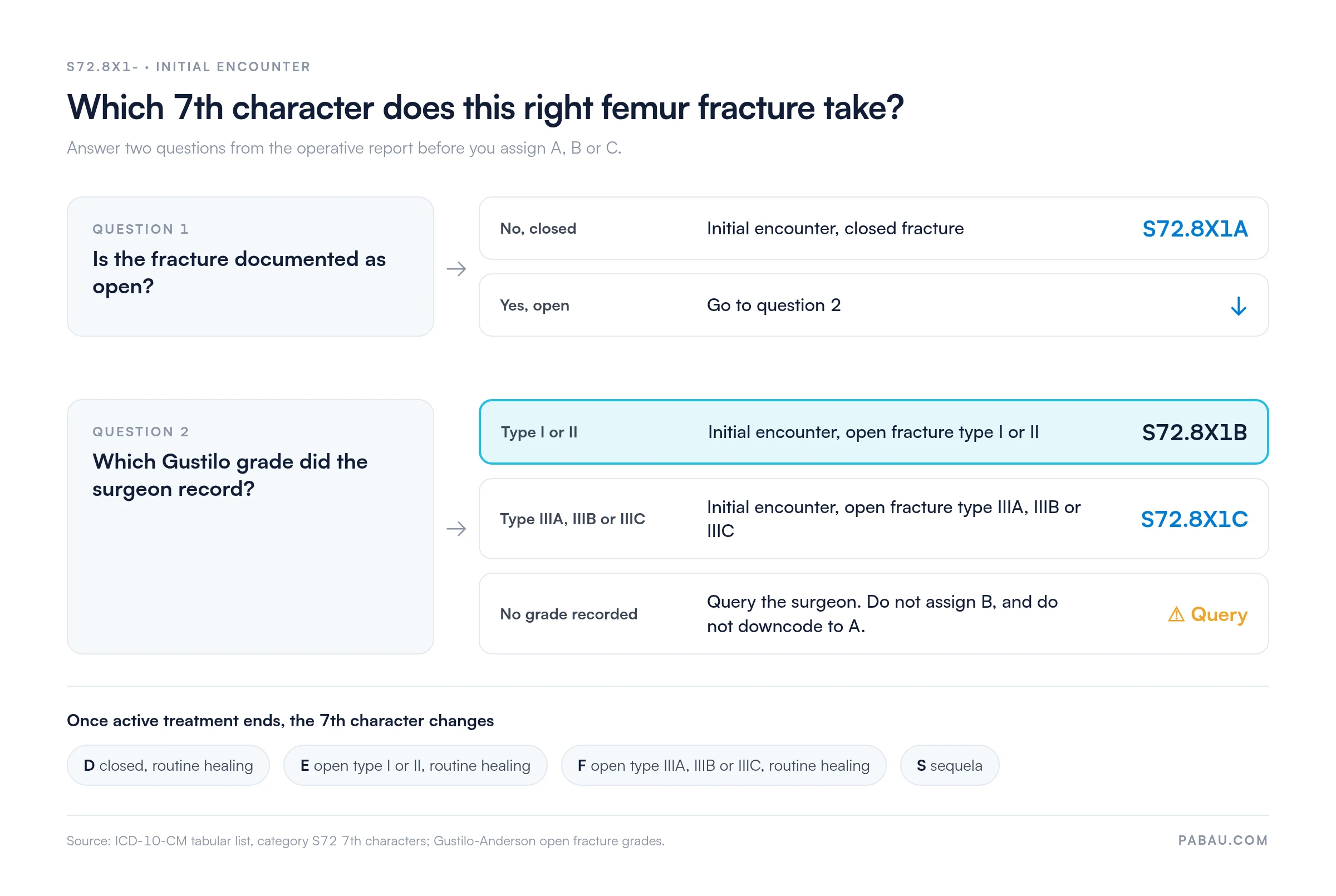
Four codes share almost identical character strings with S72.8X1B. Getting them right requires checking exactly two characters: position 6 (laterality) and position 7 (encounter type and fracture openness).
The S72.8X1A versus S72.8X1B confusion is the most common denial trigger. When the operative report documents an open wound with bone exposure but does not specify Gustilo grade, some coders default to A.
That is incorrect. The fracture is open, so the coder must query the surgeon for the Gustilo grade rather than downcode to closed.
The S72 category carries exclusion notes that apply to S72.8X1B by inheritance. Reporting an Excludes1 pair on the same claim typically trips a payer edit.
Excludes2 means the excluded condition is not part of category S72, but a patient can have both at once. A fall that fractures the right femur and the right ankle, for example, takes S72.8X1B plus the matching S82.- code.
Minor trauma can break bone already weakened by a metastatic lesion or osteoporosis. That fracture takes a pathological code from M80 or M84, not S72.8X1B. Query the surgeon when the note leaves the cause unclear.
Missing even one of the following elements forces a query back to the physician or produces a claim denial. According to the CMS ICD-10-CM coding guidelines, coders must assign the most specific code supported by the documented clinical facts.
For Medicare claims, medical billing compliance documentation must also align with any applicable Local Coverage Determination (LCD) for the procedure codes submitted alongside S72.8X1B. LCD requirements vary by Medicare Administrative Contractor jurisdiction. Verify the operative note language against the relevant MAC’s policy before submitting.
ICD-10-CM Official Guidelines Section I.C.20 directs coders to report external cause codes alongside injury codes whenever possible. For S72.8X1B, sequence the injury code first, followed by the external cause code.
Some commercial payers and Medicaid managed care plans require external cause codes for trauma claims. Submitting S72.8X1B without an accompanying mechanism code can trigger an edit requesting additional information, delaying payment. Build a pre-submission check into your clean claim workflow that flags any S72.x code with no associated external cause code.
The procedure codes paired with S72.8X1B depend on the surgical approach. Open fracture treatment typically requires debridement and fixation. The exact CPT selection must match the operative technique documented.
CPT and ICD-10 pairing recommendations are illustrative; actual medical necessity must be established in the medical record. No CPT/ICD-10 combination guarantees payment, and payers may apply specific National Coverage Determinations or LCD policies to individual claims.
Most S72.8X1B denials share the same handful of root causes, and each one can be caught before submission. The AAPC ICD-10-CM code reference is a quick way to confirm a code’s full 7-character form.
A clearinghouse screens each claim against payer format rules before the payer sees it, which catches truncated codes early. Medical claims clearinghouse processing follows each claim from submission to acceptance.
Run a monthly denial report filtered to S72.x codes and sort it by CARC reason code. CO-11 means the diagnosis is inconsistent with the procedure, and CO-4 points to a modifier problem. Reviewing 30 days of denials together shows whether the cause is documentation, coding, or payer policy.
These two vignettes illustrate the decision logic that separates correct S72.8X1B assignment from the most common coding errors.
A 34-year-old motorcyclist is brought to the emergency department after a collision. The surgeon’s operative note documents an open right femur fracture at a specified site that fits none of S72.0 to S72.4. The wound measures about 4 cm, with moderate soft-tissue damage and exposed bone. The note records Gustilo type II and no vascular injury.
A 51-year-old construction worker falls from scaffolding. The operative report documents an open right femur fracture at the same kind of site. It notes a 14 cm wound, periosteal stripping, and significant soft-tissue loss. The report records Gustilo type IIIB. The coder, seeing “right femur,” assigns S72.8X1B.
That is wrong. Gustilo IIIB requires the 7th character C, not B. The correct code is S72.8X1C. Submitting S72.8X1B on this claim understates injury severity. It may not support the resource intensity of the procedure, which raises the risk of a medical necessity denial.
Medicare femur fracture claims are subject to Local Coverage Determinations issued by Medicare Administrative Contractors. LCD policies govern medical necessity for specific fixation approaches. The operative documentation must align with the LCD’s coverage criteria for the procedure code billed alongside S72.8X1B.
For billing teams managing denial management in healthcare, the most efficient approach is a pre-authorization checklist specific to open femur fracture cases. Confirm the payer, DRG implications, and LCD applicability before the case goes to surgery.
That way the surgical team knows the documentation requirements in advance. The electronic remittance advice returned after submission will carry adjustment reason codes that signal exactly where any payer-specific requirement was not met.
Many orthopedic billing teams still build a fracture claim by hand. They rekey invoice details into a clearinghouse portal, confirm coverage by phone, and chase remittances in a separate inbox.
Pabau, the practice management platform we build, turns the invoice you already raise into an electronic CMS-1500 claim. Its Claim.MD integration sends that claim to thousands of US payers and runs real-time eligibility checks (270/271) before treatment.
Before each claim goes out, Pabau’s claims management software checks that required details like membership numbers and authorization codes are in place.
Claim statuses then update from the payer, denied claims are flagged for rework, and ERA remittances match back to the claims they settle. Your team sees which S72.8X1B claims are paid, pending, or denied in one dashboard.

Pabau turns invoices into electronic CMS-1500 claims and sends them through Claim.MD to thousands of US payers. Real-time eligibility checks and ERA tracking help orthopedic practices avoid coverage denials.

S72.8X1B is simple to assign once the operative note is complete. When a claim on this code fails, the cause usually sits upstream, in a note that omits the Gustilo grade or the side.
So put the effort before coding, not after the denial. Build the Gustilo query into your pre-coding workflow and hold the claim until the grade is documented. Then pair every S72.x code with an external cause code. The trade-off is a short delay on a few claims, set against weeks of rework on a denied one.
Book a demo to see how Pabau takes S72.8X1B claims from invoice to payer, with eligibility checked before the patient is seen.

Want to understand how clearinghouse submission works end to end? EDI 837 file guide explains how electronic claims are structured, validated, and transmitted to payers.
ICD-10 Code S72.8X1B is the diagnosis code for other fracture of the right femur, initial encounter for open fracture type I or II. It covers a Gustilo type I or II open fracture at a femur site outside the head, neck, trochanteric, subtrochanteric, shaft, and distal subcategories.
Yes. S72.8X1B is a fully specified, billable ICD-10-CM code, valid for FY2027 claims. The parent codes S72.8 and S72.8X are not billable, so claims need the full 7-character code.
S72.8X1A is an initial encounter for a closed fracture, while S72.8X1B is an initial encounter for an open Gustilo type I or II fracture. The only difference is the 7th character. Using A when the operative report documents an open wound and exposed bone is a coding error.
S72.8X2B covers the left femur, and S72.8X1B covers the right. The 6th character is the only difference: 1 for right, 2 for left. Verify laterality against the operative note and imaging report before submitting, since a mismatch is a common denial trigger for S72 codes.
The 7th character B covers Gustilo type I (wound under 1 cm, minimal contamination) and type II (wound 1 to 10 cm, moderate soft-tissue damage). Gustilo types IIIA, IIIB, and IIIC take the 7th character C.
Switch from S72.8X1B to S72.8X1E once active treatment ends and the patient moves to routine follow-up care. E is the subsequent encounter for an open type I or II fracture with routine healing, while D applies only to closed fractures. The change reflects the treatment phase, not the visit count.