ICD-10 code S61.201A: Open wound of left index finger without nail damage
ICD-10 code S61.201A covers a left index finger wound of unstated type ICD-10 co...

Last Updated: Oct 16, 2026
Billable Code Specific Code
S62.635G is the billable ICD-10-CM code for a displaced fracture of the distal phalanx of the left ring finger, subsequent encounter, with delayed healing. Use it at a follow-up visit when the provider documents that the fingertip bone of the left fourth finger is healing more slowly than expected.
The 7th character G marks delayed healing. D covers routine healing, and K covers nonunion. The record should name the left ring finger, show a displaced distal phalanx on imaging, and state that healing is delayed.
Let Pabau's smart automation suggest the right codes, reduce claim denials, and keep your practice compliant—effortlessly.
Automate repetitive tasks and focus on what matters most—your patients.
Reduce coding errors and ensure compliance with the latest regulations.
Clean claims, fewer denials, and faster reimbursements.
Powerful insights and reporting to help your practice thrive.
HIPAA compliant SOC 2 certified GDPR-compliant Trusted by 4,000+ clinics worldwide

ICD-10 code S62.635G reports a displaced fracture of the distal phalanx of the left ring finger at a follow-up visit with delayed healing.
The 7th character G means delayed healing. D means routine healing, K means nonunion and P means malunion.
Laterality sits in the 6th character: 5 is the left ring finger and 4 is the right ring finger (S62.634G).
The record needs three facts: left ring finger, a displaced distal phalanx on imaging, and a provider statement that healing is delayed.
At the follow-up, report the external cause with a D character, such as W19.XXXD, and skip the place and activity codes.
ICD-10 code S62.635G covers a displaced fracture of the distal phalanx of the left ring finger, subsequent encounter for fracture with delayed healing. In plain terms, the fingertip bone of the left fourth finger broke out of alignment. The patient is back for follow-up, and the bone is knitting more slowly than expected.
It’s a valid, billable ICD-10-CM code. Use the table below as a quick check before you read the detail.
Read the code from left to right, and each character narrows the claim. A slip at any position points to a different finger, bone or visit.
Two defaults from the S62 category notes matter here. A fracture not documented as displaced or nondisplaced is coded as displaced. A fracture not documented as open or closed is coded as closed. You can confirm both in the CDC/NCHS ICD-10-CM browser tool.
The same left-to-right reading works on every injury code in our ICD-10-CM code library, so it’s worth learning once.
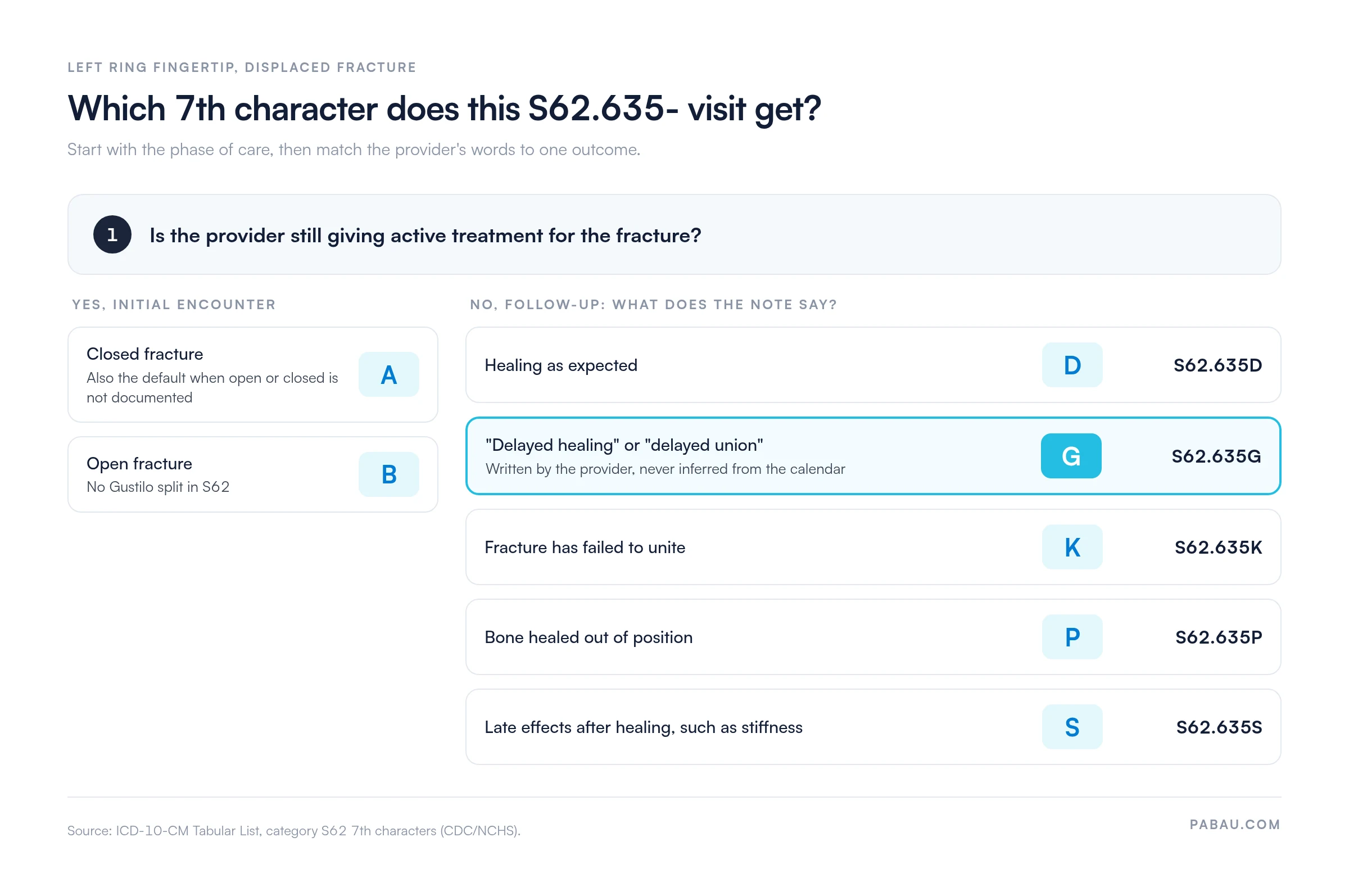
The 7th character carries the phase of care. For S62 fractures, seven letters are valid, and there is no Q.
Coders mix up G and D more than any other pair. Both describe a follow-up visit. D says healing is on track, while G says it has slowed. Pick G only when the provider writes that healing is delayed. A coder should never infer it from the calendar alone.
Also note that subsequent letters do not split open from closed. An open fracture takes B at the initial encounter, then D, G, K, P or S afterward.
A subsequent encounter is care after active treatment ends, while the fracture heals. S62.635G fits that phase only when healing has stalled.
Typical visits include:
If the same visit shows the fracture healing well, the code is S62.635D. If the provider diagnoses nonunion, it’s S62.635K. Nonunion follows the same pattern on other fingers, as S62.630K shows for the right index finger.
At the visit, settle the phase of care first. Then match the provider’s wording to one outcome, as the flow below shows.
Several fractures look similar on paper but belong elsewhere. Check this list before you settle on the code.
Most errors sit one character away from S62.635G. The table shows which character changed and what it means.
Remember that S62.60- means an unspecified phalanx of a named finger. It is not a catch-all for an unspecified finger.
Before you assign S62.635G, check three facts in the note. Is it the left ring finger? Does imaging show a displaced distal phalanx? Does the provider say healing is delayed? If any answer is no, pick a neighbor code.
A claim is only as strong as the note behind it. Auditors look for five elements.
Good notes also support clean claim submission, because the coder has less to guess.
Take two minutes with the chart before the claim leaves your system. Each step catches a common denial.
Once coded, the claim goes through your scrubber and clearinghouse, then on to the payer. Problems tend to surface at three points.
External cause codes come next. There is no national rule that makes them mandatory, but many payers and states ask for them. At this visit, report the cause with the D character, for example W19.XXXD for an unspecified fall. Place of occurrence (Y92) and activity (Y93) codes belong only on the initial encounter.
Denials on this code follow a familiar pattern. Most trace back to one character or one missing phrase.
A denial management workflow that sorts rejections by reason code shows which of these hits your practice most.
The CPT code must describe the service delivered at this visit. These are the common pairings.
CPT 26750 (closed treatment of a distal phalangeal fracture, without manipulation) is a treatment code. It belongs with the initial encounter, S62.635A, not with a G follow-up. Repeat films that track the slow healing usually go out as 73140, with at least two views.
Follow-up fracture claims stall when the note, the code and the claim live in separate places. The biller then has to chase the provider for the side or the healing status.
Pabau, the practice management and billing platform we build, keeps the visit note and the claim in the same patient record. The coder sees the provider’s “delayed union” line next to the code they’re about to send.
From there, Pabau’s claims management for practices sends the claim electronically through the Claim.MD clearinghouse. You spend less time rekeying and more time checking the record.

Pabau keeps the follow-up note and the claim in one patient record. Claims go out electronically through the Claim.MD clearinghouse integration.

S62.635G stands or falls on the provider’s wording. If the note says the left ring fingertip is healing slowly, and imaging shows a displaced distal phalanx, the code holds up. If either fact is missing, a neighbor code is the honest choice.
So build the habit into your follow-up template. Prompt the provider to state side, bone, displacement and healing status at every fracture visit. Book a demo to see how Pabau keeps fracture follow-up notes and claims in one place.

Need to understand what happens when a claim is rejected? Denial management in healthcare covers the end-to-end process for tracking, appealing, and preventing claim denials by CARC reason code.
Want to validate claims before they reach the payer? How the Claim.MD clearinghouse works explains eligibility checks, 837P submission, and ERA processing for US practices.
Looking for a structured approach to the full billing workflow? Electronic remittance advice (ERA) explained walks through how 835 remittance files map denial reasons back to specific claim lines.
S62.635G is the billable code for a displaced fracture of the distal phalanx of the left ring finger. It covers a follow-up visit where healing is delayed.
Yes. S62.635G is a valid, billable ICD-10-CM code with all seven characters in place.
G means a subsequent encounter for a fracture with delayed healing. D means routine healing, K means nonunion, and P means malunion.
No. ICD-10-CM guidelines say aftercare Z codes are not used for injuries. Report the fracture code with its subsequent-encounter character, here G.
Report the original cause with a D character, such as W19.XXXD for an unspecified fall. Place and activity codes belong only on the initial encounter.
Common pairings are 99213 or 99214 for the visit, 73140 for finger X-rays, and 29130 or 29131 for a static or dynamic finger splint.
Most denials come from G used where D fits, the wrong side, imaging that does not show a displaced distal phalanx, or no delayed-healing statement.