ICD-10 code S61.201A: Open wound of left index finger without nail damage
ICD-10 code S61.201A covers a left index finger wound of unstated type ICD-10 co...

Last Updated: Oct 16, 2026
Billable Code Specific Code
S52.311P is the billable ICD-10-CM code for greenstick fracture of shaft of radius, right arm, subsequent encounter for fracture with malunion. You use it when a right radial shaft greenstick fracture has healed out of alignment and the patient returns for care of that malunion.
The 7th character carries the decision. P marks malunion, so the code replaces D once the provider documents faulty union, and S stays reserved for other late effects. Pick the wrong one and the claim describes a different stage of care. The sections below cover the 7th-character choice, the note and the claim itself.
Let Pabau's smart automation suggest the right codes, reduce claim denials, and keep your practice compliant—effortlessly.
Automate repetitive tasks and focus on what matters most—your patients.
Reduce coding errors and ensure compliance with the latest regulations.
Clean claims, fewer denials, and faster reimbursements.
Powerful insights and reporting to help your practice thrive.
HIPAA compliant SOC 2 certified GDPR-compliant Trusted by 4,000+ clinics worldwide

S52.311P reports a greenstick fracture of the right radius shaft that has healed with malunion, at a subsequent encounter.
The 7th character P means malunion, while S means sequela, D routine healing, G delayed healing and K nonunion.
Documentation must state the right arm, the greenstick type, the shaft site and the malunion finding itself.
Most denials come from coding S for a malunion, dropping the 7th character, or pairing acute fracture CPT codes.
The switch from D to P follows a documented finding of faulty union, not a set number of weeks.
ICD-10 code S52.311P is a billable ICD-10-CM code for a greenstick fracture of the right radius shaft that has healed with malunion. The official descriptor reads Greenstick fracture of shaft of radius, right arm, subsequent encounter for fracture with malunion. Malunion means the bone has united, but in a faulty position.
The descriptor carries no closed or open qualifier. A greenstick fracture is incomplete and always closed, so S52.31- uses a shorter set of six 7th characters. Here’s what each character of the code tells the payer:
S52.311P needs no placeholder X or further characters. It belongs to the CMS ICD-10-CM code set and is reported for each encounter that evaluates or treats the malunion.
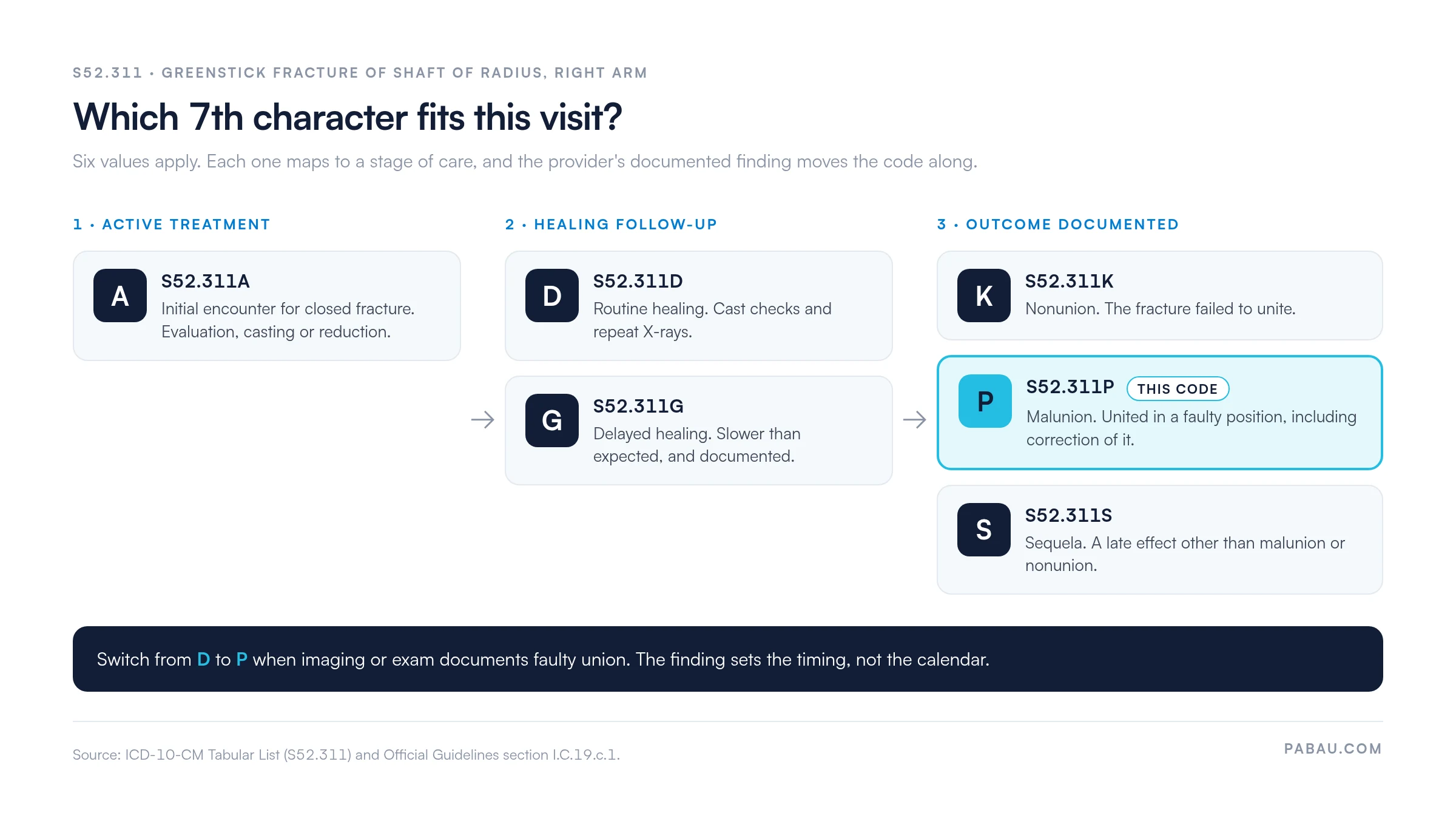
The 7th character on S52.311 describes the encounter, not the fracture. Only six values apply to greenstick shaft fractures, and each one maps to a different stage of care.
Guideline I.C.19.c.1 reserves A, B and C for active treatment, and D, G, K and P for routine care once active treatment ends. Malunion has its own 7th character, P, so S is not used for it.
That makes S52.311P the code for every malunion visit, whether the plan is observation, therapy or corrective surgery. S52.311S covers other late effects, and the condition code for that effect is sequenced first.
The switch from D to P follows the provider’s finding, not the calendar. Once imaging or exam documents union in a faulty position, P applies from the next encounter for that problem. The flow below shows how one fracture moves through all six values.
Audit fracture claims where the 7th character changed between visits. Each change, such as D to P, should match a new finding in the note. If the radiology report and the assessment disagree, query the provider before the claim goes out.
S52.311P inherits the notes printed at category S52, so the code does carry Excludes notes. Check them before you add a second injury code to the claim.
A greenstick fracture is an incomplete break in which one cortex fractures and the opposite cortex bends. It happens mostly in children, whose bones are more flexible than adult bone.
The distal radius, near the wrist, is the most common greenstick site. Fractures of the radial shaft are less frequent, which is one reason site documentation matters for S52.311P.
Malunion follows when the fracture heals with residual angulation or rotation. Children can remodel some angulation as they grow, so providers often observe a mild malunion before deciding on treatment.
A malunion visit can involve several problems, and the note should describe each one present:
S52.311P has no age limit. An adult with a documented malunion of a right radial shaft greenstick fracture takes the same code, provided the record supports it.
Every S52.311P claim depends on a note that supports each character of the code. The record should establish five elements:
Picture a child who falls from a jungle gym and fractures the right radial shaft. The case is illustrative, but the coding path is typical:
Once the coder assigns S52.311P, the claim follows a predictable path. Each step is a chance to catch an error early:
S52.311P pairs with CPT codes for malunion evaluation, therapy and correction. Therapy visits often bill 97110 for exercise and 97530 for functional retraining. The table lists the pairings coders see most often.
Fracture treatment codes describe the acute injury, not malunion care. Closed and open treatment of a radial shaft fracture falls under 25500 to 25525. Codes 25600 and 25605 cover closed treatment of distal radius fractures.
Pairing any of them with S52.311P signals a mismatch, because P means the fracture has already united.
The codes pulled in error for S52.311P differ by side, encounter or fracture type. Check each one against the note before you submit.
S52.311P sits in category S52, fracture of forearm, which splits fractures by bone, site and type. Knowing the boundaries prevents miscoding when old records describe the injury in plain anatomical terms.
Torus, or buckle, fractures of the radius are a separate type. They code to S52.52- at the lower end or S52.11- at the upper end, never to S52.31-.
A torus fracture compresses the cortex without breaking through it, while a greenstick fracture breaks one cortex. Confirm the type in the original treating record before assigning any S52.31- code.
Each neighboring code has its own entry in our library of diagnostic codes. Compare the descriptors side by side when the record is unclear.
Denials on ICD-10 code S52.311P follow predictable patterns. A denial management review usually traces them to one of these errors:
A clean claim for S52.311P clears seven checks before it leaves the practice:
Before submitting a corrective osteotomy claim, compare the operative note with the diagnosis. The repair codes split by one bone or both bones, and by whether an autograft was used. The note should support both choices.
Malunion claims fail when the note and the claim tell different stories. A provider describes angulation in free text, and the coder still picks D or S out of habit.
Pabau, the practice management and billing platform we build, keeps structured clinical notes on each patient record. Templated assessment fields prompt the provider for side, fracture type and healing status. The coder then finds those details in one place.
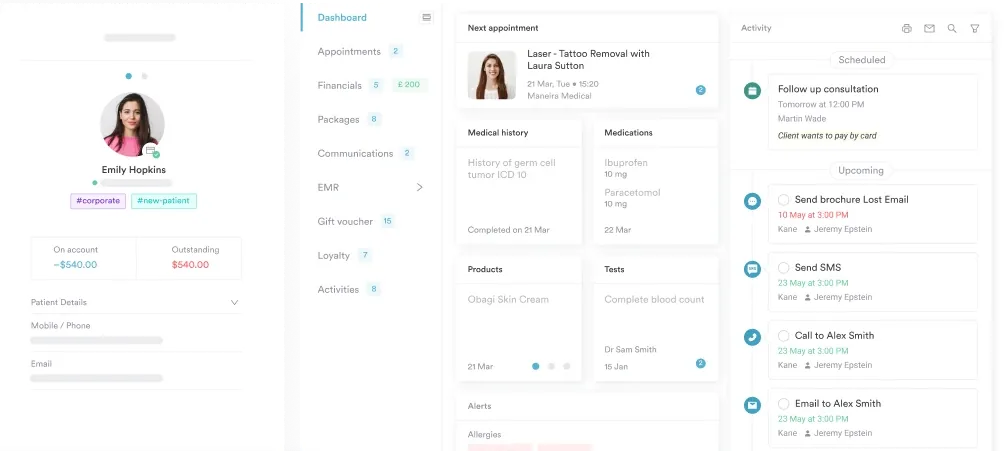
Its claims management software builds each claim from that record. For US practices, the Claim.MD integration submits the claim and returns the payer response to the same record.
Your team spends less time pulling charts to answer payer requests. Fewer claims come back for a wrong 7th character, too.

Pabau’s structured clinical notes and claims management, connected to Claim.MD, help your team document malunion and catch 7th character errors before claims go out.

S52.311P is the correct code once a right radial shaft greenstick fracture has united out of alignment. Malunion has its own 7th character, so S never stands in for it.
The work sits in the note. Document the side, the greenstick type, the shaft site and the malunion finding, and the code choice follows from the record.
Timing is the trade-off to watch. Switch to P too early and the claim outruns the evidence. Switch too late and each malunion visit goes out as routine healing.
Book a demo to see how Pabau links the malunion note to the claim, so your S52.311P claims go out right the first time.

Need a structured approach to medical billing compliance? Medical billing compliance guide covers the documentation and coding standards that prevent claim rejections across ICD-10 categories.
Want to understand how electronic claims move through the system? Electronic remittance advice (ERA) explained breaks down how payer responses map back to submitted diagnosis codes, including fracture claims.
Looking for a denial management workflow? Denial codes in medical billing is a reference guide to CARC denial reason codes and how to respond when a malunion claim is rejected.
Coding a malunion at another radius site? ICD-10 code S52.511P covers a displaced right radial styloid fracture that healed with malunion.
S52.311P means a greenstick fracture of the right radius shaft, seen at a subsequent encounter after it healed with malunion. The visit evaluates or treats that malunion.
No. The sequela code is S52.311S. Malunion has its own 7th character, P, so a malunion visit takes S52.311P instead.
Not under ICD-10-CM itself, which has no national reporting mandate. Some states and payers require one. If you report it, use the subsequent encounter character, D. Place and activity codes go on the initial encounter only.
Yes. When a patient is admitted for corrective osteotomy of the malunited radius, S52.311P can be sequenced first. It names the condition the surgery treats.
S52.311P has been part of ICD-10-CM since the US switched from ICD-9-CM on October 1, 2015. It remains a valid, billable code.
Common pairings are office visits, forearm X-rays, therapy codes 97110 and 97530, and malunion repair codes 25400 to 25420. Acute fracture treatment codes do not fit a malunion encounter.