ICD-10 code S61.201A: Open wound of left index finger without nail damage
ICD-10 code S61.201A covers a left index finger wound of unstated type ICD-10 co...

Last Updated: Oct 16, 2026
Billable Code Specific Code
S52.024K is the billable ICD-10-CM code for nondisplaced fracture of olecranon process without intraarticular extension of right ulna, subsequent encounter for closed fracture with nonunion. You use it when a patient returns after active treatment and imaging shows the right olecranon fracture has stopped healing.
Most of the coding decision sits in the 7th character. Code D or G when the record says nonunion, or K without imaging to back it, and the claim stalls. This guide walks through the 7th-character choice, laterality, documentation, CPT pairings and the denials worth heading off.
Let Pabau's smart automation suggest the right codes, reduce claim denials, and keep your practice compliant—effortlessly.
Automate repetitive tasks and focus on what matters most—your patients.
Reduce coding errors and ensure compliance with the latest regulations.
Clean claims, fewer denials, and faster reimbursements.
Powerful insights and reporting to help your practice thrive.
HIPAA compliant SOC 2 certified GDPR-compliant Trusted by 4,000+ clinics worldwide

S52.024K is for a closed, nondisplaced olecranon fracture of the right ulna at a follow-up visit where nonunion is confirmed.
The 7th character K needs imaging that shows no bridging callus, plus a provider assessment that names the nonunion.
Choosing K over D (routine healing) or G (delayed healing) without that support is a common reason these claims get denied.
K applies to closed fractures only, so an open fracture with nonunion takes M or N instead.
In S52.02-, the 6th character sets both displacement and side, so S52.025K is the left-sided version.
ICD-10 code S52.024K is the billable code for a follow-up visit on a closed, nondisplaced fracture of the right olecranon that has not healed. It sits in category S52, which covers fractures of the forearm.
The full official descriptor comes from the CDC/NCHS ICD-10-CM coding tool. It reads: Nondisplaced fracture of olecranon process without intraarticular extension of right ulna, subsequent encounter for closed fracture with nonunion.
Each character narrows the injury down a little further. Here is what each one tells the payer.
The code is billable and valid for FY 2027, which runs from October 1, 2026 to September 30, 2027. Codes change every October 1, and the CMS ICD-10 codes page carries the official tabular list and update files. Recheck it each year.
Section I.C.19 of the ICD-10-CM Official Guidelines for Coding and Reporting defines the 7th character for injury codes. On a fracture code, it tells the payer two things: the type of encounter, and how healing is going at that visit.
This table lists the closed-fracture characters only, and K belongs to closed fractures. An open olecranon fracture with nonunion takes M (open fracture type I or II) or N (type IIIA, IIIB or IIIC).
The other open-fracture variants exist too. B and C cover the initial encounter, and E and F cover routine healing. H and J cover delayed healing, while Q and R cover malunion.
Time alone never decides K. A visit three weeks after the injury is still coded A while active treatment continues. A visit 18 months later is coded K only if nonunion is confirmed. So the provider’s note has to state the healing status, because “fracture follow-up” on its own does not support K over D.
The S52.024 base code has 16 7th-character variants, and ICD-10 code S52.024K is one of them. Ten of them cover open fractures. The full set (A, B, C, D, E, F, G, H, J, K, M, N, P, Q, R and S) spans every stage of healing.
The decision flow below shows how to choose between the closed-fracture variants at a given visit.
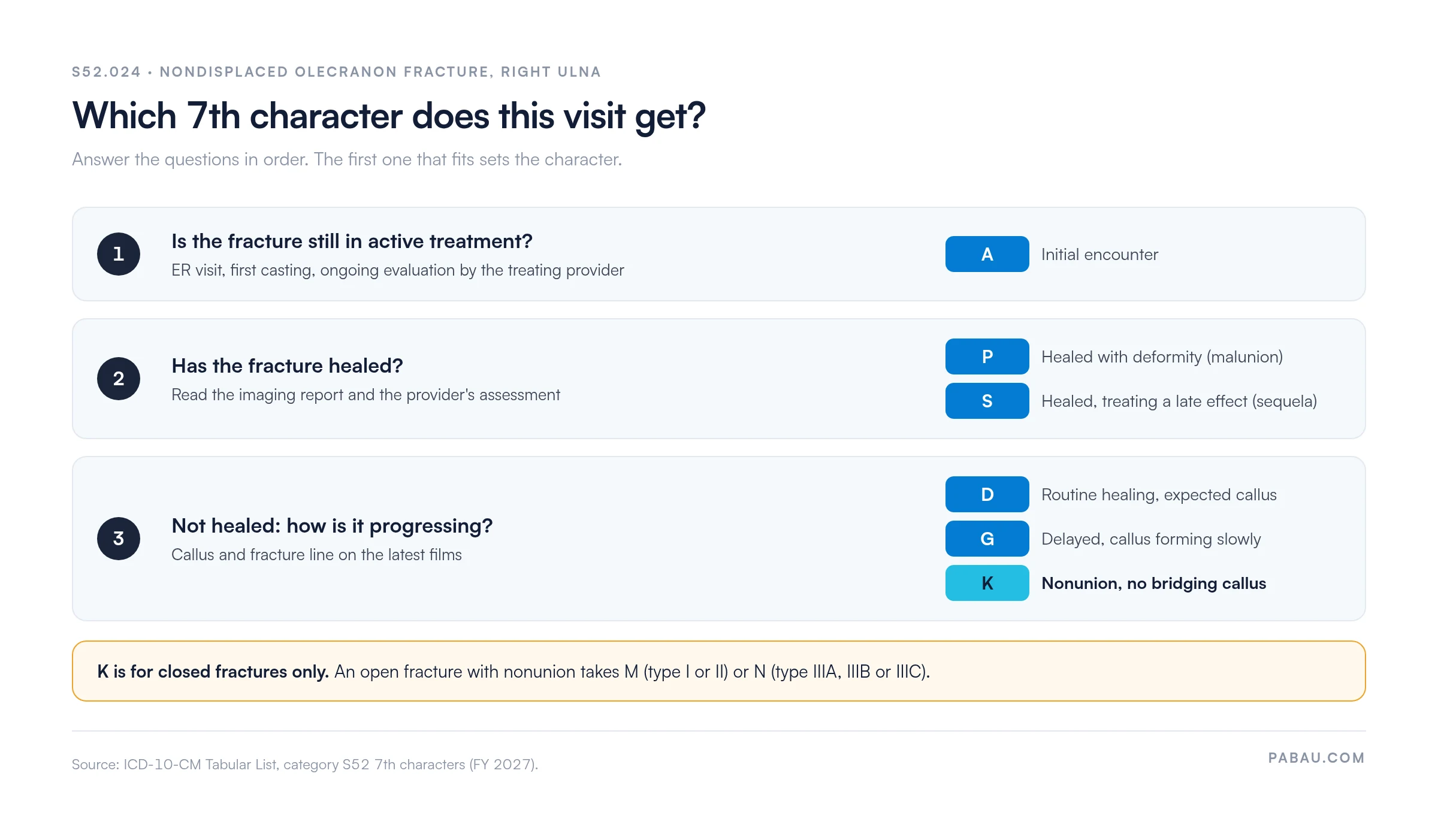
The table then maps each closed-fracture scenario to its code.
The line between G and K is the one coders argue about most. Delayed healing (G) means the fracture is progressing, just slowly. Nonunion (K) means progression has stopped. On imaging, sclerotic fracture margins with no bridging callus point to nonunion. Partial callus with ongoing remodeling points to delayed healing.
Here is how that plays out on a typical chart. A patient fractures her right olecranon in March, and it is treated in a cast. At the four-month visit, the films still show a clear fracture line with no bridging callus. The orthopedist writes “nonunion of right olecranon fracture” in the assessment, so the visit is coded S52.024K.
S52.024K sits where several details meet: the bone, the sub-site, displacement, side and healing status. Change any one of them and you land on a different code.
What this code covers:
Excludes1: traumatic amputation of forearm (S58.-). An Excludes1 note means the two conditions are never coded together, so a traumatic amputation is coded to S58.- instead.
Excludes2: fracture at wrist and hand level (S62.-), and periprosthetic fracture around internal prosthetic elbow joint (M97.4). Excludes2 means that condition is not part of this code, but you can report both when the patient has both.
Neighboring fractures are a separate question. A shaft fracture of the ulna (S52.2-), a radial head fracture (S52.1-) or a coronoid fracture (S52.04-) each has its own code. The look-alike table further down covers them.
In subcategory S52.02-, the 6th character encodes both displacement and side. Digits 1 to 3 are displaced fractures, and digits 4 to 6 are nondisplaced. A wrong digit is a simple data-entry slip, but it can trip payer edits and get the claim rejected.
Make sure the record names the side. “Olecranon fracture with nonunion” with no side forces the unspecified code, S52.026K, and some payers answer that with a records request. If the operative or imaging report names the side, that is enough. The provider doesn’t need to add a separate laterality statement to the progress note.
Check the imaging report header, not just the clinical note, for laterality confirmation. Radiology reports reliably document side; orthopedic notes sometimes omit it. Using the imaging report as the laterality source is defensible in audit.
The record has to support each part of the code: site, displacement, side, encounter type and healing status. K claims are most exposed when the nonunion appears in the imaging report but never reaches the provider’s assessment and plan.
That disconnect is a classic medical billing compliance problem, because a coder can’t assign a diagnosis the provider hasn’t made.
Before you submit, check these five points:
Run through the list before coding K, and submitting a clean claim on the first pass gets much easier. Building the same checklist into the EHR workflow means fewer incomplete notes reach the billing queue.
S52.024K is a diagnosis code, so it always sits on the claim next to a procedure (CPT) code. Which CPT code depends on what was done at the visit, not on the diagnosis.
These are the pairings you’ll see most often in nonunion care.
Surgical dates need extra care. When the surgeon repairs the nonunion, don’t assume the character resets to A. 7th-character selection on a surgical date follows the provider’s documentation and AHA Coding Clinic guidance, so verify before assuming A applies. Check the same guidance for the follow-up visits after surgery.
Medicare and commercial payers treat S52.024K differently depending on the procedure billed with it. Knowing how medical billing works for fracture aftercare helps you see where authorization slows a claim down.
Local Coverage Determinations (LCDs) vary by Medicare Administrative Contractor (MAC) jurisdiction. Check the CMS Coverage Database before you submit claims for surgical nonunion repair, because the medical necessity criteria differ from one jurisdiction to the next.
Subsequent-encounter fracture codes draw plenty of denials, and the 7th character is usually the reason. Good denial management workflows for this code start with a pre-bill audit, not an appeal. Knowing the medical billing denial codes payers send back also helps your team triage and appeal faster.
S52.024K sits among codes that look almost identical in the tabular list. Displacement, sub-site and side are what separate them. The AAPC ICD-10-CM lookup helps you confirm neighboring descriptors in S52.
Displaced versus nondisplaced (S52.021K vs. S52.024K) is the most common mix-up. “Nondisplaced” means the fragments stay in anatomical alignment.
If the first films showed displacement and later films show it persisting or worsening, the displaced code applies, nonunion or not. The PGM Billing ICD-10 lookup tool is handy for cross-checking neighboring S52 codes before you finalize.
When in doubt between K (nonunion) and P (malunion), look for the phrase ‘healed’ in the imaging report or provider note. K = not healed. P = healed with deformity. If the fracture is healed, K is wrong regardless of any remaining deformity.
A nonunion follow-up passes through several hands. The provider reads the films, a coder picks the 7th character, and billing often rekeys the claim in a separate system. Each handoff is another chance for the side, the character or a payer ID to slip.
Pabau, the practice management platform we build, includes claims management software that pre-fills the claim from the patient record. The S52.024K diagnosis and the visit’s CPT codes land on the claim without retyping. Built-in ICD-10-CM and CPT lookup libraries keep codes searchable, and required claim fields are checked before the claim can be sent.
For US practices, the Claim.MD clearinghouse connection handles submission, eligibility checks, ERA posting and claim tracking. So your team sees a rejected claim in the same place it gets fixed.

Pabau’s claims management tools include real-time eligibility checks, required-field validation and Claim.MD submission so practices submit cleaner claims.

S52.024K is a narrow code, and that works in your favor. Once the chart shows a closed, nondisplaced right olecranon fracture with confirmed nonunion, the code choice is settled. The work lies in making sure the chart says so before the claim leaves.
If you change one habit, make it a pre-bill check on the 7th character. Match the imaging report to the provider’s assessment, then confirm the side and that the fracture was closed. It adds a few minutes per claim, and it is far cheaper than an appeal.
Surgical dates are the one place to slow down further, since the character there depends on documentation and Coding Clinic guidance. Book a demo to see how Pabau’s eligibility checks, required-field validation and Claim.MD submission keep fracture follow-up claims moving.

Need to understand the broader denial landscape? What is revenue cycle management covers how fracture aftercare fits into the end-to-end billing cycle.
Submitting electronic remittance for orthopedic claims? Electronic remittance advice explains how ERA files surface denial reason codes for faster appeal routing.
Managing insurance eligibility before fracture follow-up visits? Insurance eligibility verification outlines the pre-visit checks that prevent authorization-related denials.
Yes. S52.024K is a valid, billable ICD-10-CM code for FY 2027, which runs from October 1, 2026 to September 30, 2027. Recheck it each October, when the annual code update takes effect.
S52.024A covers active treatment, such as the ER visit or first casting. S52.024K covers a later visit where nonunion is confirmed. On a surgical repair date, the character follows the provider’s documentation and AHA Coding Clinic guidance, so verify before assuming A applies.
That depends on your payer and state, because external cause reporting is often voluntary. If you report one, such as W01.- for a fall from slipping or tripping, give it the subsequent-encounter 7th character D at each follow-up visit.
No. S52 codes describe traumatic fractures. A fracture caused by disease is coded in chapter 13, for example M84.4- for pathological fractures or M80.- for osteoporotic ones. Those codes carry their own K character for nonunion.
ICD-10-CM sets no time limit, so the provider’s diagnosis decides it. Clinical definitions vary, and many rely on serial films that show no healing progress over several months. Code K only once the provider documents nonunion.