ICD-10 code S62.635G: Left ring distal phalanx, delayed healing
ICD-10 code S62.635G at a glance ICD-10 code S62.635G covers a displaced fractur...

Last Updated: Oct 16, 2026
Billable Code Specific Code
S61.201A is the billable ICD-10-CM code for unspecified open wound of left index finger without damage to nail, initial encounter. It applies while the wound is in active treatment and the note does not name the wound type. "Unspecified" refers to that missing wound type only.
Each finger on each hand has its own code in S61.20-, so the digit and side must both be documented. A named laceration, puncture or bite moves the claim to a more specific code. Miss one of these facts and the claim comes back for recoding. The sections below show how to check each one before you submit.
Let Pabau's smart automation suggest the right codes, reduce claim denials, and keep your practice compliant—effortlessly.
Automate repetitive tasks and focus on what matters most—your patients.
Reduce coding errors and ensure compliance with the latest regulations.
Clean claims, fewer denials, and faster reimbursements.
Powerful insights and reporting to help your practice thrive.
HIPAA compliant SOC 2 certified GDPR-compliant Trusted by 4,000+ clinics worldwide

S61.201A is the billable ICD-10-CM code for an unspecified open wound of the left index finger without damage to the nail, initial encounter.
Laterality in S61.20- is coded per digit, so each finger on each hand has its own code, from S61.200A to S61.207A.
Use S61.201A only when the wound type is undocumented, because a documented laceration, puncture or bite has its own S61.2- subcategory.
A wound that damages the nail moves to S61.3-, and an open fracture of that finger (S62.- with 7th character B) is excluded.
Before you submit, confirm the note records the digit, side, nail status, wound type and treatment phase.
ICD-10 code S61.201A is billable for an unspecified open wound of the left index finger without nail damage. The A marks the initial encounter. It is valid in the FY2026 release listed in the CMS ICD-10-CM code files. Below, one table sets out the full code anatomy.
In the S61.2 subcategory, “other finger” means any finger except the thumb, which is coded in S61.0-. “Unspecified” in the descriptor describes the wound type only. The finger and the side are both stated.
Check the code against the active release in the CDC/NCHS ICD-10-CM browser before submission. S61.201A has been valid since ICD-10-CM took effect on October 1, 2015. Codes for the other digits and wound types sit in our ICD-10-CM code library.
S61.201A applies to an open wound of the left index finger. The exam must also confirm an intact nail and nail bed. Finally, the note must leave the wound type undescribed. Once the clinician names the wound type, a more specific subcategory takes over.
These are the left index finger codes for each documented wound type, all without nail damage:
Nail involvement changes the subcategory again. Subungual lacerations, nail bed injuries and avulsions that tear the nail plate go to S61.3-. That subcategory covers open wound of finger with damage to nail. The unspecified left index finger equivalent is S61.301A.
In practice, S61.201A shows up in emergency departments, urgent care centers and occupational health practices. Take a worker who cuts the left index finger on the job. Staff dress the wound before anyone describes it in detail, so S61.201A fits that visit. If a later note names a laceration or puncture, update the code to match.
The seventh character A does not mark the first calendar visit. Under ICD-10-CM Official Guidelines Section I.C.19.a, A applies to every encounter with active treatment for the injury.
That covers the emergency visit and the surgical repair. It also covers evaluation and continuing treatment by the same or a different clinician.
The most common seventh-character error is switching to D too early. If a follow-up visit still involves active treatment, A remains correct. D applies once the visit is routine care during healing.
Laterality in S61.20- is coded per digit, not per hand. Each finger on each side has its own code, so a note that says “left index finger” maps straight to S61.201A. The full subcategory looks like this:
Every code in the table is billable and takes the seventh characters A, D and S. Code to the highest specificity the record supports. If the note names the index finger but not the hand, query the provider for the side. Use S61.209A only if the side stays undocumented, and S61.208A only for an unlisted other finger.
Before assigning S61.201A, confirm the left index finger appears somewhere in the encounter record. Triage notes, nursing assessments and X-ray requisitions often record the digit and side when the physician’s note does not. Code to the finger and side the record documents.
Several codes near S61.201A look alike but differ on finger, side, wound type or nail status. The flow below runs those checks in order. After it, the table names the one fact that separates each neighbor.
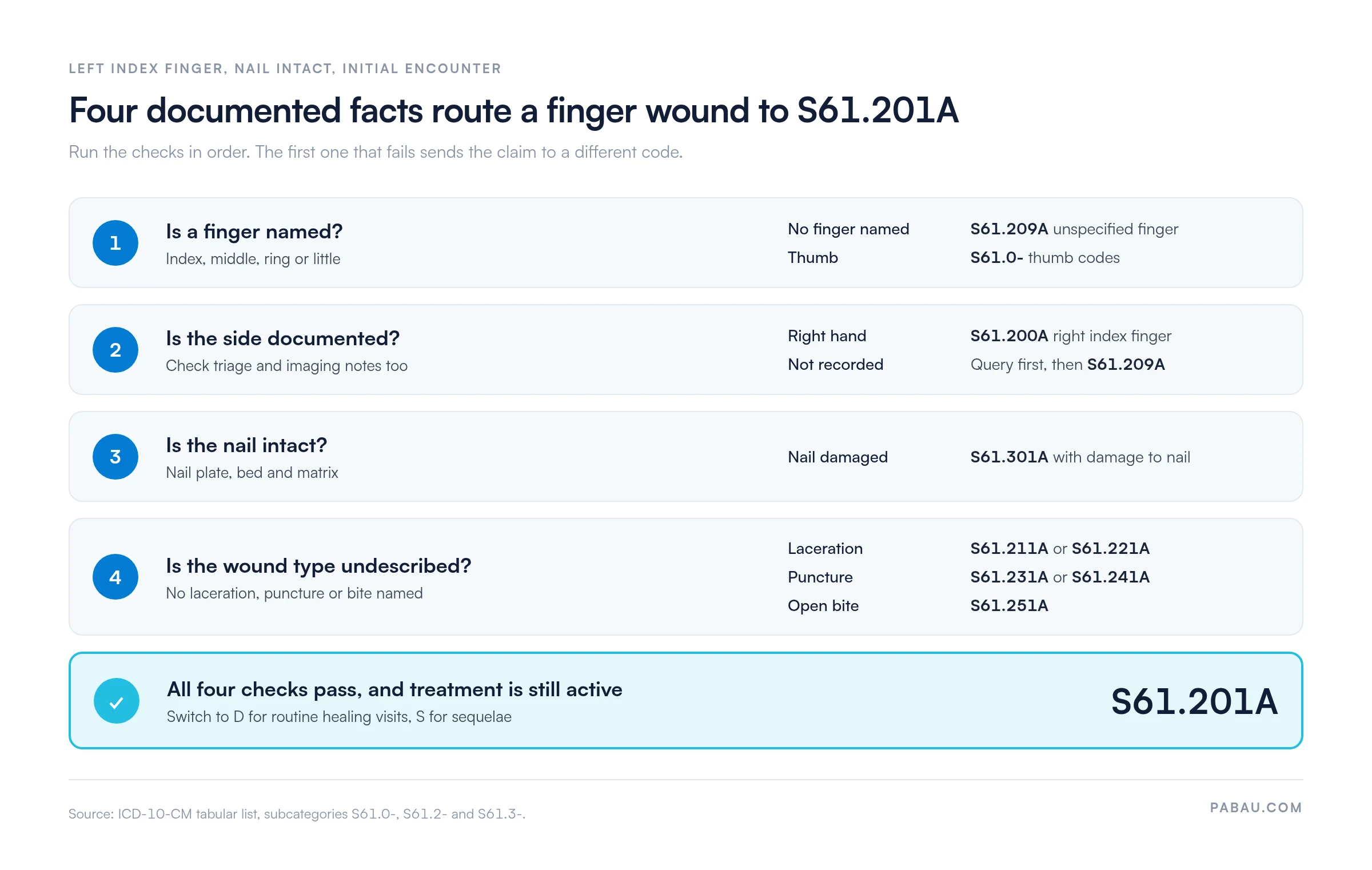
Several instructional notes attach to the S61 category and the S61.2 subcategory. Knowing them prevents rejections from Excludes1 conflicts.
Chapter 20 external cause codes explain how, where and during what activity the injury happened. Per Official Guidelines Section I.C.20, there is no national mandate to report them. Report them where a state mandate or a payer requires it, and to the extent the documentation supports.
S61.201A appears as the diagnosis on claims for finger wound repair or debridement. The CPT code depends on repair complexity and wound length, whatever the diagnosis. A simple closure of 2.5 cm or less, for example, bills as 12001.
The table lists common pairings from the AMA CPT Integumentary section.
Intermediate repair (12041 or 12042) needs a documented layered closure. A heavily contaminated wound that needed extensive cleaning also qualifies. Billing intermediate repair without that documentation is a frequent audit target. The procedure note must record both the wound length in centimeters and the repair type.
Medicare, Medicaid and commercial payers each set their own rules. Still, every finger wound claim passes the same five checkpoints on its way to payment. Each one maps to a stage in standard medical billing workflows.
S61.201A claims are denied for a predictable set of reasons, and each has a specific fix. Good denial management workflows treat them as a checklist before submission.
A clean claim for S61.201A has every field correct on the first submission. Most of the denials above trace back to the note. A pre-bill check against the documentation catches them early. Pre-filling claims with automated claims management also removes rekeying errors.
A note that says only “finger injury” or “hand wound” leaves a reviewer unable to match the code. Run down this checklist before each claim. It follows AAPC coding guidance for injury documentation.
Run a pre-bill review against this checklist before submitting any S61.201A claim. The nail-intact statement and the wound length in centimeters are the two items most easily left out. Both take seconds to add to the note.
Finger wound claims often come back for clerical reasons. A wrong digit, a missing seventh character or a blank payer field is enough. Catching those by hand means a coder rekeys the note into the claim form and rereads it before it leaves.
Pabau, the practice management and billing platform we build, pre-fills the claim form from the patient record. Diagnosis slots are seeded from the recorded problem list. Coders search its ICD-10-CM library for S61.20- codes from the claim itself. The left index finger code is one search away.
Pabau also checks that every claim-required field is complete before the Send button unlocks. US claims go out through Claim.MD, with real-time eligibility checks, claim-status tracking and ERA posting in the same workflow. Your team spends less time on rework and gets paid sooner.

Pabau pre-fills each claim from the patient record and holds it until every required field is complete. Your team submits S61.201A claims without rekeying the note.

S61.201A is a narrow code, and that narrowness protects the claim. It only fits when the note names the left index finger, confirms an intact nail and leaves the wound type open.
So the fix starts upstream, in the chart. Ask clinicians to record the digit, side, nail status and wound type in every finger injury note. Coders can then choose the most specific code on the first pass. A few extra words per note cost far less than a resubmitted claim.
When those notes flow straight into the claim, the right code travels with them. Book a demo to see how Pabau turns a finger wound note into a claim that’s ready to send.

Need a streamlined claims submission workflow? Claim.MD clearinghouse overview covers how electronic claims reach payers, what happens at each validation stage, and how clearinghouse edits catch denials early.
Seeing repeated denial reason codes you do not recognize? Denial codes in medical billing breaks down the most common CARC and RARC codes, what triggers each, and how to correct each denial type.
Want to understand the full revenue cycle behind injury claims? Revenue cycle management explained walks through every stage from eligibility verification through payment posting, including where injury claims tend to stall.
Did the laceration damage the nail? ICD-10 code S61.311A covers a left index finger laceration without foreign body where the nail is damaged.
Yes. S61.201A is a billable, specific ICD-10-CM code, valid in the FY2026 code set. Annual updates take effect each October 1, so check the active CDC/NCHS release before you submit.
Query the provider first, since triage and imaging notes often record the side. If the side stays undocumented, report S61.209A, the unspecified-finger code. S61.208A is for an unlisted other finger, not a missing side.
Use S61.211A for a laceration without foreign body and S61.221A when a foreign body is present. Both assume an intact nail. A laceration that damages the nail moves to S61.311A or S61.321A.
No. Thumb wounds are coded in S61.0-, which the S61.2 subcategory lists as an Excludes2 note. An unspecified open wound of the left thumb without nail damage is S61.002A.
Yes. S61.201A can be first-listed when the finger wound is the reason for the visit. External cause codes never can, so list the W, Y92, Y93 and Y99 codes after it.
Switch to D once active treatment ends and the patient gets routine care while the wound heals. A wound check or suture removal is a typical D encounter. Until then, A stays correct.