ICD-10 Code S79.109P: Physeal fracture with malunion
ICD-10 Code S79.109P: Definition and quick-reference facts ICD-10 Code S79.109P ...

Last Updated: Nov 10, 2026
Billable Code Specific Code
S79.141K is the billable ICD-10-CM code for Salter-Harris Type IV physeal fracture of lower end of right femur, subsequent encounter for fracture with nonunion.
The K seventh character does not mean any follow-up visit. It reports a fracture that has failed to unite, and the record must show it. Serial imaging should show no bridging callus or no healing progress over the expected timeframe, and the physician must state nonunion. A fracture that healed in a poor position is malunion, which takes the P seventh character instead.
Let Pabau's smart automation suggest the right codes, reduce claim denials, and keep your practice compliant—effortlessly.
Automate repetitive tasks and focus on what matters most—your patients.
Reduce coding errors and ensure compliance with the latest regulations.
Clean claims, fewer denials, and faster reimbursements.
Powerful insights and reporting to help your practice thrive.
HIPAA compliant SOC 2 certified GDPR-compliant Trusted by 4,000+ clinics worldwide

ICD-10 Code S79.141K covers a Salter-Harris Type IV physeal fracture of the right distal femur at a follow-up visit where nonunion is documented.
The K seventh character means nonunion, so the fracture has failed to unite. A fracture that healed in a poor position is malunion, which takes P instead.
Laterality errors drive denials. S79.141K is the right femur, S79.142K the left and S79.149K unspecified, so confirm the side in every encounter note.
Pabau, the practice platform we build, connects to Claim.MD so US orthopedic and pediatric practices can submit 837P claims and track their status.
ICD-10 Code S79.141K reports a Salter-Harris Type IV physeal fracture of the right distal femur at a follow-up visit for nonunion. The fracture has failed to unite, and the code applies only to a skeletally immature patient whose record documents nonunion.
The code packs six distinct pieces of clinical information into seven characters. Each character is a coded assertion that documentation must support. If any one of them is wrong, the whole code is wrong.
Per the CDC/NCHS ICD-10-CM tabular list, the S70-S79 range covers injuries to the hip and thigh. Within that range, the S79.1 subcategory captures physeal fractures at the lower end of the femur. Only skeletally immature patients injure this site, since the growth plate closes at skeletal maturity.
A Salter-Harris Type IV fracture is a growth plate injury whose fracture line crosses three anatomical zones. It runs through the metaphysis, the physis (growth plate) and the epiphysis. That transphyseal path is what defines Type IV and separates it from lower-severity types.
The Salter-Harris system, established in 1963, classifies physeal fractures by fracture line path and associated risk of growth disturbance. In standard pediatric orthopedic teaching, Type IV carries a moderate-to-high risk of physeal arrest if it is not anatomically reduced.
The distal femoral physis is one of the most active growth centers in the lower extremity. Because Type IV fractures cross the entire physis, anatomical reduction and stable fixation are typically required. That makes precise ICD-10 documentation critical when justifying surgery to payers.
The seventh character K means the patient is at a subsequent encounter and the fracture has failed to unite. Three facts must hold together. The visit is a follow-up, the expected healing period has passed, and the physician has documented nonunion.
K does not mean malunion. In every ICD-10-CM fracture category, K reports nonunion and P reports malunion. The two letters are easy to swap, and a swapped letter misstates the patient’s condition.
Nonunion is uncommon after a distal femoral physeal fracture, because bone near the growth plate heals quickly in children. The complication these fractures more often leave behind is early closure of the growth plate, which K does not describe.
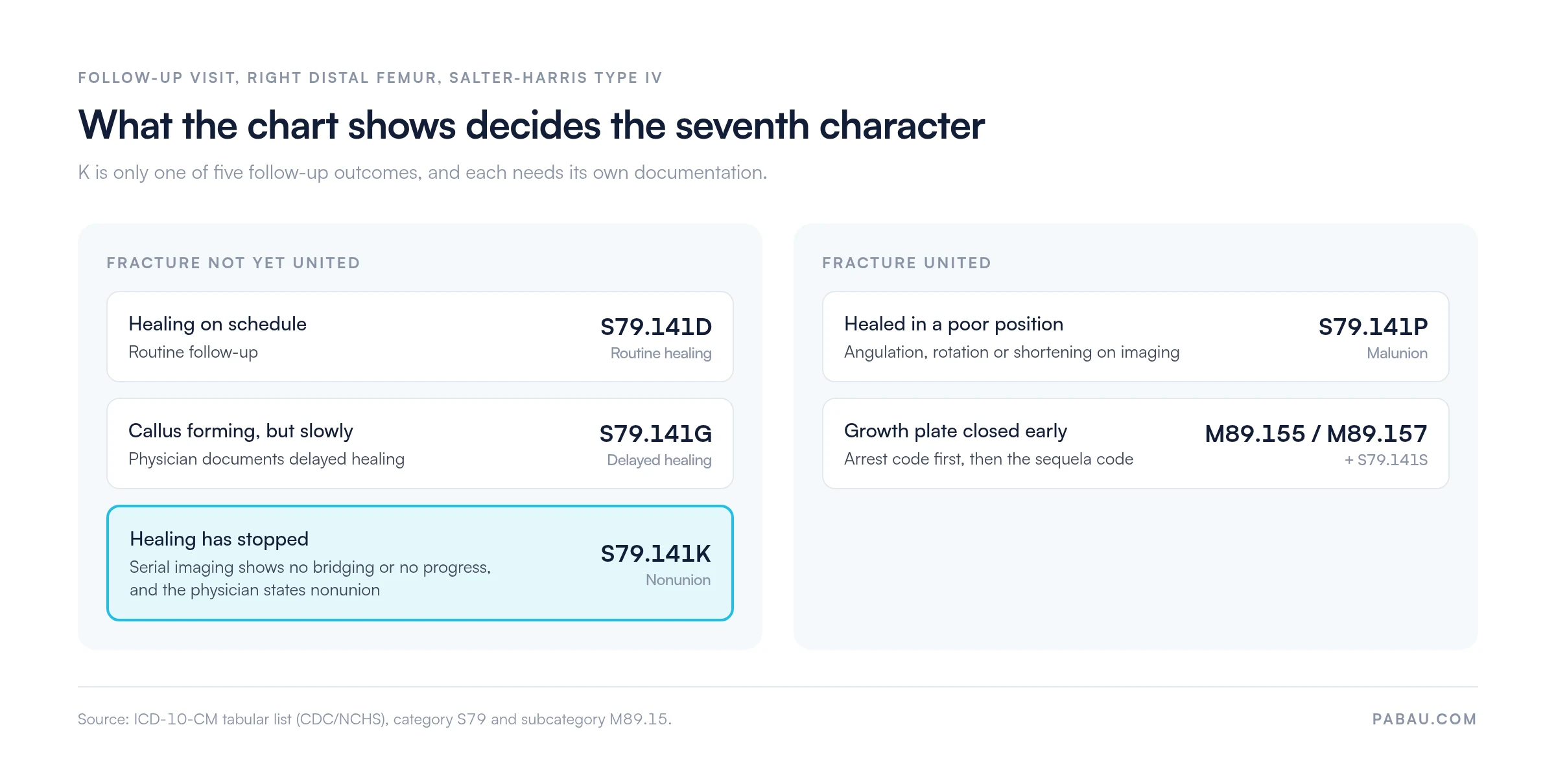
Coders frequently confuse the G, K and P seventh characters. Each describes a different healing outcome, and each needs its own documentation before it can be assigned.
The critical distinction sits between G and K. Delayed healing means the fracture is still uniting, only slowly. Nonunion means healing has stopped. A note that says “slow to heal” or “callus forming” supports G, not K.
The second boundary separates nonunion from malunion. If the bone has united with angulation, rotation or shortening, the fracture is malunited and the code is S79.141P. A routine follow-up with a healing fracture takes D.
A Type IV fracture that heals can still stop the physis from growing. That growth arrest is neither nonunion nor malunion, so it never justifies K or P. Code the arrest itself from subcategory M89.15.
Angular deformity or a leg-length difference from a growth arrest follows the same logic. The residual condition is coded first, and the injury code takes the S seventh character.
Put together, every follow-up outcome for this fracture turns on one question first: has the bone united?
S79.141 is not a billable code on its own. It requires a seventh character to be complete. Below is the full reference for the right-femur variant (S79.141x) and its left-side counterpart (S79.142x), per the CDC/NCHS ICD-10-CM web tool.
Active treatment, including the original open treatment, is reported with S79.141A. Once that phase ends, each visit moves to D, G, K, P or S.
Unspecified laterality (S79.149K) should only be used when the operative report and clinical note do not state which femur is involved, which is rare. Payers routinely flag unspecified codes for additional documentation requests.
Subcategory S79.1 carries no Excludes1 or Excludes2 note of its own in the FY2026 ICD-10-CM tabular. The notes that govern ICD-10 Code S79.141K sit in the block above it and in the neighboring femur and M84 codes.
Documentation supporting ICD-10 Code S79.141K must address six elements. Missing any one of them gives payers grounds for a denial or a medical necessity review.
When plain films are equivocal, a CT billed as 73700 can confirm that no bridging bone has formed. Running these claims through orthopedic claims software with a pre-submission review catches an unsigned or incomplete note before the payer does.
Most denials on ICD-10 Code S79.141K trace back to the seventh character. The payer sees a nonunion claim, looks for the proof, and denies when the chart does not carry it.
Denials of this kind usually arrive as medical necessity or missing-information denials. The denial codes in medical billing guide explains how to read the CARC and RARC codes behind them. A documented denial management routine then turns each denial into a template fix.
Add a hard stop to the encounter template for K. The visit note cannot close until the physician has typed nonunion and the date of the last imaging study. That one prompt blocks the two commonest K denials, a missing statement and a missing time frame.
S79.141K is a diagnosis code, so it justifies services rather than describing them. Which services depend on the treatment plan. The table lists the CPT codes most often linked to a distal femur nonunion.
CPT codes 27470 and 27472 cover repair of either a nonunion or a malunion. The diagnosis code tells the payer which one applies. S79.141K supports nonunion repair, while S79.141P points to a malunion. Check each payer policy before scheduling, since prior authorization rules differ.
A K claim is assembled from several records. The imaging reports show failure to unite, the operative note gives the side and the fracture type, and the progress note carries the physician statement. When one of them is missing, the denial arrives weeks later.
Pabau keeps those records in one client file, with treatment notes, images and forms stored against each appointment. The encounter template can prompt for laterality, healing status and the nonunion statement while the patient is still in the room.
For US practices, Pabau connects to Claim.MD, so your team can submit 837P claims and track their status from the same record. Pabau’s claims management software shows which nonunion claims are paid, pending or denied. Your coders then spend their time on the right fixes.

Pabau keeps imaging, physician notes and electronic claims in one client record. Orthopedic and pediatric practices can check a fracture code against its documentation before submission.

S79.141K is a narrow code with a strict test. The fracture is a Type IV physeal injury of the right distal femur, and the bone has stopped healing. The chart has to say so in the physician’s own words.
That test also protects the clinical story. A fracture that is merely slow takes G, one that united badly takes P, and a stopped growth plate takes a physeal arrest code. Choosing among them at charge capture costs seconds, while a denial costs a rework cycle.
If your practice reworks fracture claims often, start with the encounter template. Book a demo to see how Pabau supports fracture documentation and electronic claim submission.

Need the initial encounter code? S79.141A covers the same right distal femur fracture during active treatment.
Need another nonunion example? S72.435M walks through documenting a condyle fracture that never united.
Confirming nonunion on imaging? CPT code 73700 explains billing a CT of the lower extremity without contrast.
Facing a denial? Denial codes in medical billing maps common CARC and RARC codes to the right correction.
ICD-10 Code S79.141K is a billable ICD-10-CM diagnosis code for a Salter-Harris Type IV physeal fracture of the lower end of the right femur. It is used at a subsequent encounter when the fracture has failed to unite. The physician must document nonunion.
Yes. S79.141K is a complete seven-character code, so it can be submitted on claims. The record must show right laterality, a Salter-Harris Type IV fracture and a physician statement of nonunion, supported by serial imaging.
K reports a subsequent encounter for a closed fracture with nonunion. The bone has stopped healing. It does not mean any follow-up visit. Routine healing takes D, delayed healing takes G, and malunion takes P.
S79.141K reports nonunion, where the fracture has not united. S79.141P reports malunion, where the fracture united in an abnormal position such as angulation, rotation or shortening. Imaging and the physician note decide which one applies.
The left femur code is S79.142K. Use S79.149K only when the record does not state which side is involved. Choosing the unspecified code when the side is documented can trigger a specificity flag.
A growth arrest is neither nonunion nor malunion, so K and P do not apply. Code the arrest from subcategory M89.15, then add S79.141S when the arrest is a late effect of the fracture, per the sequela guideline.