ICD-10 Code V91.84XS: Other burn due to burning watercraft
ICD-10 Code V91.84XS: overview and key facts ICD-10 Code V91.84XS identifies the...

Last Updated: Oct 30, 2026
Billable Code Specific Code
S72.452C is the billable ICD-10-CM code for an open, displaced supracondylar fracture of the left femur at the initial encounter. Its full descriptor adds two details. The fracture has no intracondylar extension, and the open wound is Gustilo type IIIA, IIIB, or IIIC.
The fracture sits in the distal femoral metaphysis, just above the condyles, so it is not a medial or lateral condyle fracture. Most errors on this code come from the seventh character. Coders pick A (closed) when the record documents an open fracture, or C without a recorded type III Gustilo grade. Without that grade, the guidelines assign B.
Let Pabau's smart automation suggest the right codes, reduce claim denials, and keep your practice compliant—effortlessly.
Automate repetitive tasks and focus on what matters most—your patients.
Reduce coding errors and ensure compliance with the latest regulations.
Clean claims, fewer denials, and faster reimbursements.
Powerful insights and reporting to help your practice thrive.
HIPAA compliant SOC 2 certified GDPR-compliant Trusted by 4,000+ clinics worldwide

S72.452C codes an open, displaced supracondylar fracture of the left femur with no intracondylar extension. It is billable in the current ICD-10-CM code set.
Seventh character C means an initial encounter for a Gustilo type IIIA, IIIB, or IIIC open fracture. Type I or II uses B, and a closed fracture uses A.
The record must state the side, the supracondylar site, open status, and a type III Gustilo grade. With no grade stated, the guidelines assign B, not C.
Open treatment of this fracture usually pairs with CPT 27511. A fracture that splits between the condyles is S72.462C and pairs with CPT 27513.
Pabau’s claims management software submits S72.452C claims electronically through its Claim.MD integration.
ICD-10 code S72.452C is a valid, billable ICD-10-CM diagnosis code, listed in the CDC/NCHS ICD-10-CM web tool. Officially, it reads: Displaced supracondylar fracture without intracondylar extension of lower end of left femur, initial encounter for open fracture type IIIA, IIIB, or IIIC.
The code sits in chapter 19 (S00-T88, injury, poisoning and certain other consequences of external causes). Within that chapter it falls in block S70-S79 (injuries to hip and thigh), category S72 (fracture of femur), and subcategory S72.45. The sixth character 2 marks the left side.
The quick-reference table below shows S72.452C alongside its closest sibling codes.
S72.452 covers a fracture above the femoral condyles that does not extend into the joint between them. Coders often confuse it with the condyle codes, S72.42- (lateral condyle) and S72.43- (medial condyle). It is also easy to miss an intracondylar split, which moves the fracture to S72.46-.
The supracondylar region is the distal femoral metaphysis, the flared lower end of the femur just above the medial and lateral condyles. A fracture here sits between the shaft and the knee joint surface. In younger adults it usually follows high-energy trauma, such as a motor vehicle collision or a fall from height.
That high-energy pattern is why open Gustilo type III injuries are common at this site. “Without intracondylar extension” means the fracture line stays above the condyles. It does not run down between them into the knee joint.
“Displaced” means the fracture fragments have shifted out of anatomical alignment. Nondisplaced fractures of the left side use S72.455-, a separate code family. The official guidelines code a fracture to displaced when the record does not say either way.
ICD-10-CM S72.452 requires a seventh character on every claim. The character encodes both the fracture type (open or closed) and the encounter stage (initial, subsequent, or sequela). Per the CMS ICD-10-CM guidelines, Section I.C.19.c, coders choose it from the medical record, not from an assumed encounter type.
The Gustilo-Anderson classification, first published in the Journal of Bone and Joint Surgery in 1976, grades open fractures by wound size, contamination, and soft-tissue damage. ICD-10-CM uses this grading directly to decide whether seventh character B or C applies.
The Gustilo grade is a clinical call made by the treating surgeon at initial evaluation or surgery. Coders assign C only when the emergency or operative report documents type IIIA, IIIB, or IIIC. When an open fracture has no documented grade, the guidelines assign the type I or II character, B.
When the surgeon’s note says ‘open fracture’ without a Gustilo grade, query the surgeon before you finalize the seventh character. If no grade comes back, the guidelines default to B. Billing C without a documented type III grade invites audit and recoupment.
All three initial encounter characters describe the same fracture site, side, and displacement. They differ only in whether the fracture is open and, for open fractures, its Gustilo grade. Getting this choice wrong is the most common S72.452 denial trigger.
Check the AAPC ICD-10-CM code lookup for the full descriptor and any guideline notes for the current code year.
Seventh character C applies to every encounter where the patient receives active treatment for the fracture. Once active treatment ends, the code switches to a subsequent encounter character for routine care during healing. The switch depends on clinical status, not on time elapsed.
Aftercare Z codes such as Z47.89 are not used for traumatic fractures. Section I.C.19.c.1 of the guidelines tells coders to keep the acute fracture code with the right seventh character instead. Follow-up care for this fracture therefore stays on S72.452 with F, J, N, R, or S.
Section I.C.19.c says fracture codes follow the level of detail in the medical record. For S72.452C, the record must support all six elements below. Maintaining medical billing compliance starts with an operative note that covers each one before the claim goes out.
The record must also support initial encounter status. That usually means the emergency visit, the operative note, or another encounter for active fracture treatment. The decision path below runs those checks in order and shows which code each failed check points to instead.
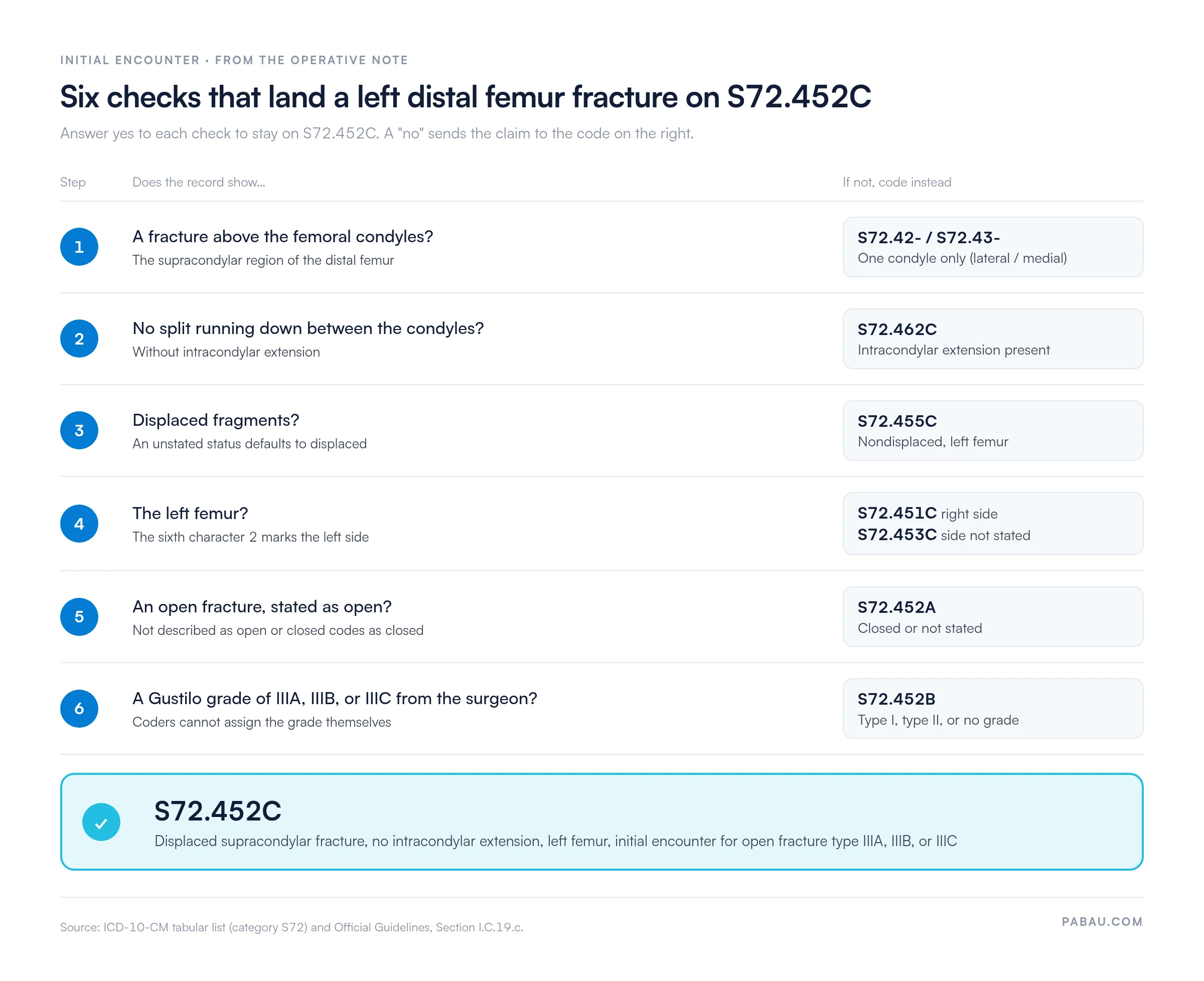
External cause codes from chapter 20 describe how the injury happened. Section I.C.20 of the guidelines says there is no national requirement to report them. Report them when the record documents the cause, unless a payer or a state mandate requires them anyway.
Laterality is built into the code itself. In S72.45-, the sixth character marks right (1), left (2), or unspecified (3) for displaced fractures. S72.452C billed for a right-sided fracture is a documentation mismatch that payers flag on audit.
The CPT code on a claim must match the procedure documented in the operative report. The diagnosis code does not decide which CPT applies. Even so, open type III supracondylar fractures are usually debrided and then fixed, either with open reduction and internal fixation or with external fixation first.
Check NCCI edits before billing debridement alongside fixation on the same claim. Confirm each procedure descriptor in a current CPT code reference before you pair it with S72.452C. Verify current reimbursement against the CMS Physician Fee Schedule lookup, as RVU-based rates update every year.
Medicare pays for S72.452C fracture care under standard Part A and Part B rules, and the fracture repair CPT carries a 90-day global period. Understanding medical billing fundamentals for trauma cases helps orthopedic billing teams prepare claims that pass first review. The electronic remittance advice returned after adjudication shows the CARC code behind any rejection.
Open fracture claims need more documentation detail than closed fracture claims, so they fail more often. Effective denial management workflows for orthopedic practices start with a pre-submission check of the points below. A clean claim submission the first time avoids the revenue delays of an appeal.
Build a pre-submission checklist for S72.452C claims. (1) Open fracture documented. (2) Gustilo type III grade recorded by the surgeon. (3) Left side matches the code. (4) No intercondylar extension. (5) CPT matches the operative note. (6) External cause codes added where the payer requires them.
S72.452C inherits tabular notes from the S72 category and the S72.4 subcategory. They decide which codes may sit alongside it on the claim.
The table below covers the neighbor codes most often confused with S72.452C and when each applies instead.
During physical therapy and other rehabilitation after this fracture, subsequent encounter characters (F, J, N, R) govern the coding. The initial encounter character C no longer applies.
An open supracondylar fracture claim passes through several hands. The surgeon dictates the operative note, and a coder reads it for side, fracture pattern, and Gustilo grade. A biller then builds the claim, and each handoff can turn left into right or C into B.
Pabau, the practice management and billing platform we build, handles electronic claims submission via Claim.MD. The integration connects Pabau’s claims management software to a US clearinghouse reaching thousands of payers. Built-in CPT and ICD-10 catalogs help your team check code pairings before a claim goes out.
Remittance advice comes back into Pabau as well, so a denial reason sits beside the claim it belongs to. Your billing team can trace a rejected S72.452C claim back to the operative note behind it. Fixing that note template stops the same denial from returning on the next claim.

Pabau integrates with Claim.MD to submit S72.452C claims electronically, with CPT and ICD-10 catalogs built in. See how orthopedic and multi-specialty practices manage complex fracture billing.

S72.452C is correct only when the record supports a precise set of facts. The fracture sits above the left femoral condyles with no split between them. It is displaced and open, and the surgeon graded it Gustilo type IIIA, IIIB, or IIIC. Change any one fact and a different code applies, such as S72.451C, S72.462C, or S72.452B.
The most reliable fix sits upstream of coding. An operative note template that asks for side, intercondylar extension, and Gustilo grade removes most of the queries this code generates. Pabau then carries the coded encounter into a Claim.MD submission with CPT and ICD-10 catalogs built in. See how it handles orthopedic trauma billing by booking a demo.

Need to understand how claims get processed after submission? Medical claims clearinghouse guide explains how electronic claims move from practice to payer and where they can fail.
Looking for guidance on coding denial codes on the remittance? Denial codes in medical billing covers the most common CARC and RARC codes you will see on rejected fracture claims.
Want to understand how eligibility checks prevent claim rejections? Insurance eligibility verification outlines how real-time eligibility checks flag inactive or lapsed coverage before a claim is submitted.
ICD-10 code S72.452C is the diagnosis code for a displaced supracondylar fracture without intracondylar extension of the lower end of the left femur. It applies at the initial encounter for an open fracture of Gustilo type IIIA, IIIB, or IIIC. The fracture sits above the femoral condyles and does not split the joint between them.
Yes, S72.452C is a valid billable ICD-10-CM code in the current code set. It can be reported as a principal or secondary diagnosis. Its sixth character already marks the left side, so no separate laterality code is needed.
S72.452A is the initial encounter for a closed fracture. S72.452C is the initial encounter for an open fracture graded Gustilo type IIIA, IIIB, or IIIC. The site, side, and displacement are identical, and using A for a documented open fracture is a common denial trigger.
Use seventh character C for an initial encounter with a Gustilo type IIIA, IIIB, or IIIC open fracture. Type I and II open fractures use B, and closed fractures use A. When an open fracture has no documented grade, the guidelines assign B.
There is no national requirement to report external cause codes, according to Section I.C.20 of the ICD-10-CM guidelines. Report them when the record documents how the injury happened, and always when a payer or state mandates them. Typical examples are a W-series fall code or a V-series transport code.
Follow-up care stays on the S72.452 code with a subsequent encounter character. Use F for routine healing, J for delayed healing, N for nonunion, R for malunion, and S for sequela. The guidelines say aftercare Z codes such as Z47.89 are not used for traumatic fractures.
CPT 27511 is the usual match, covering open treatment of a supracondylar fracture without intercondylar extension. CPT 27513 is for fractures with intercondylar extension, which code to S72.462C instead. Debridement of the open wound may add 11010 to 11012 when the operative note documents it.
S72.452C codes a fracture above both condyles, in the distal femoral metaphysis. A fracture of the medial condyle alone codes to S72.43-, such as S72.432C on the left. A fracture of the lateral condyle alone codes to S72.42-.
Common reasons are a closed-fracture character on an open fracture, or C billed without a documented type III grade. Others are a side that does not match the operative note, or a condyle fracture coded as supracondylar. Billing CPT 27513 with S72.452C also triggers denials, because 27513 implies intercondylar extension.