ICD code S79.109P – Physeal fracture with malunion
Billable Code•Specific Code
Code Definition
S79.109P is the billable ICD-10-CM code for unspecified physeal fracture of lower end of unspecified femur, subsequent encounter for fracture with malunion. It applies once active treatment has ended and the treating provider documents that the growth plate fracture healed out of alignment.
Two parts of the code stay unspecified: the Salter-Harris type and the side of the femur. The 7th character P is specified, because it records malunion at a follow-up visit. When the record names the type or the side, a more specific S79.1 code replaces S79.109P.
Related Information
Chapter
S00-T88 Injury, poisoning and certain other consequences of external causes
Category
S79 Other and unspecified injuries of hip and thigh
Group
S79.109 Unspecified physeal fracture of lower end of unspecified femur
Automate repetitive tasks and focus on what matters most—your patients.
Improve accuracy
Reduce coding errors and ensure compliance with the latest regulations.
Get paid faster
Clean claims, fewer denials, and faster reimbursements.
Grow with confidence
Powerful insights and reporting to help your practice thrive.
HIPAA compliant•SOC 2 certified•GDPR-compliant•Trusted by 4,000+ clinics worldwide
Key takeaways
S79.109P describes a physeal (growth plate) fracture of the distal femur when neither the Salter-Harris type nor the affected side is documented.
The 7th character P applies only at a subsequent encounter, after active treatment has ended, when the treating provider documents malunion.
Billing P with an active-treatment CPT code such as 27516 or 27519 is a common denial trigger for this code.
Pabau, the practice management platform we build, checks patient eligibility in real time through Claim.MD and submits your coded claims electronically.
ICD-10 Code S79.109P: Definition and quick-reference facts
ICD-10 Code S79.109P reports a growth plate fracture of the lower femur that has healed with malunion, seen at a follow-up visit. The record names neither the Salter-Harris type nor the side.
The code has been billable since October 1, 2015, and it is valid in the FY 2026 code set. Confirm it against the current FY 2027 tabular before you bill.
It sits in Chapter 19 of the ICD-10-CM code set, within the S70-S79 range for injuries to the hip and thigh. Chapter 19 covers injury, poisoning, and certain other consequences of external causes.
Field
Value
Code
S79.109P
Official descriptor
Unspecified physeal fracture of lower end of unspecified femur, subsequent encounter for fracture with malunion
Code system
ICD-10-CM (US clinical modification)
Billable
Yes, as a 7-character code at full specificity
Chapter
19: Injury, poisoning, and certain other consequences of external causes (S00-T88)
Code range
S70-S79: Injuries to the hip and thigh
Valid FY
Valid in the FY 2026 code set. Confirm against the current FY 2027 tabular.
Primary patient population
Pediatric and adolescent patients (growth plate present)
Code descriptor breakdown for S79.109P: What each segment means
Each segment of S79.109P records a clinical and coding decision. Read left to right, the code shows what the documentation has to support.
Segment
Meaning
Documentation driver
S79
Other and unspecified injuries of hip and thigh
Injury falls within the hip/thigh anatomical region (S70-S79)
.1
Physeal fracture of lower end of femur
Fracture involves the physis (growth plate) at the distal femur
.10
Unspecified physeal fracture type
Salter-Harris classification not documented or not determinable from imaging
.109
Unspecified laterality (side not specified)
Physician documentation is silent on whether the fracture is right or left
P
Subsequent encounter for fracture with malunion
Active treatment has ended. The treating provider documents that the fracture healed out of alignment.
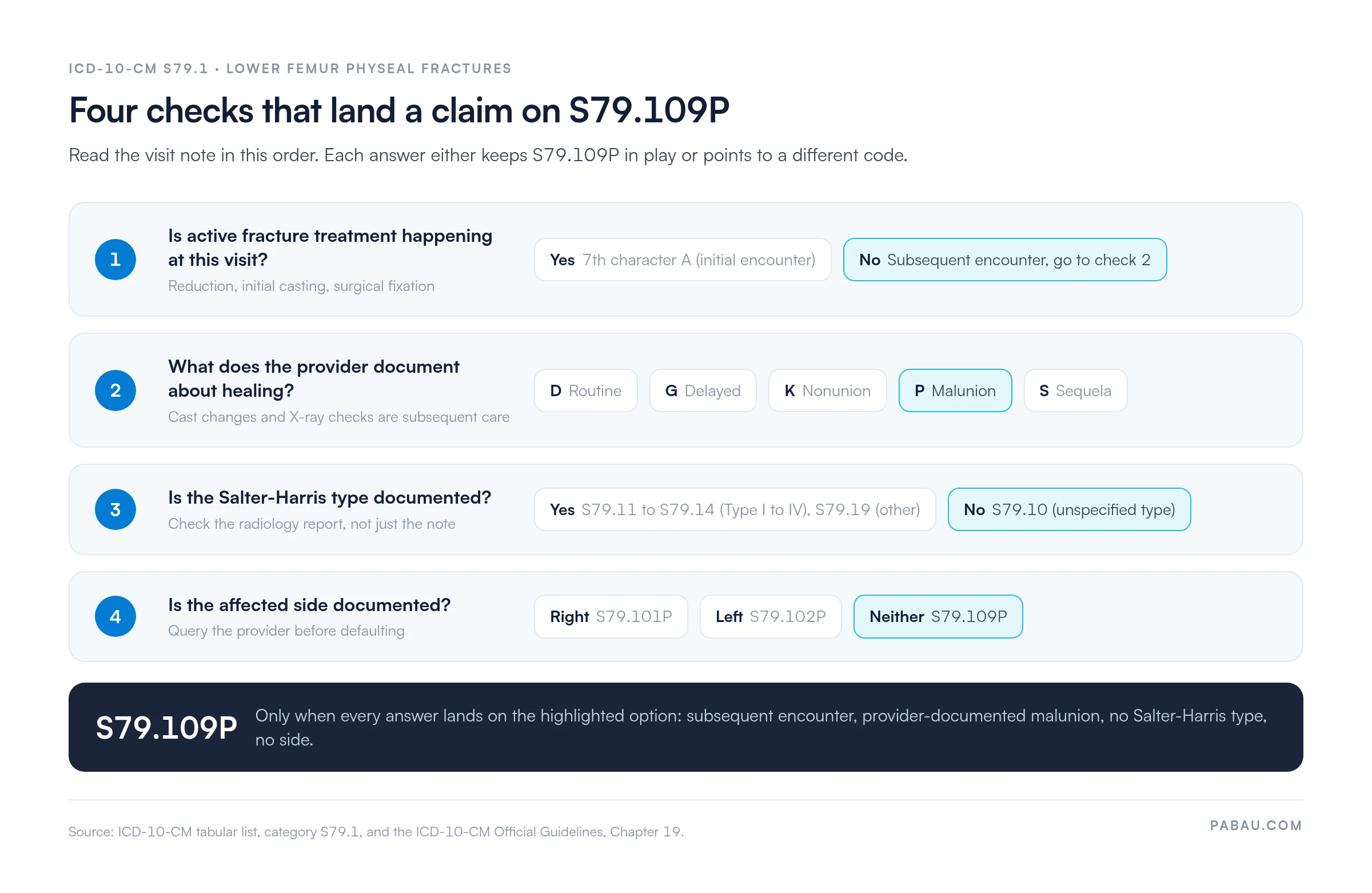
Two unspecified decisions sit in this code: the Salter-Harris type and the side of the femur. The 7th character P is specified, because it records malunion at a subsequent encounter. Each unspecified element should prompt a provider query before the coder accepts it. The four checks below run in the order a coder reads the visit note.
S79.109P is the right code only when all four answers land on the highlighted option. Code structure from the ICD-10-CM tabular list, category S79.1, and the Official Guidelines.
A query on the side and the Salter-Harris type before submission prevents the specificity edits that most often return this code.
Clinical context: Physeal fractures of the distal femur
A physeal fracture of the lower end of the femur runs through or involves the epiphyseal plate at the distal femur. That plate is the cartilage growth zone present in skeletally immature patients.
The physis is the weakest structural element in a child’s bone. Shear and valgus forces that would sprain a ligament in an adult often fracture the growth plate in a child or adolescent instead.
Typical patient population: Children and adolescents aged 10-16, more often male, with open growth plates confirmed on imaging
Common mechanisms: Sports contact, falls from height, motor vehicle trauma, and valgus stress during landing
Clinical presentation: Distal thigh or knee pain, swelling, restricted range of motion, and tenderness at or just above the joint line
Why laterality matters: Documenting the side matters for the clinical record, for later leg-length comparison, and for code specificity
When “unspecified” is appropriate: Only when the provider’s note does not state the side. Query the provider before defaulting to unspecified
Malunion is a recognized complication of physeal fractures. A distal femur growth plate fracture can heal with angular deformity, leg-length discrepancy, or rotational malalignment. When the provider documents that outcome, the coder reports the 7th character P on subsequent visits. P separates the visit from routine healing follow-up (D) and from failed healing (K, nonunion).
Salter-Harris types and neighboring S79.1 codes
The Salter-Harris system grades physeal fractures by how the fracture line crosses the growth plate, which shapes the risk of growth disturbance. ICD-10-CM gives each Salter-Harris type its own subcategory under S79.1, so the provider’s or radiologist’s classification drives code selection.
Types I to IV sit at S79.11 to S79.14, and S79.19 covers other physeal fractures. The CDC/NCHS ICD-10-CM coding tool lists the lower femur codes below.
Code (P suffix)
Salter-Harris type
Laterality
Use instead of S79.109P when…
S79.101P
Unspecified
Right
Documentation confirms right side, type not specified
S79.102P
Unspecified
Left
Documentation confirms left side, type not specified
S79.111P
Salter-Harris type I
Right
SH type I documented, right side
S79.112P
Salter-Harris type I
Left
SH type I documented, left side
S79.119P
Salter-Harris type I
Unspecified
SH type I documented, side not specified
S79.009P
Unspecified
Unspecified
Fracture is at the upper (proximal) end of the femur, not the lower end
Every P code in this family means malunion, so the neighbors differ only in how much the record says about type and side. Picture a radiology report that reads “Salter-Harris type II fracture, right distal femur, with angular malunion.” Once the provider confirms the malunion, that record supports S79.121P rather than S79.109P.
The 7th character P: Subsequent encounter with malunion
The 7th character P means the fracture healed in an abnormal position, and the visit is a subsequent encounter after active treatment has ended. The CMS ICD-10-CM coding and reporting guidelines treat any visit after active fracture treatment as subsequent. That includes cast changes or removal, follow-up X-rays, physical therapy, and malunion evaluation visits.
Follow-up showing expected healing, cast changes or removal
G
Subsequent
Delayed healing
Healing slower than expected but still progressing
K
Subsequent
Nonunion
Fracture failed to heal, and the bone ends remain separated or fibrous
P
Subsequent
Malunion
Fracture healed in angular deformity, rotation, or leg-length discrepancy
S
Sequela
Late effect
Complication or late effect that is the direct result of the fracture
Pro Tip
Confirm the encounter type before assigning the 7th character. Reduction, initial casting, and surgical fixation are active treatment, so those visits are coded with A as the 7th character. Cast changes or removal, follow-up X-rays, and healing checks are subsequent care, coded D, G, K, or P as the note supports. The 7th character P is for visits where the provider evaluates or manages a fracture that has already healed out of alignment.
Malunion vs. nonunion: Coding the difference correctly
Malunion and nonunion are distinct clinical outcomes with different 7th characters. Using P when the provider documented nonunion, or K for a documented malunion, is a coding error. It exposes the claim to denial and audit risk.
Feature
Malunion (7th character P)
Nonunion (7th character K)
Healing status
Fracture has healed, but in an incorrect position
Fracture has not healed, and the bone ends remain ununited
Imaging findings
Callus present, with angular deformity, rotation, or shortening on X-ray
Visible fracture line, no bridging callus, and possible sclerosis at the fracture ends
Required documentation
Provider states “malunion,” “healed in deformity,” or “angular malunion.” Imaging that shows malalignment supports the diagnosis.
Provider states “nonunion” or “failure to heal.” Imaging showing no bridging callus after the expected healing period supports it.
Common treatment
Corrective osteotomy, realignment procedures
Bone grafting, internal fixation revision, biological stimulation
Coding error risk
Using P for a documented nonunion, or on an initial encounter
Using K when the fracture has healed, even poorly, or using S (sequela) instead of K
Never infer malunion from an imaging description alone. Radiology reports may describe angular deformity without calling it malunion. The treating provider must state the diagnosis of malunion in the note, or the coder queries before assigning P.
Documentation requirements for S79.109P
A claim for S79.109P without complete supporting documentation can be denied or queried. The provider note for the visit should cover all five of these elements.
Fracture location confirmed: The note places the fracture at the growth plate of the lower (distal) femur, not the shaft, neck, or upper end
Not an initial encounter: The note reflects a follow-up visit after active treatment ended. No reduction, initial casting, or surgical fixation happens at this visit
Malunion explicitly stated: The treating provider’s assessment names it, using terms such as “malunion,” “healed in deformity,” or “angular malunion.” A signed imaging report showing malalignment supports the diagnosis but does not replace it
Laterality documented or confirmed absent: A stated side moves the code to S79.101P or S79.102P. Only a note silent on the side supports S79.109P, and a provider who treated one side without recording it should be queried
Salter-Harris type addressed: If the original imaging classified the fracture, that type belongs in the chart and calls for a more specific code. Only an unclassified physeal fracture supports the .10 subcategory
Common CPT codes billed alongside S79.109P
The CPT code billed with S79.109P must match the service performed at the subsequent encounter, not the original fracture treatment. P marks a visit after active treatment, so pairing it with an active fracture treatment code invites a denial.
A malunion follow-up visit usually bills as an established-patient office visit such as 99213. The AAPC ICD-10-CM code reference is a quick way to check neighboring codes.
CPT code
Description
Appropriate with P suffix?
99213-99215
Office/outpatient E&M, established patient
Yes, for a follow-up evaluation of the malunion
27448
Osteotomy, femur, shaft or supracondylar; without fixation
Yes, for corrective osteotomy of the malunion. Treating an already-malunited fracture is a subsequent encounter, so P stays.
27450
Osteotomy, femur, shaft or supracondylar; with fixation
Yes, when the corrective osteotomy includes fixation. P still applies.
27510
Closed treatment of femoral fracture, distal
No, because it is an active treatment code. Pairing it with P invites a denial.
27516
Closed treatment of distal femoral epiphyseal separation
No, because it is an initial treatment code. Pair it with A only.
27519
Open treatment of distal femoral epiphyseal separation
No, because it is a surgical treatment code. Pair it with A only.
Top reasons S79.109P claims are denied and how to correct them
S79.109P denials cluster around a predictable set of errors. The denial management process for physeal fracture codes starts with the remittance remark code. It tells you which of these five patterns caused the rejection.
P on an initial encounter: The most common error. Closed reduction, surgical fixation, and initial casting or splinting are active treatment, so those visits take A as their 7th character. Cast changes, follow-up X-rays, and healing checks stay subsequent care. Using P on an active-treatment visit produces a clinical-logic edit denial.
Unspecified laterality when the side is documented: The provider’s note, operative report, or imaging report may name a side. If any of them does, use S79.101P (right) or S79.102P (left). Using S79.109P when the side is documented triggers payer specificity and clinical-logic edits.
Missing malunion documentation: P requires the treating provider to document malunion. An imaging report describing “mild angulation” without that diagnosis is not enough. Without it, the visit codes more accurately with D (routine healing follow-up).
CPT/ICD-10 mismatch: Billing an active treatment CPT code (27516, 27519) with S79.109P creates an encounter-type conflict. Active treatment codes pair with the A character. Follow-up office visits (99213-99215) pair with P.
Absent or incomplete external cause coding: Some payers and state reporting programs expect an external cause code (V00-Y99) on injury claims. Check the payer’s policy, because external cause codes are not a national requirement.
How to correct and resubmit a denied S79.109P claim
Correcting a denied S79.109P claim follows five steps, and the first one is the remittance rather than the chart.
Read the remark code on the ERA: The 835 electronic remittance advice lists Claim Adjustment Reason Codes (CARCs) and Remittance Advice Remark Codes (RARCs). Together they show why the claim failed. Record the CARC before pulling the chart.
Pull and review the provider note: Confirm whether malunion is documented, whether the side is stated, and whether the visit involved active treatment. These three questions resolve most S79.109P denials.
Query the provider if malunion is absent: The note may describe angular deformity, leg-length discrepancy, or abnormal alignment without the word “malunion.” In that case, send a provider query. Record the query and response in the chart before resubmitting.
Correct the code or the CPT: Adjust the 7th character, laterality digit, or CPT code as the documentation supports. Never change the code without documentation support.
Resubmit with corrected claim and attachments: Some payers want imaging reports or operative notes attached to the corrected claim. Use the payer’s claim correction process rather than a new original claim, which avoids duplicate claim denials. The clean claim checklist covers the elements payers check before adjudication.
Coding tips for orthopedic and billing teams
These rules apply across every physeal fracture code in the S79.1 family. Building them into the team’s medical billing workflow cuts query turnaround time and pre-payment edits. The Chapter 19 sections of the ICD-10-CM Official Guidelines, published by CMS and NCHS, govern fracture coding. The ICD List code reference helps with quick lookups alongside them.
Match the encounter type to the 7th character on every visit: Review the current note instead of reusing the last visit’s character. The encounter type changes as healing progresses
Query before defaulting to unspecified laterality: A brief query recorded in the chart takes less time than a resubmission cycle. Surgeons can usually state the side at once
Read the radiology report, not just the provider note: Radiologists often record the Salter-Harris type, angulation, and callus formation that the note omits. Those details affect code specificity
Distinguish a Salter-Harris type from generic physeal language: “Growth plate fracture” or “physeal injury” alone does not support a type-specific code. A stated Salter-Harris type does
Use the most specific code available: Each step toward specificity, such as right instead of unspecified, reduces audit exposure and strengthens medical necessity support
Confirm code validity annually: ICD-10-CM updates each October 1, so check S79.109P and its neighbors against the current fiscal year release
Pro Tip
Before submitting any physeal fracture claim with P, ask two questions. Has active treatment ended? Does the treating provider document malunion? If either answer is uncertain, hold the claim and query, because a held claim resolves faster than a denied and appealed one.
How Pabau supports clean S79.109P claims
Most S79.109P problems start before the claim exists. A coverage question goes unchecked at check-in, or a claim is rekeyed by hand from the visit note into a payer portal.
Pabau’s claims management software keeps that work on the patient record. Through the Claim.MD clearinghouse, your team runs a real-time eligibility check before the follow-up visit. The claim your coder builds from the record then goes out electronically as a CMS-1500, and its status stays visible in the same place.
Pabau does not choose the code or validate it. Your coders still decide between P, K, and D and query the provider. What changes is the time spent rekeying and chasing eligibility, which goes back into those queries.
Pabau’s claims screen keeps the invoice, the payer, and the submission status on one patient record, so a corrected S79.109P claim is easy to trace.
Spend less time rekeying fracture follow-up claims
Pabau checks patient eligibility in real time through Claim.MD and submits your team’s coded claims electronically. Your billers spend that time on the provider queries that decide the code.
S79.109P should be the last code you reach for in the S79.1 family, not the first. Two of its elements are unspecified, and each one is a query that was not sent. The P character is the only part that must be documented outright, by the treating provider.
Build the query into the workflow, and most of these claims move to a more specific code before they ever reach a payer. When the record truly lacks the type and the side, S79.109P is correct, and the provider’s malunion note carries the claim.
Book a demo to see how Pabau handles eligibility checks and electronic claim submission for orthopedic follow-up visits.
Continue your research
Need to understand how claims move through the clearinghouse?Medical claims clearinghouse guide explains how 837P files are validated, scrubbed, and forwarded to payers.
Looking for the full denial code reference?Denial codes in medical billing covers CARC and RARC codes so you can read remittance advice accurately.
Want to verify eligibility before the visit?Insurance eligibility verification outlines how real-time eligibility checks prevent authorization-related denials on orthopedic follow-up visits.
Frequently asked questions
What is ICD-10 Code S79.109P?
ICD-10 Code S79.109P is the billable ICD-10-CM code for an unspecified physeal fracture of the lower end of an unspecified femur with malunion. It is reported at a subsequent encounter, once the fracture has healed out of alignment. The record names neither the Salter-Harris type nor the affected side.
Is S79.109P a billable ICD-10 code?
Yes. S79.109P is a billable ICD-10-CM code at full 7-character specificity, and it is valid in the FY 2026 code set. Confirm it against the current FY 2027 tabular before you bill. It can be reported when the documentation supports a lower femur physeal fracture, a subsequent encounter, and malunion.
What documentation is needed to support S79.109P?
The note must place the fracture at the physeal region of the distal femur and show a follow-up visit after active treatment ended. The treating provider must document malunion, and a signed imaging report only supports that diagnosis. The record must also lack a Salter-Harris type and a stated side. If any element is unclear, complete a provider query before coding.
Why do claims with S79.109P get denied?
Five errors cause most denials. Coders use P on an active-treatment visit, or pick unspecified laterality when the note states a side. Some charts lack the provider’s malunion documentation. Others pair an active-treatment CPT code such as 27516 or 27519 with P, or miss an external cause code a payer expects. Each reason shows up as its own CARC on the 835 remittance.