ICD-10 code S70.10XA: Contusion of unspecified thigh, initial encounter
Each character of ICD-10 code S70.10XA has a job ICD-10 code S70.10XA is the bil...

Last Updated: Oct 23, 2026
Billable Code Specific Code
S72.434D is the billable ICD-10-CM code for nondisplaced fracture of medial condyle of right femur, subsequent encounter for closed fracture with routine healing. It applies once initial treatment is complete and the bone is knitting as expected.
Coders often misapply the 7th character on femur fracture follow-ups, especially when healing is routine. The 6th character trips people too, because 4 means right and 5 means left. Either single-character error can lead to claim denials. Getting both right starts with reading each character, then matching it to the physician's note.
Let Pabau's smart automation suggest the right codes, reduce claim denials, and keep your practice compliant—effortlessly.
Automate repetitive tasks and focus on what matters most—your patients.
Reduce coding errors and ensure compliance with the latest regulations.
Clean claims, fewer denials, and faster reimbursements.
Powerful insights and reporting to help your practice thrive.
HIPAA compliant SOC 2 certified GDPR-compliant Trusted by 4,000+ clinics worldwide

S72.434D covers a nondisplaced fracture of the right femur medial condyle, and the left-side equivalent is S72.435D.
The 7th character D marks a follow-up visit where the fracture is healing without complication, not the initial active-treatment encounter.
Aftercare codes such as Z47.89 aren’t used for traumatic fractures, because the fracture code with 7th character D replaces them (ICD-10-CM Official Guidelines, Section I.C.19.a).
Pabau’s claims management software lets orthopedic and physical therapy practices submit claims electronically through the Claim.MD clearinghouse and run eligibility checks.
ICD-10 code S72.434D reports a nondisplaced fracture of the medial condyle of the right femur at a follow-up visit. It fits when the closed fracture is healing on schedule. It’s billable, and you’ll use it on most routine orthopedic and physical therapy visits after the first treatment.
Here are the facts to confirm before the claim goes out.
Every character in S72.434D carries a distinct clinical meaning. Misread one position, such as the 6th character laterality digit, and the wrong code lands on the claim.
For S72.43x codes, the 6th character carries displacement and laterality together. Character 4 means nondisplaced right femur, and character 5 means nondisplaced left femur. Characters 3 and 6 are the unspecified-side variants, displaced and nondisplaced.
That’s where most side swaps happen, so it helps to see all six options in one place.
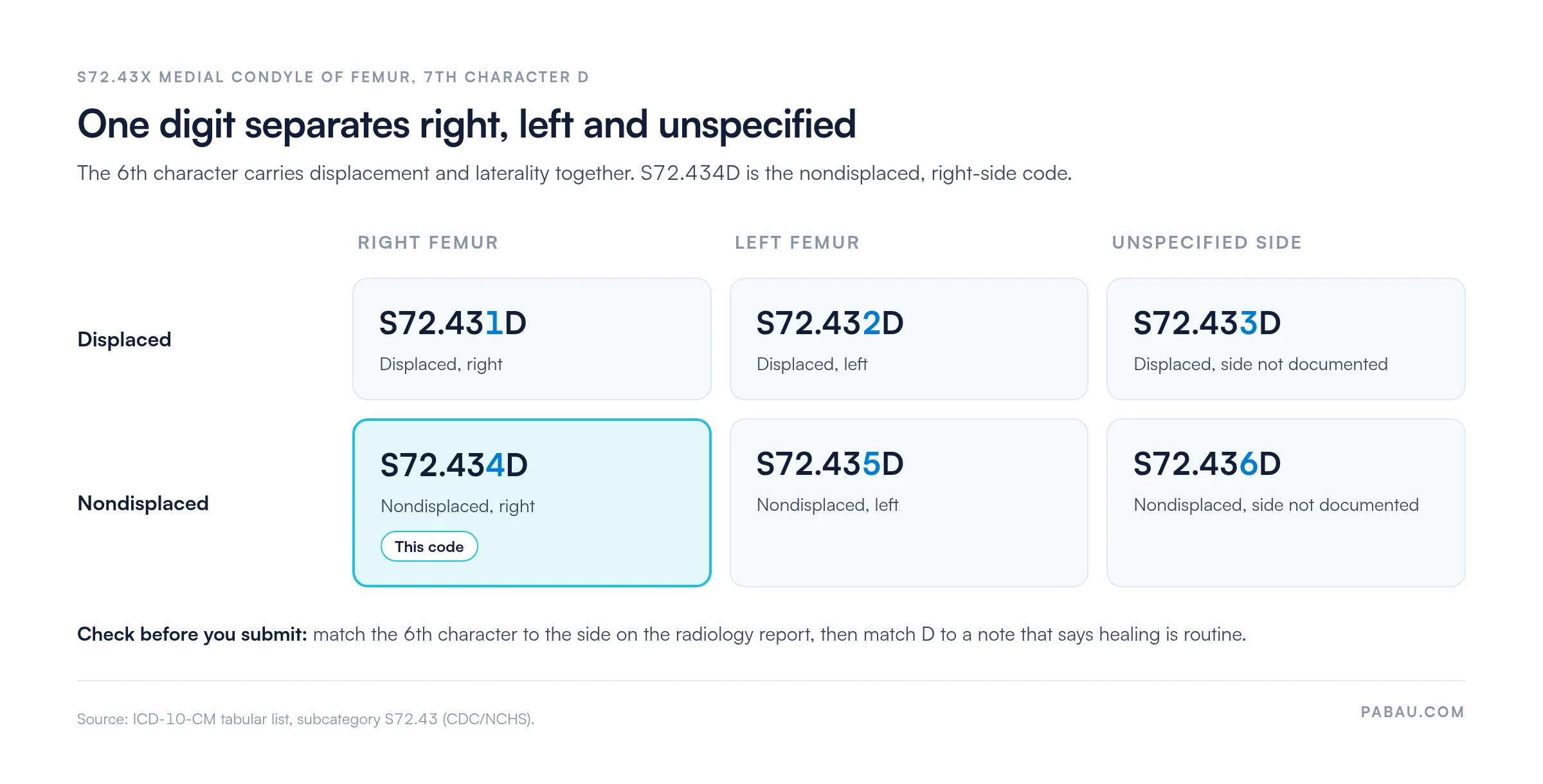
The medial condyle is the rounded knob on the inner side of the lower femur. It forms part of the knee joint, so a fracture here can disturb the joint surface and knee mechanics.
Nondisplaced means the bone has cracked, but the fragments stay in alignment. Imaging shows no step-off between them. Most of these fractures heal with protected weight-bearing, a brace and structured rehab. The physician may still choose surgical fixation when displacement looks likely.
Typical causes are a direct blow to the knee, a fall, a car accident or a sports collision. Older patients with bone density loss can fracture a condyle in a much smaller fall. When the physician attributes that fracture to osteoporosis, it’s coded in M80, not S72.
On a fracture follow-up, the 7th character is the decision that matters most. Billing A for a routine follow-up visit is a frequent denial trigger in this code family.
These six cover closed fractures. The open-fracture characters B, C, E, F, H, J, M, N, Q and R also exist for S72 femur codes. None of the codes above apply to an open fracture.
The line between D and G is a clinical call, not a count of weeks. If the physician documents normal progress, D is correct. If the note states delayed healing, G applies. Once healing is complete and late effects remain, the claim moves to S72.434S. Coders shouldn’t make any of these calls on their own.
Laterality errors and anatomy mismatches cause most of the mix-ups in the S72.43 subcategory. Here’s how the usual suspects differ.
S72 codes, including ICD-10 code S72.434D, apply to traumatic fractures only. A fracture from an identifiable injury is coded in Chapter 19 (S00-T88). Osteoporotic fractures go to M80. M84 covers pathological fractures NOS, fractures in neoplastic or other disease, and stress fractures.
The classic slip is an older patient with a low-energy condyle fracture and fragile bone. The note decides it. Did the physician name a traumatic mechanism, or describe bone fragility as the main cause?
Whichever chapter you land in, payers expect the coded etiology to match the documented cause of the fracture.
The record has to support every element of S72.434D to survive an audit. A missing element can mean a denial or a recoupment later.
When the physician captures these points at the visit, the coder verifies instead of guessing. Submitting a clean claim starts with the note, not the billing queue.
Build a fracture follow-up checklist into your EHR template. Have it prompt the clinician to confirm the fracture site, side, displacement, healing progress and visit type. A template that won’t close until each field is answered stops incomplete notes from reaching the coder.
The ICD-10-CM Official Guidelines published by CMS settle this in Section I.C.19.a. For traumatic fractures, aftercare codes from category Z47 aren’t used. The fracture code, with its 7th character, carries both the diagnosis and the encounter type.
Other areas work differently. Post-surgical follow-up for some conditions does use Z47 codes, so coders moving over from those specialties sometimes bring the habit with them.
The same logic runs through medical billing for every injury code. The 7th character carries the encounter, and the fracture code handles its own aftercare.
Each CPT code on the claim needs a diagnosis pointer back to S72.434D. That link is what shows medical necessity. A superbill helps the team capture every billable service at the point of care.
Medicare Part B generally covers orthopedic follow-ups and outpatient PT billed with S72.434D. Coverage still depends on Local Coverage Determinations (LCDs) and medical necessity documentation. Prior authorization rules vary by payer and plan, so don’t assume one rule fits all.
Run insurance eligibility verification before the visit. It confirms active coverage and flags plan-specific PT authorization rules before services are delivered.
PT practices use S72.434D when fracture recovery is the focus of care. The code explains why the patient needs therapy. On its own, though, it doesn’t justify coverage.
Medicare Part B wants a plan of care that ties the diagnosis to measurable functional goals. For a healing medial condyle fracture, record baseline limits, target outcomes and planned interventions. Full weight-bearing and walking without an aid are typical targets. A reusable plan-of-care template keeps those fields consistent from patient to patient.
The AAPC’s ICD-10-CM code lookup and the ICD List free lookup tool both help you cross-check S72.43 codes for a PT authorization packet.
Wrong encounter type is a frequent denial reason across the S72.434 family. Billing A on a follow-up, or D while the clinician treats a complication, puts the diagnosis at odds with the procedures on the claim.
Effective denial management in healthcare starts with the Claim Adjustment Reason Code (CARC) on each rejection. CARC 4 means the procedure code is inconsistent with the modifier used. CARC 97 means the benefit is included in payment for another service already adjudicated.
A non-covered charge comes back as CARC 96, which points to a coverage problem instead. Our guide to denial codes lists the rest, with the usual fix for each.
An S72.434D claim moves through the same four stops every time. The visit is charted, the code is assigned, coverage is checked and the claim goes to the payer through a clearinghouse. Most errors start at the first two stops, so run this check before you send.
Five yes answers mean the claim is ready. A single no means a query to the physician before the claim leaves.
In many orthopedic and PT practices, a follow-up claim still passes through several hands. Someone retypes the diagnosis from the note, checks coverage by phone and uploads the claim to a separate portal. Each handoff is another chance for a 4 to become a 5.
Pabau, the practice management and billing platform we build, keeps those steps together. Its claims management software runs eligibility checks and submits claims electronically through the Claim.MD clearinghouse. Notes, invoices and claims sit on the same patient record, so nobody retypes from a printout.
The result is fewer manual touches per claim, so fracture follow-ups go out sooner and with fewer keying errors.

Pabau’s claims management software helps orthopedic and rehabilitation practices run eligibility checks and submit claims electronically through the Claim.MD clearinghouse. See how it fits your fracture follow-up billing.

S72.434D is narrow by design: one bone, one condyle, the right femur and one healing status. That’s why a single wrong character sinks it. The check that pays off is matching the 6th and 7th characters to the radiology report and the healing note.
That check costs a few seconds per claim, while a denial costs weeks of rework. If your practice bills fracture follow-ups every week, make it a fixed step in the workflow.
Pabau lets you submit claims electronically through the Claim.MD clearinghouse and run eligibility checks from the patient record. Book a demo to see how it fits your fracture follow-up billing.

Managing denial patterns across orthopedic claims? Denial codes in medical billing covers the most common CARC and RARC codes that trigger orthopedic claim rejections and how to resolve them.
Coding late effects once the fracture heals? ICD-10 code S72.434S explains the sequela code for post-traumatic arthritis or residual knee pain after this fracture.
Need a clearinghouse for electronic fracture claims? Medical claims clearinghouse guide explains how clearinghouses validate, scrub, and route claims to payers, including what to look for when evaluating one for your practice.
Want to understand the full billing cycle for these visits? Revenue cycle management overview walks through the end-to-end process from eligibility verification to payment posting.
ICD-10 code S72.434D is the billable code for a nondisplaced fracture of the medial condyle of the right femur, at a subsequent encounter. It’s used for follow-up visits while a closed fracture heals with no documented complication.
For a nondisplaced fracture, it’s S72.435D. A displaced left-side fracture takes S72.432D. Both use 7th character D for a routine-healing follow-up.
No. S72.434 is a non-billable parent code. It needs a 7th character, such as A, D, G, K, P or S, before a claim will accept it.
Yes, when PT treats the functional limits caused by the fracture. Medicare Part B also needs a physician-certified plan of care linking therapy goals to the right femur fracture. Commercial authorization rules vary, so confirm them first.
Use 7th character K instead of D. That’s S72.434K (nondisplaced fracture of medial condyle of right femur, subsequent encounter for closed fracture with nonunion). The treating clinician must document the nonunion.
No. Place of occurrence, activity and external cause status codes are reported once, at the initial encounter. An external cause code itself, like W19.XXXD for an unspecified fall, can carry 7th character D on follow-ups.