ICD-10 Code Y74.2: General hospital and personal-use implant failure
ICD-10 code Y74.2: Definition, descriptor, and billable status ICD-10 code Y74.2...

Last Updated: Oct 29, 2026
Billable Code Specific Code
S72.435S is the billable ICD-10-CM code for nondisplaced fracture of medial condyle of left femur, sequela. It applies once the fracture has healed and the patient is treated for a late effect, such as knee pain or stiffness.
A common coding error is assigning D (subsequent encounter) when the fracture has already resolved. Another is reporting S72.435S without a code for the nature of the late effect, which is sequenced first. Both lead to denials that documentation can prevent.
Let Pabau's smart automation suggest the right codes, reduce claim denials, and keep your practice compliant—effortlessly.
Automate repetitive tasks and focus on what matters most—your patients.
Reduce coding errors and ensure compliance with the latest regulations.
Clean claims, fewer denials, and faster reimbursements.
Powerful insights and reporting to help your practice thrive.
HIPAA compliant SOC 2 certified GDPR-compliant Trusted by 4,000+ clinics worldwide

S72.435S is a valid, billable ICD-10-CM code for sequela of a nondisplaced left medial condyle femur fracture, not an active one.
The 7th character S applies only after the fracture has healed. Use A, D, G, K or P while a closed fracture is still present.
A code for the nature of the sequela, such as M25.562 for left knee pain, is sequenced first and S72.435S follows it.
Claims software such as Pabau, with its Claim.MD clearinghouse integration, helps orthopedic and musculoskeletal practices catch 7th character errors before submission.
ICD-10 code S72.435S describes a nondisplaced fracture of the medial condyle of the left femur, coded at the sequela stage. A sequela is a late effect that persists after the fracture itself has healed. The code is valid and billable in the current (FY2027) ICD-10-CM, and it sits in the injury chapter at this point in the hierarchy:
S72.435 is a non-billable stem. Every claim must carry the full 7-character code. S72.435S is the sequela variant. It is the only appropriate code once the fracture has resolved but still causes symptoms, such as chronic knee pain, stiffness, or deformity. Codes for other femur fracture sites sit in our ICD-10-CM code library, grouped by category.
The medial condyle is the rounded projection at the distal end of the femur that forms the inner half of the knee joint. A nondisplaced fracture means the bone fragments retain their normal anatomical alignment, unlike a displaced fracture where fragments have shifted. This distinction has direct coding consequences: Displaced fractures of the left medial condyle map to S72.432, not S72.435.
Nondisplaced medial condyle fractures typically result from direct axial loading, valgus stress, or a fall onto a partially flexed knee. Because the cortical alignment is maintained, these fractures are often managed conservatively with immobilization and partial weight-bearing. Comminution or articular surface involvement can still prompt open reduction and internal fixation (ORIF). The 7th character follows the episode of care at each visit, whatever the treatment was.
The 7th character extension is the most consequential coding decision for the S72.435 code family. Per the CMS ICD-10-CM coding guidelines, each character maps to a specific episode of care. Assigning the wrong one is a frequent cause of denials for this code family.
S72.435 takes sixteen 7th characters in all. The ten open-fracture characters are B, C, E, F, H, J, M, N, Q and R, which leaves six for closed fractures and sequela. The table covers the closed-fracture characters plus sequela, since a nondisplaced condyle fracture is usually closed.
Key distinction: S72.435K (closed fracture with nonunion) means the fracture still exists and has failed to heal. S72.435S (sequela) means the fracture is gone and only the aftermath remains. Assigning K to healed bone is a coding error. So is assigning S while the fracture still shows on imaging, and each one weakens the medical necessity record differently.
Sequela coding applies once the nondisplaced medial condyle fracture has fully healed. The patient then presents with a late effect caused by that prior injury. ICD-10-CM Official Guidelines Section I.C.19.a assigns the 7th character S to these late effects, and Section I.B.10 covers sequela coding generally. The fracture no longer exists as a current condition, so the code describes its consequence.
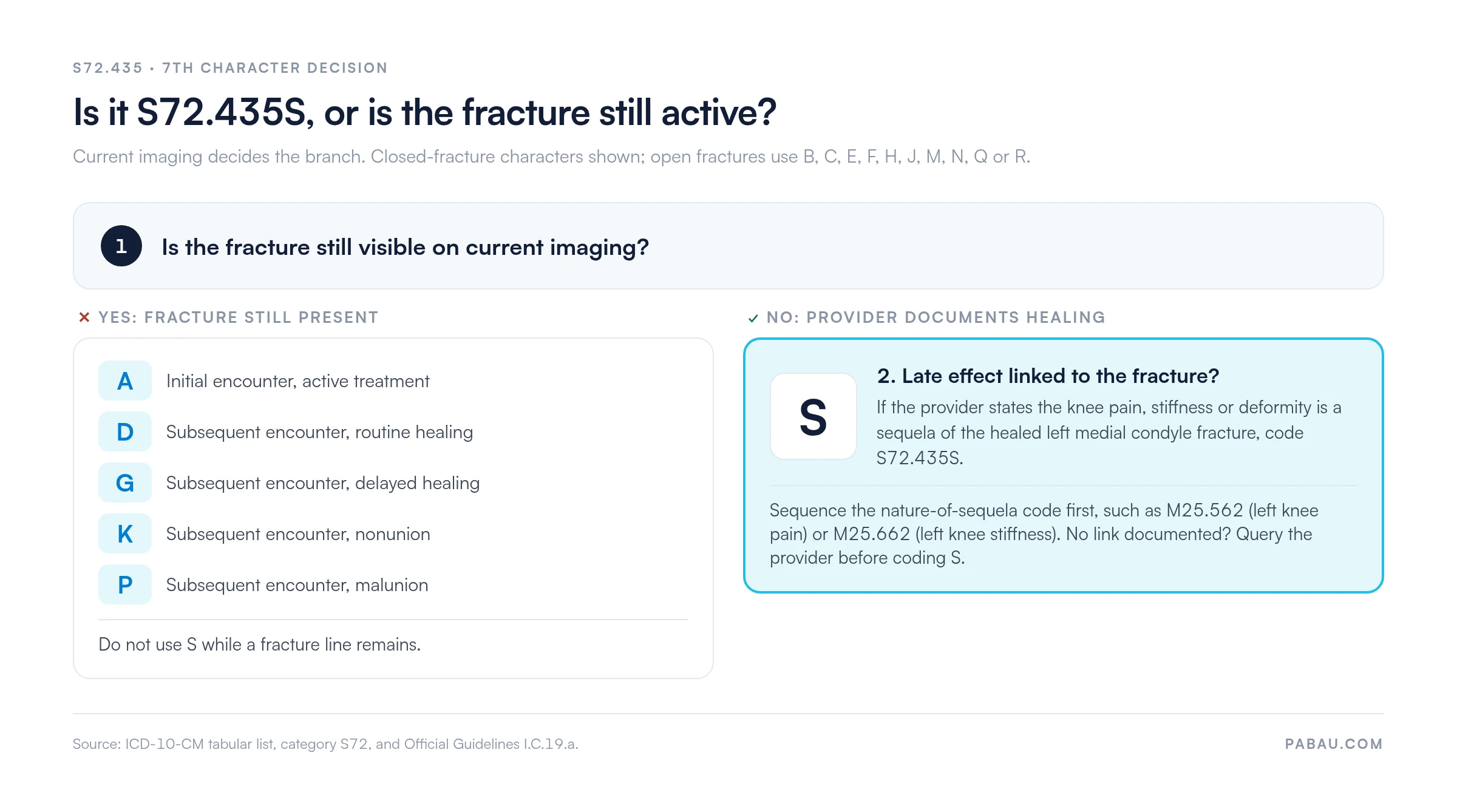
Use this decision sequence to select the correct 7th character:
The chart condenses those four questions into one path, from the imaging check to the final 7th character.
Sequela codes under ICD-10-CM are not time-limited. There is no defined minimum elapsed time between the fracture and the sequela visit. What matters is clinical documentation confirming the fracture has healed and the presenting condition is its late effect.
Sequela coding does not require a specific number of months to have passed. A patient can present six weeks post-fracture with confirmed healing on X-ray and chronic pain attributable to the injury. If the documentation supports it, S72.435S is correct. Do not default to D because the fracture is recent.
The S72.43 family contains several easily confused codes. Getting laterality or displacement wrong leads to a specificity denial. The record documents the side, but the billed code does not reflect it. According to the CDC/NCHS ICD-10-CM web tool, laterality must always be coded to the highest level of specificity when the medical record documents it.
The most common confusion is between S72.435S and S72.435K. Both involve a patient with a past fracture who still has symptoms. Imaging is the differentiator. If current imaging confirms nonunion, with a visible fracture gap and no bridging callus, assign K to the claim. If imaging shows healed bone with late-effect symptoms, assign the sequela character.
Payer medical necessity review for sequela codes is more document-intensive than for active fracture codes. The medical record must contain all of the following to support S72.435S and pass medical billing compliance standards for orthopedic sequela claims:
Medicare and commercial payers may request medical records for retrospective review on sequela claims, particularly when the time elapsed since the original fracture is short. Maintaining a documented imaging timeline strengthens the record significantly.
S72.435S represents a healed fracture with a late effect. The CPT codes for sequela visits therefore differ from those used in the acute or healing phases. Acute fracture treatment codes are for active fracture repair. Examples are CPT 27503 (closed treatment of supracondylar or transcondylar femoral fracture, with manipulation) and CPT 27506 (open treatment of femoral shaft fracture). Pairing them with S72.435S creates a clinical inconsistency that payers flag.
Hardware removal is the procedure most often tied to this sequela. When a retained plate or screw causes the knee pain, the removal bills as 20680 with S72.435S as the supporting diagnosis.
Denials on S72.435S claims cluster around three root causes: The wrong 7th character, insufficient documentation of the sequela-fracture link, and laterality mismatches. Understanding the specific Claim Adjustment Reason Code (CARC) attached to each denial type speeds up denial management in healthcare for orthopedic billers.
Pre-submission claim scrubbing checks these edit pairs before a claim reaches the clearinghouse, so most of these errors never reach a payer. The clean claim requirements for sequela codes are stricter than for active fracture codes, because payers scrutinize the healed-fracture assertion more heavily.
A few recurring errors cost orthopedic and physical therapy practices time on appeals every billing cycle. These apply across the ICD-10-CM code range for femur fractures, but they are especially common with sequela codes.
Each femur sequela claim needs three items confirmed: The original fracture date, the healed-fracture confirmation, and the nature of the sequela. When those live in separate notes or systems, coders miss them. Gathered in one structured record, they make the 7th character choice straightforward.
Pabau, the all-in-one practice management system we build, stores clinical notes, imaging reports, and provider attestations against the patient record. Billing staff see them without switching systems. Our claims management software then routes each claim through the Claim.MD clearinghouse integration, which checks CPT-ICD pairs against payer edits. An acute fracture code paired with S72.435S gets flagged before the payer sees it.
Physical therapy and sports medicine practices gain most when the PT evaluation and the referring orthopedic visit share one record. The PT evaluation (97161-97163) and the referring E&M visit then carry the same sequela diagnosis and the same side. Left-right errors and date mismatches tend to start where two disconnected systems meet.
Keeping the episode of care visible in scheduling and in the clinical record also stops returning patients from defaulting to the wrong 7th character. That habit is part of a wider revenue cycle management workflow built to keep sequela denials low.
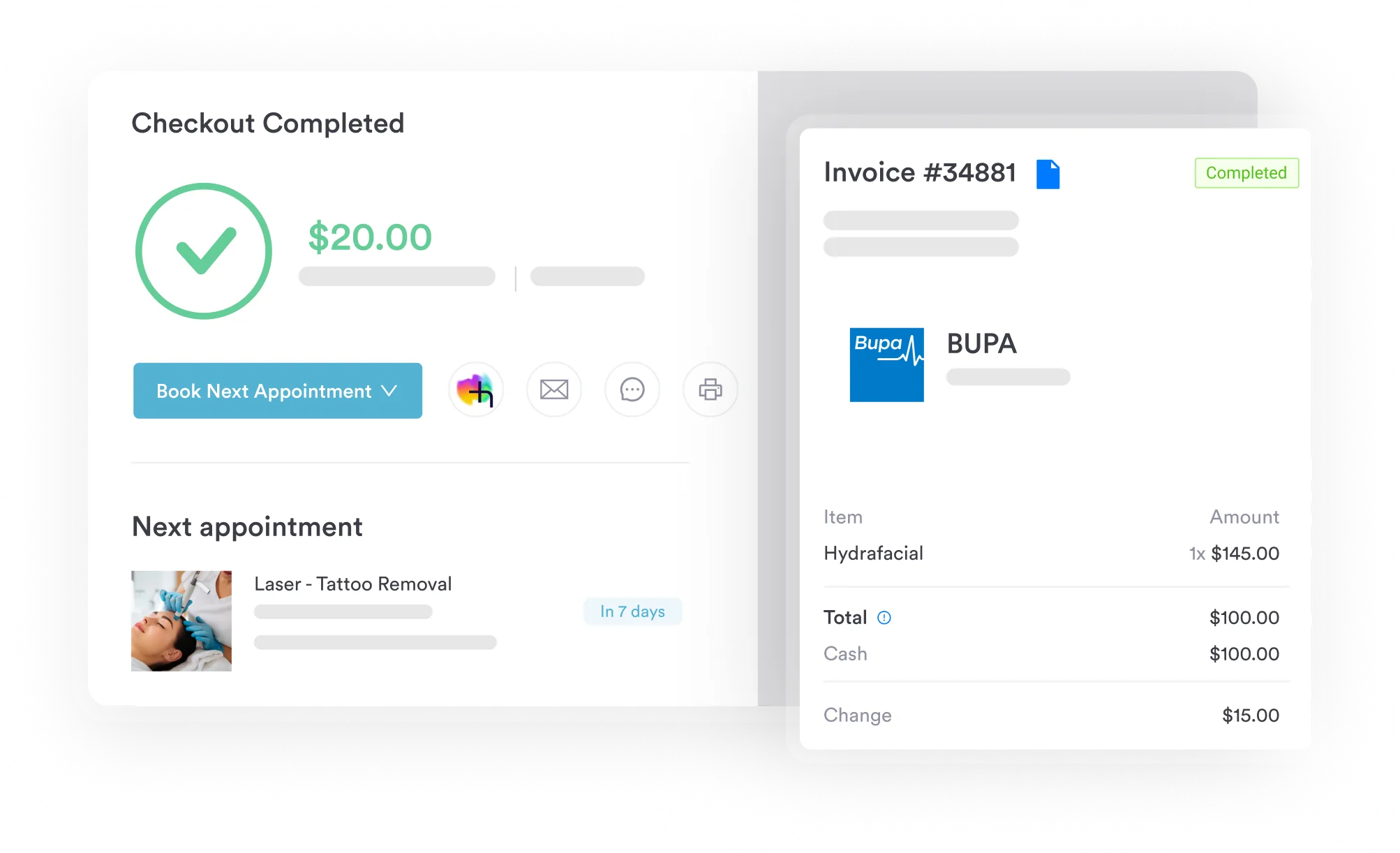

Pabau keeps imaging reports, sequela statements, and claims in one patient record. Its Claim.MD integration checks CPT-ICD pairs against payer edits before a claim goes out.

Code S72.435S only when the record proves two facts: The left medial condyle has healed, and the provider ties the current problem to that fracture. If imaging still shows a fracture line, the claim belongs to A, D, G, K, or P instead.
The trade-off is a minute of documentation at the visit against weeks of appeals later. A standard sequela statement in the assessment and a nature-of-sequela code on every claim remove two frequent denial triggers.
Book a demo to see how Pabau keeps the imaging report, the sequela statement, and the claim in one patient record.

Need help navigating ICD-10 denial codes? Denial codes in medical billing covers CARC and RARC codes that appear on remittances when a sequela claim is rejected.
Want to strengthen your claim submission workflow? Medical superbill documentation explains how to build a superbill that captures sequela diagnosis and nature-of-sequela codes together.
Looking for clearinghouse options for US fracture claims? Medical claims clearinghouse overview explains how clearinghouses validate ICD-CPT pairs before submission.
ICD-10 code S72.435S is the billable diagnosis code for a nondisplaced fracture of the medial condyle of the left femur, sequela. It means the original fracture has healed and the patient presents with a late effect of that injury. Typical late effects are chronic pain, joint stiffness, or functional limitation at the medial knee.
Yes, S72.435S is valid and billable in the current (FY2027) ICD-10-CM. The stem code S72.435 is not billable on its own and needs a 7th character. S72.435S is complete and accepted by payers for claims where the fracture has healed.
S72.435K is a subsequent encounter for closed fracture with nonunion, meaning the fracture exists but has failed to heal. S72.435S is a sequela, meaning the fracture has healed and the patient has a late effect of the injury. Current imaging settles it: Nonunion is visible on X-ray, and a healed sequela is not.
Use the 7th character S once the original fracture has healed and the patient presents with a condition it caused. The provider must also document that link. ICD-10-CM Official Guidelines Section I.C.19.a assigns S to late effects, and Section I.B.10 covers sequela coding generally. Neither sets a minimum time since the injury, so confirmed healing is what qualifies the visit.
Common pairings are established-patient E&M codes (99213-99215), physical therapy evaluations (97161-97163), therapeutic exercises (97110), deep implant removal (20680), and arthrocentesis (20610). Acute fracture treatment codes such as 27503 and 27506 do not fit sequela encounters, because they imply an active fracture.
Usually, yes. ICD-10-CM guidelines call for a code describing the nature of the sequela, sequenced first. Examples are M25.562 for left knee pain and M25.662 for left knee stiffness. S72.435S follows it. If the late effect has no separate code, S72.435S can stand alone, but reporting both supports medical necessity for any associated procedure.
Denials usually trace to code selection or documentation. Common denial reasons include: Using S72.435D after the fracture has healed, omitting the causality statement, or leaving off the nature-of-sequela code. A laterality mismatch, or an acute surgical CPT code paired with the sequela, also triggers denials.