

ICD-10 code S61.201A: Open wound of left index finger without nail damage
ICD-10 code S61.201A covers a left index finger wound of unstated type ICD-10 co...

Last Updated: Oct 16, 2026
Billable Code Specific Code
S72.434S is the billable ICD-10-CM code for nondisplaced fracture of medial condyle of right femur, sequela.
The sixth character is the one to read twice. That 4 records the right femur, and it does not mean unspecified. Read it the other way and a laterality error goes out on every claim in the episode.
Let Pabau's smart automation suggest the right codes, reduce claim denials, and keep your practice compliant—effortlessly.
Automate repetitive tasks and focus on what matters most—your patients.
Reduce coding errors and ensure compliance with the latest regulations.
Clean claims, fewer denials, and faster reimbursements.
Powerful insights and reporting to help your practice thrive.
HIPAA compliant SOC 2 certified GDPR-compliant Trusted by 4,000+ clinics worldwide

S72.434S is a billable ICD-10-CM code for the sequela of a nondisplaced fracture of the medial condyle of the right femur
The 4 in the sixth character means nondisplaced and right. Use S72.435S for the left femur and S72.436S when no note names a side
The 7th character S applies only once the fracture has healed and a late effect is being treated
Code the residual condition first and S72.434S second, as ICD-10-CM Official Guidelines Section I.B.10 requires
The parent code S72.434 is not billable, and the family offers 16 possible 7th characters rather than seven
Pabau, practice management software for healthcare practices, integrates with Claim.MD to submit 837P claims and process remittances
Yes, you can bill it. S72.434S is a specific ICD-10-CM code, valid for electronic submission to Medicare, Medicaid, and commercial payers.
Its parent, S72.434, is not. Strip the S off the end and the claim is rejected before a human reads it.
The code carries no dollar value on its own. It supports the procedure or evaluation billed alongside it, which is why the residual condition has to be coded too.
Read the code from left to right and each character records a single decision the chart has to prove. The sixth character records two of them at once, which is where most errors start. The breakdown below reads the code one position at a time.
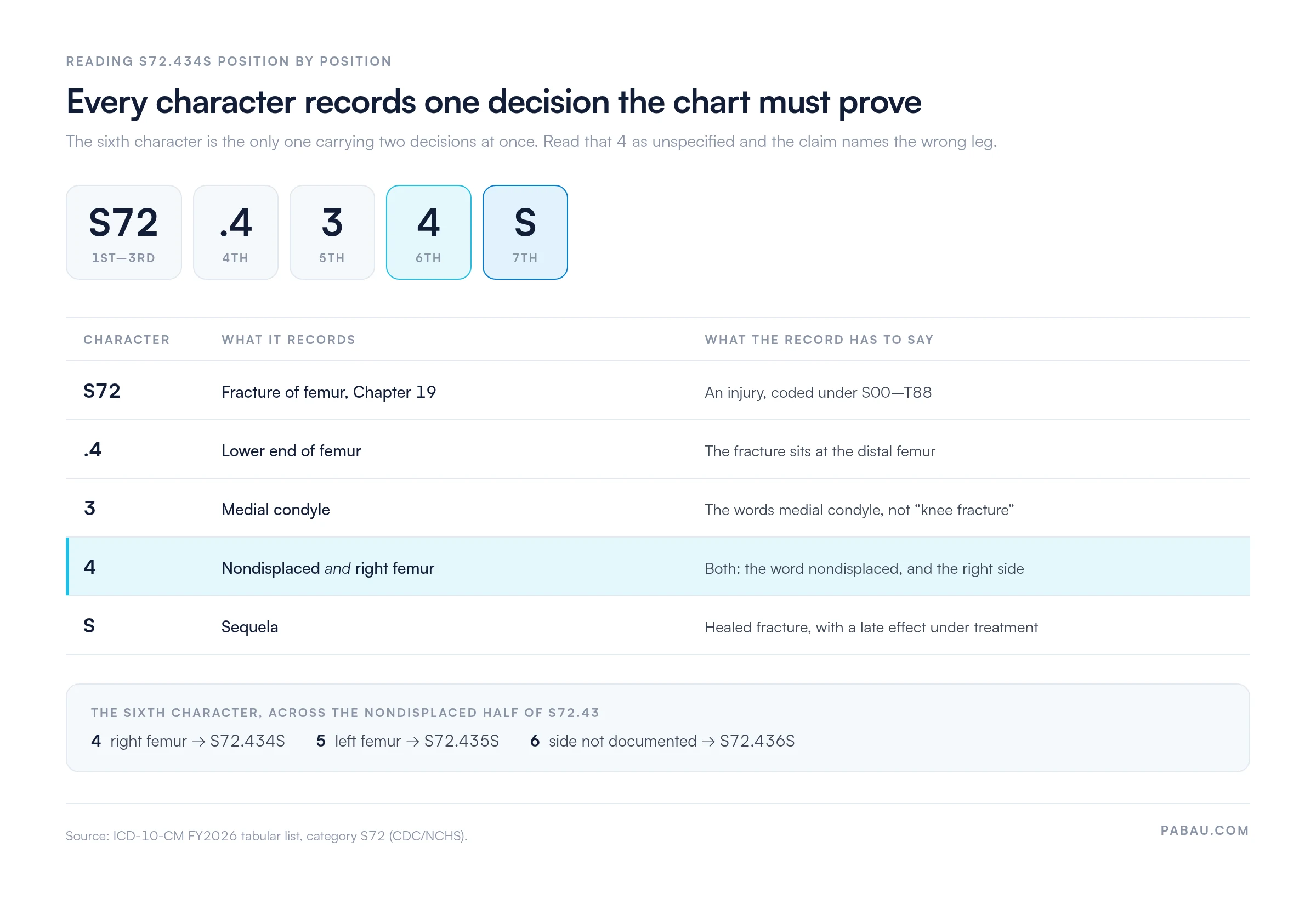
The code sits in ICD-10-CM Chapter 19, injury, poisoning and certain other consequences of external causes. Within that chapter it falls under category S72, fracture of femur. From there it narrows to S72.4, fracture of lower end of femur, and then to S72.43, fracture of medial condyle.
According to the Centers for Medicare and Medicaid Services (CMS), the S72 family covers every femur fracture coded under ICD-10-CM for fiscal year 2026.
The medial condyle is the inner, weight-bearing prominence at the distal end of the femur, and it forms part of the knee joint. A nondisplaced fracture means the bone cracked while the fragments stayed in their anatomical position.
That distinction drives the code. Displaced and nondisplaced fractures carry separate codes, different prognoses, and different surgical plans. Coding one as the other is a common audit trigger.
Coders work from the treating clinician’s explicit wording. When the original operative or radiology report reads nondisplaced, a nondisplaced code applies.
When the record says neither, the ICD-10-CM Official Guidelines default the fracture to displaced. That rules S72.434S out.
On a sequela claim, the note that settles this may be years old and held by another facility. Retrieve it before you code, because displacement status is fixed by what it says.
The list below shows where each combination of displacement, laterality, and healing phase lands:
The sixth character of an S72.43x code carries displacement and laterality together. A 4 there means nondisplaced and right.
The trap is assuming laterality restarts at the top of each displacement group. It does not. The family runs displaced right, left, and unspecified first, then nondisplaced right, left, and unspecified.
So S72.434S is a right-femur code. S72.435S covers the left femur, and S72.436S is the one to use when no note in the record names a side.
Laterality matters more on a sequela claim than it does on an acute one. The residual condition is lateralized too, so the diagnosis, the residual-condition code, and the procedure modifier all have to name the same knee.
Distal femur and knee procedures normally carry an RT or LT modifier. An RT procedure line sitting next to a left-femur diagnosis contradicts itself, and the payer will read it that way.
The 7th character S reports a residual condition caused by a past fracture. The acute phase has ended, and no further fracture treatment is planned.
ICD-10-CM sets no time limit on a sequela. A patient can present with one a few months after the injury or several decades later.
These are the residual conditions that most often bring a healed medial condyle fracture back into a practice:
Each of those codes reports what the patient has now. S72.434S reports where it came from. Both belong on the claim, in that order.
ICD-10-CM Official Guidelines Section I.B.10 sets the order. The code for the residual condition is sequenced first, and the sequela code follows it.
So a visit treating post-traumatic arthritis of the right knee after a healed medial condyle fracture reports M17.31 first, then S72.434S. Reversing the two is a sequencing error a payer can spot without reading the chart.
One exception applies. Where a code already names the residual condition in its own title, a second code adds no information, and the sequela code stands alone.
The external cause code follows the same logic. Where the mechanism code takes a 7th character, use S there too, so it reports a sequela rather than an initial encounter. It is sequenced after the fracture code, never before it.
This is the decision that generates the most denials in the S72 family. The two characters are never interchangeable, and the difference is clinical rather than administrative.
A practical rule settles most cases. Character D applies while the fracture is still the clinical problem. Character S applies once the fracture is resolved and the patient has a downstream condition caused by it.
S72.434 takes 16 possible 7th characters, running A through S with I, L, and O omitted. Each one combines an encounter phase, a wound classification, and a healing status.
Summaries that list only seven characters are describing closed fractures. This family also codes open fractures by Gustilo type, which is where the other nine come from. The table below lists all 16, per the CDC/NCHS ICD-10-CM code tool.
S stands apart from the other 15. Characters A through R all describe a fracture still under care, and each carries a wound classification with it.
Sequela drops that distinction entirely. One S covers a healed fracture whether the original injury was open or closed. The original wound type never changes the code at this stage.
Laterality and displacement are settled one character earlier, in the sixth. S72.43 covers every fracture of the medial condyle of the femur, and it splits into six subcategories.
Three cover displaced fractures and three cover nondisplaced ones, each with a right, left, and unspecified option. Checking your code against this grid is the fastest way to catch a laterality error.
None of the six subcategories is billable on its own, and neither are the parent codes S72.43, S72.4, and S72. Each one needs a 7th character first.
The same six-way split repeats through the rest of the distal femur codes. Our ICD-10-CM code index covers those families one by one.
S72.434S inherits every instructional note published above it in the tabular list. Read the category and subcategory notes, not just the code description.
The Excludes1 note is the one that generates edits at the payer. A claim carrying both S72.434S and an S78 traumatic amputation code for the same limb contradicts itself.
A code this specific holds up only when each element of its description appears somewhere in the record.
Rehabilitation and pain management teams usually inherit that record from acute care. What the emergency department and the operating room wrote years earlier decides what can be billed now.
A note that records four of the five leaves the coder guessing on the fifth. Querying the provider is faster than appealing a denial, and it leaves a better record behind for the next encounter.
Ask what the patient is being treated for before you reach for S72.434S. A sequela code answers the question of cause, not the question of what is wrong now. If the note names no residual condition, the sequela code has no condition to sit behind. The claim then goes out with the sequencing rule broken.
On a sequela encounter the paired CPT code usually reports rehabilitation, hardware removal, or joint replacement rather than fracture care. S72.434S describes the diagnosis, and the CPT code describes what was done at the visit.
Code selection always belongs to the treating clinician and coder, working from the note for that encounter.
Every one of these lines can carry an RT modifier, and on this diagnosis it should. S72.434S names the right femur, so a left-side modifier on the same claim reports two different legs.
Five checks catch most of what goes wrong on an S72.434S claim, and together they take far less time than an appeal.
After that the claim travels as an 837P file to the clearinghouse, which screens format and eligibility before the payer sees it. Payer edits then test whether the diagnoses, the procedure, and the modifiers agree with each other.
A clean claim clears both layers on the first pass. On a sequela case that almost always comes down to sequencing and documentation rather than code choice.
The most frequent error is the one this article opened with, reading the 4 as unspecified. The rest cluster around the 7th character and the sequencing rule.
Tracking denials by code inside software built for claims shows which of these a practice keeps repeating. That turns a coding argument into a documentation fix.
In most orthopedic and rehabilitation practices, the diagnosis is captured once in the clinical note and then typed again into the billing system.
Every re-key is a chance for a laterality to flip or a 7th character to drop. Nobody notices until the remittance arrives weeks later.
Pabau, our practice management software, keeps the record and the claim in one place. The diagnosis recorded at the encounter travels with the patient into billing, and eligibility runs before the visit rather than after it.
Claims go out to Claim.MD as 837P files from the same system that holds the note. Remittances come back into that record, so the person who coded the encounter can see how it was paid and why.
A sequela claim spans an episode that may have started years earlier at another facility. Across a history that long, keeping the diagnosis, the residual condition, and the modifier on one record is what keeps the claim clean.

Pabau integrates with Claim.MD to submit 837P claims, run eligibility checks, and process remittances for orthopedic and rehabilitation practices. See how the claims workflow handles a post-fracture case from note to payment.

S72.434S is precise on three points. It fixes the fracture as nondisplaced, the femur as the right one, and the encounter as one treating a late effect rather than the fracture.
The two ways it goes wrong are both avoidable. One is reading the 4 as unspecified, and the other is putting the sequela code ahead of the condition it explains.
Get the side from the record and the order from Section I.B.10, and the claim carries its own justification. Book a demo to see how Pabau handles a post-fracture claim from the clinical note through to the remittance.

Coding the unspecified-femur version of this fracture? ICD-10 code S72.436C works the same six-way split where the record never names a side.
Want to see how the claim reaches the payer? What is a medical claims clearinghouse? explains the 837P submission path from practice to payer.
Chasing a denial on a trauma claim? Denial codes in medical billing maps the most common CARC codes and the documentation that clears them.
Need to read the payer’s answer? What is electronic remittance advice (ERA)? shows how an 835 file reports an adjudication decision back to the practice.
New to the billing cycle? What is medical billing? covers the full path from patient registration through to payment posting.
It is a right femur code. S72.434S reports the sequela of a nondisplaced fracture of the medial condyle of the right femur. The left-femur code is S72.435S, and S72.436S is the one to use when no note in the record names a side.
The residual condition is listed first and S72.434S second, as ICD-10-CM Official Guidelines Section I.B.10 requires. A visit for post-traumatic arthritis of the right knee would report M17.31, then S72.434S.
Use S72.434D while the fracture is still healing and the patient returns for fracture care. Use S72.434S only after the fracture has united and the visit addresses a late effect it caused. The two characters are never interchangeable.
No. Aftercare Z codes do not apply to injuries. Keep the same S72.434 code and change the 7th character to the one that matches the encounter and the healing status.
No. The X placeholder only pads codes shorter than six characters. S72.434 already has six, so the S attaches directly and the complete code runs to seven characters.
Sixteen. They run A through S with I, L, and O omitted. They also separate closed fractures from open fractures of Gustilo type I or II and type IIIA to IIIC. Only S reports a sequela.
Yes. S72.434S is valid for FY2026, covering encounters from October 1, 2025 through September 30, 2026. It was already valid in FY2025, and the FY2026 annual update neither deleted nor revised it.



