ICD-10 code S70.10XA: Contusion of unspecified thigh, initial encounter
Each character of ICD-10 code S70.10XA has a job ICD-10 code S70.10XA is the bil...

Last Updated: Oct 23, 2026
Billable Code Specific Code
S63.637S is the billable ICD-10-CM code for sprain of interphalangeal joint of left little finger, sequela. It covers the stiffness, laxity or grip pain that stays after the ligament injury itself has healed.
The S at the end is where these claims go wrong. Billed while the sprain is still being treated, it describes a phase of care the note doesn't support. Active care takes S63.637A, and healing follow-ups take S63.637D. Getting the switch right comes down to three facts in the record, and each one is spelled out below.
Let Pabau's smart automation suggest the right codes, reduce claim denials, and keep your practice compliant—effortlessly.
Automate repetitive tasks and focus on what matters most—your patients.
Reduce coding errors and ensure compliance with the latest regulations.
Clean claims, fewer denials, and faster reimbursements.
Powerful insights and reporting to help your practice thrive.
HIPAA compliant SOC 2 certified GDPR-compliant Trusted by 4,000+ clinics worldwide

ICD-10 code S63.637S is the billable sequela code for a left little finger interphalangeal joint sprain, under subcategory S63.63.
Use the S character only once the original sprain has healed. Active care takes S63.637A, and healing follow-ups take S63.637D.
Code the residual condition first, such as joint stiffness, and add S63.637S second as its cause.
The record must show the sprain healed, name the residual condition and link the two, or the claim is exposed to denial.
ICD-10 code S63.637S is the official ICD-10-CM code for “Sprain of interphalangeal joint of left little finger, sequela.” It’s billable, it isn’t a header code, and it’s valid in the current fiscal year. You use it when the sprain has healed but stiffness, laxity or grip pain hasn’t.
The code sits in Chapter 19 of ICD-10-CM, which covers injury, poisoning and certain other consequences of external causes. Within that chapter, it belongs to block S60-S69, injuries to the wrist, hand and fingers.
The hierarchy narrows step by step. S63 covers dislocation and sprain of joints and ligaments at wrist and hand level. Below it sit S63.6, sprain of finger(s), and S63.63, sprain of interphalangeal joint of other and unspecified finger(s). S63.637 then names the left little finger, and the 7th character S completes the code.
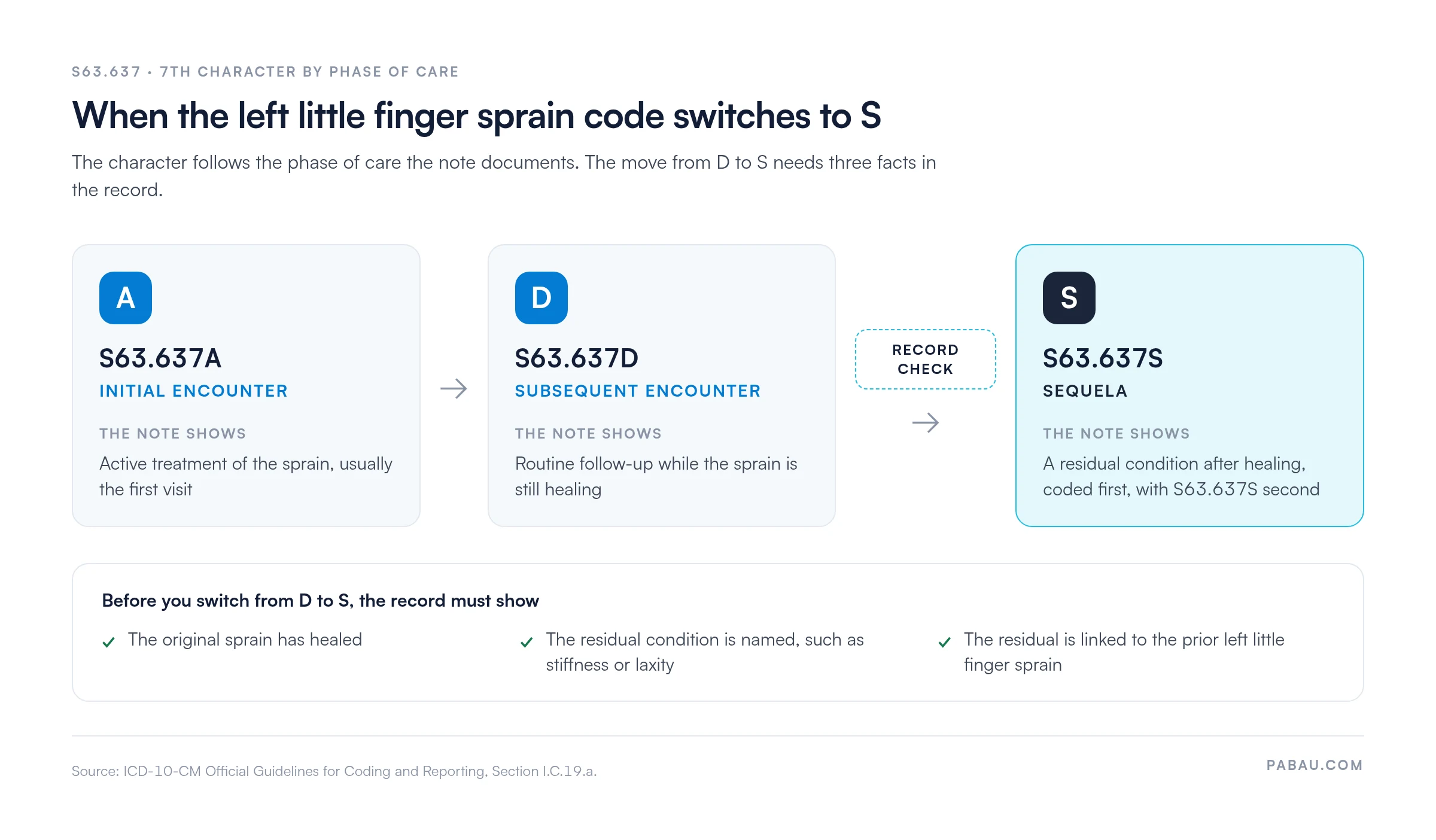
The 7th character is the biggest coding decision on any S63.637 encounter. Section I.C.19 of the ICD-10-CM Official Guidelines defines three values, and each one maps to a phase of care. Pick the wrong one and the claim describes a visit the note doesn’t.
The usual slip is moving from S63.637D to S63.637S too early. The sequela phase starts when the clinician documents that the sprain has healed and a residual condition remains. Until that sentence is in the note, keep billing S63.637D.
The flow below shows the three phases and the record check that sits between D and S.
The little finger has two interphalangeal joints. The proximal interphalangeal (PIP) joint sits between the proximal and middle phalanges. The distal interphalangeal (DIP) joint sits between the middle and distal phalanges.
A sprain at either joint stretches or partly tears the collateral ligaments or the volar plate, without a full dislocation. ICD-10-CM doesn’t split PIP from DIP at this level. Note the joint in the record anyway, because the therapist and any later reviewer will want it.
Sequela usually shows up as chronic stiffness, persistent laxity, recurring instability or pain with grip. Those residual conditions are what S63.637S explains.
At the S63 category level, the ICD-10-CM Includes note lists seven injuries of joints and ligaments at wrist and hand level.
S63 carries one Excludes2 note: strain of muscle, fascia and tendon at wrist and hand level (S66.-). A flexor or extensor tendon strain is a separate injury, so you can report both when the patient has both. If the note describes only a tendon strain, query the provider and look at S66 instead.
The S63.63 subcategory covers interphalangeal joint sprains of the fingers other than the thumb. Most mix-ups here come down to laterality, digit or encounter type. The table maps the codes most often confused with S63.637S.
Which structure is injured? A sprain involves the joint’s ligaments or capsule, which is the S63 block. A strain involves muscle or tendon, which is the S66 block.
What if the note only mentions a tendon? Then S63.637S isn’t supported. Query the provider or review the imaging report before you code.
When reviewing a record for sequela coding, look for provider language confirming the original injury has resolved. Phrases like ‘prior sprain, now presenting with residual stiffness’ support S63.637S, as does ‘chronic instability following finger sprain’. Language like ‘ongoing sprain treatment’ or ‘still healing’ does not.
The Official Guidelines expect a sequela code to rest on the residual condition and its link to the earlier injury. For S63.637S, the note has to establish three facts.
A patient jams their left little finger playing basketball, and the PIP joint is splinted. The first visit codes S63.637A, and the splint checks code S63.637D.
Three months later, the provider writes: “PIP sprain healed, residual stiffness of the left little finger, referred to occupational therapy (OT).” The stiffness code for the left hand, M25.642, goes first. S63.637S goes second as the cause.
Sequela claims travel the same route as any other claim. They simply meet more questions on the way, especially when therapy runs for weeks. Here is the usual path.
Medicare and commercial payers expect each physical therapy (PT) or OT visit to show functional progress. A PT or OT claim under S63.637S with no progress noted is a common denial trigger. Running insurance eligibility verification before the visit also surfaces payer rules that change how the claim is built.
Workers’ compensation rules vary by state. Most state programs accept ICD-10-CM codes, but some carriers set their own thresholds for sequela-phase care. Confirm the requirements with the state board or the carrier before you submit.
Some MACs publish Local Coverage Determinations (LCDs) that add requirements for specific injury categories. Check your MAC’s policies before you leave external cause codes off the claim.
Sequela claims for finger sprains draw a predictable set of denials. Good denial management workflows catch them before submission rather than on the remittance.
Knowing the medical billing denial codes payers return speeds up the fix. Sequela denials often carry CARC 50 (not medically necessary) or CARC 16 (missing information). CARC 197 (precertification or authorization absent) and CARC 97 (included in the allowance for another service) also turn up.
Run this check on every sequela claim before it leaves the practice.
Physical and occupational therapists treating residual interphalangeal joint problems often pair S63.637S with codes from several CPT families. National Correct Coding Initiative (NCCI) edits can affect how some of them bundle. Check the current CMS NCCI tables before you bill a combination.
In a stiffness case, 97110 usually carries most visits. 97140 joins it when the therapist mobilizes the joint by hand.
NCCI pairs still get checked against the CMS tables by hand. Sending a clean claim on the first pass cuts the rework on sequela visits and speeds up payment.
Check the CMS NCCI table before you bill 97140 and 97530 on the same date of service. The pair carries a conditional NCCI edit. Billing both requires documentation of distinct, separately identifiable interventions at that visit.
In many therapy and hand practices, the claim gets coded in one system and re-keyed into a payer portal. Claim status then lives in a third tool, so a denied sequela claim is easy to miss.
Pabau, the practice management platform we build, sends the claim from the patient record through its Claim.MD clearinghouse connection. Its claims management software then shows where each claim stands after submission.
Your coders still choose the residual code and the 7th character. The difference is that nobody has to chase an S63.637S claim across three tools to find out why it stalled.

Send S63.637S and other sequela claims through Pabau’s Claim.MD connection, then follow each claim’s status without switching tools.

S63.637S rewards patience. Hold the S until the note says the sprain has healed, names what it left behind and ties the two together.
Get that wording into the record before you code, and the claim holds up to review. Skip it, and the same visit comes back as a medical necessity or encounter-type denial that costs more to fix than to prevent.
If your team wants sequela claims submitted and tracked without re-keying, book a demo and see the Claim.MD workflow in Pabau.

Need guidance on denial codes returned for musculoskeletal claims? Denial codes in medical billing breaks down the most common CARC and RARC codes and how to resolve them.
Billing functional task training in the sequela phase? CPT code 97530: Therapeutic activities billing guide explains how therapeutic activities are documented and billed.
Splinting a lax interphalangeal joint? CPT code 97760: Orthotic management and training billing guide covers how orthotic management and training visits are billed.
Want to understand the full billing cycle behind sequela claims? What is revenue cycle management covers the end-to-end process from coding to payment posting.
Running therapy claims through a clearinghouse? Medical claims clearinghouse guide explains how clearinghouse validation works and what to look for in a claims partner.
When a jammed finger is diagnosed as an interphalangeal joint sprain, the left little finger codes to S63.637. Add A, D or S for the phase of care. The right little finger uses S63.636.
Code the stiffness first. M25.642 covers stiffness of the left hand, not elsewhere classified. Then add S63.637S to show the old sprain caused it.
No. ICD-10-CM sets no time limit. The switch to S depends on the provider documenting that the sprain has healed and a residual condition remains.
Usually not. The Official Guidelines sequence the residual condition first, so S63.637S follows it as the cause. Each PT or OT visit still needs documented functional progress.
ICD-9-CM used 905.7, late effect of sprain and strain without mention of tendon injury. ICD-10-CM replaced it with the S character on the injury code itself.