

ICD-10 code S61.201A: Open wound of left index finger without nail damage
ICD-10 code S61.201A covers a left index finger wound of unstated type ICD-10 co...

Last Updated: Oct 16, 2026
Billable Code Specific Code
S61.409D is the billable ICD-10-CM code for unspecified open wound of unspecified hand, subsequent encounter. It applies to follow-up visits after active treatment of a hand wound is complete, such as wound checks, dressing changes, and suture removal.
Use it only when the chart names neither the injured hand nor the wound type. If either detail is documented, a more specific S61.4 code applies. While active treatment is still under way, the initial encounter code S61.409A applies instead.
Let Pabau's smart automation suggest the right codes, reduce claim denials, and keep your practice compliant—effortlessly.
Automate repetitive tasks and focus on what matters most—your patients.
Reduce coding errors and ensure compliance with the latest regulations.
Clean claims, fewer denials, and faster reimbursements.
Powerful insights and reporting to help your practice thrive.
HIPAA compliant SOC 2 certified GDPR-compliant Trusted by 4,000+ clinics worldwide

S61.409D covers an open wound of the hand itself, not the fingers or wrist, when the chart names neither the hand nor the wound type.
The 7th character D marks a subsequent encounter: routine care after definitive treatment, such as a wound check or suture removal.
Billing S61.409A instead of S61.409D on a follow-up visit is a frequent reason hand wound claims are denied.
S61.409D has been in effect since October 1, 2015, and remains current for FY2027.
Pabau, the practice management platform we build, checks each claim for missing insurer details before it reaches the payer.
ICD-10 Code S61.409D is the billable code for an unspecified open wound of an unspecified hand at a subsequent encounter. Use it for follow-up visits once active treatment is complete, when the chart documents neither the injured hand nor the wound type.
The code sits in chapter S00-T88, injury, poisoning, and certain other consequences of external causes, within block S60-S69 for wrist, hand, and finger injuries. Its category is S61, open wounds of the wrist, hand, and fingers, and its subcategory is S61.4, open wound of hand.
S61.409D has been in effect since October 1, 2015, when the US adopted ICD-10-CM. It remains current for FY2027, effective October 1, 2026, and no deletion has been proposed under CMS ICD-10-CM coding guidelines.
Each segment of S61.409D carries a specific anatomical or clinical meaning. Reading it segment by segment shows which chart details the code assumes are missing.
Both “unspecified” qualifiers matter. The 0 in the fifth position applies when documentation does not confirm whether the wound is a laceration, puncture, or bite.
The 9 in the sixth position applies when the provider has not documented the right or left hand. If either detail is in the chart, a more specific code exists and should be used.
The 7th character D designates a subsequent encounter. The patient is receiving routine care after the provider has completed, or substantially completed, active (definitive) treatment of the open wound. Payers read it against the visit note, so it has to match what happened at the encounter.
ICD-10-CM Official Guidelines Section I.C.19 allows the initial encounter character (A) for several visits while active treatment is ongoing. That holds even if the patient has been seen before. The switch to D happens when definitive treatment is complete and later visits are for routine monitoring or care.
A patient returning for suture removal three weeks after laceration repair is a subsequent encounter. A patient whose wound edges have opened, and who needs irrigation plus re-closure, may still qualify as an initial encounter, depending on clinical judgment.
Document the specific treatment delivered at each visit. ‘Wound check’ alone does not tell the coder whether active treatment or routine monitoring occurred. A single phrase like ‘suture removal, wound healing well’ clearly supports S61.409D. A note that says ‘wound edges gaping, irrigation performed, re-approximated with adhesive strips’ signals that active treatment is ongoing and A may still apply.
S61.409D is one of nine closely related codes in the S61.40x family. The differences come down to laterality, wound type specificity, and encounter type.
Under the specificity rules in the AAPC ICD-10-CM code reference, a documented right hand, left hand, or wound type calls for a more precise code. The diagram below walks through that choice in two steps.
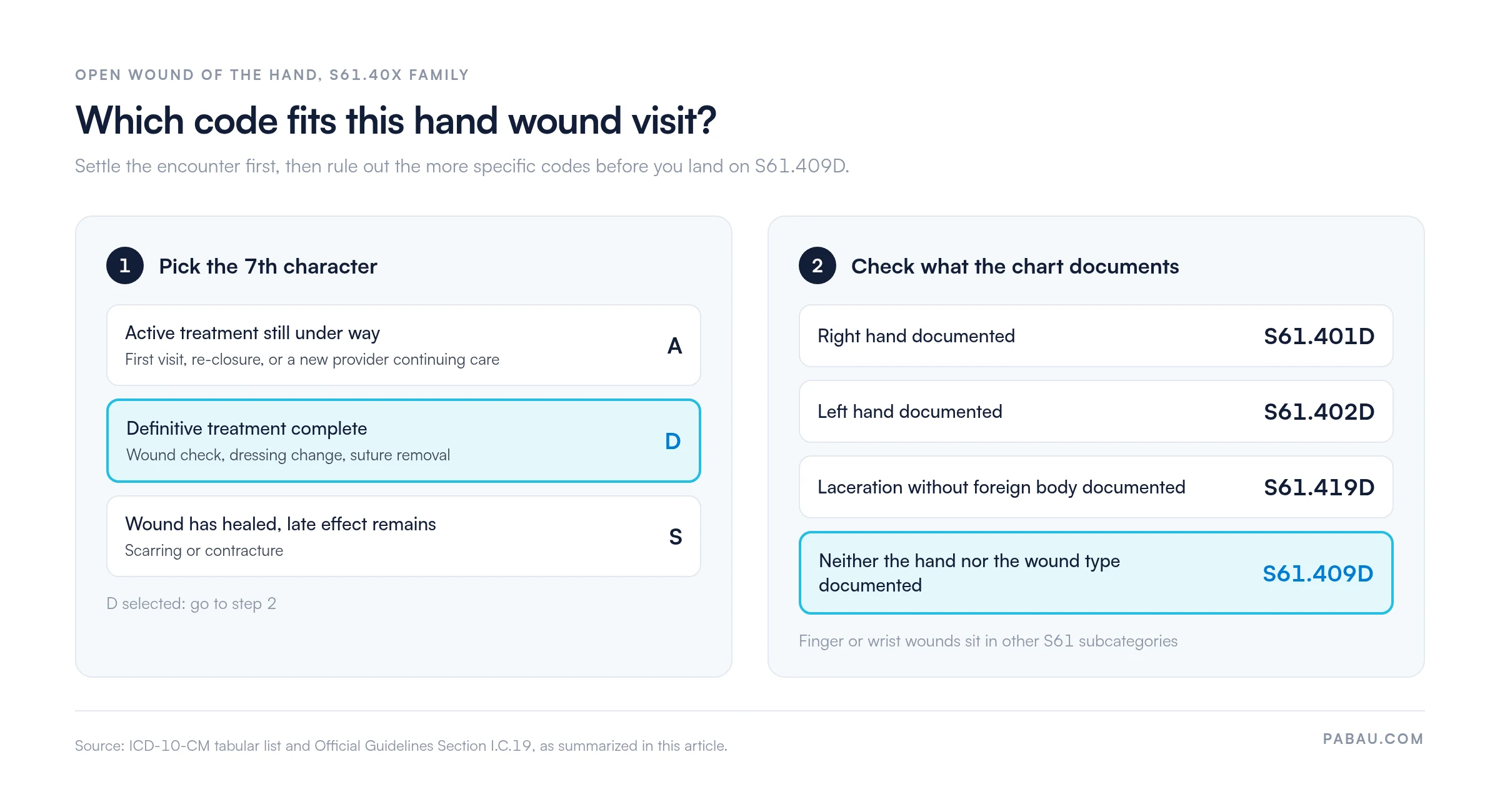
The table lists the closest alternatives and when each one applies.
Two Excludes1 notes under category S61 prevent common cross-coding errors. Excludes1 means the excluded condition cannot be coded with S61 at the same encounter.
Finger wounds are not an Excludes1 note. They sit in sibling subcategories S61.0-S61.3, and S61.4 covers the hand without the fingers. A patient with a palm laceration and a separate finger wound needs both an S61.4- code and an S61.0- to S61.3- code.
No Excludes2 note applies at the S61.409D level. Category S61 does carry a “code also” instruction for any associated wound infection. If the chart confirms retained foreign material, an S61.4 code for a wound with foreign body applies instead of S61.409D.
The medical record must contain specific elements to support S61.409D. Missing any one of these is grounds for a coder query or a payer audit finding. A medical billing workflow that reviews the note before the claim is built keeps those queries to a minimum.
Capture these elements in the visit note before the claim is built. Claims management software can then confirm the insurer details are complete before the claim goes out.
Watch for these four errors on S61.409D claims. Each one has a different consequence.
S61.409D denials usually trace back to one of five causes, from the wrong encounter character to a claim sent to the wrong payer. The table pairs each cause with the step that prevents it.
A denial management workflow tracks these patterns across encounters. A repeated 7th character error then shows up as a trend you can fix at the source.
Reviewing denial reason codes monthly shows when a provider query process is needed. The guide to medical billing denial codes maps the CARC and RARC codes that come back with these rejections.
Medicare and Medicaid follow CMS ICD-10-CM coding guidelines directly. Commercial payers may impose additional edits, particularly around unspecified codes. Practices billing S61.409D should watch four payer-level variables.
The CPT codes commonly billed alongside S61.409D depend on what clinical service is rendered at the subsequent encounter.
The pairing must be medically consistent: the ICD-10 code supports the procedure, and the procedure matches the visit documentation. Verify current National Correct Coding Initiative (NCCI) edits before submitting any of these combinations.
Pairing 97597 or 97598 with S61.409D requires documentation showing the wound needed tissue removal at that visit. A dressing change alone does not support either code. Billing debridement without that documentation is one of the higher-risk combinations for audit, so check each pairing against current NCCI edits first.
When debridement (97597/97598) is billed at a subsequent encounter visit, the documentation must separate the two services clearly. A dressing change is not separately billable, while active debridement of devitalized tissue is. Note the wound dimensions, tissue type removed, and clinical rationale. Auditors look for this distinction specifically on wound care claims.
Follow-up wound visits produce a string of small claims, one for each wound check or suture removal. Each one needs the right insurer, policy details, and diagnosis attached before it goes out.
Pabau stores the insurer and policy on the patient record, so every invoice routes to the correct payer automatically. Before a claim is sent, Pabau checks that details like membership numbers and authorization codes are in place. The Send button stays disabled until they are.
In the US, claims go out electronically through Claim.MD, with real-time eligibility checks and ERA remittance posting in the same dashboard. Every claim then shows a live status from pending to paid, so a rejected follow-up claim gets fixed and resubmitted quickly.
Choosing between S61.409A and S61.409D stays a coding decision, and Pabau keeps the claim around it complete.

Pabau checks each claim for missing insurer details before it is sent, then tracks it through to payment. Your billing team spends less time chasing rejected follow-up claims.

S61.409D is a narrow code. It fits only when the visit is routine aftercare and the chart names neither the injured hand nor the wound type.
The most effective fix sits in the visit note, since a recorded side or wound type moves the claim to a more specific code. Build those fields into your wound-visit template, and the 7th character choice follows from what was documented.
Book a demo to see how Pabau keeps insurer details complete on every follow-up wound claim before it reaches the payer.

Want to understand how claims move through the clearinghouse? Medical claims clearinghouse guide explains how electronic claims are validated, scrubbed, and routed to payers.
Need to understand ERA and remittance after a claim posts? Electronic remittance advice (ERA) explained covers how to read 835 remittance files and reconcile payment against expected reimbursement.
Looking for guidance on credentialing with payers? How to get credentialed with insurance companies walks through the enrollment steps required before submitting claims to Medicare and commercial payers.
ICD-10 Code S61.409D is the billable diagnosis code for an unspecified open wound of an unspecified hand at a subsequent encounter. It covers routine care, such as a wound check, dressing change, or suture removal, after definitive treatment is complete.
Yes, S61.409D is a billable ICD-10-CM code. It has been in effect since October 1, 2015, and remains current for FY2027, starting October 1, 2026. As a complete 7-character code, it meets the specificity requirements for claim submission under CDC/NCHS ICD-10-CM guidelines.
S61.409A designates an initial encounter, used while active treatment of the open hand wound is ongoing. S61.409D designates a subsequent encounter, used for routine follow-up care after definitive treatment is complete. Using A instead of D on a wound check visit is a frequent denial trigger for this code family.
Use the 7th character D when the visit is for routine wound monitoring, dressing changes, or suture removal after the provider has completed active treatment. Per ICD-10-CM Official Guidelines Section I.C.19, the switch from A to D occurs when definitive treatment is complete. A set number of days does not trigger it.
Yes, S61.409D fits wound care follow-up visits for an unspecified open hand wound, such as wound checks, dressing changes, and suture removal. If the visit delivers new active treatment, such as re-closing a wound that has opened, the initial encounter character A may apply instead.
The usual causes are S61.409A billed for a follow-up visit, missing medical necessity documentation, and unspecified laterality flagged by payer edits. Bundling conflicts between the diagnosis and the paired wound care procedure code are another. Check NCCI edits and document wound status at every visit.



