ICD-10 Code S42.444P: Medial epicondyle fracture, right humerus
ICD-10 Code S42.444P: full descriptor and code validity ICD-10 Code S42.444P car...

Last Updated: Oct 13, 2026
Billable Code Specific Code
S51.002S is the billable ICD-10-CM code for unspecified open wound of left elbow, sequela. It reports a residual condition that remains after an open wound of the left elbow has healed. Common examples are a scar, stiffness, or elbow pain.
The code sits in category S51 (open wound of elbow and forearm) within the S00-T88 injury chapter. "Unspecified" means the original record never classified the wound type. The residual condition is coded first, with S51.002S listed after it to show the cause.
Let Pabau's smart automation suggest the right codes, reduce claim denials, and keep your practice compliant—effortlessly.
Automate repetitive tasks and focus on what matters most—your patients.
Reduce coding errors and ensure compliance with the latest regulations.
Clean claims, fewer denials, and faster reimbursements.
Powerful insights and reporting to help your practice thrive.
HIPAA compliant SOC 2 certified GDPR-compliant Trusted by 4,000+ clinics worldwide

S51.002S is a billable ICD-10-CM code for unspecified open wound of the left elbow, sequela, valid for FY 2027 claims.
The 7th character S applies only after the wound has fully healed and a residual condition, such as scarring or reduced range of motion, remains.
Sequela coding needs a companion code for the residual condition, listed first on the claim with S51.002S after it.
Routine care while the wound is still healing takes S51.002D, never a Z48 aftercare code, because injury aftercare uses the 7th character D.
Pabau’s claims management software checks membership numbers and authorization codes before submission and runs real-time eligibility checks through Claim.MD.
ICD-10 Code S51.002S is a valid, billable ICD-10-CM diagnosis code with the full official descriptor “Unspecified open wound of left elbow, sequela.” It reports a residual condition, such as a scar or stiffness, that remains after an open wound of the left elbow has healed. The code sits within this hierarchy:
Per the CDC/NCHS ICD-10-CM web tool, S51.002S is billable and valid for diagnosis submission. In this descriptor, “unspecified” describes the original wound type.
The first record never classified it as a laceration, a puncture wound, or an open bite. If the original wound type was documented, a more specific code from the S51 family applies instead.
The 7th character S designates sequela, a residual condition or late effect that persists after the wound itself has healed. Under the ICD-10-CM Official Guidelines, Section I.B.10, it applies when the patient presents for a condition caused by the wound. Treatment of the original wound itself takes A or D.
The three encounter-type characters for S51.002 each represent a distinct phase of care. Applying the wrong one is a frequent coding error on this code family.
A practical rule: if the wound is still open or actively healing, S is never correct. S applies when a provider could write “the patient’s left elbow wound has healed; they are here today for [residual condition] resulting from that injury.”
S51.001S is the right elbow counterpart to S51.002S. Across the S51 family, the 6th character encodes laterality: 1 for the right side, 2 for the left, and 9 for an unspecified side. This is the standard ICD-10-CM laterality convention.
Laterality must match the documentation exactly. A chart documenting a left elbow wound can’t take S51.001S just because the provider treated the right arm at a later visit. If the original injury affected the left elbow, S51.002S covers every sequela encounter for that injury. That holds whichever side the provider treats for other conditions later.
Aftercare and sequela describe two different stages of the same injury, and their codes are not interchangeable. ICD-10-CM Official Guidelines Section I.C.19.a also rules out the Z48 aftercare codes for injuries. Aftercare of an injury takes the injury code with the 7th character D instead.
The chart below shows which code each visit takes, starting from the status of the wound on the day.
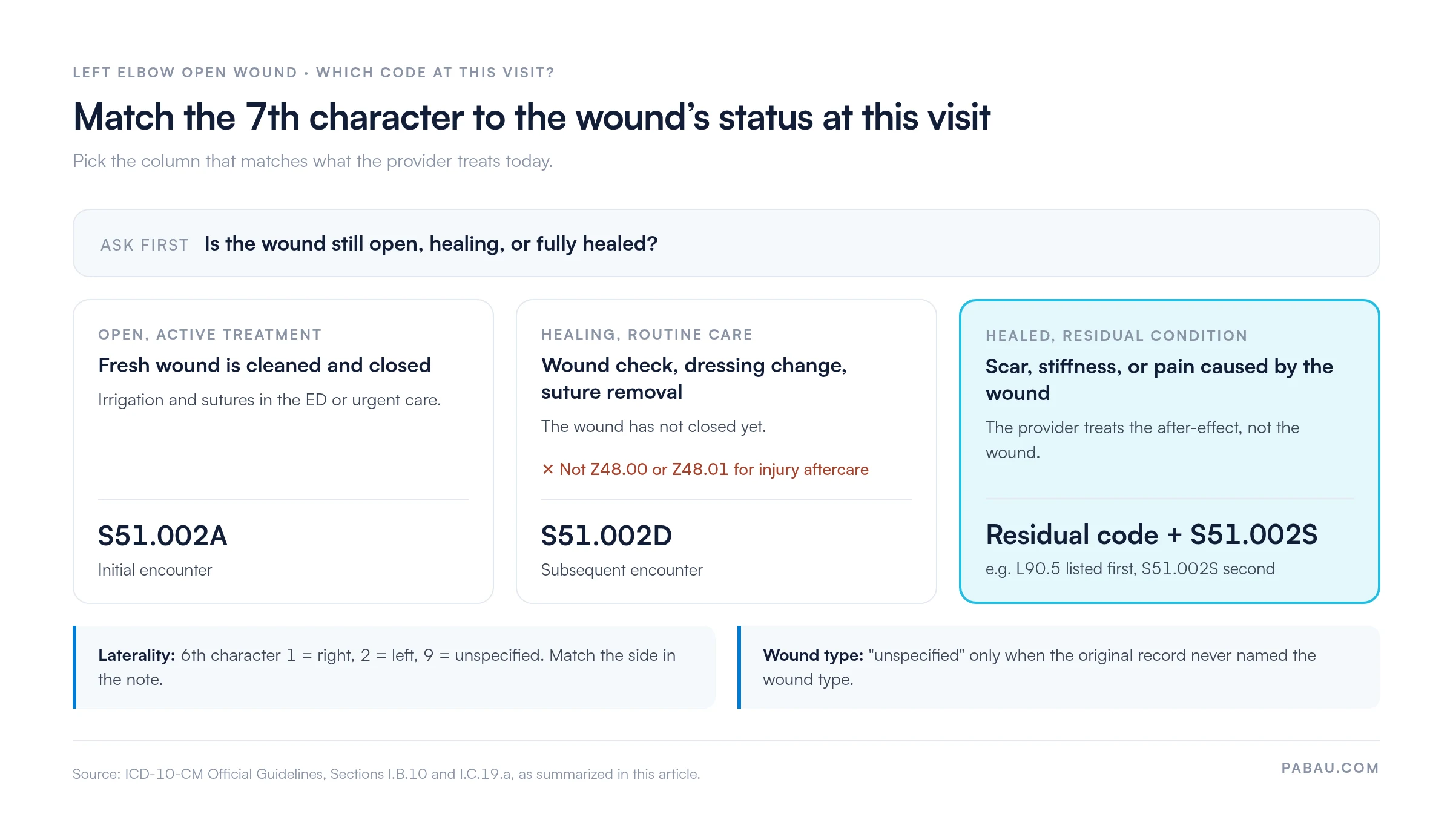
Once the wound has closed and the concern is a residual condition, the correct path is the sequela character (S) plus the residual condition code. Using S51.002D after healing is complete will typically draw a medical necessity denial. The payer reads a subsequent-encounter code as an actively healing wound, which the note no longer describes.
Payers scrutinize sequela claims more closely than initial-encounter claims because the temporal link between the original injury and the current condition is less obvious. The clinical note must establish that link explicitly.
Keeping clear medical billing documentation from the first encounter through sequela care reduces the risk of denial on ICD-10 Code S51.002S.
These elements should appear in the documentation:
If prior records are not in the current chart, a brief history noting the original injury is sufficient. Full prior records do not need to be attached to every claim, but the current note must be self-sufficient for audit purposes.
Run a query in your practice management system for all claims coded S51.002S before submission. Confirm each has a companion residual-condition code sequenced first on the claim. Payers routinely reject a sequela code submitted without its residual condition code, however strong the documentation is.
The S51 category covers open wounds of the elbow and forearm in detail. When the wound type at original presentation was documented more precisely than “unspecified,” a more specific code within S51.0 applies for the sequela encounter.
The table below shows the elbow-specific options at the sequela 7th character level, verified against the CMS ICD-10-CM code files.
When coding a sequela encounter, review the original injury documentation first. If the wound type was never specified in the initial records, S51.002S is appropriate.
Upcoding to a more specific sibling without documentation support creates an audit risk. When the side was never recorded either, the unspecified-elbow codes apply, such as S51.029S for a laceration with foreign body.
ICD-10 Code S51.002S claims are denied for a predictable set of reasons. Most of them are preventable with a pre-submission review of the claim against the clinical note.
The most frequent denial triggers:
Reviewing denial management data by code tends to show S-character denials repeating across claims. A pre-submission checklist for sequela codes stops most of them at the source.
When a claim does come back denied, the electronic remittance advice (ERA/835) gives you the payer’s CARC code. You can then answer the exact denial reason on appeal instead of resubmitting blind.
The following ICD-10-CM Official Guidelines sections govern correct use of ICD-10 Code S51.002S. CMS and the CDC/NCHS issue them jointly with each annual ICD-10-CM release. They carry the same authority as the Tabular List itself.
The AAPC Codify ICD-10-CM lookup and the WHO ICD-10 browser both provide searchable reference access to the S51 code family. For the US-specific ICD-10-CM Tabular, the CDC/NCHS official lookup tool is the primary reference.
Payer-specific acceptance rules for injury sequela codes come back to you through the clearinghouse. Our Claim.MD clearinghouse review explains how submissions, eligibility checks, and remittances move between your practice and the payer.
Our guide to medical billing denial codes explains the CARC and RARC codes payers return when they reject a sequela claim. That detail tells you what to correct before you resubmit.
Sequela claims usually fail on details a coder checks by hand. Those are the residual code listed first, the S character, and the left side matching the note. Those checks stay with your coding team. Software can take the administrative side of the claim off their plate, along with the follow-up after it goes out.
Pabau, the practice management platform we build, keeps the clinical note, the invoice, and the claim in one patient record, with claims management built in. Before each submission, it runs background checks that membership numbers and authorization codes are in place.
In the US, Pabau connects to the Claim.MD clearinghouse. Your team can run real-time eligibility checks before the visit and follow each claim from submission to payment or denial. ERA remittances post back against the claims they settle, and denied claims are flagged for rework.
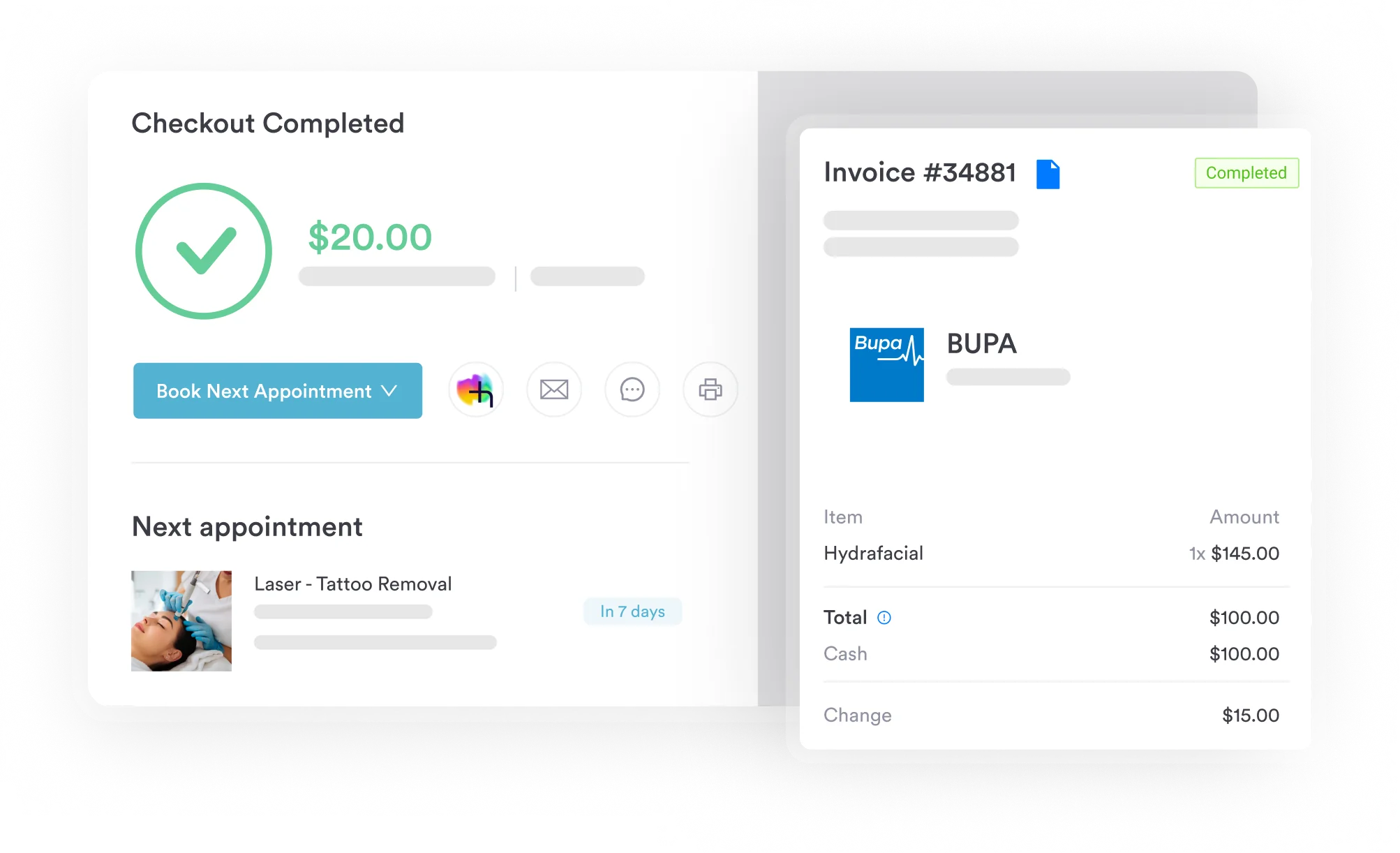

Pabau checks membership numbers and authorization codes before each claim goes out. Real-time eligibility checks and ERA posting run through the Claim.MD clearinghouse.

S51.002S belongs at the end of an injury’s course, once the wound has closed and a condition it caused still needs treatment. If the note can’t show both, the claim isn’t ready for an S code.
Spend your query time on healing status and laterality, because payers cross-check both against earlier claims for the same patient. An unspecified wound type is defensible when the original records never named one.
If you’d like eligibility checks, claim tracking, and remittances in one place for your injury coding, book a demo.

Want to reduce your overall claim denial rate? Clean claim submission checklist covers the structural requirements payers check before adjudicating any diagnosis-coded claim.
Building a denial management workflow? Revenue cycle management fundamentals provides the framework for tracking and resolving sequela code denials systematically.
Coding a forearm wound instead? ICD-10 code S51.801S covers the sequela of an unspecified open wound of the right forearm.
ICD-10 Code S51.002S is the diagnosis code for unspecified open wound of the left elbow, sequela. It covers a residual condition, such as scarring, reduced range of motion, or nerve sensitivity, that persists after the elbow wound has healed. The “S” 7th character confirms the wound’s acute phase is over and the current encounter addresses a direct consequence of that injury.
Yes, S51.002S is a valid, billable ICD-10-CM diagnosis code confirmed by CMS and the CDC/NCHS for fiscal year 2027. It requires a companion code for the specific residual condition (e.g. scar, pain, stiffness) sequenced first on the claim. Submitting S51.002S without that companion code is a structural error that most payers will automatically reject.
S51.002A applies during active treatment of the original left elbow wound. S51.002D applies during subsequent encounters while the wound is still healing (e.g. dressing changes, suture removal). S51.002S applies only after the wound has fully healed and the patient presents for treatment of a residual condition caused by the original injury. Selecting the wrong character is one of the most frequent denial triggers on S51 claims.
While an injury is still healing, its aftercare is coded with the injury code and the 7th character D, such as S51.002D. The Z48 aftercare codes are not used for injuries. Sequela codes such as S51.002S apply once the wound has healed and the patient is treated for a condition it caused. The two never share an encounter.
The usual cause is a missing residual-condition code, which must be listed first. Other triggers are the wrong 7th character after healing, a left/right mismatch, a Z48 code on the same encounter, or missing causal linkage. A pre-submission coding review catches most of them.
The clinical note must confirm four points. A prior left elbow open wound appears in the patient’s history, and that wound has healed. A specific residual condition is present. The note links that condition to the original injury with explicit language such as “resulting from” or “secondary to.” Laterality (left) must be stated consistently throughout the note and match the codes submitted on the claim.