ICD-10 Code R06.02: Shortness of breath billing guide
ICD-10 Code R06.02: Definition and quick-reference details ICD-10 Code R06.02 is...

Last Updated: Nov 9, 2026
Billable Code Specific Code
W31.9XXD is the billable ICD-10-CM code for contact with unspecified machinery, subsequent encounter. It applies to a follow-up visit after active treatment has ended, when the record does not name the type of machine.
The code sits in Chapter 20 of ICD-10-CM, External causes of morbidity. It is always reported after the injury code and never as the principal diagnosis. Workers' compensation carriers often ask for it to document how a work injury happened.
Let Pabau's smart automation suggest the right codes, reduce claim denials, and keep your practice compliant—effortlessly.
Automate repetitive tasks and focus on what matters most—your patients.
Reduce coding errors and ensure compliance with the latest regulations.
Clean claims, fewer denials, and faster reimbursements.
Powerful insights and reporting to help your practice thrive.
HIPAA compliant SOC 2 certified GDPR-compliant Trusted by 4,000+ clinics worldwide

W31.9XXD reports contact with unspecified machinery at a subsequent encounter, after active treatment for the injury has ended.
It is an external cause code, so it is always sequenced after the injury diagnosis code, such as the fracture or laceration.
The two X placeholders in positions 5 and 6 are mandatory, and a claim submitted as W31.9D is rejected as an invalid code.
Workers’ compensation carriers often require the code to document how the injury happened, while Medicare and Medicaid treat it as supplemental.
Pabau submits and tracks claims through Claim.MD, so your billers can follow each machinery-injury claim after it leaves the practice.
ICD-10 Code W31.9XXD is a valid, billable ICD-10-CM code for fiscal year 2026, effective October 1, 2025. Its official descriptor is “Contact with unspecified machinery, subsequent encounter.” The code belongs to category W31, Contact with other and unspecified machinery. Subcategory W31.9 applies when the record does not name the type of machine, and the 7th character D marks a follow-up visit after active treatment.
W31.9XXD is a 7-character code. Every position carries a specific meaning. One wrong character produces either an invalid code or the wrong encounter type.
The placeholder X characters at positions 5 and 6 are not optional filler. ICD-10-CM requires them whenever a code takes a 7th character but its base code has fewer than six characters. Submitting W31.9D without the XX produces an invalid 5-character code. Most clearinghouses reject it before the claim reaches the payer.
The 7th character D designates a subsequent encounter. It applies when the patient receives routine or follow-up care after the active phase of treatment has concluded. This is a clinical determination, not a fixed number of days or visits. The treating clinician’s documentation, not a billing rule, establishes whether active treatment is ongoing.
The transition from A to D is not automatic at discharge. Active treatment means the provider is still managing the injury with debridement, casting, or surgical repair. Once that phase is complete and the patient returns for monitoring, rehabilitation, or clearance, D is correct. When the patient presents with a residual condition caused by the original injury, use S.
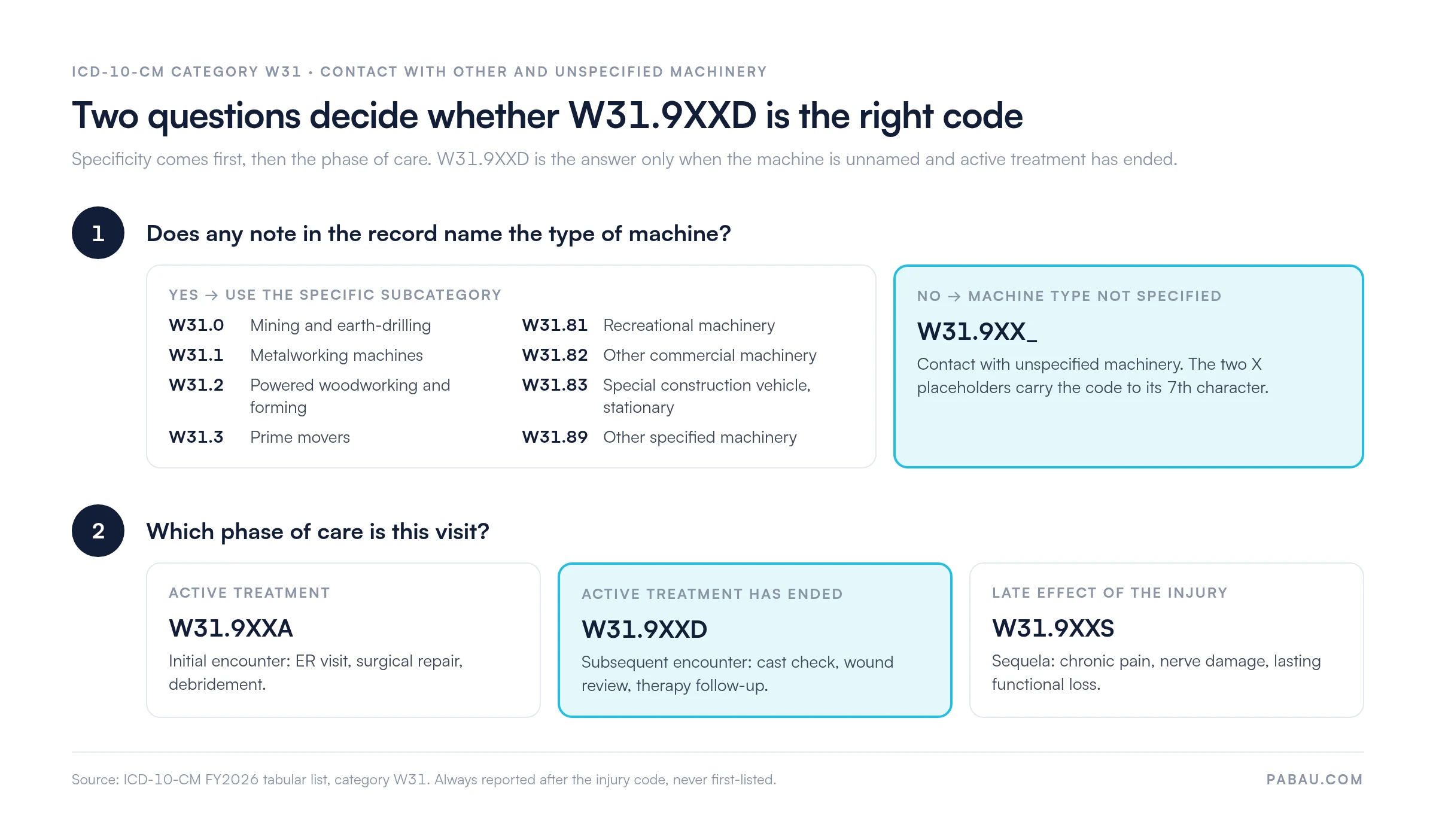
W31.9XXD applies to contact with machinery where the type is not specified in the medical record. It covers any machine the more specific W31 subcategories do not name, in any setting.
Included scenarios: Follow-up visits where the record names “machinery” as the cause of injury but not the equipment itself. An occupational medicine follow-up for a machinery injury fits here once active treatment has ended.
Excluded by the Excludes1 note under W31:
When a specific machine type is documented, a more specific W31 subcategory takes precedence. Using W31.9 when the chart reads “lathe” or “table saw” is a specificity error that payers may flag during pre-payment review. Refer to the CMS ICD-10 codes page for the full tabular exclusion notes under W31.
The costliest confusion is using W31.9XXD while the patient is still in active treatment, because that visit requires W31.9XXA. Coders also confuse W31.9 with the machine-specific W31 subcategories. The AAPC ICD-10-CM lookup lists each of them, and each one takes precedence over W31.9 when the record supports it.
W31.8 is not one code. W31.81 covers recreational machinery, W31.82 other commercial machinery, and W31.83 a special construction vehicle in stationary use. Each has its own D code, such as W31.83XD, and a table-saw follow-up belongs under W31.2XXD.
Most common coding error: Applying W31.9XXD to a visit where the physician notes still document active wound management or post-surgical follow-up for a fresh injury. That visit takes W31.9XXA. Use the CDC/NCHS ICD-10-CM web tool to verify the full W31 hierarchy before defaulting to the unspecified subcategory. The two decisions run in a fixed order, machine type first and phase of care second.
The medical record must support four things before a coder assigns W31.9XXD. Missing any one of them creates audit exposure and risks a medical billing compliance finding if the claim is reviewed.
Some payers, particularly workers’ compensation carriers, also ask for a place-of-occurrence code (Y92.-), an activity code (Y93.-), and an external cause status code (Y99.-). The ICD-10-CM guidelines report these three once, at the initial encounter. On a W31.9XXD follow-up, add one only when the payer’s coding companion asks for it.
Before assigning W31.9XXD, run a quick record review: (1) Is active treatment complete? (2) Does the chart say ‘machinery’ but not name it? (3) Is the injury code first-listed? Three yeses means the code is defensible. Any no means reassess the 7th character or the specificity level before filing.
W31.9XXD is never the principal or first-listed diagnosis. Under the ICD-10-CM Official Guidelines for Coding and Reporting (Section I.C.20), Chapter 20 external cause codes are supplemental. They explain how or where an injury occurred and are assigned in addition to the injury code, never instead of it. The rule follows from medical billing fundamentals, since payers reimburse for treating the injury, not for how it happened.
Correct sequencing order:
The injury code drives reimbursement. The external cause code provides context for population health reporting, workers’ compensation documentation, and OSHA recordkeeping. Some Medicare and Medicaid claims process without the external cause code at all. Workers’ compensation carriers often require it and may deny claims where it is absent.
Workers’ compensation carriers commonly require external cause codes to establish that an injury is work-related. W31.9XXD satisfies that requirement for follow-up machinery-injury visits. Payer policies vary by state and carrier. Some require a more specific W31 subcategory before they accept the unspecified code, so check the payer’s coding companion before defaulting to W31.9.
Medicare and Medicaid treat Chapter 20 external cause codes as supplemental. They do not drive reimbursement on those payers, but they remain best practice for complete documentation. A practice billing both groups should code external causes on every injury claim, so a later workers’ compensation claim needs no rework.
Denials for W31.9XXD cluster around six recurring errors. Each is preventable with pre-submission review. Robust denial management workflows start by catching these before the claim leaves the practice.
When you appeal a denial tied to the XXD vs XXA distinction, lead with the treating physician’s note. The strongest version states that the acute phase of treatment is complete. Pairing that with guidance on denial codes in medical billing and a corrected claim that sequences the injury code first typically resolves the issue. For practices using electronic claim submission, submitting a clean claim means verifying these sequencing rules before the 837P file is transmitted.
Run a quarterly audit of your W31.9XXD claims with three filters. Flag claims with the code in position 1, claims with no injury code, and claims whose visit note still mentions active wound care. Those three filters catch most denial-generating errors before they compound.
A machinery-injury follow-up usually ends in a workers’ compensation claim. Billers then check its status in a payer portal, a clearinghouse, and the patient record, each kept apart from the others.
Pabau, the practice management platform we build, submits and tracks claims through Claim.MD from the data your team has already entered. Its claims tracking software shows each claim’s status beside the patient’s visit. Your billers can then follow a W31.9XXD claim without opening a separate portal.
Pabau does not choose or validate codes for you. Your coder still confirms the 7th character and sequences the injury code first, and Pabau carries those codes through submission and status tracking.

Pabau submits and tracks claims through Claim.MD, using the codes your team has already entered. See how occupational medicine and workers’ compensation teams follow each claim after submission.

W31.9XXD belongs on a claim only when the record documents two facts: active treatment has ended, and no note names the machine. When either fact is missing, the correct code is W31.9XXA, W31.9XXS, or a specific W31 subcategory.
Put both checks into chart review before coding, not into denial work afterward. Confirming the phase of care and the machine type once costs far less than a corrected claim and a second wait for payment.
Book a demo to see how Pabau submits and tracks your practice’s workers’ compensation claims through Claim.MD.

Need to audit denial codes across your machinery injury claims? Denial codes in medical billing covers CARC and RARC denial reason codes with actionable resolution steps.
Submitting workers comp claims through a clearinghouse? Pabau’s Claim.MD clearinghouse guide explains how the 837P workflow applies payer-specific edits before transmission.
Looking for the 837P EDI file format for external cause codes? Understanding the 837 file explains loop and segment requirements for diagnosis code sequencing in electronic claims.
ICD-10 Code W31.9XXD is the external cause code for contact with unspecified machinery, subsequent encounter. The patient is attending a follow-up or aftercare visit for a machinery injury after active treatment has ended. It sits in Chapter 20 of ICD-10-CM and is always assigned as an additional code alongside the primary injury diagnosis.
Yes. W31.9XXD is a valid, billable ICD-10-CM code for fiscal year 2026, but only as an additional (secondary) code. It cannot be listed as the principal or first-listed diagnosis. Chapter 20 external cause codes identify the injury mechanism, not the condition driving reimbursement.
W31.9XXA is for initial encounters where the patient is still receiving active treatment for the machinery injury. W31.9XXD is for subsequent encounters, such as follow-up visits, aftercare, or monitoring once active treatment has concluded. Using XXD while the physician is still actively managing the injury is the most common coding error and a frequent denial trigger.
Yes. Workers’ compensation carriers commonly require external cause codes to confirm work-relatedness, and W31.9XXD satisfies that requirement for machinery-injury follow-up visits. Payer policies vary by state and carrier. Some require a more specific W31 subcategory before accepting W31.9, so check the payer’s coding companion before submission.