ICD-10 Code Y76.0: Diagnostic obstetric and gynecological devices
ICD-10 Code Y76.0: Definition and billable status ICD-10 Code Y76.0 is a valid, ...

Last Updated: Oct 23, 2026
Billable Code Specific Code
S43.303A is the billable ICD-10-CM code for subluxation of unspecified parts of unspecified shoulder girdle, initial encounter.
The mix-up has a traceable source. The S43 category-level includes note lists sprain of cartilage, joint or ligament of shoulder girdle among its included terms. That note makes every code in the block look sprain-adjacent. Subcategory titles decide the code, though, and S43.3 is titled subluxation and dislocation of other and unspecified parts of shoulder girdle.
Let Pabau's smart automation suggest the right codes, reduce claim denials, and keep your practice compliant—effortlessly.
Automate repetitive tasks and focus on what matters most—your patients.
Reduce coding errors and ensure compliance with the latest regulations.
Clean claims, fewer denials, and faster reimbursements.
Powerful insights and reporting to help your practice thrive.
HIPAA compliant SOC 2 certified GDPR-compliant Trusted by 4,000+ clinics worldwide

ICD-10 code S43.303A reports a subluxation of unspecified parts of an unspecified shoulder girdle at an initial encounter.
S43.303A is not a sprain code. A documented sprain of the shoulder joint belongs in S43.4-, and S43.409A covers it when laterality is missing.
The sixth character encodes injury type and side together. Digits 1 to 3 mean subluxation of the right, left and unspecified girdle, and 4 to 6 mean dislocation.
S43.303 is already six characters long, so no X placeholder goes before the seventh character A.
Practice management software like Pabau flags unspecified codes at the point of coding, so your team can query the provider first.
The table below gives you the at-a-glance facts for S43.303A.
S43.303A is the ICD-10-CM code for a subluxation of unspecified parts of an unspecified shoulder girdle, documented at an initial encounter. Breaking the code apart clarifies what each segment contributes.
The word “unspecified” appears twice in the code title, and each instance carries a different meaning. The first refers to the parts of the girdle. The record doesn’t name the glenohumeral, acromioclavicular, or sternoclavicular joint, so the code sits under the catch-all S43.30. The second refers to laterality, because the chart does not identify a right or left shoulder.
Clinically, a subluxation is a partial displacement of a joint. The articular surfaces separate incompletely and then return to position, either on their own or with manipulation.
That sits between a sprain, which is a stretch or tear of a ligament, and a dislocation, which is a complete loss of articulation. The CDC/NCHS ICD-10-CM web tool confirms S43.303A as a valid, billable code under Chapter 19.
The shoulder girdle itself is the clavicle and scapula together with their articulations. A girdle-level code such as S43.303A is therefore broader than a shoulder joint code. It says something happened somewhere in that complex, without pinning down where.
S43 splits into two halves. Subcategories S43.0 through S43.3 cover subluxation and dislocation. Subcategories S43.4 through S43.9 cover sprains. Knowing where the line falls is what stops a documented sprain being coded as a subluxation.
The split decides the code. S43.303A applies when the chart documents a subluxation, or describes a partial displacement, with no joint and no side named. A documented sprain always belongs in the S43.4 to S43.9 half.
In software built for occupational therapists, each S-code links to the functional goals guiding a patient’s recovery.
Most ICD-10-CM laterality axes are predictable. A 1 means right, a 2 means left, and a 9 means unspecified. S43.30- breaks that habit, because its sixth character carries two facts at once.
The consequence is easy to miss. A coder who treats the sixth character as pure laterality will pick 3 for an unspecified-side injury. That reports a subluxation even when the note describes a full dislocation. The correct code in that scenario is S43.306A.
The same 1-to-3 and 4-to-6 split runs through S43.00- as well, so the habit is worth unlearning across the whole category.
Per ICD-10-CM Official Guidelines Section I.C.19, every injury code in Chapter 19 needs a 7th character to indicate encounter type. Getting it wrong is one of the most common audit triggers in musculoskeletal billing.
One misconception is worth clearing up. “Initial encounter” doesn’t mean the first calendar visit. It describes the phase of care. A patient in active rehabilitation for a shoulder girdle subluxation across several visits stays in that phase, so S43.303A holds throughout. Once active treatment stops and care shifts to monitoring residual effects, move to S43.303D.
The same three values run through the rest of the category.
Document the phase of care explicitly in your clinical notes, not just the diagnosis. A chart that reads ‘continuing active physical therapy for acute shoulder girdle subluxation’ justifies the A seventh character. That line holds on every active-treatment visit.
S43.303A has close neighbors in three directions. One axis is laterality, one is the severity of the displacement, and one is the tissue injured. The table below maps all three so you can pick the correct code first time.
Two rows in that table deserve a second look. S43.409A is the code most often assigned to S43.303A by mistake, because it holds the description many people expect S43.303A to carry. S43.90XA is the other near-miss, and it needs an X placeholder that S43.303A does not.
S43.303A fits a narrow set of circumstances. Four conditions need to hold at the same time.
Per the CMS ICD-10-CM coding guidelines, coders assign the code that most precisely describes the documented condition. Unspecified codes are a valid last resort rather than a default. When a provider writes something vague such as shoulder injury, query for clarification before reaching for S43.303A.
Several official guidelines govern how S43.303A is reported. Misapplying any of them raises denial risk.
For practices managing HIPAA compliance, the Health Insurance Portability and Accountability Act mandates ICD-10-CM for all covered electronic health transactions. Accurate code selection is therefore a compliance matter as well as a revenue one.
Five mistakes account for most of the trouble with this code. Each one has a straightforward fix.
The chart reads shoulder sprain, the coder searches for an unspecified shoulder code, and S43.303A comes back. Assign S43.409A instead when the shoulder joint is sprained and no side is recorded.
If the note names a structure, move to the matching subcategory such as S43.42 for the rotator cuff capsule. Where that sprain leaves a late effect on the right side, S43.491S carries the sequela character.
A note documenting a dislocated shoulder girdle with no side recorded codes to S43.306A, not S43.303A. Reaching for 3 because it usually means unspecified downgrades a dislocation to a subluxation on the claim. Check the injury type before you check the side.
S43.303XA is not a valid code. The placeholder X only fills an empty character position, and S43.303 has no empty position to fill. The habit usually comes from neighboring codes that do need it.
Imaging. Once the glenohumeral joint is confirmed, subsequent claims should carry an S43.0 code. Where the chart records a complete posterior dislocation of the right humerus at a follow-up visit, the code is S43.024D.
Once the AC joint is confirmed, they should carry an S43.1 code. An unspecified code that never updates looks like a documentation failure on audit.
The A character survives as long as active treatment continues, and no longer. A visit that reviews progress, adjusts nothing, and confirms healing is a subsequent encounter. Switch to S43.303D at that point, and to S43.303S if you are treating a late effect such as recurrent instability.
S43.303A is a valid, billable ICD-10-CM code accepted under Medicare, Medicaid, and most commercial plans. Acceptance still comes with conditions worth knowing.
Practices using claims management software can flag unspecified codes at the point of coding and prompt a provider query before the claim leaves the building. That removes a category of avoidable denial without adding manual review time.
S43.303A is a diagnosis code, not a procedure code. It pairs with CPT codes describing the services delivered at the encounter. The combinations below are clinically plausible examples, so verify medical necessity against your payer’s LCD or NCD before billing any of them.
The AAPC Codify ICD-10-CM lookup provides crosswalk functionality for each code.
Audit risk for S43.303A concentrates in three places. The first is using the unspecified code when the note supports specificity. The second is mislabeling a dislocation as a subluxation. The third is holding the A character past the active-treatment phase.
Better documentation habits prevent all three. Note templates in clinical documentation software can prompt for each detail at the point of care.
Practices that build medical documentation workflows around ICD-10 specificity see fewer laterality-related denials. Laterality prompts in intake forms and clinical note templates also cut the volume of coder-to-provider queries. Structured patient record management keeps those prompts inside the encounter, so the problem never reaches the billing team.
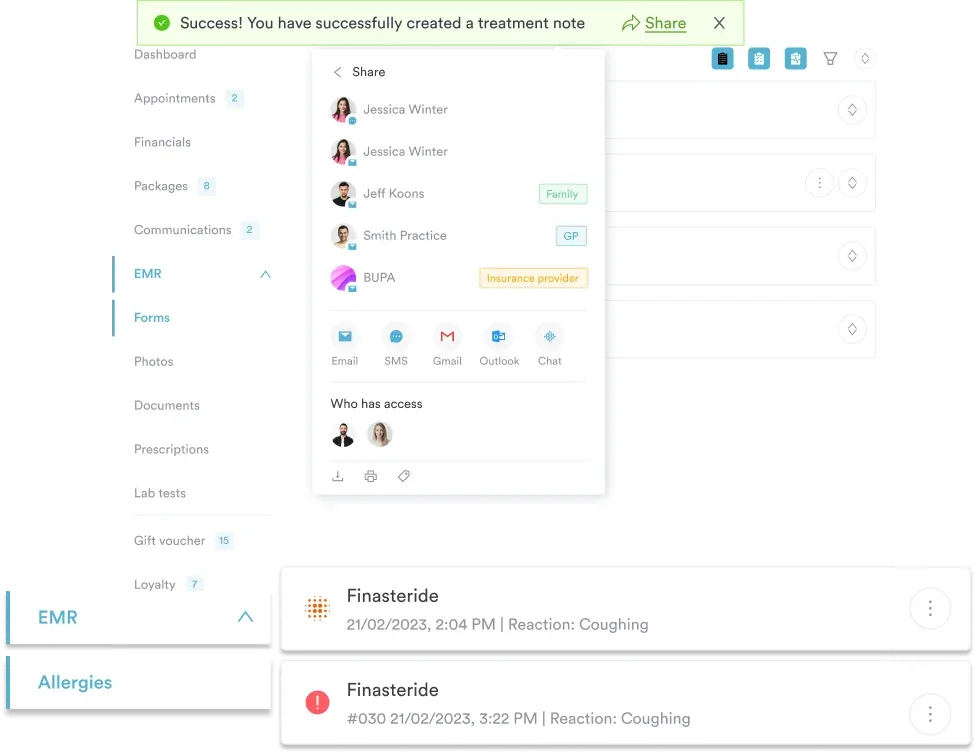
Many practices go one step further and set up EHR integration. Connecting the EHR to the practice management platform lets codes chosen during charting flow straight into the claim. That removes transcription errors and keeps the 7th character aligned with the clinical record.
Add two fields to your shoulder intake template. Ask for the injured side, and ask whether the displacement was partial or complete. Those two answers move most charts off S43.303A and onto a specific code before the note ever reaches coding.
In most practices, a coding problem like this surfaces after the denial arrives. The note says shoulder injury, the coder picks the nearest available code, and the payer queries it three weeks later. By then the provider has seen fifty other patients and the note is hard to clarify.
Pabau is an all-in-one practice management system, so the clinical note and the claim sit on the same patient record. Intake forms and note templates can require the injured side and the degree of displacement before an encounter closes. Diagnosis codes chosen during charting carry through to the claim, so nobody retypes them at the billing desk.
The outcome is fewer charts arriving with a missing side or an unnamed joint. Your coders spend less time chasing providers, and more claims clear on first submission. Unspecified codes then go out only when they are genuinely the right answer.

Pabau brings clinical notes, coding, and claims into one system. Intake prompts capture the injured side and the degree of displacement up front, so fewer claims leave your practice on an unspecified code.

S43.303A is a valid, billable code with a narrow job. It reports a partial displacement somewhere in the shoulder girdle when the record names neither the joint nor the side. A sprain documented in the chart belongs elsewhere in S43, and a documented side moves you to S43.301A or S43.302A.
The strongest lever a practice has here is documentation quality at the point of care. Prompts for laterality, a field for the degree of displacement, and a phase-of-care line remove most of the guesswork before coding starts. Book a demo to see how Pabau keeps that detail attached to the claim.

Billing a mid-size facial excision? CPT 11641 facial excision guide covers the 0.6 to 1.0 cm range and how site and diameter decide the right code.
Billing a sling after the encounter? A4566 is the supply code for a shoulder sling abduction restrainer, and the guide covers its documentation.
Coding anesthesia for a shoulder procedure? 01650 covers anesthesia for shoulder and axilla artery procedures, with the documentation each claim needs.
Documenting a shoulder wound rather than a joint injury? S41.021A reports a laceration with a foreign body of the right shoulder at an initial encounter.
Working with 7th characters on fracture codes? S52.131Q shows how the extension set widens once a fracture and its healing status are involved.
ICD-10 code S43.303A reports a subluxation of unspecified parts of an unspecified shoulder girdle at an initial encounter. It sits in Chapter 19 (S00-T88), under subcategory S43.3 for subluxation and dislocation of other and unspecified parts of the shoulder girdle. The code is valid and billable. Both uses of the word unspecified carry weight, because the record names no particular joint of the girdle and gives no side.
No. S43.303A describes a subluxation, which is a partial displacement of a joint. A documented sprain of the shoulder joint codes to S43.4-, and S43.409A is the version used when laterality is absent. A sprain of the shoulder girdle with no part named codes to S43.90XA instead. The S43 category-level includes note does list sprain terms, which is why S43.303A is so often misread as a sprain code.
The sixth character. S43.303A reports a subluxation, meaning a partial displacement, of an unspecified shoulder girdle. S43.306A reports a complete dislocation of an unspecified shoulder girdle. In S43.30-, digits 1 to 3 cover subluxation of the right, left and unspecified side. Digits 4 to 6 cover dislocation across those same three options.
Only the phase of care. S43.303A marks an initial encounter, used while the patient receives active treatment for the shoulder girdle subluxation. S43.303D marks a subsequent encounter, used once active treatment has ended and routine healing or aftercare continues. The injury description is identical in both codes.
No. S43.303 already runs to six characters, so the 7th character A attaches directly and produces S43.303A. Writing S43.303XA gives you an invalid code. Compare S43.90XA, where the sprain subcategory stops at five characters and the X placeholder fills position six.
Yes, workers’ compensation carriers generally accept S43.303A for shoulder girdle subluxation claims. Requirements vary by state and carrier, and most examiners prefer a laterality-specific code such as S43.301A or S43.302A. A documented mechanism of injury is usually expected as well. Submitting S43.303A when the chart records the side invites a query or a delay.
Plausible pairings include 99213 and 99214 for office visits, plus 73030 for a shoulder X-ray. Physical therapy adds 97110 and 97530, and 20610 covers a major joint injection. These are examples rather than approved combinations. Verify medical necessity against your payer’s local coverage determination before billing any of them.