ICD-10 Code R34: Anuria and oliguria
ICD-10 Code R34 is the billable ICD-10-CM diagnosis code for anuria and oliguria...

Last Updated: Oct 6, 2026
Billable Code Specific Code
S43.024D is the billable ICD-10-CM code for posterior dislocation of right humerus, subsequent encounter. It records the direction (posterior), the side (right) and the stage of care. It belongs on follow-up, physical therapy and post-reduction monitoring visits after initial treatment.
Claims submitted with S43.024D on a first-time emergency visit are likely to be denied or queried, because that visit takes S43.024A. Posterior dislocations account for roughly 2-4% of glenohumeral dislocations and are more often missed on initial imaging. Getting the 7th character wrong is a common cause of denials.
Let Pabau's smart automation suggest the right codes, reduce claim denials, and keep your practice compliant—effortlessly.
Automate repetitive tasks and focus on what matters most—your patients.
Reduce coding errors and ensure compliance with the latest regulations.
Clean claims, fewer denials, and faster reimbursements.
Powerful insights and reporting to help your practice thrive.
HIPAA compliant SOC 2 certified GDPR-compliant Trusted by 4,000+ clinics worldwide

S43.024D is the billable ICD-10-CM code for posterior dislocation of the right humerus at a subsequent (follow-up) encounter.
The 7th character D covers routine healing and rehabilitation visits, while the initial emergency visit takes A.
Claims commonly fail when the wrong 7th character is assigned or when imaging confirmation of posterior displacement is missing from the record.
In Pabau’s practice management software, the Claim.MD clearinghouse integration supports electronic claim submission, real-time eligibility checks and claim status tracking.
ICD-10 Code S43.024D is the billable ICD-10-CM code for posterior dislocation of the right humerus, subsequent encounter. It belongs on follow-up, rehabilitation and routine-healing visits after the dislocation was first treated. The code records four clinical facts across seven characters, and a claim needs all seven.
The decimal point after S43 is part of the official notation and must appear in all documentation and claim submissions. Submitting the code as “S43024D” without the decimal is a formatting error that most clearinghouses will flag before the claim reaches the payer. Per CMS ICD-10-CM coding guidance, the full seven-character code is required for specificity. Shorter versions, such as S43.024 without the 7th character, are not billable.
A posterior dislocation of the right humerus occurs when the humeral head displaces posteriorly relative to the glenoid fossa of the shoulder joint. The glenohumeral joint (GH joint) is inherently mobile. Posterior displacement means the head moves toward the back of the body rather than the front.
This injury pattern is clinically distinct from the far more common anterior dislocation. It has its own set of typical causes, and seeing one in the medical record supports the posterior direction the provider documented.
The 7th character D applies when the patient is receiving routine care during the healing phase after the dislocation has already been treated. Section I.C.19.a of the ICD-10-CM Official Guidelines for Coding and Reporting defines “subsequent encounter” as care after active treatment is complete. It covers healing-phase visits such as monitoring, rehabilitation, physical therapy and medication adjustments for the original injury.
The decision rule is short. When active treatment is over and the dislocation is still healing, the visit takes D as its 7th character. When a complication or late effect appears after full healing, use S and sequence the sequela condition first. The panel below maps each character to its typical visits and the CPT codes it can support.
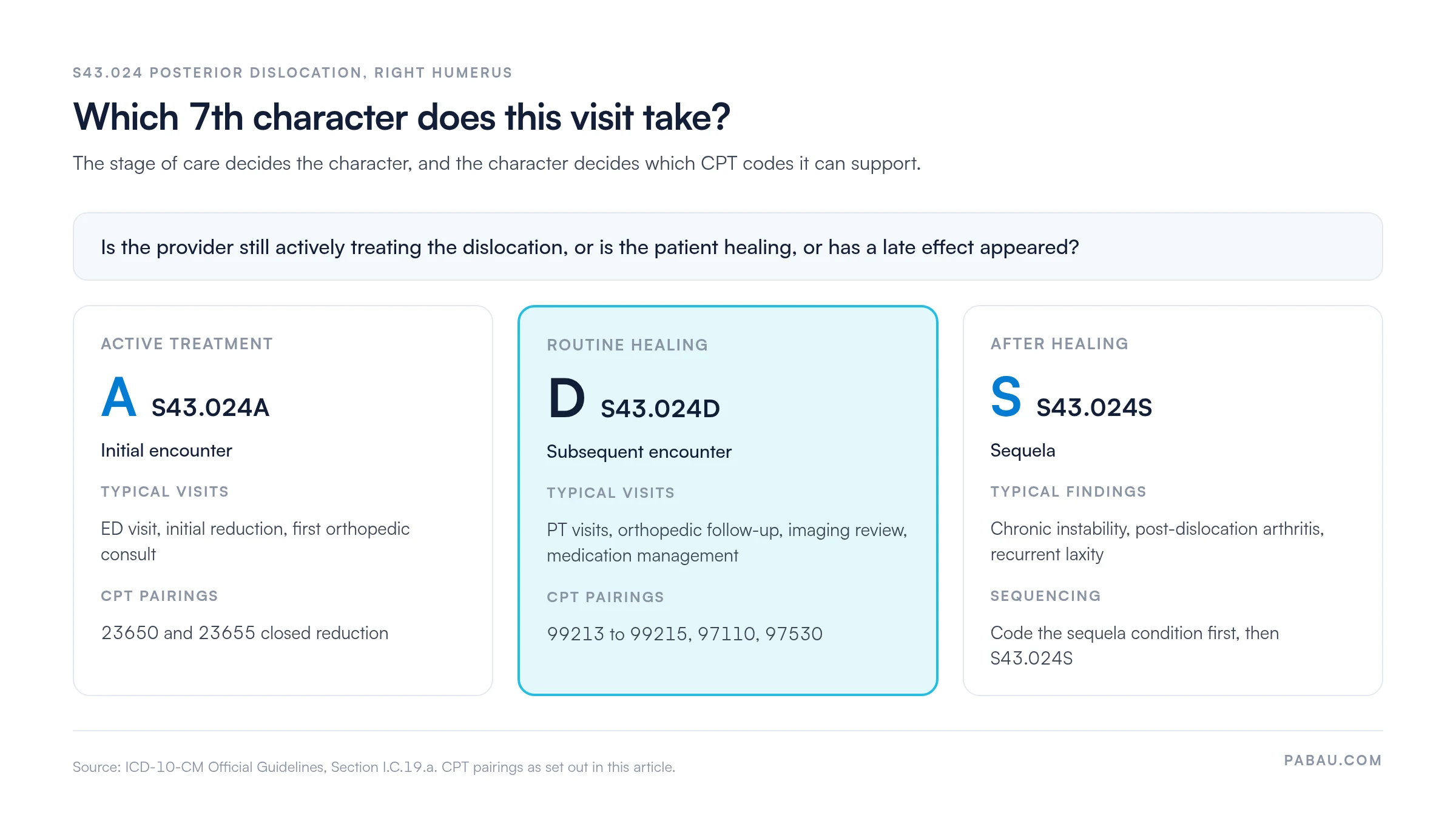
S43.024D is a valid, billable ICD-10-CM code confirmed in the FY2025 and FY2026 tabular lists. It carries a “billable” designation, meaning it is specific enough to use on a claim without requiring a more granular child code. The CDC/NCHS ICD-10-CM web tool is the authoritative resource for confirming current-year validity before submission.
The full ICD-10-CM hierarchy for S43.024D runs from the chapter down to the billable code.
Confirm the code’s validity for the fiscal year of the date of service, not the date of billing. ICD-10-CM codes can be retired or amended between fiscal years. The FY runs October 1 to September 30. A claim billed in November for a September service date should use the prior FY code set.
The S43 category carries includes and Excludes2 notes that govern what this code captures. Misreading them leads to a missed or wrongly added secondary code.
S43 includes dislocation of the acromioclavicular joint and of the glenohumeral joint, where S43.024D sits. It also covers sprains of the ligaments of the shoulder girdle. The includes note confirms that both subluxation and dislocation of the shoulder joint are captured within the S43.0 subcategory.
S43 has an Excludes2 note for strain of muscle, fascia and tendon of the shoulder and upper arm (S46.-). A rotator cuff strain is coded to S46.-, not S43.024D, but both may be reported when both injuries are documented. The category also tells coders to code any associated open wound as well.
When a fracture-dislocation is documented, report both the dislocation and the fracture code. Sequence first the injury the provider identifies as most serious and the focus of treatment, per guideline I.C.19.b.
The S43.024 family includes multiple closely related codes that share nearly identical descriptors. The AAPC ICD-10-CM lookup is useful for side-by-side comparison when confirming laterality and direction. The table below captures the most commonly confused adjacent codes.
The direction confusion most often occurs between S43.014D (anterior) and S43.024D (posterior) because anterior dislocation accounts for roughly 95% of shoulder dislocations. When a coder sees “shoulder dislocation, subsequent encounter” in notes without a documented direction, query the provider before defaulting to anterior.
The CPT codes most commonly billed alongside S43.024D depend on the encounter type. The diagnosis and the procedure must align, so a subsequent encounter code cannot support a first-time reduction such as CPT 23650. Use a CPT-to-ICD-10 crosswalk tool to verify payer-specific pairing requirements before submitting.
Physical therapists billing CPT 97110 or 97530 at follow-up shoulder rehabilitation visits pair these with S43.024D as the supporting diagnosis. The diagnosis stays on D for the whole rehab episode, however many visits it runs.
Payers reviewing shoulder dislocation claims look closely at 7th-character accuracy and imaging documentation. Meeting the requirements below protects the claim in pre-payment review and in retrospective audit.
Medicare Administrative Contractor (MAC) requirements for shoulder dislocation management vary by jurisdiction. Steady medical billing compliance habits keep documentation ready for whichever MAC reviews it. Pabau’s claims management software submits electronically through our Claim.MD clearinghouse integration, which reaches thousands of US payers. It also provides real-time eligibility verification before the claim is sent.
S43.024D is a denominator-eligible diagnosis under MIPS Quality Measure 221, Functional Status Change for Patients with Shoulder Impairments. The measure applies to clinicians who treat eligible patients for shoulder impairments, including rehabilitation episodes coded with S43.024D.
Quality ID 221 is a registry-reported, risk-adjusted patient-reported outcome measure built on the FOTO Shoulder FS PROM. Its denominator covers patients aged 14 and older with a shoulder-impairment diagnosis at initial evaluation. The eligible code list includes S43.024D, S43.024S, S43.025D and S43.025S. CMS reviews the criteria every year, so check the current-year MIPS measure specification before relying on them.
Practices that bill S43.024D regularly and do not track Measure 221 can miss quality reporting points. MIPS performance affects the clinician’s payment adjustment.
S43.024D claims fail in predictable patterns. Each failure below maps to a common Claim Adjustment Reason Code (CARC), printed on the explanation of benefits (EOB) or electronic remittance advice (ERA). Knowing the cause behind each CARC makes denial management workflows faster to run. The full list of denial codes covers the CARCs not shown here.
Submitting a clean claim for S43.024D requires that the 7th character, laterality, and imaging documentation are verified before the claim leaves the practice. Clearinghouse-level edits catch formatting errors, but they cannot catch clinical mismatches between the encounter type and the diagnosis code selected. That review has to happen at the point of documentation.
Run a monthly audit of S43 claims returned with CARC 11 or CARC 16, which commonly flag diagnosis mismatches and missing information. Even five denied claims a month can show which documentation step keeps producing the same error.
A 7th-character or laterality error on S43.024D often starts in the note. A follow-up note copied forward from the first visit can carry A instead of D. A note that never says “right” leaves the coder guessing.
Pabau keeps the clinical note, the appointment and the claim in one patient record. Claims go out through our Claim.MD clearinghouse integration, with real-time eligibility checks before submission and status tracking after it. Your team still owns the code review, so it checks encounter type and side against the note before the claim is sent.
Coverage problems then surface before the visit instead of on the remittance, and every returned claim sits in one status view. Our Claim.MD clearinghouse guide walks through the submission flow step by step.

Pabau connects your clinical documentation to electronic claim submission through our Claim.MD integration.

S43.024D is a precise code that requires every character to be correct. The 7th character mismatch between A and D is a common, preventable source of denials on shoulder dislocation follow-up claims. It usually traces back to a copied-forward note rather than to what the coder knows.
So fix it where it starts. Make encounter type and side explicit in every follow-up note template, and audit returned S43 claims each month.
Pabau’s Claim.MD clearinghouse integration supports electronic claim submission with real-time eligibility checks. That lets your team catch 7th-character and laterality mismatches in its own pre-submission review. To see how that works in a shoulder or orthopedic practice, book a demo with the team.

Want to understand how clearinghouse submission works end to end? Medical claims clearinghouse guide covers how claims move from provider to payer and where errors are caught.
Billing a physical therapy practice alongside orthopedic follow-up? Superbill documentation guide explains how to structure encounter-level billing documents that support subsequent encounter codes.
Need to understand how insurance eligibility affects follow-up claim approval? Insurance eligibility verification walks through real-time eligibility checks before the claim is submitted.
ICD-10 Code S43.024D is the billable diagnosis code for posterior dislocation of the right humerus at a subsequent encounter. The patient is in the healing, rehabilitation or follow-up phase after the dislocation was first treated. The code sits in ICD-10-CM Chapter 19, category S43, and the D limits it to visits after active treatment.
The most common CPT pairings for S43.024D are office visit codes 99213-99215 for orthopedic follow-up and CPT 97110 or 97530 for physical therapy. Reduction codes such as CPT 23650 and 23655 pair with the initial encounter code S43.024A. Billed against S43.024D, they are likely to be denied.
Three causes come up most. The first is the wrong 7th character, such as A instead of D on a follow-up visit. The others are missing imaging that confirms posterior displacement and a reduction CPT code billed against S43.024D. Notes that never state the right side also draw CARC 16 denials from Medicare and commercial payers.
A glenohumeral dislocation and a shoulder dislocation describe the same event. The glenohumeral joint is the shoulder’s ball-and-socket joint, so the terms are clinically interchangeable. In ICD-10-CM, all glenohumeral (shoulder joint) dislocations fall under subcategory S43.0. Direction (anterior, posterior, inferior) and laterality (right, left, unspecified) are encoded by the 5th character (direction) and the 6th character (laterality) respectively.