ICD-10 Code S53.013D: Anterior subluxation of unspecified radial head
ICD-10 Code S53.013D: Quick reference summary Use the table below as your first ...

Last Updated: Nov 6, 2026
Billable Code Specific Code
S43.031S is the billable ICD-10-CM code for inferior subluxation of right humerus, sequela.
It applies when a traumatic inferior subluxation of the right shoulder (glenohumeral) joint has left a lasting condition, such as recurrent instability or post-traumatic arthropathy. Active treatment of the original injury has ended. A frequent denial comes from billing S43.031D, the subsequent-encounter code, for a patient now treated only for that downstream condition. Code the residual condition first and S43.031S second.
Let Pabau's smart automation suggest the right codes, reduce claim denials, and keep your practice compliant—effortlessly.
Automate repetitive tasks and focus on what matters most—your patients.
Reduce coding errors and ensure compliance with the latest regulations.
Clean claims, fewer denials, and faster reimbursements.
Powerful insights and reporting to help your practice thrive.
HIPAA compliant SOC 2 certified GDPR-compliant Trusted by 4,000+ clinics worldwide

S43.031S is a billable ICD-10-CM code for a lasting condition left by a traumatic inferior subluxation of the right humerus.
The code sits in the glenohumeral (shoulder joint) subcategory S43.03, not the acromioclavicular codes, which start at S43.1-.
The sixth character 1 means right-sided subluxation, while 4 means a full inferior dislocation of the right humerus (S43.034S).
Sequela claims need two codes, with the residual condition first (for example M12.511, traumatic arthropathy, right shoulder) and S43.031S second.
Billing S43.031D for a patient whose active treatment has ended is the most avoidable denial for this code.
ICD-10 code S43.031S is a valid, billable ICD-10-CM code for inferior subluxation of the right humerus, sequela. It describes a lasting problem in the right shoulder joint caused by an earlier traumatic subluxation.
The shoulder joint, or glenohumeral joint, is where the head of the humerus sits in the shallow glenoid socket of the scapula. In an inferior subluxation, trauma pushes the humeral head partly downward out of the socket. The joint surfaces keep some contact, which separates a subluxation from a full dislocation.
The “sequela” designation means the acute injury has resolved. The patient is no longer being treated for the original subluxation. Instead, they present with a residual condition that is a direct consequence of that prior trauma.
Common residual conditions reported with S43.031S include recurrent right shoulder instability, traumatic arthropathy, stiffness, and chronic pain from the earlier injury. When the treating note names the right shoulder, S43.031S is correct once the original injury has healed and the visit treats its after-effects.
S43.031S sits at the end of a seven-level path inside Chapter 19 of the ICD-10-CM code set. Each level narrows the joint, the direction, the side, and the encounter.
Inside S43.03, the sixth character carries two facts at once. Values 1, 2 and 3 mean subluxation of the right, left or unspecified humerus. Values 4, 5 and 6 mean a full inferior dislocation on the same three sides.
ICD-10-CM uses a mandatory seventh character to identify the encounter type for injury codes in Chapter 19. There are three options for the S43.031 root code. Choosing the wrong one is the most preventable billing error on these shoulder claims.
The ICD-10-CM Official Guidelines, Section I.C.19.a, reserve sequela codes for conditions that arise as a direct result of an injury. There is no minimum time requirement. A sequela can appear weeks or years after the original injury, based on the treating provider’s judgment.
What matters is documentation. The provider must state that the current condition is a late effect of the prior subluxation, not a new or ongoing acute injury.
The most common coder error is submitting S43.031D when the correct code is S43.031S. Take a patient who subluxed their right shoulder six months ago, finished rehab, and was discharged.
They now return with episodes of the shoulder slipping and pain on overhead reaching. They are no longer in the “subsequent encounter” phase, because active healing ended at discharge. The current visit addresses a sequela, so S43.031S applies.
Using S43.031D in this scenario tells the payer that the original injury is still being actively treated. Medicare and most commercial payers flag this mismatch, especially when the claim date sits far from the injury date. The denial follows from the conflict between the encounter type and the clinical picture.
A practical decision rule helps here. Ask whether the provider note documents active treatment of the original subluxation or management of a downstream condition. If downstream, use S43.031S. If still actively healing, use S43.031D. The diagram below maps all three outcomes and the claim order that follows a sequela visit.
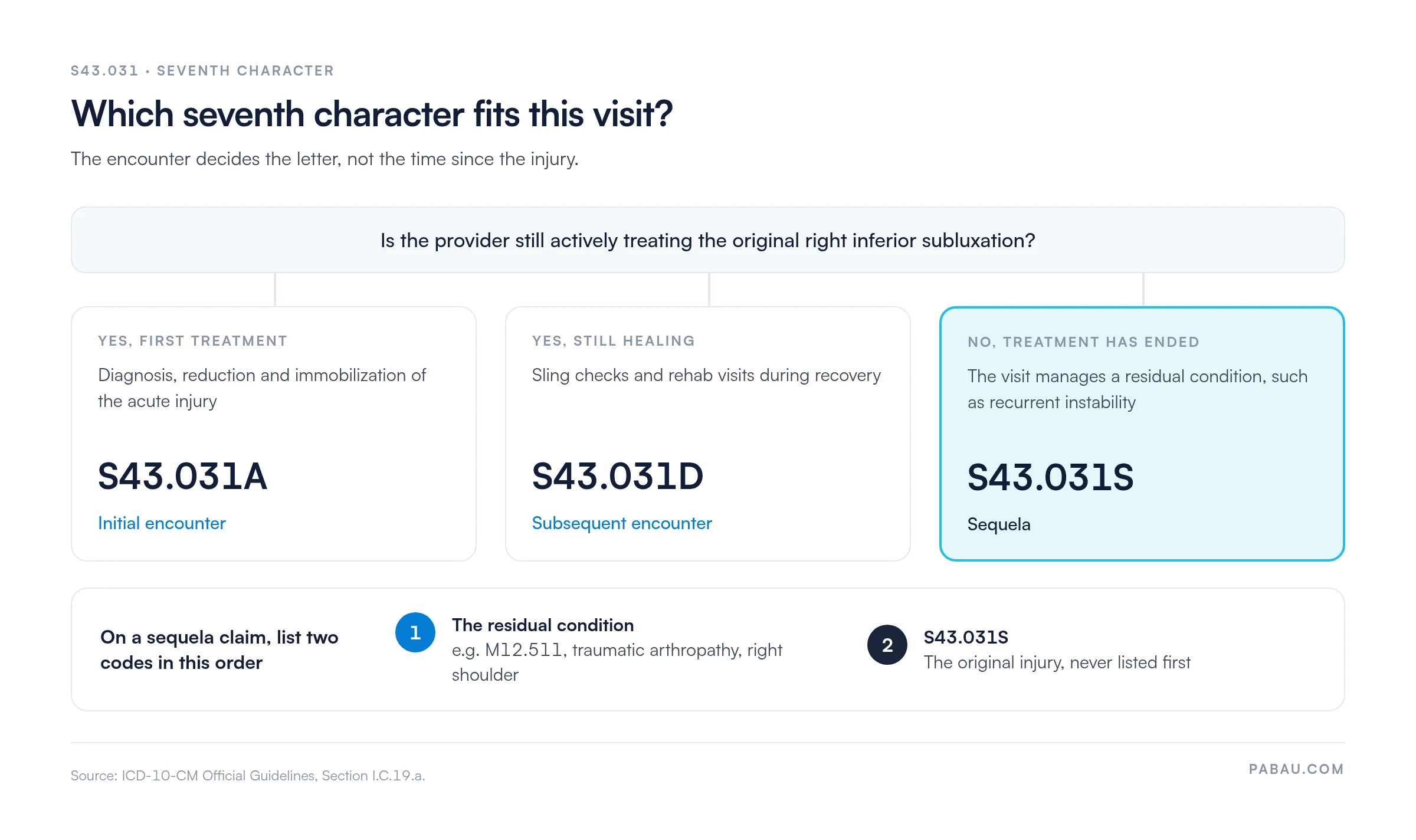
S43.031S is intentionally narrow. Knowing its scope prevents laterality and anatomy mismatches that trigger edits at the clearinghouse.
Coders often confuse adjacent codes when the note does not state the side, the direction or the degree of displacement. The table below lists the codes most likely to be mixed up with S43.031S. When the note names the side but not the direction, the unspecified codes under S43.00 apply instead, such as S43.001D at a subsequent encounter.
According to the ICD-10-CM Official Guidelines for Coding and Reporting, Section I.C.19.a, sequela coding follows a strict two-code sequence. Omitting the first code is a common audit finding. The same two-code rule applies across every injury sequela in Chapter 19, as part of wider medical billing guidelines.
A correctly sequenced claim for traumatic arthropathy after a prior inferior subluxation reads M12.511, then S43.031S. If the coder submits only S43.031S, most payers deny the claim as incomplete. The code alone does not explain why the patient is being seen today.
The guidelines also state that S43.031S may stand alone if no code exists for the residual condition. In shoulder cases, a specific condition code almost always exists. The table below lists the usual first-listed codes.
An external cause code may accompany S43.031S, and it takes the same seventh character (S). For example, a fall-related injury might carry W19.XXXS (unspecified fall, sequela).
Place of occurrence, activity and external cause status codes (Y92, Y93 and Y99) are reported only at the initial encounter. Leave them off a sequela claim.
Audit the S43.031S claims your practice submitted in the past 90 days. Flag any claim where S43.031S is the only diagnosis code. Add the condition code, such as M12.511, in first position before resubmitting.
A defensible S43.031S claim rests on five documentation points. Missing any one of them weakens clean claim submission and opens the encounter to payer scrutiny.
Workers’ compensation payers apply extra scrutiny to sequela claims. Many state systems require pre-authorization for sequela treatment, and some require an impairment rating first. Rules vary by state, so verify them before submitting S43.031S on a workers’ comp claim.
Sequela codes in the S43 family produce a predictable set of denial patterns. Strong denial management workflows catch these before submission. Claims management software that shows the provider’s note beside the codes at entry helps too.
S43.031S supports CPT codes for evaluating and treating the residual effects of a prior right inferior subluxation. On the claim form, each procedure line should point to the residual condition code first, with S43.031S as the supporting diagnosis.
The table below lists commonly paired codes for glenohumeral instability and its after-effects. Verify payer coverage for each CPT code against current Local Coverage Determinations before submission. For arthroscopic stabilization, the CPT 29806 guide covers capsulorrhaphy billing in more depth.
CPT 29806 covers arthroscopic capsulorrhaphy only. A SLAP lesion repair is a separate code, 29807, and the two are commonly bundled under NCCI edits. Document a distinct lesion before billing both, and check current edits.
Most denials on S43.031S start in the clinical record. The note says “shoulder” instead of “right shoulder,” or the condition code never reaches the claim.
Pabau, the practice management and billing platform we build, keeps the clinical note, the diagnosis codes and the claim in one patient record. The coder sees the provider’s late-effect wording next to the codes being billed.
Claim.MD, Pabau’s US clearinghouse partner, sends claims electronically and checks patient eligibility in real time. Our Claim.MD clearinghouse review explains how the connection works.

Pabau keeps the note, the diagnosis codes and the claim in one record. Coders see the late-effect wording beside the codes before the claim goes to the payer.

S43.031S is a narrow code, and most errors come from reading it too broadly. Confirm three facts before you bill it. The note must say right shoulder, subluxation rather than dislocation, and a late effect rather than active healing.
Then put the residual condition first and S43.031S second. Practices that build this check into intake avoid most of the denials listed above. Book a demo to see how Pabau helps orthopedic and sports medicine practices code shoulder sequela claims correctly the first time.

Need to understand how a clearinghouse handles your claims? Claim.MD clearinghouse review walks through real-time eligibility checks and electronic claim submission with Pabau.
Want a guide on managing claim denials systematically? Denial codes in medical billing covers CARC denial reason codes and appeals workflows applicable to sequela code rejections.
Want to read denial reasons straight from the payer? Understanding electronic remittance advice explains how ERAs identify denial reasons so you can correct and resubmit S43.031S claims quickly.
Billing a shoulder injection for post-traumatic arthropathy? CPT code 20610 covers arthrocentesis billing, modifiers and Medicare rates for major joints.
ICD-10 code S43.031S is the billable code for inferior subluxation of the right humerus, sequela. It covers a lasting condition caused by an earlier traumatic partial downward slip of the right shoulder joint, after active treatment has ended.
Yes. S43.031S is a valid, billable ICD-10-CM code accepted for HIPAA-covered electronic transactions. The seventh character S completes the code to its most specific level.
No. S43.031S describes the glenohumeral (shoulder) joint, where the humeral head meets the glenoid. AC joint subluxations and dislocations are coded from S43.1-.
S43.031A is the initial encounter for the acute subluxation. S43.031D covers return visits while the injury is still healing. S43.031S covers visits for a residual condition after healing has ended, and using D when S is correct is a common denial cause.
Yes, in almost all shoulder cases. Guideline I.C.19.a puts the condition code first, such as M12.511 for traumatic arthropathy of the right shoulder, with S43.031S second. Submitting S43.031S alone when the condition can be coded is a common denial trigger.
The most common reasons are billing S43.031D instead of S43.031S and leaving out the condition code. Others are a laterality mismatch, coding a full dislocation as a subluxation, a missing seventh character, and no record of the earlier injury.
Workers’ compensation payers generally accept S43.031S for documented late effects of a work-related right shoulder injury. Many states require pre-authorization for sequela treatment, and some require an impairment rating first. Check state rules before submitting.