ICD-10 Code S53.013D: Anterior subluxation of unspecified radial head
ICD-10 Code S53.013D: Quick reference summary Use the table below as your first ...

Last Updated: Nov 6, 2026
Billable Code Specific Code
S43.001D is the billable ICD-10-CM code for unspecified subluxation of right shoulder joint, subsequent encounter. It covers follow-up visits in the healing phase of a right shoulder subluxation whose direction isn't documented.
A frequent cause of denials on this code is submitting seventh character A (initial encounter) when the patient is already in the healing phase. Another is billing the parent subcategory S43.001 without a seventh character.
Let Pabau's smart automation suggest the right codes, reduce claim denials, and keep your practice compliant—effortlessly.
Automate repetitive tasks and focus on what matters most—your patients.
Reduce coding errors and ensure compliance with the latest regulations.
Clean claims, fewer denials, and faster reimbursements.
Powerful insights and reporting to help your practice thrive.
HIPAA compliant SOC 2 certified GDPR-compliant Trusted by 4,000+ clinics worldwide

S43.001D is a billable ICD-10-CM code for unspecified subluxation of the right shoulder joint at the subsequent encounter, valid from FY2016 through FY2027.
The seventh character D means the patient is getting routine care in the healing phase, whatever the visit number.
Billing S43.001A (initial encounter) on a follow-up visit is a frequent denial cause, so match the seventh character to the documented treatment phase.
Strain codes in S46.- are an Excludes2 note for S43, so you can report both when the patient has both conditions.
Pabau’s practice software lets you customize SOAP note templates, so every follow-up note asks for laterality and the treatment phase.
ICD-10 code S43.001D is a valid, billable ICD-10-CM diagnosis code for unspecified subluxation of the right shoulder joint, subsequent encounter. Orthopedic, sports medicine and physical therapy clinicians use it for follow-up visits once active treatment of a right glenohumeral subluxation has ended.
Verify the current year’s descriptor against the CDC/NCHS ICD-10-CM web tool, which publishes official tabular list updates each October for the following fiscal year.
The seventh character D designates subsequent encounter. The patient is receiving routine care during the healing phase, after active treatment has ended. That care includes physical therapy, manipulation, follow-up imaging and monitoring.
D tracks the treatment phase, so the visit count never decides it. A patient at their second appointment is still at the initial encounter if active treatment is ongoing.
The ICD-10-CM Official Guidelines for Coding and Reporting (Section I.C.19.a) tie “subsequent” to the phase of treatment rather than the visit count. The treating clinician’s note must clearly indicate that the active-treatment episode has concluded and the patient is now in a healing or rehabilitative phase.
Flag the encounter phase in the clinical note at the start of every visit, as well as at admission. Phrases such as ‘Patient continues rehabilitation following initial shoulder reduction’ signal subsequent encounter clearly. Vague entries like ‘shoulder follow-up’ leave the seventh-character decision open to interpretation, which is where denials begin.
Subluxation is a partial displacement of a joint’s articular surfaces. The humeral head shifts out of its normal position in the glenoid fossa but keeps partial contact. Dislocation is a complete loss of joint contact. S43.001D covers subluxation only, and dislocation has its own 6th-character codes, e.g. S43.004, S43.014, S43.024.
The “unspecified” qualifier means the direction or type of subluxation is not documented: Anterior, posterior, inferior, or multidirectional. Use this code only when the provider’s note does not record subluxation direction. If the note hints at a direction, such as anterior glenohumeral subluxation, query the provider before defaulting to “unspecified.”
Understanding where S43.001D sits in the code tree helps coders navigate to adjacent codes quickly and avoid selecting a parent subcategory that is non-billable. The full path from chapter to code is shown below.
The CMS ICD-10 codes page publishes the annual tabular list update files each October. Always confirm that the code remains active for the date of service you are billing.
The S43 category carries an Includes note and an Excludes2 note. Review both before you submit, because they decide which other injury codes can share the claim.
S46.- is an Excludes2 note, so S43.001D and an S46.- code may be reported together when both conditions exist. Excludes2 means the strain is not part of S43, but a patient can have both injuries at once.
S43.001D sits within a tight cluster of similar codes. The decision path and table below cover the three most frequent sources of confusion: Encounter type, laterality, and subluxation versus dislocation.
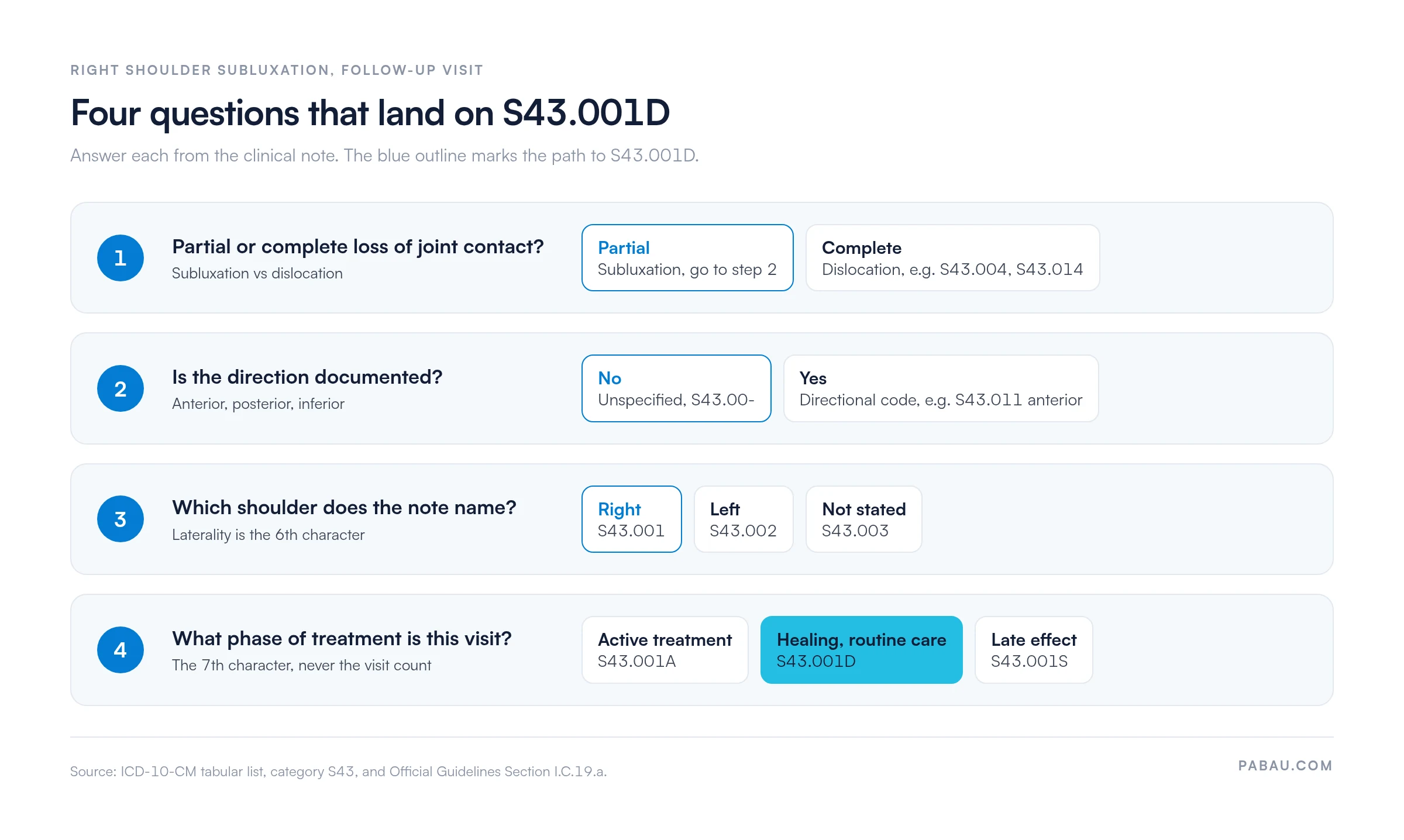
If the follow-up note documents a complete anterior dislocation of the right humerus, the correct code is S43.014D instead.
If the note specifies an inferior direction and the encounter treats a late effect of the original subluxation, report S43.031S.
Refer to the AAPC ICD-10-CM code lookup to view the full S43 family and cross-reference related codes when documentation is ambiguous.
A claim submitted with S43.001D is supportable only when the clinical note contains all four of the following elements. Missing any one is grounds for a medical necessity denial.
S43.001D is a billable ICD-10-CM code for Medicare, Medicaid, and commercial payers. Coverage and prior authorization rules still vary by plan. Submit through a clearinghouse that validates your claim against active payer edits before transmission.
Pabau, the practice management system we build, integrates with Claim.MD’s clearinghouse to route claims to thousands of US payers. Edit failures are caught there, before they reach the payer and turn into a denial.
Therapeutic exercise under 97110 is billed in 15-minute units. Record the minutes spent in the same note that supports the S43.001D diagnosis.
Many commercial plans require prior authorization for ongoing PT beyond a set number of visits. When requesting authorization, document both the subluxation diagnosis and the functional limitations that justify continued rehabilitation. Real-time insurance eligibility verification before each PT visit confirms active coverage and any remaining authorized visits. That check lowers the risk of billing into an exhausted benefit.
Denials on ICD-10 code S43.001D follow predictable patterns. Knowing them before submission is more efficient than working appeals after the fact. Effective denial management in healthcare starts with pre-submission validation rather than retrospective correction.
Submitting a clean claim for S43.001D means validating all five elements above before transmission. Those are the seventh character, the complete code, matching laterality, medical necessity documentation and active authorization. If a payer still rejects the claim, our guide to denial codes explains how to respond.
Each month, audit the S43.001x claims that carry an A as the seventh character. A claim with seventh character A on a visit more than 30 days after the injury date of service is a red flag. Either the note is not capturing the treatment phase, or the coder is defaulting to A when D or S applies. Fix the note first, then the code.
Many practices write shoulder follow-up notes as free text and leave the coder to infer side and treatment phase later. When a note says only “shoulder follow-up,” the seventh character turns into a query or a guess.
In Pabau, you can customize SOAP note templates so each follow-up note asks for laterality, subluxation direction and treatment phase. Digital forms collect intake and history before the visit, and both sit in the same patient record.
Pabau’s claims management software then sends the claim through the Claim.MD integration. Reporting tools let you track billing performance, so you can spot repeat errors early.

Pabau’s customizable SOAP note templates and digital forms help clinicians record laterality and treatment phase at every visit. Claims then go out through the Claim.MD integration.

The seventh character on ICD-10 code S43.001D is decided in the clinical note, long before anyone opens a claim. A note that names the right side, a subluxation and a finished active-treatment phase gives the coder the answer without a query.
So fix the note template before you chase denials. Add laterality and treatment-phase fields to your follow-up template, then audit A-coded follow-ups each month. It costs a few seconds per note and saves reworking claims later.
To see where coding fits in the wider cycle, read how revenue cycle management connects notes, claims and payments. Book a demo to see how Pabau’s SOAP templates and Claim.MD integration support your shoulder follow-up billing.

Need to understand how ICD-10 codes flow into claims? What is medical billing walks through the full note-to-payment cycle for US practices.
Coding a posterior shoulder dislocation follow-up? ICD-10 code S43.024D covers posterior dislocation of the right humerus at the subsequent encounter.
Billing functional training at the same visit? CPT code 97530 explains the therapeutic activities code that often accompanies shoulder rehab.
Want to reduce claim denials across your shoulder caseload? Denial codes in medical billing covers the most common CARC codes and how to respond to each.
ICD-10 code S43.001D is the billable ICD-10-CM diagnosis code for unspecified subluxation of the right shoulder joint, subsequent encounter. It is used for follow-up care, such as physical therapy or routine monitoring, after active treatment of a right glenohumeral subluxation has ended. The code has been valid since FY2016 and remains active through FY2027.
Yes. S43.001D is a billable ICD-10-CM code valid for submission on HIPAA-covered transactions. The parent subcategory S43.001 (without a seventh character) is not billable. Only the seven-character codes S43.001A, S43.001D, and S43.001S may be submitted on a claim.
S43.001A (initial encounter) is used while the patient is receiving active treatment, such as reduction, immobilization, or acute orthopedic management. S43.001D (subsequent encounter) is used once active treatment is complete and the patient is healing or in rehabilitation. The distinction is treatment phase, so a patient can have several visits under S43.001A while active treatment continues.
The seventh character D in ICD-10-CM designates subsequent encounter. The patient is receiving routine care during the healing phase after active treatment has been completed. Per the ICD-10-CM Official Guidelines Section I.C.19.a, “subsequent” refers to the phase of treatment rather than how many times the patient has been seen.
Common CPT codes paired with S43.001D in rehabilitation settings include 97110 (therapeutic exercise), 97530 (therapeutic activities), 97012 (mechanical traction), and 73030 (shoulder X-ray, two views). The right CPT code depends on the service rendered, so always match the procedure to the documented encounter.
The five most common denial causes are listed here in order. (1) S43.001A is submitted for a follow-up visit. (2) The non-billable parent code S43.001 goes out without a seventh character. (3) S43.003D (unspecified side) is used when the note documents the right shoulder. (4) Medical necessity documentation is missing. (5) The prior authorization has expired. A clearinghouse check before submission catches the coding errors among these.
Use S43.001S (sequela) when treating a late effect that arose directly from the original right shoulder subluxation. Examples include chronic glenohumeral instability, secondary osteoarthritis of the shoulder joint, or post-injury nerve damage. S43.001D covers the healing phase of the original injury, while S43.001S covers a new condition that injury caused. The sequela code is reported alongside a code for the nature of the sequela itself.