ICD-10 code S42.134B: Nondisplaced coracoid process fracture, right shoulder, open
ICD-10 code S42.134B: Quick reference ICD-10 code S42.134B describes a nondispla...

Last Updated: Nov 3, 2026
Billable Code Specific Code
S43.223D is the billable ICD-10-CM code for posterior subluxation of unspecified sternoclavicular joint, subsequent encounter. It covers a follow-up visit after active treatment has ended. The medial end of the clavicle has partly slipped backward at the breastbone, and the record does not name the side.
The code sits in category S43 of Chapter 19, under subcategory S43.22 for posterior sternoclavicular injuries. Assignment turns on four facts. The joint is sternoclavicular, the shift is posterior and partial, no side is documented, and the visit is routine healing-phase care.
Let Pabau's smart automation suggest the right codes, reduce claim denials, and keep your practice compliant—effortlessly.
Automate repetitive tasks and focus on what matters most—your patients.
Reduce coding errors and ensure compliance with the latest regulations.
Clean claims, fewer denials, and faster reimbursements.
Powerful insights and reporting to help your practice thrive.
HIPAA compliant SOC 2 certified GDPR-compliant Trusted by 4,000+ clinics worldwide

S43.223D codes routine follow-up care for a posterior subluxation of the sternoclavicular joint when the record does not name the side.
The seventh character D applies once active treatment has ended and the patient is in the healing or recovery phase.
A visit that includes a reduction or surgical stabilization is active treatment, so it takes S43.223A even when it is not the first visit.
Use S43.221D (right) or S43.222D (left) when the side is documented, and S43.224D to S43.226D when the joint fully dislocated.
Pabau, the practice management platform we build, routes claims through its Claim.MD integration so format and eligibility errors surface before the payer sees them.
ICD-10 code S43.223D is the billable code for a routine follow-up visit after a posterior sternoclavicular subluxation, when the record does not name the side. The table below gives coders the details needed to confirm it. Verify it against the CMS ICD-10-CM annual release for your fiscal year, because descriptor revisions occasionally reach the S43 category.
S43.223D packs the body region, the joint, the direction, the severity, the side and the phase of care into seven characters. Reading each one prevents coders from selecting a neighboring code when the documentation supports this one.
The fifth character, 2, is where the posterior direction is encoded. Anterior sternoclavicular injuries sit under S43.21_, and S43.20_ covers records that do not state a direction.
The sixth character carries two facts at once: Side and severity. Values 1 to 3 are subluxations of the right, left and unspecified joint, and values 4 to 6 are dislocations in the same order. The grid below maps all six codes against the seventh character.
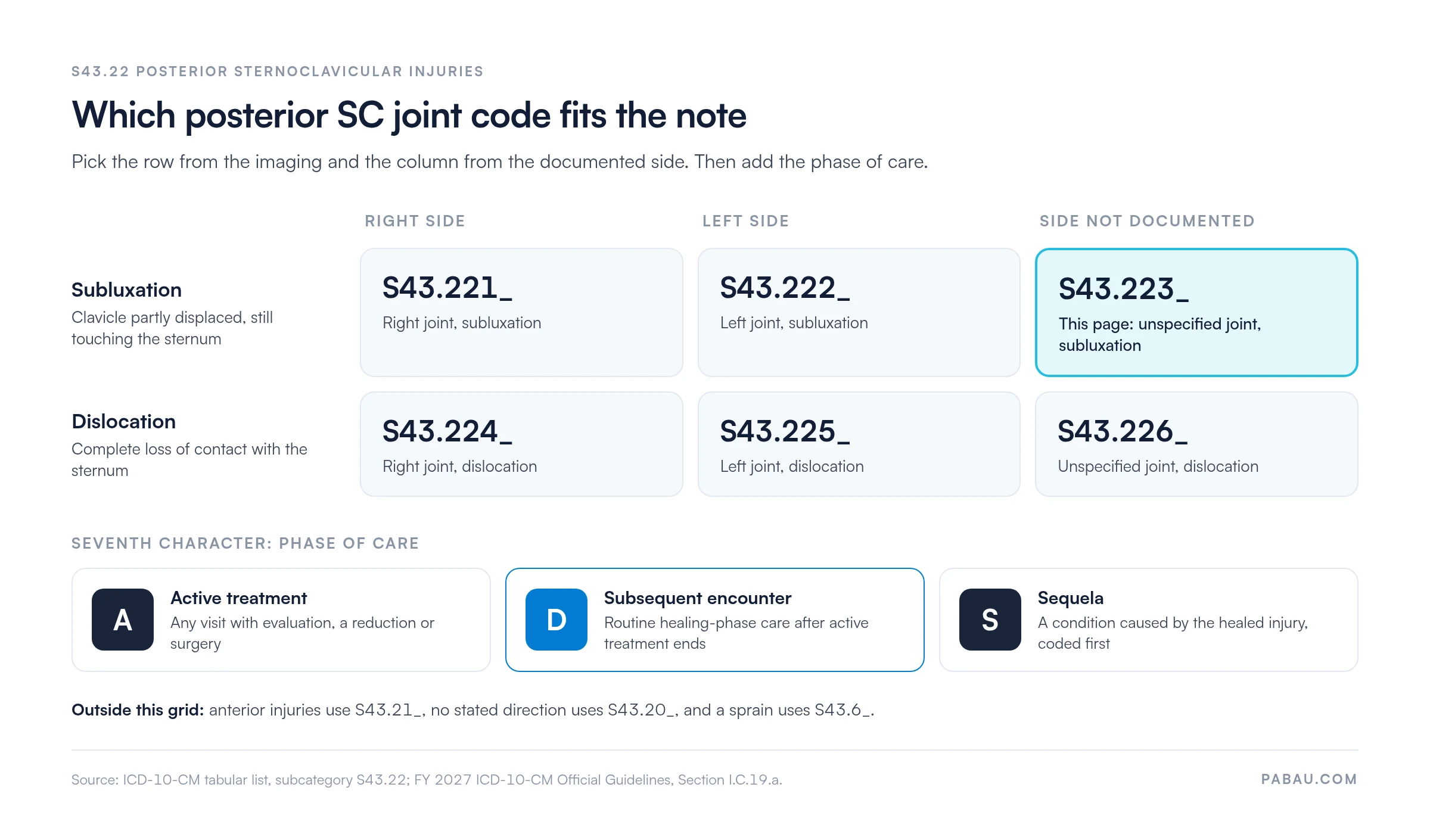
An unspecified side should prompt a provider query before submission. Defaulting to S43.223D when the CT report or exam note names a side is an avoidable denial.
The seventh character D marks a visit after the patient has completed active treatment and is receiving routine care during the healing or recovery phase. That is the definition in Section I.C.19.a of the ICD-10-CM Official Guidelines for Coding and Reporting.
Active treatment itself, such as a reduction or surgery, takes the seventh character A at every visit where it happens. The same section settles provider continuity. A new or different provider does not change the seventh character, because assignment depends on whether the patient is undergoing active treatment.
Follow-up notes often read “aftercare,” and some coders reach for a Z aftercare code such as Z47. The guidelines rule that out for injuries. For aftercare of an injury, the coder assigns the acute injury code with the seventh character D, so S43.223D stays on the claim.
When a follow-up note documents a repeat reduction or a decision to operate, that visit is active treatment again. Code S43.223A for it, then return to D once routine healing-phase care resumes.
The sternoclavicular joint links the medial end of the clavicle to the manubrium of the sternum. In a posterior subluxation, the medial clavicular head is pushed partly backward toward the mediastinum without fully losing contact with the sternum. A full loss of contact is a dislocation, which moves the code to S43.224_ through S43.226_.
The direction matters because the trachea, esophagus and great vessels sit directly behind the joint. A 2016 review in the World Journal of Orthopedics links posterior displacement to neurovascular, tracheal and esophageal injuries that can be life threatening. Red flags worth recording include dysphagia, dyspnea and signs of vascular compromise in the arm.
Plain radiographs show the mediastinum poorly, so CT has become the investigation of choice, according to the same review.
A 2015 review in the Journal of the American Academy of Orthopaedic Surgeons (JAAOS) calls the usual mechanism indirect. The typical case is lateral compression of the shoulder during sports. Direct impact on the medial clavicle, as in a rollover motor vehicle crash, is less frequent.
The JAAOS review also notes that patients younger than 25 more often have a physeal separation than a dislocation. When CT shows a posteriorly displaced fracture of the sternal end of the clavicle, code from S42.014 to S42.016 with a fracture seventh character instead. Documenting the mechanism and the imaging also supports medical necessity when payers review the follow-up claim.
The S43.22_ subcategory covers posterior sternoclavicular injuries only. Its codes differ by side, by subluxation versus dislocation, and by encounter. Picking the wrong sibling is an easy mistake in this group, so confirm each against the note before submission.
Four neighbors outside this subcategory are easy to confuse with it. S43.0_ covers the shoulder (glenohumeral) joint, where posterior humeral injuries sit under S43.02_. S43.1_ covers the acromioclavicular joint, S43.21_ covers anterior sternoclavicular injuries, and S43.6_ covers a sternoclavicular sprain.
Category S43 carries a “code also” note for any associated open wound. Its Excludes2 note lists strain of muscle, fascia and tendon of shoulder and upper arm (S46.-), so both can be reported when both are documented. Pabau’s ICD-10-CM code library carries reference pages for neighboring injury codes, such as S43.215D and S43.226S.
A claim for S43.223D withstands payer scrutiny when the medical record supports every element the code encodes. The checklist below reflects what medical billing compliance reviewers and auditors look for in injury subsequent-encounter claims.
CPT selection depends on what the provider performs at the visit, and the procedure also decides the seventh character. Closed or open treatment of the joint is active treatment, so those codes pair with S43.223A instead. Confirm pairings against current AAPC Codify crosswalk data and payer policy before billing.
A routine healing-phase check outside a global period is billed as an established-patient office visit, such as 99213, at the level the note supports. Codes 23540 to 23552 describe acromioclavicular treatment, and 23650 to 23680 describe shoulder (glenohumeral) dislocation treatment. Neither range belongs on a sternoclavicular claim.
External cause codes: Section I.C.20 of the guidelines requires an external cause code to carry the seventh character of the injury it explains. The rule applies at each encounter where the injury is treated.
With S43.223D, a sports collision coded as W51.XXXD (accidental striking against or bumped into by another person, subsequent encounter) fits. Place of occurrence (Y92) and activity (Y93) codes are reported only once, at the initial encounter, and Y92 takes no seventh character.
External cause reporting is voluntary unless a state mandate or a payer requires it. Where it is required, a mismatched seventh character is a common reason for a rejected claim.
A clearinghouse such as Claim.MD validates claims before transmission, so formatting and eligibility problems surface before the payer sees them. Matching the seventh character on the injury and external cause codes is the highest-value check before submitting a clean claim for this code.
Denials on ICD-10 code S43.223D cluster around six root causes. Each one has a corrective action that keeps the resubmission from becoming a write-off. Knowing the patterns is the basis of effective denial management for injury claims.
For practices with recurring errors across injury codes, the fix is upstream. A structured note that prompts the provider to record joint, direction, severity, side and phase of care reduces the coder’s reliance on inference. That upstream fix is the core of medical billing done well, and it keeps revenue cycle management from absorbing avoidable rework.
A wrong joint code or seventh character usually surfaces when the remittance arrives. By then, the note that would settle the question has not been opened in weeks, and a coder reworks the claim after the fact.
Pabau keeps the diagnosis on the same record as the note that justifies it. Charting templates can prompt for the joint, direction, side and phase of care. The details S43.223D needs are then captured during the visit.
Claims then route through the Claim.MD integration, which validates the claim format and checks payer eligibility before submission. Remittance data returns to the same system through Pabau’s claims management software, so a denial appears next to the encounter that produced it. Your billing team can fix the pattern once instead of chasing it claim by claim.

Pabau connects to the Claim.MD clearinghouse to validate ICD-10-CM claims and check payer eligibility before submission. See how practices cut rework on subsequent-encounter injury claims.

ICD-10 code S43.223D holds up once the record answers four questions. Is the injured joint sternoclavicular? Did the clavicle shift backward? Was the displacement partial? Has active treatment ended? A yes to all four, with no side documented, makes the code defensible.
The two errors that cost the most are a shoulder code on a sternoclavicular injury and a D on a visit that included a reduction. Settle the joint and the phase of care before the claim leaves the practice, and query the provider whenever the CT report names a side.
Pabau’s Claim.MD integration then handles eligibility checks and claim validation, so correctly coded claims move faster. Book a demo to see how Pabau supports orthopedic injury billing from the note to the remittance.

Need to understand denial codes and how to respond? Denial codes in medical billing covers common CARC and RARC codes and the corrective workflows that resolve each one.
Submitting claims through a clearinghouse for the first time? Medical claims clearinghouse guide explains how clearinghouses validate and route claims between providers and payers.
Want a deeper look at electronic remittance and ERA reconciliation? Electronic remittance advice (ERA) walks through 835 file formats and how to read denial reason codes in remittance data.
ICD-10 code S43.223D is the billable diagnosis code for posterior subluxation of unspecified sternoclavicular joint, subsequent encounter. It applies to routine follow-up care after active treatment has ended, when the record does not state which side is injured.
No. S43.223D describes the sternoclavicular joint, where the clavicle meets the breastbone. A posterior subluxation of the shoulder (glenohumeral) joint is coded from S43.02_, such as S43.023D when the side is not specified.
S43.223A applies to each visit where the patient receives active treatment, such as the initial evaluation, a reduction or surgery. S43.223D applies to later visits for routine care during healing or recovery. Late effects after the injury heals use S43.223S.
Use D for routine healing-phase care after active treatment ends, such as sling checks, follow-up imaging or supervised rehabilitation. Use S when a condition arises as a direct result of the healed injury, such as chronic joint instability. Code that condition first, then S43.223S.
No. When the record documents the right sternoclavicular joint, use S43.221D, and for the left, use S43.222D. S43.223D is reserved for records where the side is not specified. Query the provider before defaulting to it, especially when a CT report names the side.
Yes. Section I.C.20 of the ICD-10-CM guidelines requires the external cause code to carry the same seventh character as the injury code at each treated encounter. A mechanism code such as W51.XXXD carries D alongside S43.223D. Place of occurrence and activity codes are reported only at the initial encounter.
No. Section I.C.19.a states that a new or different provider does not change the seventh character. Assignment depends on whether the patient is undergoing active treatment. A physical therapist or a second orthopedist seeing the patient during routine recovery still reports D.