ICD-10 code D50.9: Iron deficiency anemia, unspecified
ICD-10 code D50.9: Definition, descriptor, and billable status ICD-10 code D50.9...

Last Updated: Nov 13, 2026
Billable Code Specific Code
R00.0 is the billable ICD-10-CM code for tachycardia, unspecified. It covers a fast heart rate, or a note that says "tachycardia," when the record names no arrhythmia behind it.
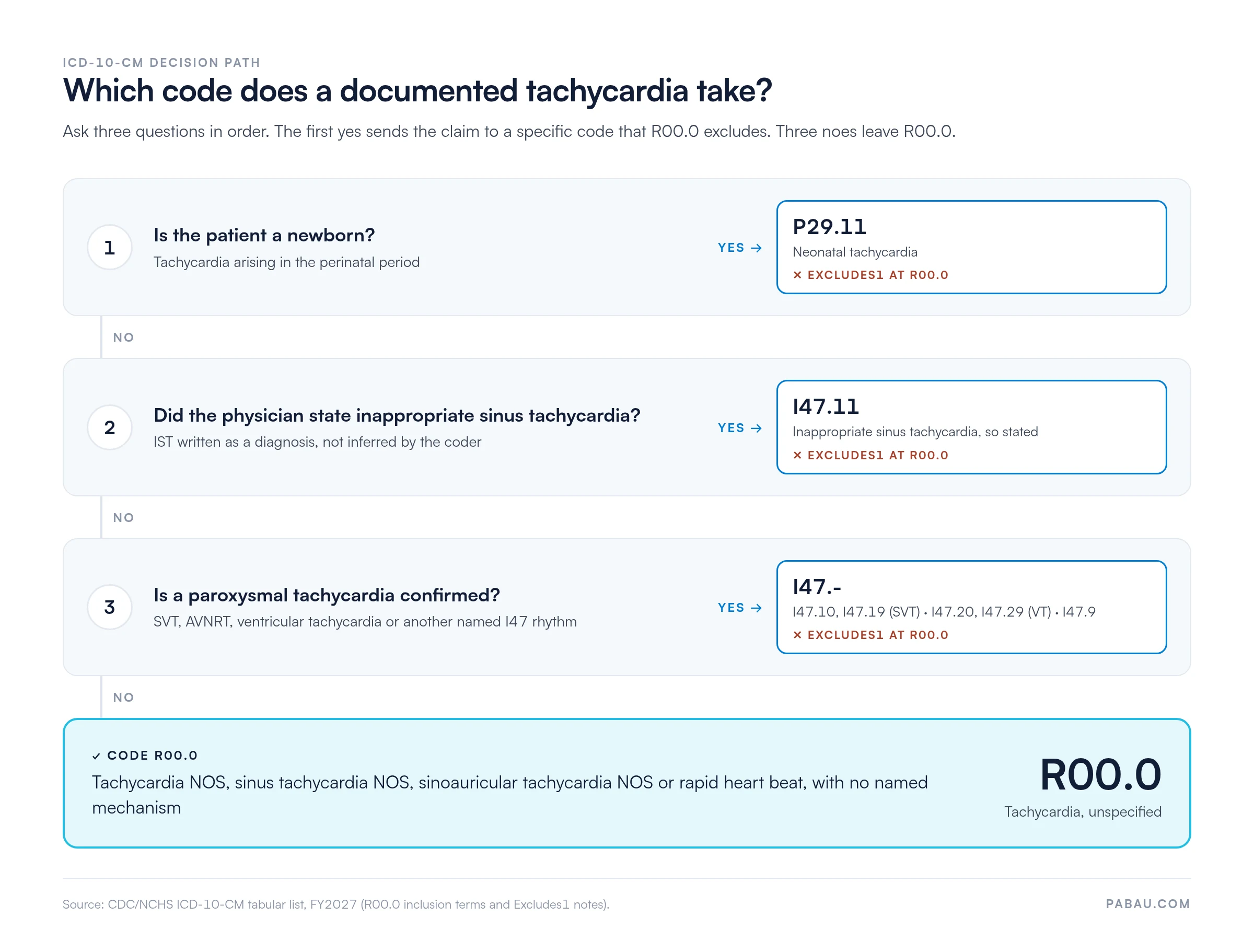
The code sits in Chapter 18 of ICD-10-CM (Symptoms, Signs and Abnormal Clinical and Laboratory Findings) and needs no seventh character. A newborn, a stated inappropriate sinus tachycardia or a confirmed paroxysmal tachycardia each takes its own code instead.
Let Pabau's smart automation suggest the right codes, reduce claim denials, and keep your practice compliant—effortlessly.
Automate repetitive tasks and focus on what matters most—your patients.
Reduce coding errors and ensure compliance with the latest regulations.
Clean claims, fewer denials, and faster reimbursements.
Powerful insights and reporting to help your practice thrive.
HIPAA compliant SOC 2 certified GDPR-compliant Trusted by 4,000+ clinics worldwide

R00.0 (Tachycardia, unspecified) is billable when the record documents a fast heart rate without a confirmed arrhythmia.
R00.0 carries three Excludes1 notes: paroxysmal tachycardia (I47.-), inappropriate sinus tachycardia, so stated (I47.11), and neonatal tachycardia (P29.11).
Sinus tachycardia NOS and sinoauricular tachycardia NOS are inclusion terms under R00.0, so only a physician-named rhythm moves the claim off it.
Pabau’s claims management software sends US claims through the Claim.MD clearinghouse and posts ERA remittances back to the patient record.
ICD-10 code R00.0 is the billable ICD-10-CM code for tachycardia, unspecified, used when the record shows a fast heart rate without a named arrhythmia.
The FY2027 ICD-10-CM tabular list publishes it under category R00 (Abnormalities of heart beat), in block R00-R09. It is valid as written, with no seventh character or further subdivision.
The CDC/NCHS ICD-10-CM web tool lists R00.0 with no Use additional code or Code first note. It can therefore stand alone as a primary or secondary diagnosis. “Unspecified” means the physician recorded tachycardia as a finding. The note names no mechanism, or the workup has not confirmed one yet.
R00.0 is the correct code when the documentation shows an elevated heart rate without an identified arrhythmia subtype. The tabular list names three inclusion terms under it, and common clinical wording maps to the same code.
What every scenario above shares is the missing specification. Once the physician writes “paroxysmal SVT” or “inappropriate sinus tachycardia,” the code path changes. When the note names a cause, as in “sinus tachycardia due to dehydration,” the cause is coded first. R00.0 is a legitimate choice while the workup is still open.
R00.0 carries three Excludes1 notes in the ICD-10-CM tabular list. An Excludes1 code is never reported alongside R00.0, because each one names a confirmed diagnosis rather than an unspecified finding.
Category R00 also carries an Excludes2 note for specified arrhythmias (I47-I49), and it applies to R00.0. Excludes2 means the arrhythmia is not part of R00, though a patient can have both.
For I47 codes, the Excludes1 note at R00.0 is stricter and governs. For I48 and I49 rhythms, Section I.B.5 of the ICD-10-CM guidelines still applies: a sign routinely associated with a disease is not coded separately.
Taken in order, these exclusions form a short decision path for any note that mentions tachycardia.
Most coding errors with ICD-10 code R00.0 come from one of two directions. Coders pick it when a more specific code is available, or they pick an arrhythmia code when the documentation only supports a symptom. This table maps each related code to its clinical trigger.
Sinus tachycardia NOS is an inclusion term under R00.0, so it has no separate code. If the physician writes only “sinus tachycardia” without a cause or subtype, R00.0 is correct. If the note names the cause, as in “sinus tachycardia due to anemia,” code the underlying condition first.
Add R00.0 only when the tachycardia is not a routine part of that condition, per guideline Section I.B.6. Stated inappropriate sinus tachycardia is the exception: it has its own code, I47.11, and never takes R00.0.
When an ECG or the physician’s assessment confirms supraventricular tachycardia, the code is I47.10 or I47.19, not R00.0. Ventricular tachycardia follows the same logic with I47.20 or I47.29. In the current code set, I47.1 and I47.2 are subcategories rather than billable codes, so the claim needs the fifth character.
Assigning R00.0 when SVT or VT is documented is undercoding. A cardioversion billed with 92960, or an electrophysiology study, tells a payer reviewer that the arrhythmia was specific. IV amiodarone billed under J0282 sends the same signal. That mismatch can trigger an audit.
Payers reviewing R00.0 claims look for documentation that justifies the “unspecified” qualifier. The chart must show that tachycardia was identified but that no specific arrhythmia was confirmed at the time of the encounter.
A clinical record can timestamp vital signs, tie the ECG billed under 93000 to the encounter, and capture the signature. Kept in one place, those answer the audit questions early. Recording them at the point of care is far easier than rebuilding them before the claim goes out.
R00.0 can be sequenced as the principal (first-listed) diagnosis when tachycardia is the reason for the encounter and no underlying condition is confirmed. A patient who arrives at urgent care with a symptomatic fast heart rate and a non-diagnostic workup leaves with R00.0 as the principal code.
R00.0 becomes a secondary code when the encounter is driven by a confirmed condition. If a patient is admitted for sepsis and the tachycardia needs its own monitoring, sepsis is the principal diagnosis. Tachycardia is a routine sign of hyperthyroidism, though, so a patient admitted for hyperthyroidism usually gets no R00.0 at all.
Query the physician before assigning R00.0 as a principal diagnosis when the encounter also documents a potential underlying cause. Under ICD-10-CM guidelines, a confirmed etiology generally displaces a symptom code as the principal diagnosis. Document the query and the physician’s response in the coding audit trail.
R00.0 denials cluster around four failure patterns. Each one can be caught by an edit before the claim leaves the practice.
Routing cardiac claims through a clearinghouse that validates diagnosis-procedure pairings catches Excludes1 and specificity conflicts before they reach the payer. Practices that submit through the Claim.MD clearinghouse can run claim edits against thousands of US payers, flagging code conflicts before a denial occurs.
Tracking remittance denial codes by diagnosis then shows whether R00.0 denials follow a pattern across the billing cycle. Our guide to denial management workflows covers how to work them back.
CMS publishes no National Coverage Determination (NCD) specific to tachycardia diagnosis codes. R00.0 encounters fall under the rules for the services billed, such as E/M visits and cardiac monitoring under 93224 or 93228.
Local Coverage Determinations (LCDs) govern much of that monitoring. A payer then asks whether the services were medically necessary for the documented scenario.
The CMS ICD-10 codes page carries the current code files and the ICD-10-CM Official Guidelines for Coding and Reporting.
Review Section I.C.18, the Chapter 18 guidance on symptoms and signs, each October when the guidelines update. Strong clean claim submission habits for cardiac encounters then cut payer touchpoints on R00.0 claims.
The R00 category covers all abnormalities of heart beat. Coders who see cardiac encounters often should know its full structure, so the most specific code is always in reach.
The AAPC Codify ICD-10-CM lookup shows the full R00 block for checking descriptors and hierarchy. The WHO ICD-10 browser shows the international base classification that ICD-10-CM builds on. R00.9 is the catch-all, so coders should rule out R00.0, R00.1 and R00.2 before defaulting to it.
Picking the most specific code the record supports is one of the medical billing fundamentals every coder works from.
Run a quarterly audit of your R00.0 and R00.9 usage ratio. If R00.9 outnumbers R00.0 on cardiac symptom encounters, providers are probably not separating rate from rhythm abnormalities. Coders then default to the broader code. A short provider education session on documenting heart rate findings can shift that ratio quickly.
Many R00.0 problems start before the claim exists. The vitals sit in one system and the ECG in another, so the coder works from a summary instead of the note.
Pabau, the practice management platform we build, keeps the encounter note, vitals and uploaded ECG results on the patient’s record. Its integrated claims management software sends CMS-1500 and 837P claims through the Claim.MD clearinghouse. Eligibility checks run before the visit, so coverage questions surface early.
When the payer responds, the electronic remittance advice (ERA) posts back against the same patient record. A denied R00.0 claim then shows up next to the note that supports it, so the fix starts from the documentation.

Pabau keeps the encounter note, vitals and ECG results with the claim. US claims go out through the Claim.MD clearinghouse, with eligibility checks and ERA posting.

R00.0 is a holding code. It is right while the record describes a fast heart rate and nothing more, and wrong once the physician names a rhythm. A newborn, a stated IST diagnosis or a confirmed paroxysmal tachycardia each moves the claim to its own code.
So check those three exclusions on every tachycardia claim, and query the physician when the note sits between a symptom and a diagnosis. Book a demo to see how Pabau keeps the cardiac note, the ECG and the claim on one patient record.

Need a refresher on what happens after a claim is submitted? What is revenue cycle management explains the full claim lifecycle from encounter to payment posting.
Getting unfamiliar remittance codes on R00.0 denials? Electronic remittance advice breaks down ERA files, CARC codes, and how to read denial reason codes.
Want to understand how the clearinghouse validates your claims before they reach the payer? Medical claims clearinghouse covers how clearinghouse edits work and what they catch.
ICD-10 code R00.0 is the billable diagnosis code for tachycardia, unspecified. It is used when a patient’s heart rate exceeds 100 bpm but the documentation does not confirm a specific arrhythmia. It sits in Chapter 18 of ICD-10-CM under category R00 (Abnormalities of heart beat) and needs no seventh character.
R00.0 is a symptom code for an unspecified fast heart rate. The I47.1 subcategory holds confirmed supraventricular tachycardia: I47.10 for SVT, unspecified, and I47.19 for other SVT such as AVNRT. Use R00.0 when the physician has not identified the mechanism, and an I47.1 code when an ECG or the assessment confirms SVT. The two are never reported together, because I47.- is an Excludes1 note at R00.0.
Use R00.0 when the documentation shows an elevated heart rate, or the physician writes “tachycardia,” without a confirmed arrhythmia type. Once the physician names SVT, VT, atrial flutter or a paroxysmal arrhythmia, the specific code replaces R00.0. “Sinus tachycardia NOS” is an inclusion term under R00.0, so “sinus tachycardia” alone still maps here.
Yes. R00.0 can be the principal diagnosis when tachycardia is the reason for the encounter. That holds while no underlying condition is confirmed by the end of the visit. When a confirmed cause is documented, such as hyperthyroidism or sepsis, that condition is sequenced first. R00.0 is added only when the tachycardia is not a routine part of that condition.
No. Inappropriate sinus tachycardia has its own code, I47.11 (Inappropriate sinus tachycardia, so stated), and it is an Excludes1 note at R00.0. When the physician documents IST, report I47.11 and never R00.0. If the note says only “sinus tachycardia” with no IST diagnosis, R00.0 still applies, and a physician query settles any doubt.
Common remittance denial codes on R00.0 claims include CO-4, CO-11 and CO-50. CO-4 means the procedure code is inconsistent with the modifier used, or a required modifier is missing. CO-11 means the diagnosis is inconsistent with the procedure, as when a cardioversion is billed against R00.0. CO-50 means the payer judged the service not medically necessary, so the note did not show why the tachycardia warranted it.