

ICD-10 Code R63.4: Abnormal weight loss
ICD-10 code R63.4: Definition, billability, and code structure ICD-10 code R63.4...

Last Updated: Nov 13, 2026
Billable Code Specific Code
D50.9 is the billable ICD-10-CM code for iron deficiency anemia, unspecified. Use it when the provider diagnoses iron deficiency anemia but the note does not document the cause.
The code sits in category D50, inside the nutritional anemias block, D50-D53. When the record names chronic blood loss or low dietary iron, D50.0 or D50.8 is the more specific choice.
Let Pabau's smart automation suggest the right codes, reduce claim denials, and keep your practice compliant—effortlessly.
Automate repetitive tasks and focus on what matters most—your patients.
Reduce coding errors and ensure compliance with the latest regulations.
Clean claims, fewer denials, and faster reimbursements.
Powerful insights and reporting to help your practice thrive.
HIPAA compliant SOC 2 certified GDPR-compliant Trusted by 4,000+ clinics worldwide

D50.9 codes iron deficiency anemia when the cause is not documented, a narrower scope than D64.9, which covers anemia of any unspecified type.
The code is billable as written, but D50.0 or D50.8 replaces it whenever the provider’s note names the cause.
Coders cannot assign D50.9 from lab values alone, because ICD-10-CM Official Guidelines Section I.A.19 bases code assignment on the provider’s diagnostic statement.
Iron deficiency anemia in a pregnant patient takes an O99.01- code first, with the D50 code added to name the type of anemia.
Pabau, the practice platform we build, submits claims through Claim.MD, checks eligibility and tracks denials on D50.9 iron infusion claims.
ICD-10 code D50.9 is a valid, billable ICD-10-CM diagnosis code with the official descriptor “Iron deficiency anemia, unspecified.” It appears unchanged in CMS’s FY 2027 ICD-10-CM files, which apply from October 1, 2026, to September 30, 2027. The code sits in Chapter 3 of the Tabular List, Diseases of the blood and blood-forming organs (D50-D89).
D50.9 is a leaf-level code, so no further subcategory exists. Coders do not append another character to make it valid on a claim.
Category D50 covers all iron deficiency anemias. D50.9 is the unspecified subcategory, the right choice only when the note confirms iron deficiency anemia but does not state the cause. When the record names chronic blood loss, D50.0 is preferred, because coders code to the highest level of specificity the documentation supports.
Category D50 carries one instructional note in the Tabular List, an Includes note that applies to every subcategory. It lists asiderotic anemia and hypochromic anemia. D50 has no Excludes1 or Excludes2 note at category level.
Two notes elsewhere in the classification still shape how D50.9 is used:
The pregnancy rule catches the most billing errors. A pregnant patient with iron deficiency anemia gets O99.01- sequenced first, per the Chapter 15 guidelines. D50.9 follows as the additional code that names the type of anemia.
Three codes account for most iron deficiency anemia coding errors. The table below shows when each code applies and what separates it from D50.9.
The D50.9 versus D64.9 choice carries the highest stakes of the three. When the note says “iron deficiency anemia” and the coder assigns D64.9, the specificity is lost. The guidelines require the most specific code the documentation supports, so the general code counts as downcoding.
Iron deficiency (E61.1) is the correct code when labs show low ferritin or low serum iron, but hemoglobin is in range. The provider has also not diagnosed anemia. The code covers iron deficiency without anemia. D50.9 needs both the iron deficiency and the anemia documented.
A practical test is whether the provider’s assessment, impression, or diagnosis statement contains the word “anemia.” If it does and iron deficiency is specified, D50.9 applies. If the note says “low ferritin” or “iron deficiency” with no mention of anemia, E61.1 is correct. Coders cannot infer anemia from an abnormal CBC without that statement.
The same logic extends across the whole iron deficiency family, and the chart below maps each documentation pattern to its code.
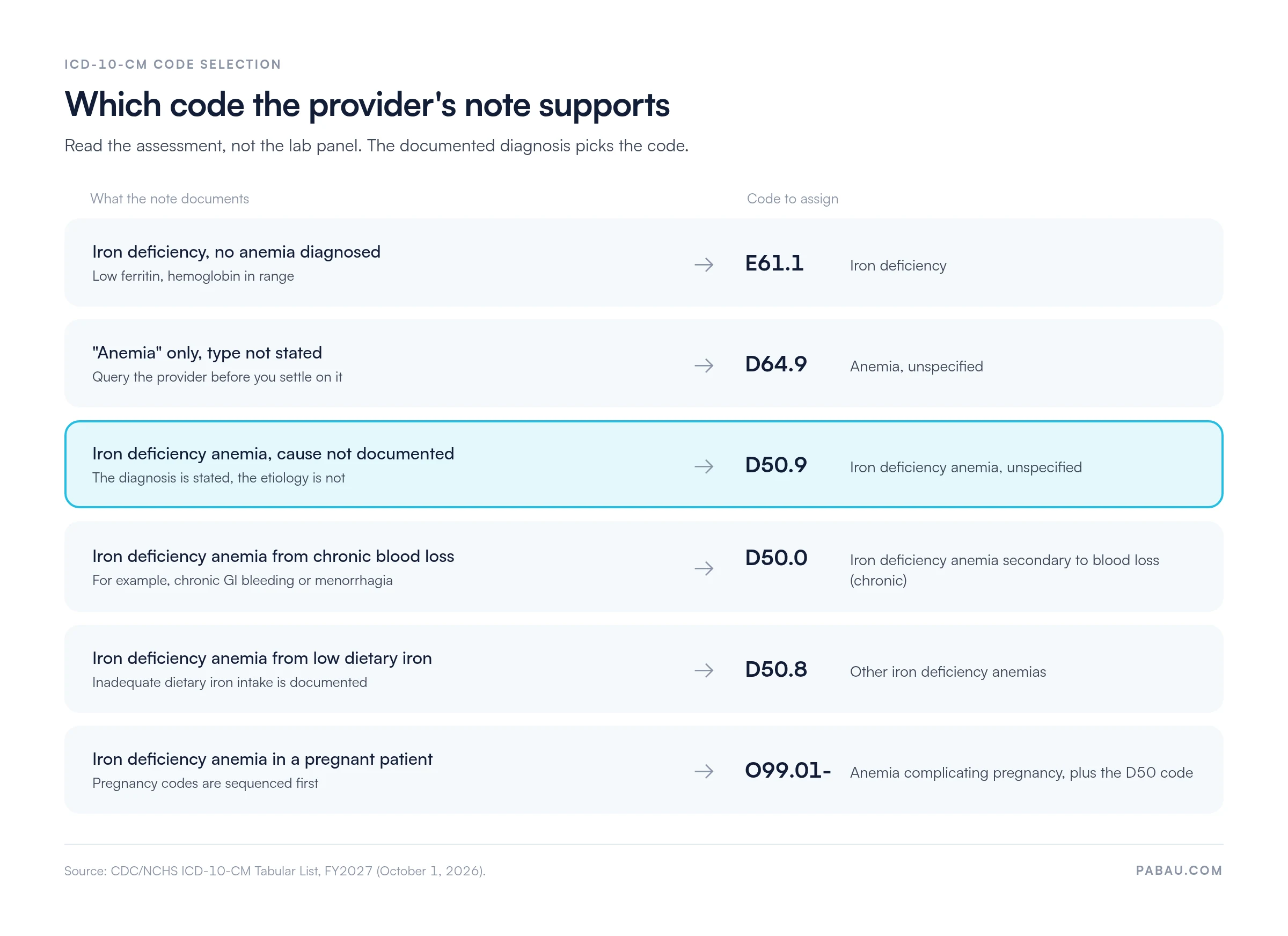
Before assigning D50.9, run a two-question check on the clinical note. Does the provider’s assessment explicitly state anemia? Is iron deficiency named as the cause or type? Both must be present. Labs showing low ferritin and low hemoglobin without a diagnosis statement do not support D50.9.
Under ICD-10-CM Official Guidelines Section I.A.19, code assignment rests on the provider’s diagnostic statement that the condition exists. Lab results alone cannot support D50.9. The provider must document iron deficiency anemia in the record, and supporting labs strengthen the claim without replacing that statement.
Solid D50.9 documentation includes these elements:
D50.9 is often the primary diagnosis on iron infusion claims. It is commonly paired with J1756 (iron sucrose injection) or J1439 (ferric carboxymaltose injection, 1 mg). Payers scrutinize these claims because intravenous iron costs more than oral supplementation.
Documenting oral iron failure or intolerance before the first infusion shortens prior authorization. Medicare coverage for IV iron paired with D50.9 is set by each Medicare Administrative Contractor (MAC) through its Local Coverage Determinations (LCDs).
Requirements vary by MAC region. Most ask for proof that the patient failed or cannot tolerate oral iron, plus the lab values listed in the documentation section above.
Commercial payers often mirror Medicare’s medical necessity criteria for iron infusion and add their own step-therapy rules. Verify prior authorization at the plan level before the infusion date. Assuming coverage from the diagnosis code alone is a leading cause of post-service denials.
D50.9 claims fail for a consistent set of reasons. Knowing them in advance is cheaper than appealing after the fact.
When a D50.9 claim is denied, check the Claim Adjustment Reason Code (CARC) on the remittance advice first. CARC 11 (the diagnosis is inconsistent with the procedure) and CARC 50 (not deemed a medical necessity) are the most common.
Denial management workflows that map CARC codes to root causes shorten appeal timelines. A clean claim submission process that checks diagnosis specificity before the claim leaves the practice prevents most of these denials.
Set up a claim scrubber rule that flags any claim pairing D64.9 with an iron infusion HCPCS code such as J1756 or J1439. That combination is a denial risk. If the provider documented iron deficiency anemia, D50.9 belongs on the claim instead of D64.9.
The table below covers codes used alongside or instead of D50.9, plus the ICD-9-CM predecessor for legacy records and older payer systems. Neighboring codes are easier to compare in a searchable ICD-10-CM code library.
The ICD-9 mapping is approximate. CMS General Equivalence Mappings (GEMs) map ICD-9-CM 280.9 forward to D50.9, but the pair is not an exact clinical match in every documentation context.
D50.9 is valid for the current fiscal year, FY 2027, with no pending deletion, revision, or replacement. The CMS ICD-10-CM annual update files show the code stable across recent years. Verify active status each October 1 using the CDC/NCHS ICD-10-CM web tool, which publishes the official tabular list and index by fiscal year.
On an iron infusion claim, the diagnosis code is only half the work. Someone still has to confirm the patient’s coverage, send the claim, and chase the CARC 11 or CARC 50 denial that comes back. Many practices split those steps across a payer portal, a clearinghouse login, and a spreadsheet.
Pabau, the practice management platform we build, keeps those steps on the patient record. Its denial-tracking claims management submits electronic claims through Claim.MD, checks eligibility and tracks denials. Claims reach thousands of US payers, with real-time eligibility checks across 400+ payers.
Your team confirms coverage before the infusion appointment and sees each denial against the visit it belongs to. Fixing a downcoded or unsupported diagnosis then starts from the note, not from a remittance printout.

Pabau submits electronic claims through Claim.MD, checks eligibility before the appointment, and tracks denials by CARC code. Your team sees every D50.9 claim and its outcome on the patient record.

Treat D50.9 as the code you reach only after the note has been read for a cause. If the provider names blood loss, dietary intake, or pregnancy, a more specific code or sequence wins. If the note never says “anemia,” D50.9 is off the table.
The trade-off is a little more querying up front for far fewer specificity denials on infusion claims. A provider query costs minutes, while a reworked infusion claim costs weeks.
Book a demo to see how Pabau tracks eligibility, submission and denials for your practice’s iron infusion claims.

Did the note say anemia without a type? ICD-10 code D64.9 explains when the unspecified anemia code is the right call.
Billing the infusion itself? CPT code 96365 covers the initial IV infusion hour that often travels with a D50.9 claim.
Need a full walkthrough of the medical billing process? What is medical billing explains the end-to-end revenue cycle from diagnosis coding through payment posting.
Seeing recurring denials on iron infusion claims? Denial management in healthcare covers CARC-based root-cause workflows and appeal strategies for common outpatient denial patterns.
Want to submit cleaner claims before they hit the payer? Clean claim submission outlines the pre-submission checks that prevent the most frequent front-end denials.
ICD-10 code D50.9 is the billable ICD-10-CM diagnosis code for iron deficiency anemia, unspecified. Use it when a provider has confirmed iron deficiency anemia but has not documented the cause. It sits in category D50 in Chapter 3 of the Tabular List and needs no additional character on a claim.
Yes. D50.9 is a valid, billable leaf-level code, so no further subdivision or 7th character is needed. It is valid for the current fiscal year, FY 2027, with no pending deletion or revision in the CMS annual update files.
D50.9 codes iron deficiency anemia specifically, while D64.9 codes anemia of unspecified type. When a provider documents iron deficiency anemia, D50.9 is required. Using D64.9 instead is downcoding, which breaks the rule to code to the highest documented specificity and can trigger denials or audit findings.
The correct code is E61.1, iron deficiency. Use it when labs show low ferritin or low serum iron, hemoglobin is in range, and the provider has not diagnosed anemia. E61.1 carries an Excludes1 note for D50.-, so the two are never coded together.
D50.0, iron deficiency anemia secondary to blood loss (chronic), applies when the provider documents chronic blood loss as the cause. GI bleeding and menorrhagia are common examples. D50.9 applies when iron deficiency anemia is confirmed but no cause is stated. Use the most specific code the documentation supports.
Yes. D50.9 can be the primary diagnosis on iron infusion claims, for example with HCPCS J1756 or J1439, when the documentation supports iron deficiency anemia. The payer’s medical necessity criteria must also be met. Medicare coverage follows each MAC’s Local Coverage Determinations, and proof of oral iron failure or intolerance is typically required.



