ICD-10 Code Y76.0: Diagnostic obstetric and gynecological devices
ICD-10 Code Y76.0: Definition and billable status ICD-10 Code Y76.0 is a valid, ...

Last Updated: Oct 23, 2026
Billable Code Specific Code
O87.0 is the billable ICD-10-CM code for superficial thrombophlebitis in the puerperium. It covers inflammation and clotting in a surface vein, usually in the leg, arising in labor, delivery or the weeks after. Puerperal phlebitis NOS and puerperal thrombosis NOS also code here.
Two common errors are using O22 after delivery and documenting vein involvement without stating superficial versus deep. Deep vein disease belongs to O87.1, and an additional I80.0- code identifies the superficial vein when applicable.
Let Pabau's smart automation suggest the right codes, reduce claim denials, and keep your practice compliant—effortlessly.
Automate repetitive tasks and focus on what matters most—your patients.
Reduce coding errors and ensure compliance with the latest regulations.
Clean claims, fewer denials, and faster reimbursements.
Powerful insights and reporting to help your practice thrive.
HIPAA compliant SOC 2 certified GDPR-compliant Trusted by 4,000+ clinics worldwide

O87.0 is a billable ICD-10-CM code for superficial (not deep) thrombophlebitis in the puerperium, including puerperal phlebitis NOS and puerperal thrombosis NOS.
The postpartum period runs about 42 days after birth. Chapter 15 codes may still be used beyond six weeks when the provider documents the condition as pregnancy-related.
O22 codes cover venous complications in pregnancy, while O87 codes cover venous complications in labor, delivery and the puerperium.
When applicable, an additional I80.0- code identifies the superficial vein thrombosis of the lower extremity.
Pabau’s claims management, part of our practice software, sends claims you have coded to payers via Claim.MD and tracks their status, including ERA matching.
ICD-10 code O87.0 is the valid, billable diagnosis code for superficial thrombophlebitis in the puerperium. It describes inflammation and clotting in a surface vein that arises in labor, delivery or the weeks after. In addition, it is current for the 2026 ICD-10-CM code year, verified against the CDC/NCHS ICD-10-CM official code tool. Besides, it needs no 7th character, although the tabular asks for an additional code for the superficial vein when it applies. Finally, the table below lists the key data at a glance.
ICD-10 code O87.0 covers inflammation and superficial clot formation in veins after birth, including conditions documented as puerperal phlebitis NOS or puerperal thrombosis NOS. The WHO ICD-10 classification groups these under the venous complications of the puerperium. Overall, they share one cause: the hypercoagulable state after birth, combined with venous stasis from less movement.
The O87 category carries three Excludes2 notes. An Excludes2 condition is not part of O87.0, but both codes may be reported together when the patient has both conditions.
Three sibling codes in the same category also sit outside O87.0 and are coded instead of it:
Section I.C.15 of the ICD-10-CM guidelines describes the postpartum period as the six weeks, or roughly 42 days, following delivery. However, Chapter 15 codes may still be used beyond six weeks when the provider documents the condition as pregnancy-related.
Choosing O87.0 when O87.1 applies, or the reverse, gets the severity wrong. Superficial thrombophlebitis (O87.0) tends to carry lower thromboembolic risk and is treated with simple measures. In contrast, deep phlebothrombosis (O87.1) carries pulmonary embolism risk and usually needs anticoagulation, so auditors check the code against the treatment ordered.
A duplex ultrasound report naming the affected vein is the clearest support for choosing between O87.0 and O87.1 (great saphenous vein = superficial; femoral vein = deep). In addition, the scan is usually reported with 93971 when one leg is examined. Likewise, a note documenting puerperal phlebitis or thrombosis NOS codes to O87.0. However, query the provider when the findings suggest deep vein disease. See the AAPC ICD-10-CM code lookup for the full tabular context of the O87 category.
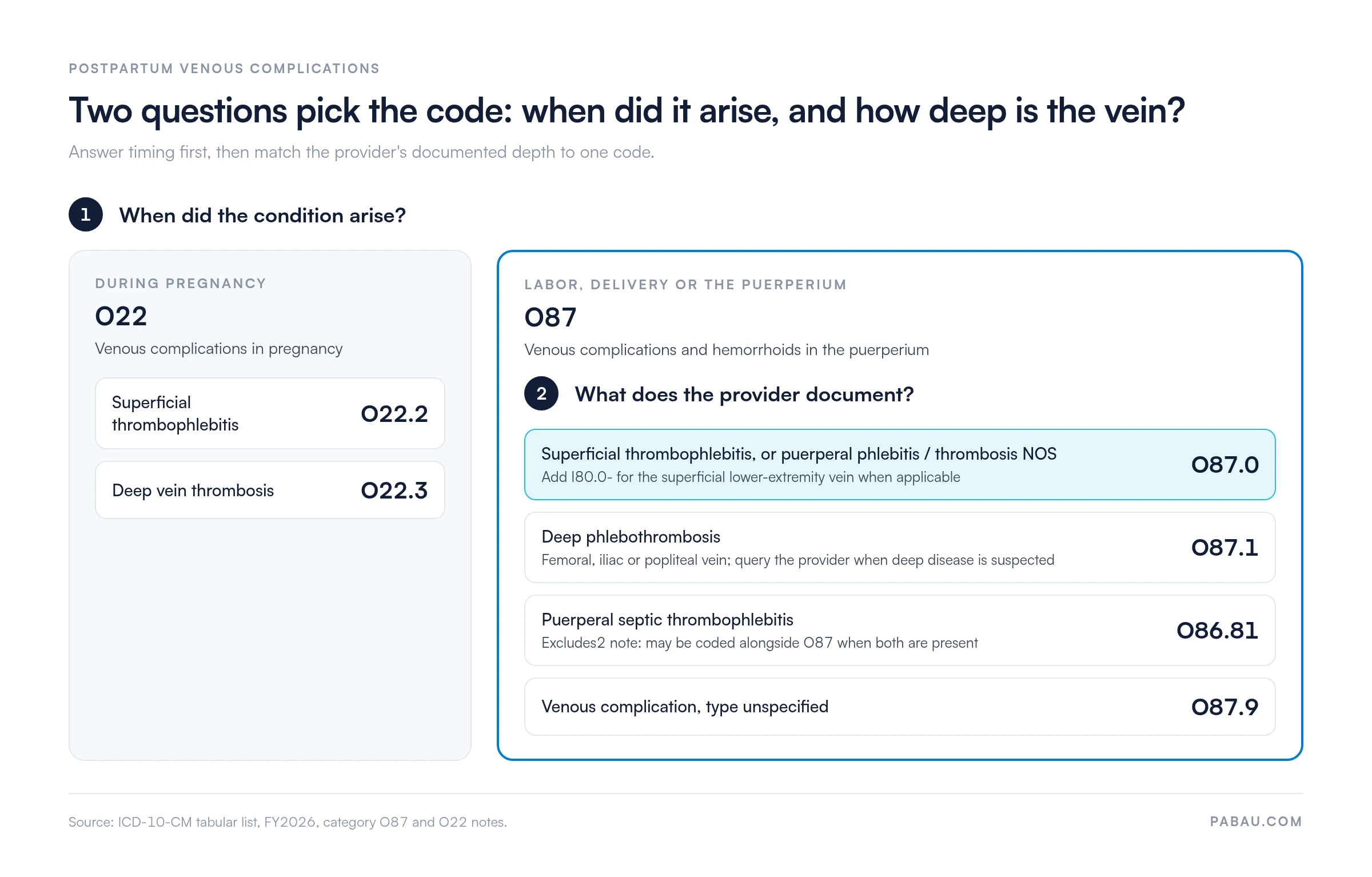
O22 codes cover venous complications in pregnancy, while O87 codes cover venous complications in labor, delivery and the puerperium. The O87 category’s own inclusion note names all three, so a superficial thrombophlebitis that starts during labor belongs to O87.0 rather than O22.2.
For example, a patient develops leg pain and a palpable cord on day two postpartum. Then the duplex confirms superficial thrombophlebitis. Meanwhile, the pregnancy record may show an earlier O22.2 (superficial thrombophlebitis in pregnancy), but the postpartum visit is coded O87.0.
First, code by the provider’s note of when the condition arose relative to delivery. Once timing places the case in O87, the documented depth of the vein picks the code, as the diagram below shows.
ICD-10-CM Chapter 15 guidelines govern all obstetric codes, including O87.0. The rules that affect how this code is sequenced and reported are listed below. Confirm current guidance in the CMS annual ICD-10 coding guidelines release, since this summary does not replace the current-year tabular.
A clean claim submission for O87.0 needs the visit note, scan report and treatment orders to agree on the diagnosis and postpartum timing. As a result, when those three documents disagree, the claim is more likely to draw a medical necessity review.
The medical record must contain specific elements before O87.0 can be coded with confidence. In fact, vague notes are what payer audits most often reverse on this code. Sound medical billing for postpartum visits depends on coders and clinicians agreeing on these elements before the claim leaves the practice.
Billing for postpartum visits involving O87.0 requires the right CPT code alongside the diagnosis, and pairing mismatches trigger medical necessity edits from commercial payers. Once the practice has coded the visit, Pabau’s claims tracking and submission sends the claim to payers via Claim.MD. The superbill documentation for each visit should reflect the CPT selected and the supporting O87.0 diagnosis.
Global OB package caution: When the delivering provider bills the global OB package (CPT 59400 or 59510), postpartum visits within the 6-week window are included. A separate postpartum E/M (99213-99215) inside that window needs modifier 24 when the visit is unrelated to routine postpartum care. Without it, expect a payer edit or denial. In contrast, modifier 25 applies only when a significant, separate E/M falls on the same day as a procedure. Therefore, confirm the global period rules with each payer.
Claims coded O87.0 are denied for a short list of reasons, and each denial comes back with a claim adjustment reason code. See CARC denial codes for what each one means.
Denial management workflows and pre-submission audits catch many of these before appeals. Good medical billing compliance for postpartum claims starts with the patterns below.
Run a monthly audit of O87.0 claims against your denial log. Filter for denial codes CO-97 (bundling), CO-4 (modifier issue), and CO-50 (medical necessity). These codes point directly to the CPT-ICD pairing and global period errors described above.
Once a coder has settled on O87.0, the claim still has to reach the payer and come back paid. For example, many practices key it into a separate clearinghouse portal, check coverage by phone, and chase status one claim at a time.
Pabau, the practice management platform we build, keeps that work next to the postpartum visit. Its claims management sends claims you have coded to payers via Claim.MD and tracks their status, including ERA matching. In addition, a real-time eligibility check before the follow-up visit confirms the patient’s coverage first.
The coding decisions in this guide stay with your coders and providers. Instead, what changes is the follow-through: denials show up against the claim that caused them, so the fix goes back to the right note.

Pabau’s claims management sends claims you have coded to payers via Claim.MD and tracks their status, including ERA matching. Real-time eligibility checks confirm coverage before the visit.

O87.0 is a simple code to assign once two facts are on the record. The condition arose in labor, delivery or the puerperium, and the vein involved is superficial. Build both into your postpartum note templates, and add the I80.0- code for the leg whenever it applies.
Keep in mind that an NOS phlebitis note is codable, but a suspected deep clot is not a coder’s call. In the end, a short provider query costs less than defending a superficial code against a deep-vein treatment plan.
If your practice wants coded postpartum claims submitted and tracked through Claim.MD without leaving the patient record, book a demo.

Need a framework for managing obstetric claim denials systematically? Denial management in healthcare walks through the denial lifecycle, CARC code interpretation, and appeal workflows for outpatient and inpatient claims.
Want to understand how clearinghouses validate obstetric claims before they reach payers? How a medical claims clearinghouse works explains 837P transmission, eligibility checks, and payer routing for US practices.
Looking for guidance on building a clean-claim checklist for postpartum encounters? What is revenue cycle management covers the end-to-end billing workflow from diagnosis coding through payment posting.
Need the code for an unspecified postpartum venous complication? ICD-10 code O87.9 explains when the record supports only the unspecified code.
Coding postpartum varicose veins instead? ICD-10 code O87.4 covers varicose veins of the lower extremity in the puerperium.
ICD-10 code O87.0 is the billable ICD-10-CM diagnosis code for superficial thrombophlebitis in the puerperium. It covers inflammation and superficial clot formation in veins after delivery. It is valid for the 2026 ICD-10-CM code year and requires no 7th-character extension.
Yes, O87.0 is a billable and HIPAA-valid ICD-10-CM code that can be used directly on claims without further specificity. It is confirmed active for the FY2026 code year, effective October 1, 2025.
O87.0 covers superficial thrombophlebitis (surface veins, lower thromboembolic risk) while O87.1 covers deep phlebothrombosis (deep veins such as femoral or iliac, significant pulmonary embolism risk). The distinction must come from explicit provider documentation or imaging, not from coder inference.
Common denial triggers include using O22 (the pregnancy-period code) postpartum and not querying the provider when deep vein disease is suspected. Billing a bilateral duplex scan against a unilateral diagnosis without justification is another. So is a postpartum E/M inside the global OB period without modifier 24. A pre-submission documentation audit catches many of these.
ICD-10-CM guidelines describe the postpartum period as the six weeks, roughly 42 days, following delivery. Chapter 15 codes may still be used beyond six weeks when the provider documents the condition as pregnancy-related.