ICD-10 Code R63.4: Abnormal weight loss
ICD-10 code R63.4: Definition, billability and code structure ICD-10 code R63.4 ...

Last Updated: Nov 13, 2026
Billable Code Specific Code
I82.409 is the billable ICD-10-CM code for acute embolism and thrombosis of unspecified deep veins of unspecified lower extremity. It reports an acute deep vein thrombosis (DVT) of the leg when the record names neither the vein nor the side.
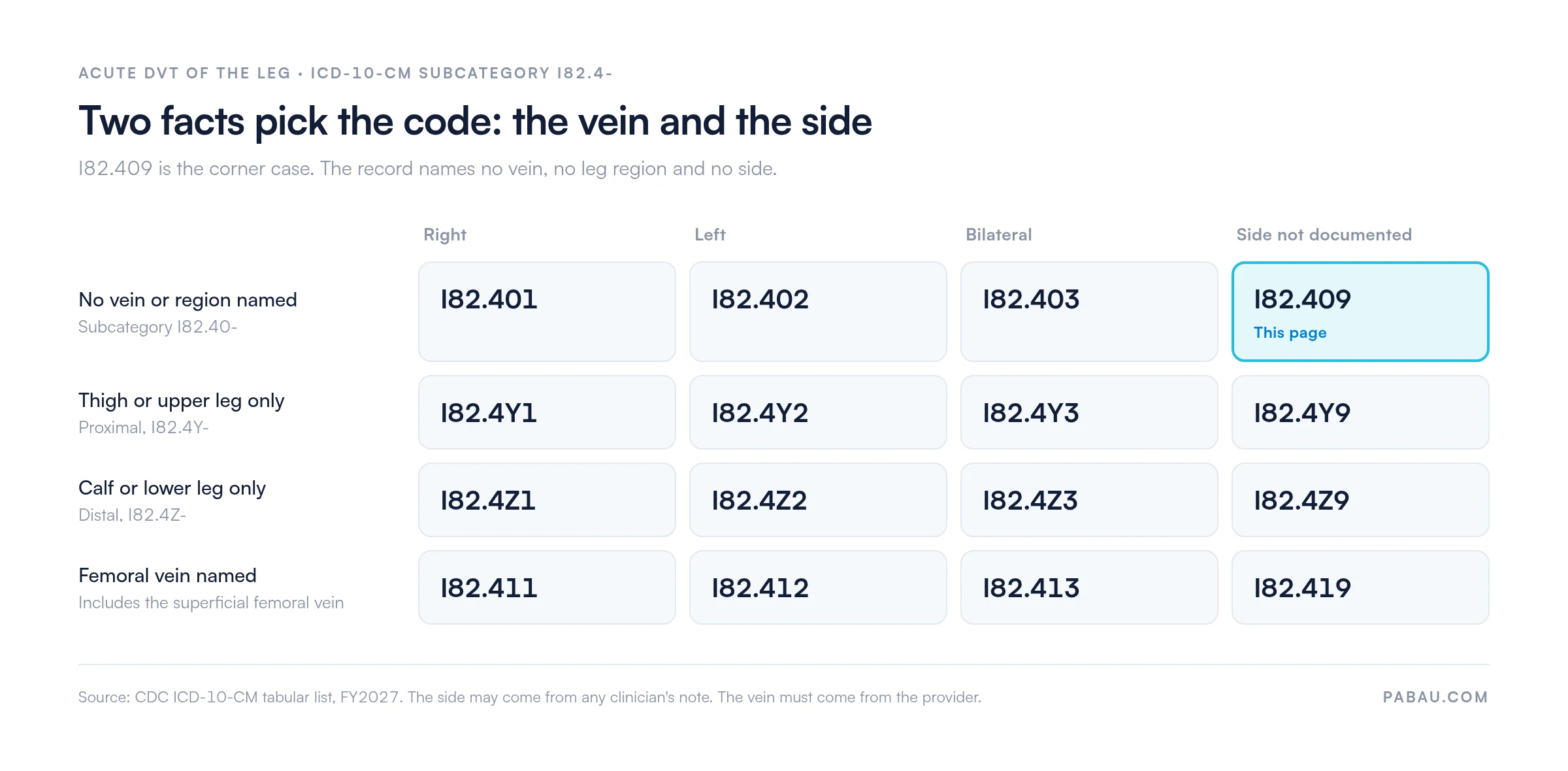
The code sits in subcategory I82.40, where the tabular list places DVT NOS. Once a side is documented, the code moves to I82.401, I82.402 or I82.403. Once a vein is named, it moves to that vein's subcategory, such as I82.41- for the femoral vein.
Let Pabau's smart automation suggest the right codes, reduce claim denials, and keep your practice compliant—effortlessly.
Automate repetitive tasks and focus on what matters most—your patients.
Reduce coding errors and ensure compliance with the latest regulations.
Clean claims, fewer denials, and faster reimbursements.
Powerful insights and reporting to help your practice thrive.
HIPAA compliant SOC 2 certified GDPR-compliant Trusted by 4,000+ clinics worldwide

I82.409 is the billable ICD-10-CM code for an acute DVT of the leg when the record names neither the vein nor the side.
A documented femoral vein DVT is coded to I82.411, I82.412, I82.413 or I82.419, never to I82.409.
Laterality may come from another clinician’s note, such as the duplex report, so an unspecified side should be rare.
Chronic DVT needs the word chronic in the provider’s documentation and moves the code to I82.50- or a vein-specific I82.5- code.
Pabau’s claims tools help practices code DVT encounters to the documented vein and side before the claim leaves.
ICD-10 Code I82.409 is the billable code for acute embolism and thrombosis of unspecified deep veins of unspecified lower extremity. The CDC ICD-10-CM tabular list places it under DVT of the leg when the record names neither the vein nor the side.
The code carries two separate “unspecified” elements. The first is the vein, because no deep vein such as the femoral or popliteal is named. The second is laterality, because the record does not say right, left or bilateral.
I82.409 sits in subcategory I82.40, where the tabular list places “Deep vein thrombosis NOS” and “DVT NOS.” Once the documentation adds detail, the code moves:
The table below summarizes the administrative attributes of ICD-10 Code I82.409 as listed in the official ICD-10-CM tabular list from the CDC/NCHS ICD-10-CM web tool.
The notes that govern I82.409 sit at three levels: subcategory I82.40, category I82 and the neighboring phlebitis category I80.
What I82.409 includes: An acute DVT of the leg documented without a named vein and without a side. “DVT NOS” and “deep vein thrombosis NOS” index here when the provider adds no detail.
What I82.409 does not include: A named deep vein always takes its own subcategory. The superficial femoral vein is anatomically a deep vein despite its name, and the Alphabetic Index sends femoral vein thrombosis to I82.41-. A documented superficial femoral vein DVT is therefore coded to I82.411, I82.412, I82.413 or I82.419.
Thrombosis of the superficial veins of the leg is a different condition, coded to I82.81-. The tabular notes that matter at each level are:
Budd-Chiari syndrome (I82.0) is a sibling code in the same category for hepatic vein thrombosis, not an exclusion note. It has no bearing on how a leg DVT is coded.
Anticoagulant status: The tabular “use additional code” note for Z79.01 (long-term current use of anticoagulants) sits at I82.5, the chronic subcategory, not at I82.4. For an acute DVT, Z79.01 follows the general Z79 guideline instead.
That guideline assigns a Z79 code for continuous long-term or prophylactic drug therapy. It excludes medication given for a brief period to treat an acute illness. The provider’s documented anticoagulation plan decides whether Z79.01 belongs on the claim. When the practice injects the anticoagulant itself, the drug bills on its own line, such as J1652 for fondaparinux.
Two decisions drive code selection in subcategory I82.4: which vein is involved and which side. Section I.B.13 of the ICD-10-CM Official Guidelines for Coding and Reporting says codes for an unspecified side “should rarely be used.”
Laterality is one of the few elements a coder may take from a clinician other than the treating provider. When the physician note says only “DVT” but the duplex report says “left,” the guidelines allow I82.402.
The vein works differently. The diagnosis itself must come from the patient’s provider. A duplex report naming the femoral vein does not move the code to I82.41- on its own. Query the provider to confirm the site, and query again when two documents disagree on the side.
The grid below maps each combination of documented vein, leg region and side to its I82.4- code.
ICD-10 Code I82.409 is always acute. The chronic counterpart for the unspecified vein and leg is I82.509, chronic embolism and thrombosis of unspecified deep veins of unspecified lower extremity.
Because the index defaults an unqualified DVT to the acute subcategory, coders do not need a query to reach I82.409. A query is warranted when the record mixes signals, such as “known DVT” alongside a new duplex finding.
Category I82 carries an Excludes2 note for pulmonary embolism, so I26.- and I82.409 may appear on the same claim. Sequencing follows the UHDDS principal diagnosis definition: the condition established after study to be chiefly responsible for the admission. When anticoagulation can’t be used, an acute DVT diagnosis often supports filter placement under CPT 37191.
Sequencing errors between PE and DVT codes change the DRG, so they draw payer review.
Run a quarterly report on inpatient claims that carry both an I26.- code and an I82.4- code. Route any encounter whose sequencing differs from your facility protocol for physician query before resubmission.
The provider’s note must state a confirmed DVT, not a “rule out” or “suspected” diagnosis. In the outpatient setting, an unconfirmed DVT is coded to its signs and symptoms instead. Sound medical billing compliance starts with capturing these elements at the point of care:
Most I82.409 claims can carry a more specific code once the duplex report is read alongside the note. Submitting clean claims for DVT encounters depends on settling the vein and side before the claim is built.
Medicare and commercial payer requirements for ICD-10 Code I82.409 vary by setting and by the services rendered. Tracking them is part of revenue cycle management for vascular, cardiology and hospitalist practices.
Payers increasingly read the attached imaging report. A claim for a named-vein, named-side DVT that carries I82.409 invites a specificity edit.
I82.409 claims deny for a predictable set of reasons. Knowing them in advance is the most efficient denial management approach for billing teams. Five common triggers and their fixes:
The General Equivalence Mappings (GEMs) map I82.409 to ICD-9-CM 453.40. That code is acute venous embolism and thrombosis of unspecified deep vessels of lower extremity. The 2018 GEMs files flag the match as approximate, and the backward map returns 453.40 to I82.409.
ICD-9-CM had no laterality, so the right, left and bilateral codes all collapse to the same ICD-9 code. Understanding medical billing fundamentals across code generations still matters for audits, legacy conversion and retrospective data work.
GEMs were last updated for FY2018 and are not a substitute for the codes themselves. Use them for legacy data conversion or retrospective audits, never for claim submission.
The codes below are often reported on the same claim as I82.409. Verify current-year validity for each with the AAPC Codify ICD-10-CM lookup.
Most I82.409 denials start with a claim built from the visit note alone, while the duplex report sits in another system. The coder never sees the side or the vein, so the least specific code goes out.
Pabau, the practice management and billing platform we build, keeps the note, the imaging report and the claim on one patient record. Its claims management software captures ICD-10 codes at the point of care, so the coder can check the documented vein and side before submission.
US claims go out electronically through Claim.MD, with eligibility checks before the visit. Electronic remittances return the denial reason codes, so a specificity denial can be corrected and resubmitted quickly.

Pabau keeps the visit note, imaging report and claim on one record, then submits US claims through Claim.MD. Coders can match the code to the documented vein and side before the claim leaves.

I82.409 is a fallback code, and the guidelines treat it that way. Use it only when neither the vein nor the side can be found anywhere in the record and the provider cannot clarify.
Read the duplex report before you settle on it. The side can be taken from that report directly, and the vein usually needs one short provider query. That small step moves most DVT claims to I82.40-, I82.41- or another vein-specific code that payers accept on the first pass.
Book a demo to see how Pabau keeps the note, imaging and claim together, so DVT claims match the documented vein and side.

Need to track denial patterns across DVT claims? Denial management in healthcare covers the frameworks practices use to monitor, categorize, and resolve recurring claim rejections.
Want to understand how claims flow from submission to payment? Medical claims clearinghouse explains the clearinghouse role in validating and transmitting ICD-10-coded claims to payers.
Looking for the 837P EDI format for professional claims? 837 file guide walks through the transaction set structure used to transmit DVT and VTE claims electronically.
ICD-10 Code I82.409 means acute embolism and thrombosis of unspecified deep veins of unspecified lower extremity. It reports an acute DVT of the leg when the record names neither the affected vein nor the side. It sits in subcategory I82.40 and is valid in the FY2026 and FY2027 code sets.
Yes, I82.409 is a billable 6-character ICD-10-CM code. It is a complete code, not a category header, and may be reported as a principal or secondary diagnosis depending on the encounter.
No, a femoral vein DVT is coded to I82.411 (right), I82.412 (left), I82.413 (bilateral) or I82.419 (unspecified side). That includes the superficial femoral vein, which is a deep vein. I82.409 applies only when no vein is named.
All four report an acute DVT of unspecified deep veins of the leg, and they differ only by side. I82.401 is right, I82.402 is left, I82.403 is bilateral and I82.409 is unspecified. The side may be taken from another clinician’s note, such as the duplex report.
Use I82.409 when the DVT is documented as acute or no acuity is stated, because the index defaults an unqualified DVT to acute. Use I82.509 when the provider documents the DVT as chronic and names no vein or side.
The GEMs map I82.409 to ICD-9-CM 453.40, acute venous embolism and thrombosis of unspecified deep vessels of lower extremity. The match is approximate. Use GEMs for legacy conversion and retrospective data work, never for claim submission.
Report Z79.01 when the provider documents long-term or prophylactic anticoagulation. The tabular note for Z79.01 sits at the chronic subcategory I82.5, so for acute DVT the general Z79 guideline decides. A brief treatment course does not qualify.