ICD-10 Code Y76.0: Diagnostic obstetric and gynecological devices
ICD-10 Code Y76.0: Definition and billable status ICD-10 Code Y76.0 is a valid, ...

Last Updated: Oct 23, 2026
Billable Code Specific Code
O70.0 is the billable ICD-10-CM code for first degree perineal laceration during delivery. It covers a slight tear of the perineal skin, fourchette, labia or vaginal mucosa, with no perineal muscle involved.
Category O70 also includes an episiotomy extended by laceration, so an extension that stays superficial is coded O70.0. Once muscle is torn, the code moves to O70.1. O70.0 is valid for FY2026 with no descriptor changes.
Let Pabau's smart automation suggest the right codes, reduce claim denials, and keep your practice compliant—effortlessly.
Automate repetitive tasks and focus on what matters most—your patients.
Reduce coding errors and ensure compliance with the latest regulations.
Clean claims, fewer denials, and faster reimbursements.
Powerful insights and reporting to help your practice thrive.
HIPAA compliant SOC 2 certified GDPR-compliant Trusted by 4,000+ clinics worldwide

O70.0 is a billable ICD-10-CM code for first degree perineal laceration during delivery, valid for FY2026 with no descriptor changes.
First degree tears involve the perineal skin, labia and vaginal mucosa only, with no muscle involvement. Any muscle damage moves the code to O70.1 or higher.
O70 includes episiotomy extended by laceration, so an extended episiotomy is coded by the resulting laceration degree. No Excludes1 note applies to episiotomy.
When the laceration is the only complication, list O70.0 first and add a Z37 outcome-of-delivery code. O80 cannot be reported once a complication is coded.
Repair by the delivering provider is included in 59400 and 59409. CPT 59300 applies only when a different provider performs the repair.
ICD-10 Code O70.0 is a billable, valid ICD-10-CM diagnosis code with the official descriptor “First degree perineal laceration during delivery.” It covers a slight tear of the perineal skin, fourchette, labia or vaginal mucosa, with no perineal muscle involved. The code sits in Chapter 15 (Pregnancy, Childbirth and the Puerperium), in the O60-O77 block for complications of labor and delivery. The CDC/NCHS ICD-10-CM web tool confirms O70.0 as active for FY2026 with no tabular revisions.
A first degree perineal laceration during delivery involves the fourchette, perineal skin, and vaginal mucosa only. No perineal muscle or fascia is disrupted. That anatomical boundary is the coding line. Once the perineal body musculature, the anal sphincter or any deeper structure is involved, the tear is no longer first degree.
The American College of Obstetricians and Gynecologists (ACOG) classifies perineal tears into four grades. O70.0 maps to Grade I. The clinical criteria for Grade I include superficial injury that may or may not require suturing. Many first degree tears heal without repair. A missing repair note does not make the tear non-billable, but the delivery note must still state the degree explicitly.
The O70 parent category covers all degrees of perineal laceration during delivery. ICD-10 Code O70.0 is the least severe child code. Knowing where O70.0 sits in the hierarchy prevents the common error of assigning the non-specific O70.9 when the degree is documented. Other Chapter 15 categories follow the same layout in our code library for coders.
The specific third degree subcodes (O70.21-O70.23) depend on the clinician documenting how much of the anal sphincter is torn. When the delivery note says “third degree” without sphincter detail, assign O70.20, and query the provider to reach O70.21-O70.23. A sphincter tear with no third degree perineal laceration takes O70.4 instead. The CMS ICD-10 codes guidance reinforces that specificity drives code selection when subcodes exist.
The O70 parent category carries notation that governs every child code, including O70.0. Two notes matter most: the Includes note for an episiotomy extended by laceration, and the Excludes1 note for a high vaginal laceration alone.
O70 includes “episiotomy extended by laceration.” A laceration that extends an episiotomy is therefore coded O70.x by its degree, so a first degree extension takes O70.0. The O70.0 inclusion terms also cover slight tears and tears involving the fourchette, labia, skin, vagina or vulva.
O70 carries one Excludes1 note: obstetric high vaginal laceration alone (O71.4). When the only injury is a high vaginal laceration with no perineal tear, code O71.4 instead of any O70 code. There is no Excludes1 note for episiotomy.
A cervical laceration (O71.3) at the same delivery may be coded alongside O70.0, because the cervix is a separate site. O71.4 works differently. It describes a high vaginal laceration alone, so it does not apply when a perineal laceration is also present. Document each injury site clearly in the delivery note so the coder can assign every code without querying the provider.
The delivery note must provide enough specificity for a coder to assign O70.0 without a provider query. Structured delivery note templates cut the number of provider queries. A note that says only “perineal laceration repaired” is not codeable to a specific degree.
When repair is performed by a resident and supervised by an attending, document the supervising physician’s name and role. Some payers require the attending’s signature even when the resident performed the procedure. Missing this detail is a recurring cause of claim adjustment, not outright denial, but it delays payment cycles.
Flag delivery notes that describe repair without stating degree. A note that reads ‘perineal repair performed’ with no degree documented requires a provider query before coding. Assign O70.9 only as a last resort, when the provider cannot be reached before the filing deadline. Resubmit with the corrected degree code once the query is resolved.
ICD-10 Code O70.0 appears on claims alongside procedure codes for the vaginal delivery and, when repair is performed, a repair CPT code. Repair by the delivering provider is included in the delivery code, so it cannot be billed separately. An obstetric superbill that pre-populates common delivery code sets helps prevent unbundling errors at the point of service documentation.
CPT 59300 is separately billable when repair is performed by a provider other than the one who delivered the baby. Verify current NCCI (National Correct Coding Initiative) edits before billing CPT 59300 alongside a delivery code, because CMS updates the edit pairs quarterly. Pabau, the practice software we build, connects to Claim.MD, a medical claims clearinghouse, so US practices can submit and track electronic claims. Check NCCI edits against the current CMS tables before submitting.
The correct degree code depends on the anatomical extent documented by the treating clinician. Coders must not infer degree from the repair technique or operative time. The provider’s stated degree determines the code, and the chart below shows which tissue layer moves the tear up each step.
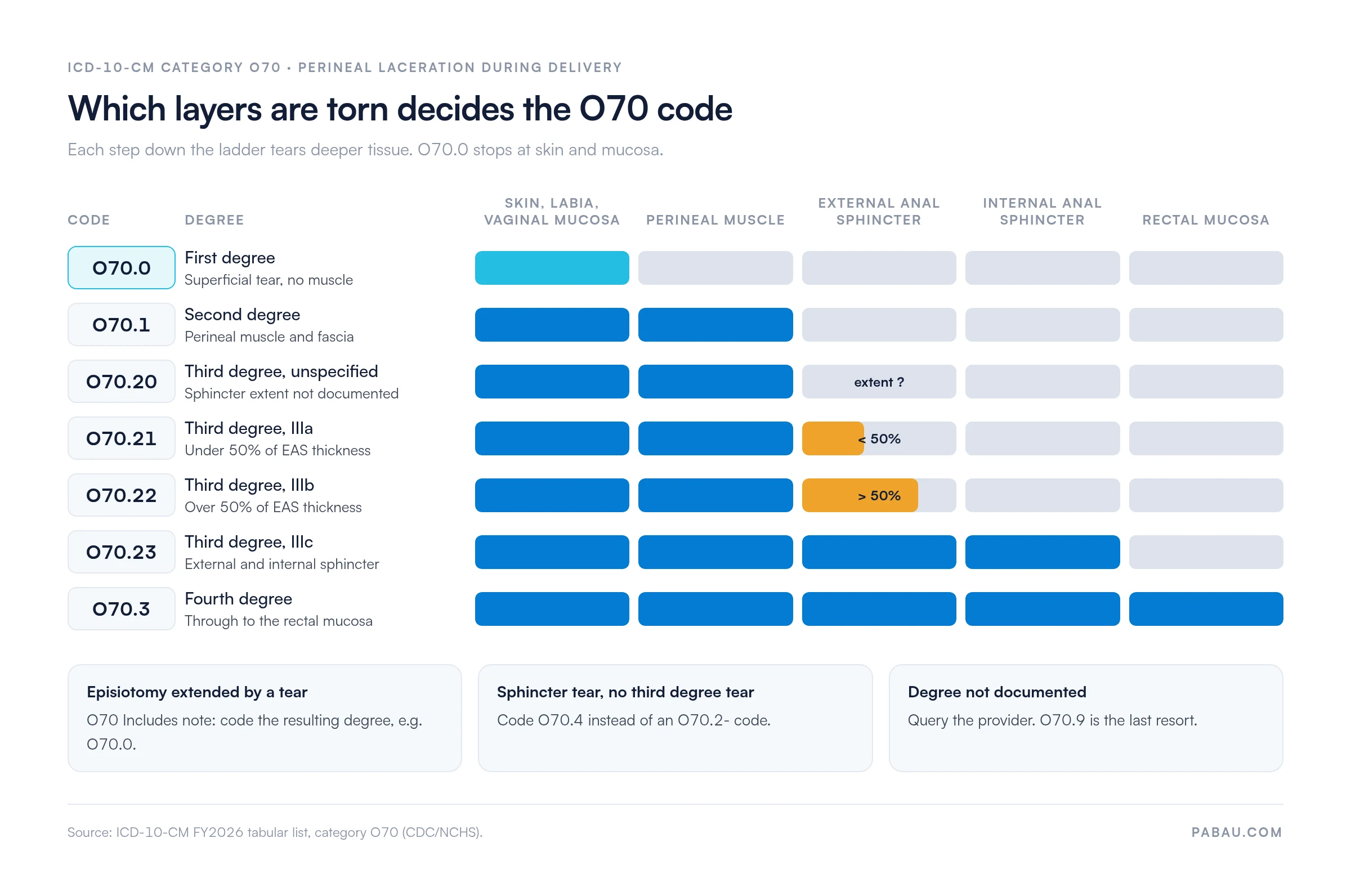
The AAPC ICD-10-CM code lookup includes the full O70 family with hierarchy navigation useful for confirming subcode specificity at the point of coding.
A patient can sustain more than one laceration during the same delivery. When the perineal tears are contiguous and represent a single wound that has extended, code the highest degree present. That approach is consistent with AHA Coding Clinic guidance.
An injury at a separate, non-perineal site is a different case. A cervical laceration documented alongside a first degree perineal tear takes its own code, so the claim carries both O70.0 and O71.3.
When the documentation is unclear, query the provider and check the current AHA Coding Clinic edition for obstetric scenarios.
An episiotomy is a planned surgical incision of the perineum to enlarge the vaginal opening. A perineal laceration is a spontaneous tear. When an episiotomy extends into a laceration, the O70 Includes note applies, so you code the resulting laceration degree. An uncomplicated episiotomy has no O70 diagnosis code at all.
Documentation language matters. “Mediolateral episiotomy repaired” codes differently from “first degree perineal tear repaired.” Coders who see “vaginal repair” without further detail should query before coding. The answer decides whether the claim carries an O70 laceration code at all.
First degree perineal laceration repair is generally not separately billable when the delivering provider performs it. That repair is included in the delivery code, whether the claim uses the global 59400 or the delivery-only 59409. Separate billing of repair CPT codes without a documented different-provider scenario is a common audit trigger. Maintaining medical billing compliance practices around obstetric global packages reduces this risk.
For Medicaid, bundling policies vary by state. Some state Medicaid programs allow separate billing of CPT 59300 when a provider other than the delivering physician performs the repair. They usually require an attestation or modifier to support the different-provider claim. Verify the relevant state Medicaid fee schedule annually, as these rules update with each fiscal year.
Obstetric claims carrying ICD-10 Code O70.0 are commonly denied for bundling conflicts, missing degree documentation, or episiotomy and laceration confusion. Each denial type has a defined appeal path. Pabau’s claims software for practices helps teams submit and track these claims, so a denial surfaces quickly. Structured denial management workflows handle the ones that come back.
Sequencing matters on delivery claims. Chapter 15 codes take sequencing priority, so when the laceration is the only complication, O70.0 is listed first. Z37.x follows as the additional outcome-of-delivery code, because Z37 codes are never first-listed. O80 cannot be used here, since it applies only to a delivery with no complication coded. A clean claim submission carries O70.0 first and Z37.x after it.
Run a monthly audit of O70.0 claims denied for bundling conflicts. Pull all claims with O70.0 plus a repair CPT code and check each for a different-provider modifier. Where a different provider performed the repair, a corrected modifier often resolves the denial without a full appeal.
A delivery claim is usually assembled by hand from the delivery note: the laceration degree, the Z37 outcome code and the delivery CPT. An error in any of them only surfaces when the payer denies the claim, often weeks later.
In Pabau, the delivery documentation and the codes your team assigns sit on the same patient record, and the claim is pre-filled from that record. Through the Claim.MD integration, US practices check eligibility, submit the claim electronically and track its status until the remittance posts.
Your billing team still chooses and sequences the codes. Pabau keeps every claim’s status in view, so a denied O70.0 claim is corrected and resubmitted well inside the filing window.

Pabau pulls the delivery record into a pre-filled claim and sends it through Claim.MD. Your team can then track each claim and correct denials quickly.

O70.0 is the right code only when the delivery note names a first degree tear and records no muscle involvement. Build that wording into your delivery note template, and fewer O70.0 claims will need a provider query.
The rules that trip these claims are narrow. An extended episiotomy takes the laceration’s degree, and repair by the delivering provider stays inside the delivery code. O70.0 goes first, with Z37.x after it. Get those three right and a payer has little left to question.
Pabau helps your team submit and track these claims, so a denial is caught while the filing window is still open. Book a demo to see how Pabau handles delivery claims from submission to payment.

Dealing with frequent claim rejections on delivery codes? Denial codes in medical billing explains the most common CARC denial codes and how to respond to each.
Submitting US claims electronically? The Claim.MD clearinghouse guide explains how the clearinghouse fits into a US practice’s claims workflow.
Coding another labor and delivery complication? ICD-10 Code O75.0 covers maternal distress during labor and delivery.
Documenting slow labor progress? ICD-10 Code O62.1 covers secondary uterine inertia and how to document it.
ICD-10 Code O70.0 is the billable ICD-10-CM diagnosis code for first degree perineal laceration during delivery. It covers tears limited to the perineal skin, labia and vaginal mucosa, with no muscle involvement. It is valid for FY2026 with no changes to its descriptor.
Yes. ICD-10 Code O70.0 remains a billable, valid code for FY2026 with no tabular revisions or descriptor changes from prior years. Confirm status annually using the CDC/NCHS ICD-10-CM web tool before each new fiscal year begins in October.
Yes, when the episiotomy extends into a laceration. O70 includes episiotomy extended by laceration, so code the resulting degree, such as O70.0 for a first degree extension. No Excludes1 note applies. An episiotomy with no extension has no O70 code.
Generally no. Perineal laceration during delivery is clinically inconsistent with cesarean section because no perineal exposure occurs in a standard cesarean. Sometimes a perineal injury occurs during a failed trial of labor that ends in a cesarean. The clinical sequence must then be documented explicitly, and the coding team should query the provider before assigning O70.0 alongside a cesarean delivery code.
The delivery code, global 59400 or delivery-only 59409, is the primary procedure code on most O70.0 claims. Repair by the delivering provider is included in either code. CPT 59300 applies only when a different provider performs the repair, subject to current NCCI edits.
For a single contiguous wound that extends across degrees, code only the highest degree present. An injury at a separate non-perineal site, such as a cervical laceration, takes its own code (O71.3) alongside the O70 code. When documentation lists multiple perineal lacerations without the degree of each, query the provider before assigning codes.