ICD-10 Code S82.242H: Displaced spiral tibial shaft fracture, delayed healing
ICD-10 Code S82.242H: Definition and code details ICD-10 Code S82.242H designate...

Last Updated: Oct 15, 2026
Billable Code Specific Code
O62.1 is the billable ICD-10-CM code for secondary uterine inertia.
It applies when uterine contractions were adequate during active labor and then became weak, infrequent, or ineffective. The code sits in category O62 under ICD-10-CM Chapter 15. It stays valid for HIPAA-covered transactions in fiscal years 2025 and 2026. The frequent error is coding it where contractions were never adequate, which is O62.0.
Let Pabau's smart automation suggest the right codes, reduce claim denials, and keep your practice compliant—effortlessly.
Automate repetitive tasks and focus on what matters most—your patients.
Reduce coding errors and ensure compliance with the latest regulations.
Clean claims, fewer denials, and faster reimbursements.
Powerful insights and reporting to help your practice thrive.
HIPAA compliant SOC 2 certified GDPR-compliant Trusted by 4,000+ clinics worldwide

O62.1 is a billable ICD-10-CM code for secondary uterine inertia, valid for FY2025 and FY2026, with no 7th character extension required.
The code applies only when contractions were adequate and then deteriorated. If they were never adequate, O62.0 applies instead.
O62.1 covers the labor period, while postpartum uterine atony is O72.1. Confusing the two is a common denial trigger.
Neither O62 nor O62.1 carries an Excludes note of its own. The notes that reach the code sit at Chapter 15 level.
Practice management software like Pabau supports the labor documentation workflows that keep O62.1 claims clean.
ICD-10 Code O62.1 carries the official descriptor “Secondary uterine inertia” and is a specific, billable code valid for use in all HIPAA-covered electronic transactions. It applies when uterine contractions were adequate during active labor and then became weak, rare, or ineffective. In short, the table below sets out the core details coders need before working through documentation and sequencing.
Confirm current-year validity against the CDC/NCHS ICD-10-CM official lookup tool before submitting claims, as annual code updates can affect billable status.
Secondary uterine inertia is a labor complication in which uterine contractions become weak, rare, or ineffective after a period of adequate active-phase labor. The word “secondary” does the work here. Contractions were working, then they stopped working. In other words, that sets it apart from primary uterine inertia, where contractions were never adequate from the onset of labor.
Clinically, secondary inertia presents during the active phase of the first stage of labor. It usually appears as an arrest of cervical dilation or fetal descent after measurable progress was made. The labor and delivery note may record it as “arrested active phase” or “secondary arrest of contractions.” It may also describe contractions that became desultory or rare after earlier adequate frequency and strength.
Common clinical scenarios that prompt O62.1 coding include:
The O62 category contains three inertia codes that coders often confuse. Choosing the wrong one is one of the top audit findings in obstetric billing, so the distinction needs to be precise.
The selection rule turns on one line in the note. First, read the labor and delivery record for evidence of a prior adequate contraction pattern. If it documents regular contractions with cervical change before the deterioration, ICD-10 Code O62.1 is correct. If no adequate phase is described, use O62.0. If the pattern fits neither, O62.2 is the fallback. The AAPC ICD-10-CM code lookup carries the full O62 category list.
Two questions settle the assignment, and they are worth running in that order.
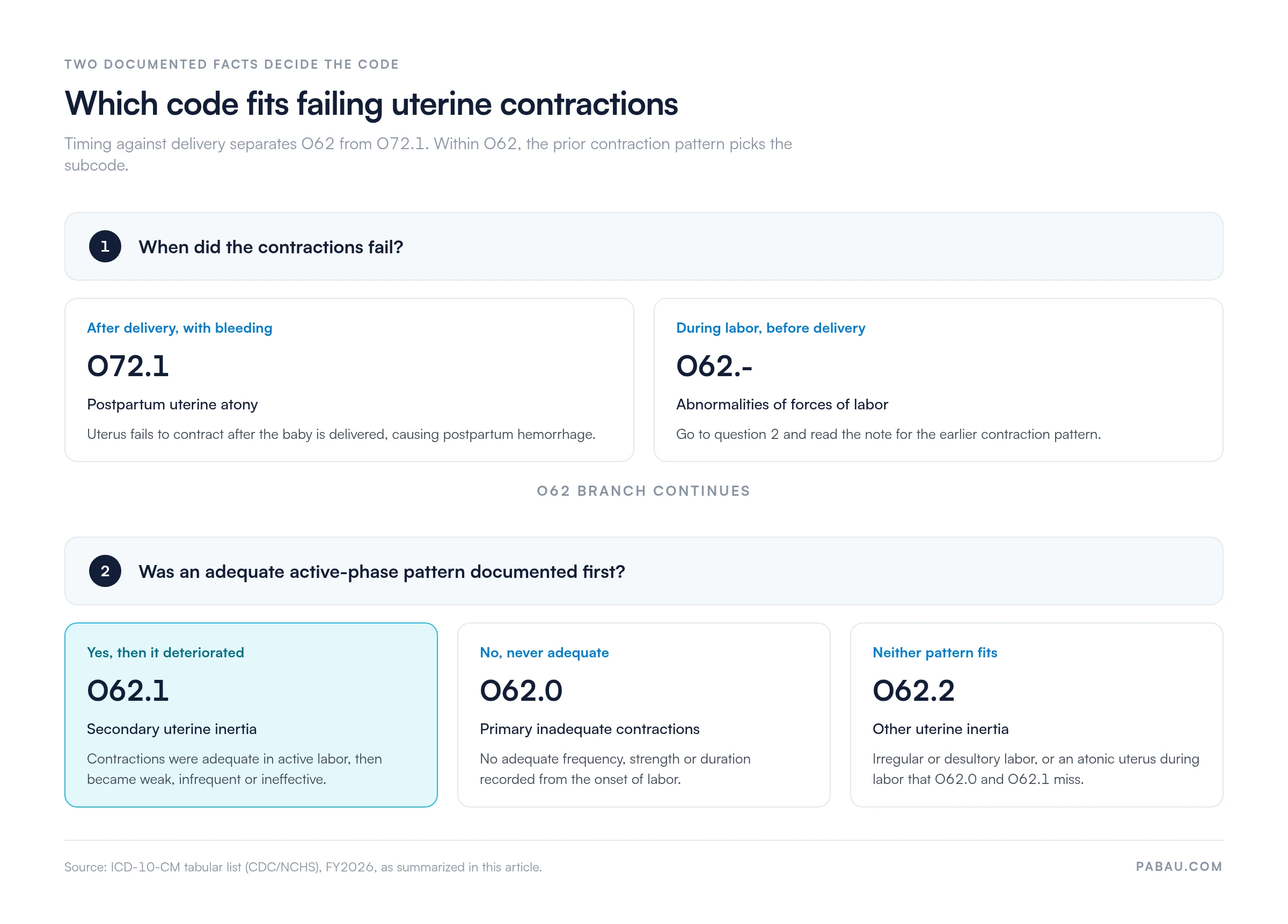
Secondary uterine inertia (O62.1) and postpartum uterine atony (O72.1) are two entirely different conditions separated by the moment of delivery. Coding O72.1 when O62.1 is correct, or vice versa, is a documented audit risk and a common payer denial trigger in obstetric billing.
Put simply, the documentation test is short. If the condition occurred before delivery and affected the labor process, it is O62.1 territory. If it occurred after the baby was delivered and caused bleeding, it belongs in the O72 category.
O62.1 claims are denied most often because documentation does not establish that an adequate contraction pattern existed before the deterioration. The physician or midwife note must contain specific elements for the code to survive audit.
Namely, five documentation elements are required to support ICD-10 Code O62.1 on a labor and delivery note:
Chapter 15 rules restrict coding to conditions that complicate the pregnancy, affect its management, or require treatment. So secondary uterine inertia that prompts augmentation or operative delivery meets that standard.
ICD-10-CM Chapter 15 (Pregnancy, Childbirth and the Puerperium) operates under its own Official Guidelines for Coding and Reporting. Those chapter guidelines come before the general coding rules wherever the two conflict, so they decide how O62.1 is reported.
Four OGCR Chapter 15 rules directly affect how ICD-10 Code O62.1 is reported:
ICD-10 Code O62.1 supports medical necessity for the intervention that secondary inertia prompted. Also, pairing the diagnosis with the right procedure code is what keeps denial risk down. Our CPT code reference covers the wider surgical and medicine code families that obstetric claims draw on.
Payer behavior around O62.1 follows a pattern you can plan for. For example, practices that route labor claims through cleaner claims management get clearinghouse-level edits that catch sequencing and pairing errors before submission.
Key payer factors for O62.1 claims:
Setting up one documentation checklist for secondary inertia encounters cuts the rework that lands on the revenue cycle team weeks later.
So, run a pre-submission edit check on every O62.1 claim. Confirm the note states the initial adequate contraction pattern, the deterioration that followed, and the provider-linked diagnosis. Claims where the note implies secondary uterine inertia but never names it are the ones that come back asking for more documentation.
O62.1 claims attract common denial patterns. Luckily, knowing them in advance lets coders build the documentation habits that prevent them, and each one below has a fix the coding team controls.
Secondary uterine inertia rarely appears alone on a labor claim. So, knowing which codes pair with O62.1 helps coders capture the full clinical picture and avoid the sequencing errors that trigger denials. A written sequencing protocol for the common obstetric combinations saves the same argument every month.
Excludes notes decide whether two codes can sit on the same claim. Misreading an Excludes1 note produces a rejection or an audit finding, so it pays to know which notes reach O62.1 and which do not.
Per the official ICD-10-CM tabular list, the notes that govern O62.1 sit above the category:
Most labor and delivery teams write the contraction narrative in one system and build the claim in another. The coder then reads a note that was never structured around the questions a payer asks. Meanwhile, the query goes back to the floor days later, and the claim waits.
Practice management software like Pabau keeps the clinical record and the claim in one place. For example, structured labor templates capture the initial contraction pattern, the deterioration, and the provider-linked diagnosis at the point of care. Those fields carry into the claim rather than being retyped from a scanned note.
Claims then leave with the documentation that supports them already attached. Fewer O62.1 claims come back asking for a note that was written on the day. As a result, the coding team spends less of its week chasing addendums.

Pabau helps labor and delivery practices manage clinical documentation, claims management, and billing workflows in one place. See how accurate ICD-10 documentation flows directly into cleaner obstetric claims.

Secondary uterine inertia claims are decided by the labor and delivery note, not by the code sheet. In fact, ICD-10 Code O62.1 is billable, takes no 7th character, and carries no Excludes note of its own. What it demands is a record showing that contractions were adequate first, and then were not.
So build the query into the workflow rather than into the appeal. A labor template that asks for the initial contraction pattern before it asks for the arrest will catch most of what payers send back.
Pabau captures that detail at the point of care, in the record the claim is built from. Book a demo to see how it cuts addendum requests for OB/GYN and labor and delivery teams.

Need a broader overview of obstetric coding compliance? Medical billing compliance covers the audit standards and documentation rules that apply across labor and delivery claims.
Managing denial patterns across your obstetric claims? Denial management in healthcare gives a systematic framework for root-cause analysis and prevention.
Want to understand how claim submission works end to end? Medical billing workflow explains the full revenue cycle from encounter to payment for obstetric practices.
Coding the sibling that covers irregular labor? ICD-10 code O62.2 sets out other uterine inertia and when it is the safer assignment.
Billing a puerperal infection on the same stay? ICD-10 code O85 walks through puerperal sepsis documentation and sequencing.
ICD-10 Code O62.1 is the billable ICD-10-CM diagnosis code for secondary uterine inertia. It is assigned when contractions were adequate during active labor and then became weak, rare, or ineffective. The code sits in category O62 under Chapter 15 and is valid for HIPAA-covered transactions in FY2025 and FY2026.
Yes, O62.1 is a billable ICD-10-CM code valid for use in all HIPAA-covered electronic transactions. No 7th character extension is required, so the code is submitted as O62.1 exactly.
Four causes account for most of them. The note supports O62.0 rather than O62.1, because no prior adequate phase was recorded. The claim confuses O62.1 with postpartum atony (O72.1). The procedure code for the intervention is missing. Or O63 prolonged labor is sequenced ahead of the condition that drove the management. Finally, documenting the prior adequate contraction phase prevents most of these denials.
The most common pairings are 96365/96366 for IV oxytocin augmentation, 59409/59410 when vaginal delivery follows, and 59514/59515 when secondary inertia leads to cesarean delivery. O62.1 establishes the medical necessity for whichever intervention was ordered as a result of the arrested active phase.