CPT code 34812: Open femoral artery exposure for endovascular repair
CPT code 34812: Official descriptor and procedure overview CPT code 34812 is off...

Last Updated: Nov 19, 2026
59300 is the CPT code for episiotomy or vaginal repair performed by a clinician other than the one who delivered the baby. That qualifier decides almost every claim.
When the delivering clinician repairs the episiotomy or tear, the work is already paid inside the delivery code. A separate 59300 line then comes back as CO-97. The code pays only when a second, unrelated clinician does the repair and documents it under their own NPI.
Let Pabau's smart automation suggest the right codes, reduce claim denials, and keep your practice compliant—effortlessly.
Automate repetitive tasks and focus on what matters most—your patients.
Reduce coding errors and ensure compliance with the latest regulations.
Clean claims, fewer denials, and faster reimbursements.
Powerful insights and reporting to help your practice thrive.
HIPAA compliant SOC 2 certified GDPR-compliant Trusted by 4,000+ clinics worldwide

CPT code 59300 covers episiotomy or vaginal repair by a clinician other than the one who delivered the baby.
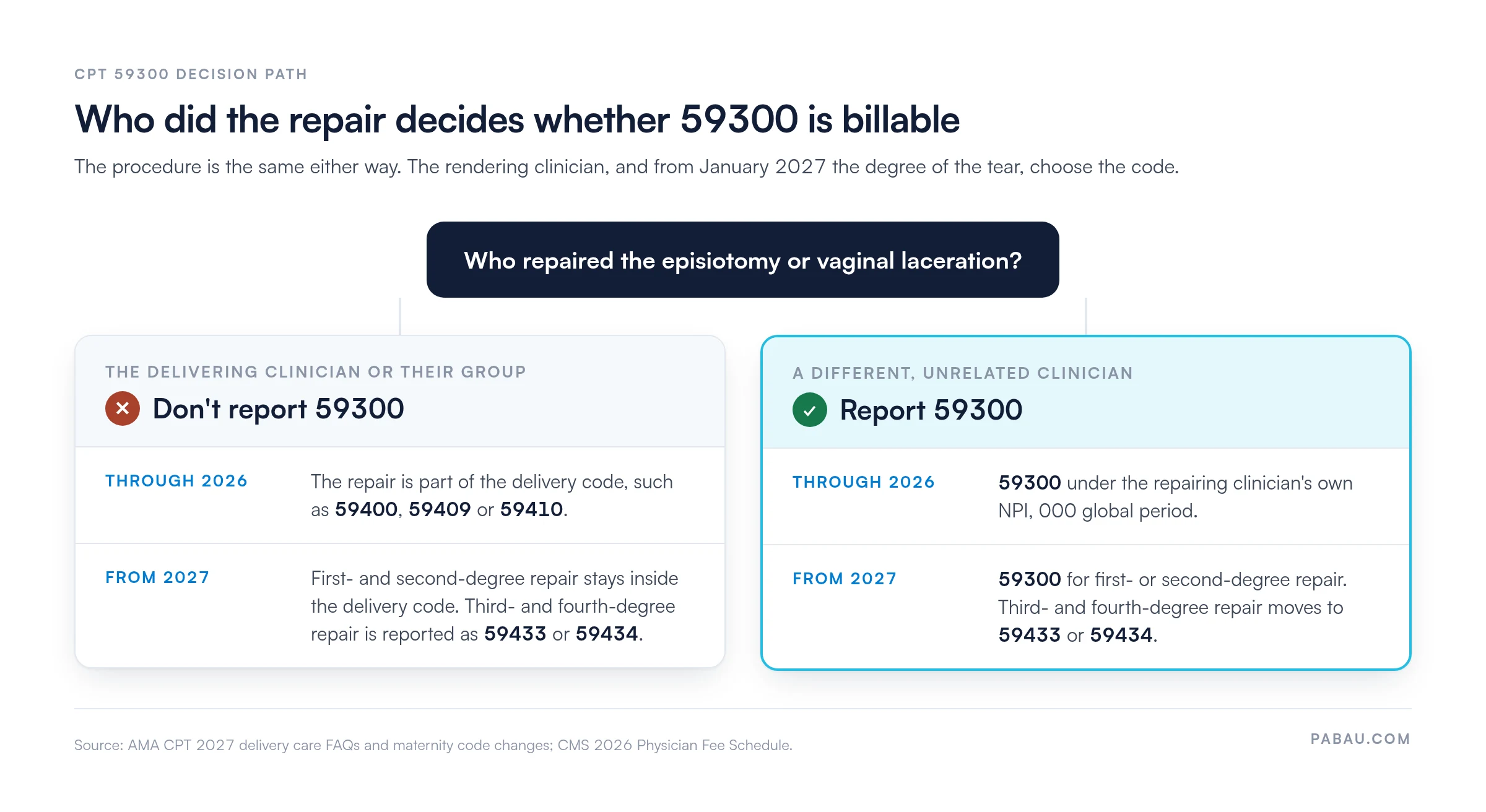
When the delivering clinician repairs the episiotomy or tear, the work is included in the delivery code and 59300 is not reported.
Modifier 59 or XU only helps when the repairing clinician’s NPI differs from the delivering clinician’s NPI and the note proves it.
In 2026, 59300 pays about $225 non-facility and $134 facility nationally, with a 0-day (000) global period.
From January 1, 2027, 59300 covers first- and second-degree repair only, and third- and fourth-degree repairs move to 59433 and 59434.
CPT code 59300 is the code for episiotomy or vaginal repair by a clinician other than the attending provider who delivered the baby. The AMA’s delivery care coding FAQs spell out the split. Repairs by the delivering clinician are included in the delivery code, and 59300 is for an unrelated clinician.
So the question on every 59300 claim is the same. Who held the needle driver, and were they part of the delivering team? The quick reference below covers the rest.
Yes, an episiotomy performed and repaired by the delivering provider is part of the global obstetric package. It is not separately reportable, and that single rule drives most CO-97 denials on this code.
The global and delivery codes (59400, 59409, 59410, 59610, 59612, 59614) include routine delivery services, episiotomy among them. The CMS Medicare Claims Processing Manual (Chapter 12) sets out how CMS applies global surgery rules.
The decision path below shows how the repairing clinician changes the code.
Three situations make CPT 59300 separately reportable:
CPT 59300 covers episiotomy or vaginal repair when a clinician other than the delivering provider performs it. An episiotomy is the incision made to widen the vaginal opening. What it doesn’t cover trips up coders just as often:
NCCI (National Correct Coding Initiative) edits bundle CPT 59300 with the obstetric delivery codes. Knowing where 59300 ends and its neighbors begin prevents both undercoding and overcoding.
The 59300 versus 59410 mix-up is the error I see most. CPT 59410 says “with or without episiotomy” because it already pays for the episiotomy when the same provider does it.
Billing 59300 next to 59410, or next to delivery-only 59409, for the same provider and date triggers an NCCI edit. The fix is never a modifier. It’s removing the line.
Payers expect a diagnosis that supports the repair. The O70 family covers perineal lacerations during delivery, and documentation must back the degree you code. A first-degree tear, for example, goes to O70.0.
Under the ICD-10-CM Chapter 15 guidelines, pregnancy and childbirth codes are sequenced first when the delivery is the reason for the encounter. O70 codes are reported as additional diagnoses when the laceration complicates the delivery.
Two modifiers come up with CPT 59300. Both are audit triggers when used loosely, so the note has to support the modifier before it goes on the claim.
CMS offers the X{EPSU} modifiers as more specific alternatives to -59. When a payer’s policy asks for XU (unusual non-overlapping service) or another X modifier, use it in place of -59.
A clean 59300 claim is decided long before anyone opens the billing screen. Here’s the path it takes in a practice that gets paid on it.
The note for CPT 59300 has to show why a second clinician was involved and that the service was distinct from the delivery. Your general medical billing compliance standards are the floor. OB repair claims add these elements:
CPT 59300 is a component procedure with a 0-day (000) global period. The CMS Physician Fee Schedule for 2026 lists a work RVU of 2.35 for 59300. The non-facility total RVU is 6.75, and the facility total is 4.00.
That puts the estimated national Medicare payment at about $225 non-facility and $134 facility, before locality adjustments. Use the FastRVU 2026 lookup tool to check the work, practice expense and malpractice RVUs for your locality. Rates change each January 1 with the conversion factor.
Commercial payment varies widely. Most commercial payers follow the same bundling logic, so 59300 rarely pays unless a different provider or non-global billing is clearly documented. Check your payer contracts before you count on it.
Dr. A, a family physician, delivers the baby in a 2026 delivery and bills 59409. A second-degree tear needs repair, and Dr. A is called to another delivery. Dr. B, an obstetrician from a separate group, repairs it.
Dr. B writes a procedure note with the tear’s degree, the layers closed and the suture used. The claim carries 59300 under Dr. B’s NPI with O70.1. O80 doesn’t apply, because the tear makes the delivery complicated.
If Dr. A had repaired the tear, there would be no 59300 line at all. The repair would sit inside 59409, and adding a modifier wouldn’t change that.
Denials on CPT 59300 are predictable. Tracking them in a structured denial management workflow stops the same error repeating every billing cycle.
The full list of medical billing denial codes has the CARC and RARC definitions behind each of these.
Run a quarterly audit of all CPT 59300 claims submitted in the prior period. Filter by rendering provider NPI and cross-reference it against the attending provider NPI on each matching delivery claim. Any case where both NPIs match signals a bundling error that may draw recoupment requests.
The AMA’s 2027 maternity care code changes take effect on January 1, 2027. They delete 17 maternity codes, including 59400, 59409 and 59410, and report care by phase in place of the single global code.
CPT 59300 survives as a revised code. From 2027 it covers first- or second-degree repair by an unrelated clinician, while third- and fourth-degree repairs move to 59433 and 59434. Those two are reportable whoever bills the delivery, so plan your 2027 charge capture now.
Most 59300 errors come from a claim built from memory or a spreadsheet, days after the delivery. The repair note sits in one place, the charge in another, and nobody checks the rendering NPI against the delivery claim.
Pabau, the practice management and billing platform we build, keeps the procedure note, the charge and the claim on the same patient record. Its OB practice claims management pre-fills the CMS-1500 from that record. You can look up CPT and ICD-10-CM codes as you go.
In the US, claims go out through Claim.MD as CMS-1500/837P claims, with eligibility checks, ERA remittances and secondary claims. Our Claim.MD clearinghouse guide explains that route. When a 59300 line comes back, the remittance lands on the same record, so your team reviews it with the note in front of them.

Pabau pre-fills CMS-1500 claims from the patient record and sends them through Claim.MD, with eligibility checks and ERA remittances. Your team sees the repair note, the charge and the payment in one place.

CPT 59300 is narrow by design, and that’s useful. If the delivering clinician did the repair, you don’t bill it. If someone unrelated did, you bill it under their NPI with their own note.
The practices that collect on this code settle that question at the bedside, not at the denial. With the 2027 changes six weeks out, now is the time to update your charge sheets for 59433 and 59434 too.
Book a demo to see how Pabau keeps each repair note, charge and remittance on one patient record.

Billing the whole pregnancy under one code? CPT code 59400 covers the global package that bundles a delivering clinician’s episiotomy.
Coding the delivery itself? ICD-10 code O80 explains when a delivery counts as uncomplicated.
Repairing a cervical tear rather than a perineal one? ICD-10 code O71.3 covers obstetric laceration of the cervix.
Delivering the placenta separately? CPT code 59414 explains how delivery of the placenta is reported on its own.
Reading the remittance on a denied 59300 line? Electronic remittance advice walks through 835 files and CARC/RARC codes.
No. CPT 59300 is a standalone surgical code, so it’s reported on its own line under the repairing clinician. It doesn’t depend on a primary code from the same provider.
No. Both are reported with the same code when a non-delivering clinician repairs them. Record the type in the note anyway, because it supports the degree and the repair technique.
No. Cesarean delivery codes include the incision and closure. CPT 59300 describes episiotomy or vaginal repair, which belongs to a vaginal delivery.
Yes, when the midwife didn’t deliver the baby and is credentialed with the payer to bill under their own NPI. If the midwife delivered, the repair stays inside the delivery code.
Yes. CPT 59300 is revised rather than deleted on January 1, 2027. It then covers first- or second-degree repair by an unrelated clinician, and third- and fourth-degree repairs use 59433 and 59434.