ICD-10 code S12.591B: Nondisplaced C6 fracture, open
ICD-10 code S12.591B: Definition and billable status ICD-10 code S12.591B is the...

Last Updated: Nov 2, 2026
Billable Code Specific Code
S21.041D is the billable ICD-10-CM code for puncture wound with foreign body of right breast, subsequent encounter. It covers follow-up visits after the wound's initial active treatment, such as wound checks, dressing changes and suture removal.
The code sits in category S21, Open wound of thorax. Assigning it depends on four documented facts. The note must name the right breast, a puncture mechanism and an identified foreign body, with active treatment already given at an earlier encounter.
Let Pabau's smart automation suggest the right codes, reduce claim denials, and keep your practice compliant—effortlessly.
Automate repetitive tasks and focus on what matters most—your patients.
Reduce coding errors and ensure compliance with the latest regulations.
Clean claims, fewer denials, and faster reimbursements.
Powerful insights and reporting to help your practice thrive.
HIPAA compliant SOC 2 certified GDPR-compliant Trusted by 4,000+ clinics worldwide

S21.041D codes a puncture wound with foreign body of the right breast at a subsequent encounter, after initial active treatment is complete.
The seventh character D depends on whether active treatment has already happened, not on whether the provider is seeing the patient for the first time.
Wrong seventh character, missing laterality and an undocumented foreign body are the denial triggers this code invites most.
Pabau’s claims management software checks seventh character assignments and CPT-ICD pairings before submission, so wound care claims go out clean.
ICD-10 code S21.041D is the billable code for a puncture wound with foreign body of the right breast at a subsequent encounter. You report it for follow-up care after the wound has already received initial active treatment.
The code sits in the S20-S29 Injuries to the thorax block of the ICD-10-CM Tabular List. Its chapter is S00-T88, Injury, poisoning and certain other consequences of external causes. The table below walks each level of the code down to the seventh character.
S21.041D is a full seven-character billable code in the CMS ICD-10-CM code set. It needs no placeholder X and no character beyond the seventh. Each code set runs from October 1 to September 30 of the following year. Confirm the code against the current fiscal year’s release before you submit.
A puncture wound with foreign body (FB) is a penetrating injury where an object pierces the breast and leaves material embedded at the wound site. A laceration is a tear or cut without that penetrating depth.
For the right breast at a subsequent encounter, a laceration without foreign body is S21.011D. A puncture wound without foreign body is S21.031D.
Foreign bodies commonly coded under S21.041D include glass fragments, metal shards, wood splinters, gravel and fabric fragments.
The record must show the foreign body was identified, by imaging (plain film, ultrasound or CT) or by direct clinical examination. A note reading “possible foreign body” or “foreign body suspected” does not support this code.
Anatomically, the right breast covers the right mammary region, including the overlying skin, subcutaneous tissue and breast parenchyma. Injuries that reach the pleura or thoracic cavity need additional or different codes. The Excludes1 and “Code also” notes in the S21 category, covered below, set out which.
The seventh character D designates a subsequent encounter. ICD-10-CM Official Guidelines Section I.C.19.a apply it once active treatment is complete. The patient is then receiving routine care during healing or recovery. It is also the element of S21.041D that coders get wrong most easily.
D does not mean a second visit, and A does not mean only the first calendar visit. Say the emergency department (ED) treats the wound and a specialist then takes over routine wound management. The specialist’s first visit still uses D, because active treatment has already been provided.
The question to ask is always whether the patient has already received active treatment for this injury.
Review the prior visit notes before assigning the seventh character on any wound care claim. If debridement, irrigation or FB removal happened at an earlier encounter, D is correct for every later wound management visit. That holds whichever provider is billing.
The sibling codes S21.041A, S21.041D and S21.041S share the same anatomical specificity but differ in encounter type. Picking the wrong one is a common reason breast wound claims come back denied.
A frequent error: A provider sees the patient weekly for dressing changes after the ED removed the foreign body. Every one of those follow-up visits should use S21.041D. Coders who default to S21.041A trigger payer edits for repeated “initial encounter” billing on the same injury.
The reverse error: Using S21.041D at the visit where the foreign body is removed for the first time. If the provider is delivering active treatment, including the first FB extraction, S21.041A applies even when the wound is days old.
Payers cross-check laterality, so the S21 family is worth knowing well. An unspecified-breast code on a claim whose note names the right breast is a documentation-coding mismatch that can trigger medical review.
The nearest codes split on three documented facts, and the decision path below runs those checks in the order a coder meets them.
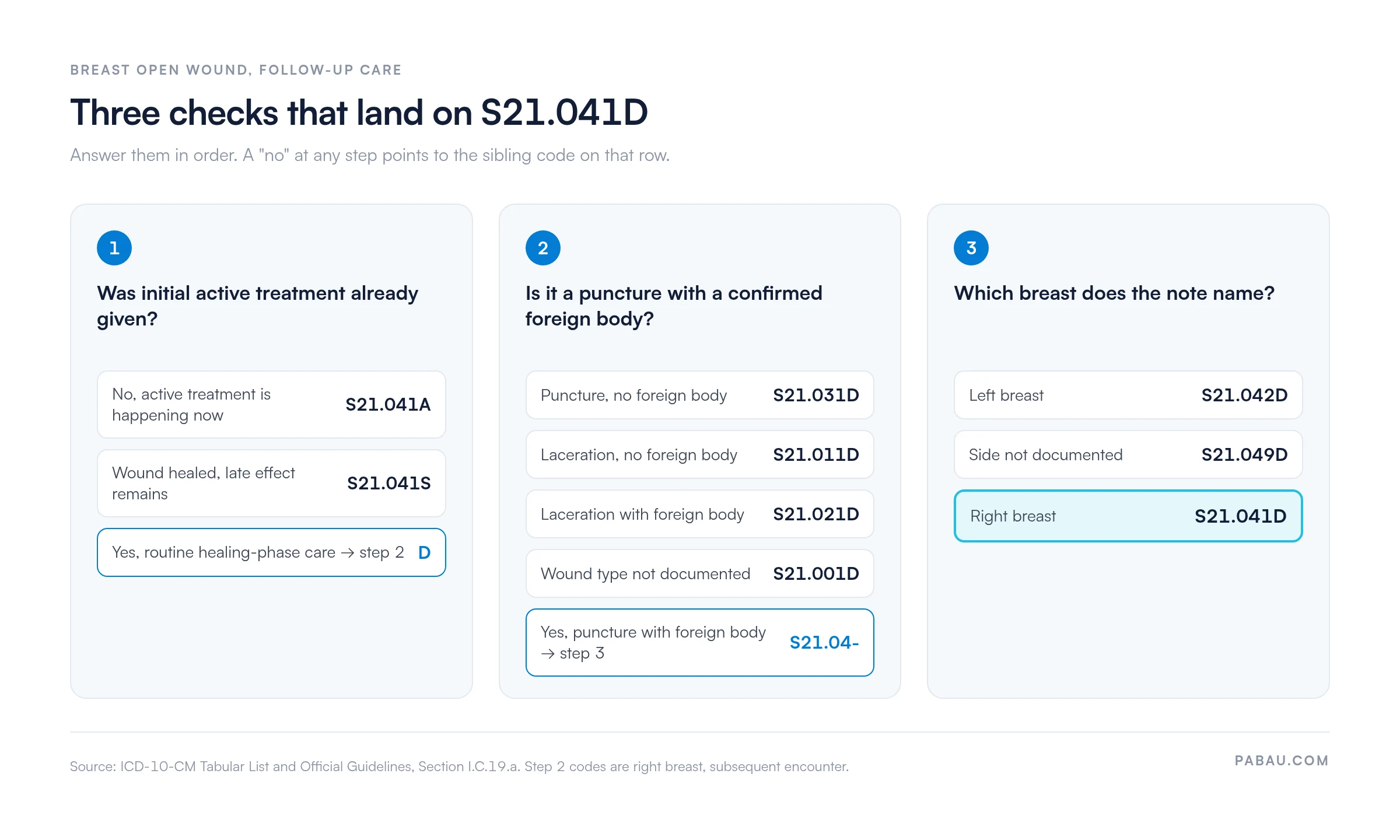
When material stays in the wound after removal attempts, add a code from Z18.- to identify the retained foreign body. Chapter 19 of ICD-10-CM carries that “Use additional code” note. The Z18.- code records what was retained, while S21.041D records the wound itself. Report both only when the note documents both.
Check the S21 category’s instructional notes before you finalize the code. S21 carries one Excludes1 note, which means the excluded code is never reported with it, plus several “Code also” notes for associated injuries.
The CDC ICD-10-CM web tool also lists a “Code also” note for any associated wound infection. When the provider documents an infected wound, add the matching infection code, such as L08.89 for other specified local infection of skin and subcutaneous tissue.
Payer audits on subsequent encounter wound codes check whether the record supports each element of the code descriptor. A note missing any of the five elements below leaves the claim open to denial or post-payment recovery.
The procedure codes billed with S21.041D depend on what happens at the follow-up visit. The usual scenarios are foreign body removal not completed at the first visit, and wound debridement or dressing management. Simple removal bills as CPT 10120, and selective debridement of the first 20 sq cm bills as CPT 97597.
National Correct Coding Initiative (NCCI) edits may bundle an evaluation and management (E/M) code with a same-day procedure such as 10120. Check the current CMS NCCI edit tables before you submit. Add modifier 25 to the E/M only when the note documents a significant, separately identifiable service that day.
Subsequent encounter diagnosis codes do not trigger prior authorization on their own. Where authorization applies, it attaches to the procedure performed at the visit, not to the ICD-10 code. Some commercial plans require it for foreign body removal (CPT 10120/10121), and many do for repeated debridement sessions (97597/97598).
Medicare Local Coverage Determinations (LCDs) for wound care vary by Medicare Administrative Contractor (MAC). Check your region’s LCD before billing repeated debridement visits with S21.041D.
LCDs often cap the sessions covered without documented wound progress. Some also require length, width and depth measurements at each visit to show the treatment is working.
Medicaid coverage and authorization rules differ by state. State programs generally accept subsequent encounter wound codes. The procedure code, though, may need specific modifiers or place-of-service codes under the state’s managed care contracts. If you bill in several states, check each state’s Medicaid fee schedule.
Pull the remittance on any denied S21.041D claim before you correct and refile it. The Claim Adjustment Reason Code (CARC) and Remittance Advice Remark Code (RARC) show which element triggered the denial. CARC 4 points to a coding or modifier issue, CARC 50 to medical necessity, and CARC 97 to bundling. Fixing the wrong cause wastes a refile attempt.
S21.041D denials cluster around a predictable set of root causes. Read the denial codes on the remittance before you correct the claim, so the refile does not repeat the error.
Without a pre-submission check, a wrong seventh character on S21.041D usually surfaces when the remittance comes back. By then the claim is denied and the refile clock is running.
Pabau’s claims management software checks each claim before it leaves the practice. Its Claim.MD clearinghouse connection runs the claim against payer edit libraries, flagging seventh character mismatches and missing laterality first.
Customizable treatment note templates can prompt the provider for side, mechanism, foreign body status and prior treatment at every wound visit. The note then supports the code before a coder ever opens it.
When payment comes back, Claim.MD posts the 835 electronic remittance advice into Pabau automatically. Denials are grouped by CARC code and payer, so your billing team fixes the most frequent patterns first.

Pabau validates seventh character assignments, laterality specificity, and CPT-ICD pairings before your claim reaches the payer. See how built-in claims management reduces wound care denials.

Code S21.041D from the encounter history, not from the visit count. Before you assign it, confirm that someone already treated the wound and that the note names the right breast, a puncture and a foreign body.
If one of those facts is missing, query the provider before the claim goes out. An addendum written today takes minutes, while a denied claim costs a refile and weeks of waiting.
Book a demo to see how Pabau checks the seventh character and laterality on every wound care claim before it reaches the payer.

Need to understand what happens after a claim reaches the clearinghouse? How a medical claims clearinghouse works covers the end-to-end submission and validation process.
Want to reduce the time spent reconciling denied claims? Pabau’s Claim.MD clearinghouse integration explains how ERA posting and CARC tracking are automated.
Need the procedure side of a wound follow-up claim? CPT code 10121 covers complicated subcutaneous foreign body removal and the documentation it needs.
ICD-10 Code S21.041D is the billable diagnosis code for puncture wound with foreign body of the right breast, subsequent encounter. It applies once the patient has received active treatment for the injury. Typical visits are routine wound care, dressing changes and wound checks during healing.
Yes, S21.041D is a full seven-character billable ICD-10-CM code, confirmed valid in the CMS Tabular List. It has sufficient specificity for claim submission without requiring additional characters or placeholder X assignments.
S21.041A is used while the patient receives active treatment, such as the first wound assessment, foreign body removal or irrigation. S21.041D applies to visits after that treatment, such as wound checks, dressing changes and suture removal. The distinction is about whether active treatment has already happened, not about visit count.
Use the seventh character D once the patient has received active treatment for the injury at an earlier encounter. It does not matter which provider gave that treatment. Under ICD-10-CM Official Guidelines Section I.C.19.a, D covers healing-phase visits such as wound checks, follow-up imaging and dressing changes.
The most common reasons are a wrong seventh character and missing laterality in the note. Others are an undocumented foreign body, CPT-ICD bundling edits without modifier 25, and thin medical necessity documentation for repeated sessions. Review the CARC and RARC codes on the remittance before correcting and refiling.
The provider note must name the right breast and describe a puncture wound. It must confirm a foreign body by imaging or clinical exam, and show that active treatment was already provided. It should also record the current wound status, such as healing, infected or dehisced.