ICD-10 Code T31.77: Burns involving 70-79% of body surface
ICD-10 code T31.77: Quick reference and code details ICD-10 code T31.77 is the b...

Last Updated: Nov 5, 2026
Billable Code Specific Code
S70.251D is the billable ICD-10-CM code for superficial foreign body, right hip, subsequent encounter. It covers follow-up visits once active treatment of the foreign body is complete, such as wound checks and suture removal.
A common billing error is submitting S70.251A (initial encounter) on a follow-up visit, which can trigger a denial.
Let Pabau's smart automation suggest the right codes, reduce claim denials, and keep your practice compliant—effortlessly.
Automate repetitive tasks and focus on what matters most—your patients.
Reduce coding errors and ensure compliance with the latest regulations.
Clean claims, fewer denials, and faster reimbursements.
Powerful insights and reporting to help your practice thrive.
HIPAA compliant SOC 2 certified GDPR-compliant Trusted by 4,000+ clinics worldwide

S70.251D is the billable ICD-10-CM code for a superficial foreign body of the right hip at a subsequent encounter. It is valid in the current FY2027 code set (effective October 1, 2026).
The 7th character D marks a subsequent encounter for routine follow-up, while A covers active treatment and S covers a sequela. Using A on a follow-up visit is a common denial trigger.
Documentation must confirm laterality (right hip), the visit type (subsequent or follow-up), and a superficial foreign body rather than an open wound.
Pabau’s claims management software helps practices track encounter type across visits, so 7th-character mismatches are caught before submission.
ICD-10 code S70.251D is the billable ICD-10-CM diagnosis code for “Superficial foreign body, right hip, subsequent encounter.” It is valid in the current FY2027 code set (effective October 1, 2026). It sits at the highest specificity level in the ICD-10-CM hierarchy and is acceptable for claim submission without further subdivision.
The code traces through the following hierarchy in the CDC/NCHS ICD-10-CM tabular list:
Every character in S70.251D carries a specific meaning. Misreading a single position, particularly position 5 (injury type) or the 7th character, creates a mismatch between the clinical note and the submitted code.
The 7th character D means subsequent encounter: The patient has completed active treatment for the foreign body and now receives routine follow-up care. That covers a wound check, suture removal, or monitoring of healing. Under the CMS ICD-10-CM Official Guidelines for Coding and Reporting, D applies after active treatment is complete, during the healing or recovery phase. A stays in use while the patient is receiving active treatment.
Three 7th-character extensions exist for S70.251. Each maps to a distinct phase of the patient’s care:
A key rule from the ICD-10-CM guidelines: The care given at the visit sets the 7th character. The number of visits does not. A patient seen three times for progressive foreign body removal may use A on every visit while active treatment continues. D applies only once active treatment is complete.
Choosing between S70.251A and S70.251D is the main coding decision in this family. Ask one question at every visit: Is active treatment still happening, or is the provider monitoring healing? The diagram below adds the second question that separates D from S.
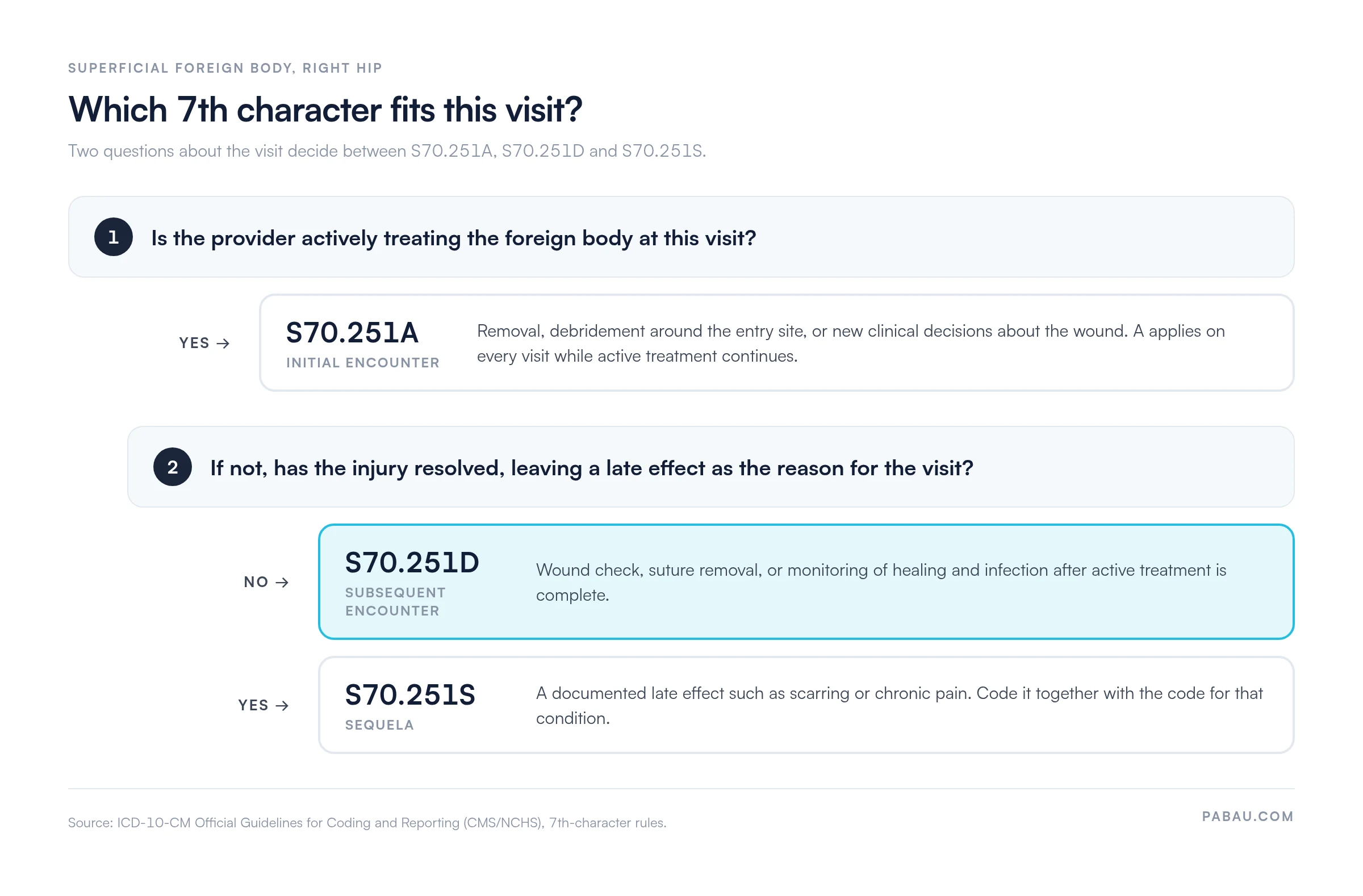
A practical test: If the operative or procedure report shows a new intervention at the right hip wound site, A is correct. If the note reads “wound healing well, no further intervention needed at this time,” D is correct.
Document the phrase ‘subsequent encounter’ or ‘follow-up visit for prior foreign body removal’ in the assessment section of the note. Coders should not have to infer the encounter type from context. The explicit label removes ambiguity and supports D on audit.
S70.251D applies to follow-up care for material embedded in the skin or subcutaneous tissue of the right hip. The foreign body must have been classed as superficial at the initial encounter. Common presentations include:
Superficial means the foreign body sits in or just below the skin, without penetrating muscle, fascia, or a body cavity. An open wound with a foreign body that has broken through the skin of the hip belongs to the S71.0- family, not S70.
The exclusion notes that affect S70.251D sit at the S70-S79 block level of the ICD-10-CM tabular list. They are Excludes2 notes, so a listed condition that occurs alongside the foreign body is coded separately.
Excludes2 at the S70-S79 block level:
Subcategory S70.25 carries one inclusion term, “Splinter in the hip.” It confirms that a splinter at this site belongs in S70.25.
An open wound is not an exclusion note here, but it is the most likely coding detour. If the foreign body created a wound through the skin, code from S71.0- instead. For a puncture wound with foreign body of the right hip, that is S71.041D.
Additional codes to consider:
If a wound infection is documented, add the infection code alongside S70.251D. A residual foreign body in soft tissue is classified to M79.5, not S70. Use M79.5 when the foreign body is established as retained long-term rather than acutely present.
Coders working with ICD-10 code S70.251D often meet nearby codes for the other side, a different encounter, or a deeper wound. The table below covers the codes most often confused with S70.251D.
A claim submitted with S70.251D stands or falls on what the clinical note says. Payers audit these four elements most often:
Medicare and commercial payers expect a clear link between the diagnosis code and the service billed. For a follow-up visit coded S70.251D, the usual pairing is an office visit E/M code such as 99213 or 99214.
If the provider debrides the site (CPT 97597) or removes further material (CPT 10120), check whether the visit has become active treatment again. An E/M billed on the same day as a procedure generally needs modifier 25 to show it was separately identifiable. Payer rules vary, so verify against the applicable LCD or payer policy before submission.
Medical necessity for follow-up visits hinges on documenting an ongoing clinical need: Monitoring for infection, assessing healing, or managing complications from the original injury. A note that only records “patient feels fine, wound looks good” may not satisfy necessity criteria for some payers.
A pre-submission scrub that checks each CPT-ICD pairing catches these mismatches before the claim reaches the payer. Review what makes a clean claim before you build the billing workflow for this code.
Claims for S70.251D are denied for a predictable set of reasons. Most can be prevented with a pre-submission checklist rather than a post-denial appeal. Set up denial management workflows for injury codes so a repeat error gets fixed at its source.
Reviewing the denial codes billers see alongside this table helps match each denial type to its remittance codes. Those are the claim adjustment reason code (CARC) and remittance advice remark code (RARC), and knowing them speeds up appeals.
This six-step workflow applies to any coder or biller processing a right hip foreign body follow-up claim.
When billing runs separately from charting, the coder often works from the superbill alone. Without the note’s assessment, they can’t tell a removal visit from a wound check, so the first visit’s A code gets copied forward.
Pabau, the practice management platform we build, keeps the treatment note, the appointment history, and the insurance claim in one patient record. The coder reads the follow-up assessment beside the claim before choosing between S70.251A and S70.251D.
Pabau’s claims management then checks the claim before it goes out. A wrong 7th character or a missing modifier gets fixed in the practice, not at the payer. That means fewer denials to rework and follow-up visits paid on first submission.

Pabau’s practice management platform links clinical notes to billing workflows, so coders can check the 7th character against the note before the claim goes out. See how it works for injury follow-up coding.

For S70.251D, finding the code is the easy part. The harder part is proving the visit was follow-up care, and that proof lives in one line of the assessment.
Make “subsequent encounter for prior foreign body removal, right hip” a standard phrase in your follow-up notes. Coders stop guessing, and auditors see why D was chosen on the first read. A few seconds of documentation per visit costs far less than a denied claim and an appeal.
Book a demo to see how Pabau links follow-up notes to claims, so the encounter type is right before you submit.

Need to understand how clearinghouse editing catches 7th-character errors before they reach the payer? Claim.MD clearinghouse overview explains how real-time edits work at the claim level.
Want a primer on how the revenue cycle connects coding to reimbursement? What is revenue cycle management walks through the full billing workflow from encounter to payment.
Looking for the superbill format that captures the right ICD-10 and CPT combination at the point of care? Superbill guide covers what the document needs to include to support clean claims.
ICD-10 code S70.251D is the billable ICD-10-CM code for a superficial foreign body of the right hip at a subsequent encounter. It is used when a patient returns for follow-up care after a splinter, glass fragment, or gravel has already been treated.
S70.251A applies when the provider is actively treating the foreign body at the current visit. S70.251D applies once active treatment is complete and the visit is for wound assessment or healing checks. Using A on a follow-up visit is a common reason for claim denial in this code family.
Use 7th character D once active treatment for the injury is complete. It covers routine care such as wound checks, suture removal, or monitoring of healing. Under the CMS ICD-10-CM Official Guidelines, the encounter type depends on the care given at the visit, not on how many visits have occurred.
Yes. S70.251D is a billable and specific ICD-10-CM code, valid for claim submission in the current FY2027 code set (effective October 1, 2026). Seven-character codes at the highest specificity level are accepted for diagnosis reporting by Medicare, Medicaid, and most commercial payers.
The sequela code is S70.251S. It applies once the injury has resolved and a documented late effect at the right hip, such as scarring, brings the patient in. S70.251S is reported with the code for that late effect and is not used for an active injury visit.
Six reasons come up most often. The first four are a wrong 7th character, missing laterality, no initial encounter on file, and a CPT-ICD mismatch. The other two are a missing modifier 25 on a same-day E/M and procedure, and a follow-up note that doesn’t reference the original foreign body.