ICD-10 Code S82.299K: Other tibial shaft fracture nonunion, unspecified leg
ICD-10 Code S82.299K: Official description and quick reference ICD-10 Code S82.2...

Last Updated: Oct 21, 2026
Billable Code Specific Code
S90.451S is the billable ICD-10-CM code for superficial foreign body, right great toe, sequela. A splinter, thorn, or similar object lodged in the skin of the right great toe has been removed, and the injury has healed. The patient now presents with a residual effect, such as scar pain or a granuloma.
Most denials on this code trace back to the seventh character. A visit while the injury is still healing calls for S90.451D, and an abrasion of the same toe is S90.411S.
Let Pabau's smart automation suggest the right codes, reduce claim denials, and keep your practice compliant—effortlessly.
Automate repetitive tasks and focus on what matters most—your patients.
Reduce coding errors and ensure compliance with the latest regulations.
Clean claims, fewer denials, and faster reimbursements.
Powerful insights and reporting to help your practice thrive.
HIPAA compliant SOC 2 certified GDPR-compliant Trusted by 4,000+ clinics worldwide

S90.451S is a valid, billable ICD-10-CM code for a superficial foreign body of the right great toe at the sequela stage.
The seventh character S applies only after active healing has ended. Using A or D for a sequela visit is a leading denial trigger.
Sequela notes must link today’s condition to the original splinter, thorn, or fragment injury and code the residual condition first.
S90.451S is not an abrasion code. A healed right great toe abrasion is coded S90.411S instead.
ICD-10 Code S90.451S is the billable code for a superficial foreign body of the right great toe at the sequela stage. It applies once the object is out, the skin has closed, and a residual effect brings the patient back.
The table below captures each field a coder or biller needs before submitting the claim.
S90.451S describes a superficial foreign body of the right great toe at the sequela stage of care. Each segment of the code narrows the meaning, read from left to right:
A superficial foreign body is an object such as a splinter, thorn, or glass sliver lodged in the outer skin layers. It is not an abrasion, which ICD-10-CM codes separately under S90.41-.
The S90-S99 block has Excludes2 notes for burns and corrosions (T20-T32) and fracture of ankle and malleolus (S82.-). It also excludes frostbite (T33-T34) and venomous insect bites or stings (T63.4). If the object passed below the skin surface, the puncture wound codes with foreign body (S91.14-) apply instead.
A superficial foreign body injury of the great toe happens when an object embeds in the skin without reaching deeper structures. Barefoot steps onto splinters, glass, thorns, or metal slivers are the usual cause.
By the time S90.451S applies, the object has been removed and the skin has closed. The patient presents because the injury left a residual problem behind. Common sequelae after a right great toe foreign body include:
A sequela, as defined by the ICD-10-CM Official Guidelines (Section I.B.10), is a residual effect of an earlier illness or injury. It remains after the acute phase has ended. The seventh character S signals exactly that encounter type to payers and coding auditors.
Some coders take S to mean the patient is still recovering. Recovery belongs to the subsequent encounter, which uses seventh character D instead. The S character applies only when the original wound has closed and a residual effect remains.
For injury sequelae, Section I.C.19.a says the S goes on the injury code only. The code for the residual condition, such as a scar or a granuloma, is sequenced first, followed by S90.451S.
The correct seventh character depends on where the patient is in their recovery, not on how many times they have been seen. The table below shows the clinical trigger for each variant.
Using S90.451A when the wound has already healed is a common denial trigger for this code family. The provider note must state that the active healing phase has ended before a sequela encounter is coded.
Coders regularly meet laterality, site, and injury-type mismatches in this code family. The table below maps the closest adjacent codes and what separates each one from S90.451S.
Always specify laterality where documentation supports it. ICD-10-CM discourages unspecified codes when the medical record clearly identifies the affected side.
Three checks settle the code, in this order, and each one rules out a different neighbor before S90.451S is assigned.
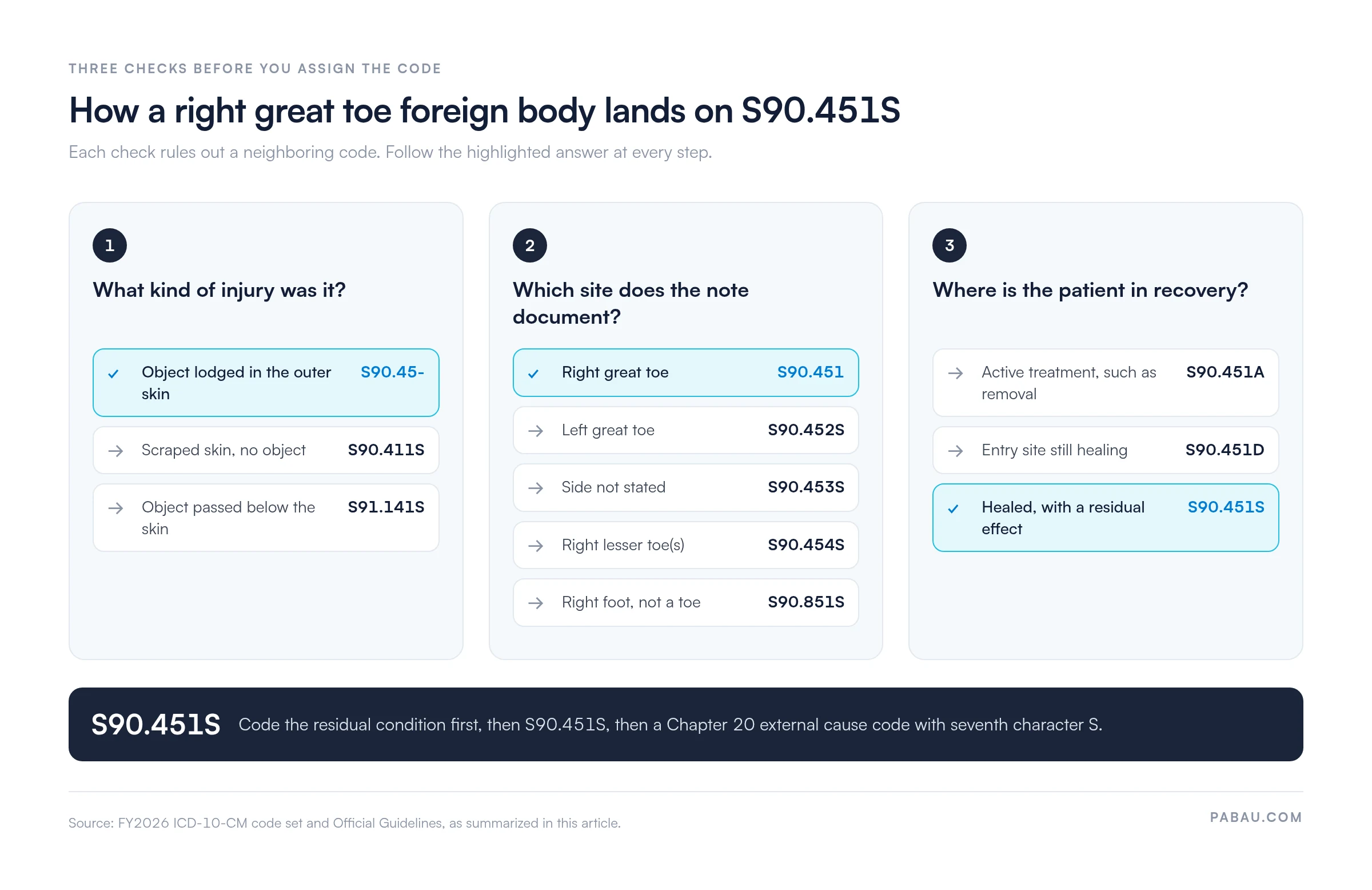
Four documentation elements should be in the medical record before S90.451S is assigned. A missing element gives a payer grounds to deny or downcode the claim. A medical billing compliance framework helps your team capture them at each encounter.
A clean claim requirements checklist for sequela encounters lets coders confirm all four elements before submission, instead of rebuilding the note after a denial.
Flag sequela encounters in your EHR workflow with two questions. Has the original entry site fully healed? Is today’s complaint a direct result of that foreign body injury? If the provider confirms both in the note, S90.451S documentation is solid.
The CPT codes submitted alongside S90.451S depend on what the provider does at the sequela visit. Common pairings span evaluation and rehabilitation services across podiatry and physical therapy settings. A podiatry visit for scar pain might bill as 99213, while manual therapy for scar stiffness bills as 97140.
CPT 97001, the old PT evaluation code, was deleted in 2017. Bill a new PT episode with 97161, 97162, or 97163 according to the documented complexity.
Medicare does not typically require prior authorization for an office-based evaluation of a healed toe injury. Medical necessity documentation must still align with the local coverage determination (LCD) for the service billed.
Commercial payers vary considerably, and four rules come up most often:
Check the CMS ICD-10 codes page and your MAC’s LCDs directly when Medicare requirements are unclear, since LCD policies differ by region.
Most denials on ICD-10 Code S90.451S fall into four categories. Denial management workflows catch them before the claim reaches the payer, which saves a round of rework.
Match the reason code on each EOB against a list of medical billing denial codes to see which root cause to fix first.
S90.451S remains valid and billable under ICD-10-CM in FY2026. The United States has not set a transition date to ICD-11, and the CDC/NCHS ICD-10-CM tool remains the authoritative reference for current US billing.
ICD-11 uses a different code architecture, so S90.451S will not have a simple one-to-one equivalent when the transition comes. The CMS ICD-10 codes page publishes each annual update, and any change to this code would appear there first.
Coding a sequela visit correctly depends on the clinician seeing the original injury record. Without it, notes skip the causal link and claims go out with the wrong seventh character.
Pabau, the practice management and billing platform we build, keeps clinical notes, diagnosis codes, and invoices in one patient record. Your coder can read the original removal note before choosing the seventh character.
Pabau’s claims management software submits claims electronically through Claim.MD, its US clearinghouse partner. Claim validation checks each claim for missing or invalid details before it leaves the practice. A wrong field gets fixed before a payer ever sees it.
When a payer wants prior authorization for therapy on a sequela, Pabau stores it as a case attached to the booking. The authorization code then follows the appointment through to the claim.

Pabau connects clinical notes, claim validation, and electronic claim submission in one place, so sequela encounters like S90.451S go out with the right code.

S90.451S is a narrow code, and most errors come from confusing it with its neighbors. It covers a healed superficial foreign body of the right great toe, not an abrasion, not the left side, and not an injury still healing.
Get the injury type, laterality, and seventh character right, and document the link to the original injury. The claim then has what a payer needs to pay it. To see how Pabau keeps those details attached to each claim, book a demo.

Need a medical billing compliance framework for sequela claims? Medical billing compliance covers the documentation standards that keep sequela encounters audit-ready.
Want to understand the full claims submission process? How a medical claims clearinghouse works explains how electronic claim routing catches code errors before payer adjudication.
ICD-10 Code S90.451S is the billable ICD-10-CM code for a superficial foreign body of the right great toe, sequela. It applies when a healed splinter or similar injury has left a residual condition, such as scar pain or a granuloma.
Yes. S90.451S is a valid, billable ICD-10-CM code, effective October 1, 2015 and still active in FY2026. It is a complete seven-character code, so no further extension is needed.
No. S90.451S covers a superficial foreign body, such as a splinter or thorn lodged in the skin. A healed abrasion of the right great toe is coded S90.411S instead.
S90.451A is for the initial encounter, when the foreign body is actively treated or removed. S90.451S is for a later visit, after the injury has healed and a residual condition remains.
Use S when the original injury has fully healed and the visit is for a residual effect, not for ongoing wound care. Code the residual condition first, then S90.451S.
Chapter 19 instructs a secondary external cause code, such as W45.8XXS, with the seventh character S. There is no national mandate. Many payers and state systems still require one, so include it when the record supports it.
Common pairings include 99212 and 99213 for office visits. Physical therapy uses 97161 to 97163 for evaluation, plus 97110 or 97140 for treatment when the sequela limits function.