ICD-10 Code S49.011P: Salter-Harris physeal fracture, right humerus, malunion
ICD-10 Code S49.011P: Quick reference ICD-10 Code S49.011P is the billable code ...

Last Updated: Oct 15, 2026
Billable Code Specific Code
S20.95XD is the billable ICD-10-CM code for superficial foreign body of unspecified parts of thorax, subsequent encounter.
Coders most often stumble at the encounter-type step. The 7th character D marks routine follow-up after active treatment, so using it during active treatment can draw a denial.
Let Pabau's smart automation suggest the right codes, reduce claim denials, and keep your practice compliant—effortlessly.
Automate repetitive tasks and focus on what matters most—your patients.
Reduce coding errors and ensure compliance with the latest regulations.
Clean claims, fewer denials, and faster reimbursements.
Powerful insights and reporting to help your practice thrive.
HIPAA compliant SOC 2 certified GDPR-compliant Trusted by 4,000+ clinics worldwide

S20.95XD is the billable ICD-10-CM code for a superficial foreign body, such as a splinter, in the thorax at a subsequent encounter.
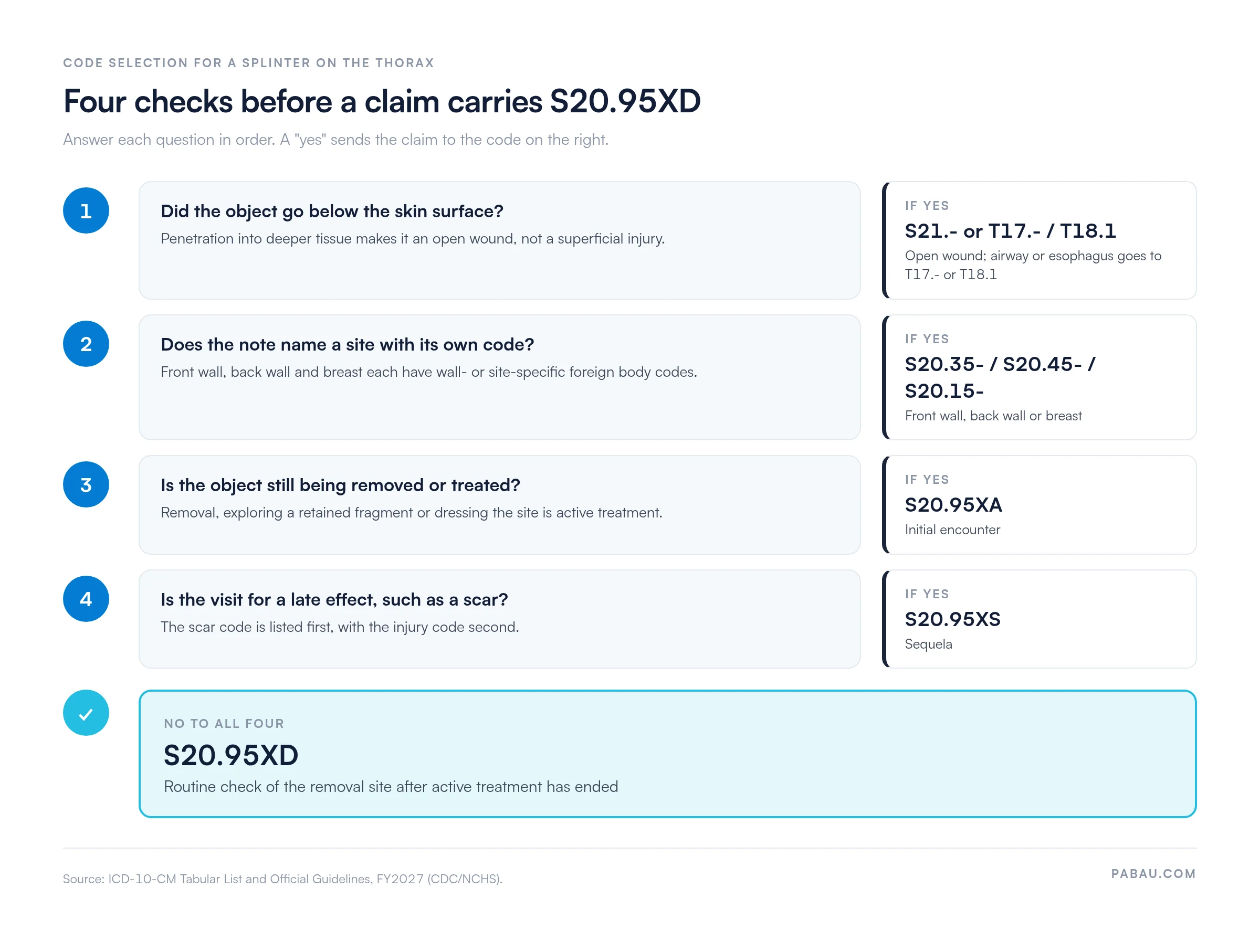
The 7th character D applies only after active treatment has ended, for routine healing checks; removing the foreign body is active treatment and takes S20.95XA.
S20.95 has no laterality axis. When the note names the front or back wall, move to S20.35- or S20.45-, which carry the side.
A foreign body that penetrates below the skin is an open wound (S21.-), and one in the airway or esophagus belongs to T17.- or T18.1.
Pabau, the practice software we build, keeps the visit note, diagnosis and claim on one record, so billers can check the D character before submission.
ICD-10 Code S20.95XD reports a superficial foreign body of the thorax, such as a splinter in the skin of the chest or upper back. It applies when the record does not say which wall the object was on. The D character marks a follow-up visit after the foreign body has been removed and active treatment has ended.
The table below captures each field a coder or biller needs before touching the claim.
S20.95XD covers a foreign object that sits in the surface layers of the skin anywhere on the thorax. The Tabular List gives one inclusion term for S20.95: splinter in thorax NOS. The S20-S29 block covers the chest wall, the breast and the interscapular area. A superficial splinter in any of those sites lands in the S20 category, but the breast has its own foreign body subcategory, S20.15-. A splinter in an unspecified breast at a follow-up visit, for example, takes S20.159D.
Typical objects documented under this code include:
Two conditions must hold for the code to apply. The object must stay superficial, with no penetration into deeper tissue, and the note must not name the front or back wall. Once the note names a wall, the wall-specific foreign body codes take over: S20.35- for the front wall and S20.45- for the back wall. Those are the codes that record right, left, bilateral and middle.
The FY2027 Tabular List places one Excludes1 note on S20.9 and a set of Excludes2 notes on the S20-S29 block. Knowing them prevents pairing S20.95XD with a code it cannot be billed alongside, or using it for an object that lodged deeper.
An Excludes1 note means the excluded condition can never be coded together with S20.95XD. An Excludes2 note means the excluded condition is not part of this code, but both may be reported when both are present and documented. Verify note wording against the current Tabular List before finalizing claims.
The 7th character D means the patient has completed active treatment and is receiving routine care during the healing or recovery phase. That definition comes from the ICD-10-CM Official Guidelines for Coding and Reporting, Chapter 19. For a superficial foreign body, removal is the active treatment, so the visit where the splinter comes out uses S20.95XA. Later visits to check the removal site use S20.95XD.
A common misconception is that a subsequent encounter means a different provider saw the patient. The 7th character tracks the treatment phase, whoever the provider is. Say the same physician removes the splinter on day one and checks the site on day ten. The day-one visit uses S20.95XA, and the day-ten visit uses S20.95XD.
Document the treatment phase explicitly in every note. Try a phrase like ‘follow-up of splinter removal site, healing well, no new intervention required.’ That gives the auditor what is needed to justify the D character. Without it, payers may assume active treatment and reject the D-coded claim.
Selecting between S20.95XD and its neighbors turns on three questions. What type of superficial injury is documented, does the note name a wall of the thorax, and which encounter type applies? The checks below put those questions in the order a coder should ask them.
Contusion of the thorax sits in S20.2-, not S20.9-. A foreign body that broke through the skin into deeper tissue is an open wound instead, such as S21.94XD, puncture wound with foreign body of unspecified part of thorax, subsequent encounter.
A clean claim for S20.95XD requires the clinical note to support each element the code asserts. A missing element creates an audit or denial risk.
Using Pabau’s claims management software, billers work from the same patient record that holds the removal note and the follow-up note. That makes it quicker to confirm the record supports the D character before the claim goes out, rather than after a payer rejection.
S20.95XD denials can follow four patterns. Recognizing them before submission saves the rework cycle.
When a denial does arrive, the appeal should include the removal visit note and the follow-up documentation. Add a short explanation of why the record supported an unspecified-parts code. Pabau’s Claim.MD clearinghouse integration returns Electronic Remittance Advice (ERA) files with CARC denial reason codes. Teams can see the exact rejection reason without waiting for a paper remittance.
The CDC/NCHS ICD-10-CM Official Guidelines, Chapter 19, govern all injury coding, including S20.95XD. The key principles for this code are specificity first, accurate encounter-type selection, and external cause reporting where required. The same checks apply to every injury code among the ICD-10-CM codes in Chapter 19.
Run a quarterly audit of S20.95X- claims. Pull each claim and check the visit note: if it names the front or back wall, S20.35- or S20.45- was the better code. Correcting this pattern early prevents payer scrutiny.
Follow-up visits for a removed splinter are short, and the claim for them often gets less attention than the visit itself. Billers end up reopening notes to confirm the removal date, the site and whether active treatment had ended.
In Pabau, the visit notes, the diagnosis on the patient record and the claim sit together. For practices billing US commercial payers, Pabau’s connection to medical claims clearinghouse workflows supports electronic 837P submission, eligibility checks and ERA receipt in one loop.
Rejections come back with their reason codes, and Pabau links into a denial management workflow. Billing teams can then spot repeat errors, such as a D character used during active treatment, before they spread across claims.

Pabau keeps visit notes, diagnoses and claims on one patient record, then submits and tracks claims through its Claim.MD clearinghouse connection. See how it works for your practice.

S20.95XD earns its place on a claim only when three facts line up in the note. The object is named and superficial, it was removed at an earlier visit, and no wall is documented. If one of them is missing, S20.95XA, a wall-specific S20.35- or S20.45- code, or an open wound in S21.- fits better.
The fastest fix sits upstream. Ask providers to record the object, the wall and the removal date at the first visit, and the follow-up code follows from the note. Book a demo to see how Pabau keeps injury notes and claims together for cleaner follow-up billing.

Need a structured denial appeals workflow? Denial management in healthcare covers how to build a systematic appeal process and reduce recurring rejection patterns across your claim portfolio.
Submitting 837P files electronically? 837 file submission guide explains the EDI format, required data elements, and how clearinghouses validate claims before they reach the payer.
New to the revenue cycle? What is medical billing walks through the end-to-end revenue cycle from encounter to payment posting.
Splinter documented in the breast? ICD-10 Code S20.159D covers a superficial foreign body of the breast at a subsequent encounter.
ICD-10 Code S20.95XD is the billable code for a superficial foreign body, such as a splinter, of the thorax at a subsequent encounter. The patient is receiving routine follow-up care after the object was removed and active treatment ended. It belongs to Chapter 19 (Injury, poisoning and certain other consequences of external causes) and the S20-S29 thorax injury block.
Yes. S20.95XD is a valid, billable 7-character code in the FY2027 ICD-10-CM code set. The medical record must support both the superficial foreign body of the thorax and the subsequent encounter status before it is submitted on a claim.
S20.91XD reports an abrasion of unspecified parts of the thorax, a scrape with no retained object. S20.95XD reports a superficial foreign body, such as a splinter, in the same area. Both are subsequent-encounter codes, so the choice depends on the injury type the note documents.
The hierarchy starts at S20 (Superficial injury of thorax) and moves to S20.9 (Superficial injury of unspecified parts of thorax). From there it runs to S20.95 (Superficial foreign body of unspecified parts of thorax) and then S20.95XD. The X fills the 6th position so the 7th character D can be added. The ICD List lookup tool displays the full hierarchy and sibling codes for any S20 code.